Small Business vs Startup Definition: Key Differences
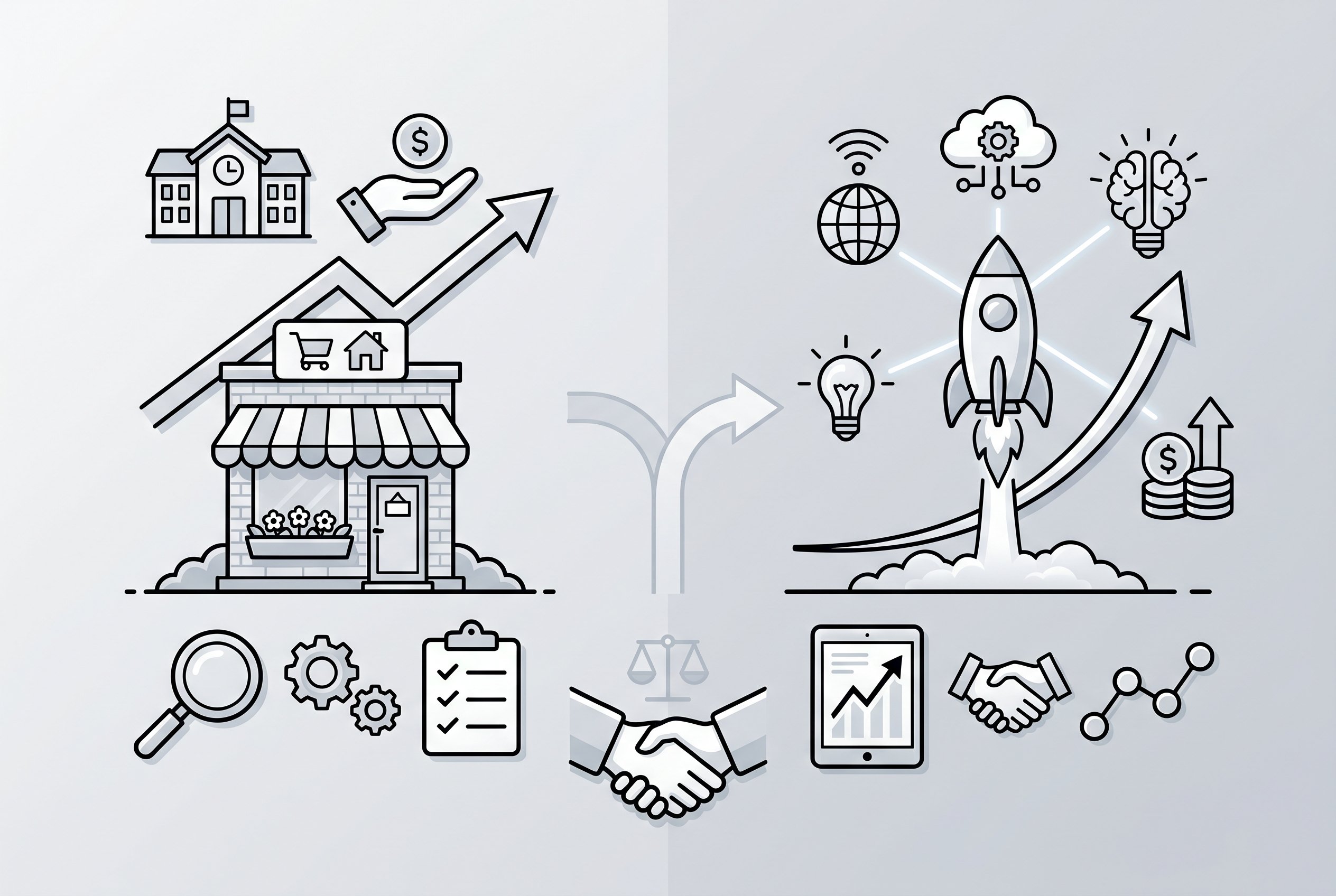
Deciding between launching a small business or a startup requires absolute clarity on their distinct trajectories. Founders often use these terms interchangeably. This creates confusion when seeking funding, hiring talent, or setting long-term goals. Understanding the exact small business vs startup definition helps you align your choice with personal ambitions and market realities. At Startup OG, we see early-stage founders wrestle with this choice daily. The distinction ultimately comes down to a simple framework: are you searching for a new business model, or are you executing a proven one? This detailed comparison breaks down the core differences in growth, risk, and structural design. You will gain practical insights for making an informed decision early in your entrepreneurial journey, saving you years of misdirected effort and capital.
Quick Verdict
Small businesses prioritize steady profits and local stability. Startups focus on rapid scaling and industry disruption. Your choice dictates your daily operations, funding options, and ultimate exit strategy.
Choose a small business if you want lifestyle balance, immediate cash flow, and lower overall risk. You execute a known model, like opening a commercial bakery or a specialized IT consulting firm. The path is predictable. You know exactly who your customers are from day one. You do not need to educate the market on why your service exists.
Choose a startup if you want high-growth potential and investor appeal. Startups operate in extreme uncertainty. You are searching for a repeatable model that can scale globally. This path requires high risk tolerance. You will likely burn through capital for years before seeing a single dollar of actual profit.
The stakes are high for either path. Roughly 20.4% of new businesses fail within their first year of operation. The best option depends entirely on your personal risk tolerance, funding needs, and long-term vision. Founders seeking to change an entire industry need the startup model. Those wanting financial independence without answering to a board of directors should build a small business.
Key Comparison Criteria
Evaluating these two paths requires looking at four specific factors: growth objectives, funding sources, risk levels, and exit strategies. Growth expectations create the sharpest divide. Small businesses grow linearly. You add a new client, you hire a new employee. Startups aim for exponential growth, where revenue scales much faster than headcount.
Technology adoption also separates the two models early on. The artificial intelligence gap is widening this divide in 2026. Currently, fewer than 30% of early-stage entrepreneurs in most global economies consider AI vital to their core strategy. Startups, conversely, build their entire infrastructure around these emerging technologies to outpace legacy competitors.
Funding sources differ dramatically. Small businesses rely heavily on personal savings, credit cards, or traditional bank loans. Startups seek venture capital or angel investment to fuel rapid, unprofitable expansion. The goal is capturing market share quickly, blocking out competitors before they can react.
Many founders wonder if a small business can become a startup. Yes, it can. If a local service business shifts from executing a proven model to searching for a highly scalable software solution for global markets, it enters the startup phase. The transition requires a complete overhaul of operations, talent acquisition, and funding structures.
What Defines a Small Business
A small business is an independently owned and operated firm organized for profit. It does not dominate its field. Instead, it executes a known, proven business model. The owner knows exactly what the product is, how much it costs to make, and who will buy it.
These ventures operate with a limited scope. They often serve local or regional markets. The primary focus remains on consistent revenue and profitability rather than explosive, disruptive growth. A coffee shop owner wants to sell more coffee at a healthy margin, not reinvent the fundamental concept of caffeine delivery.
Funding typically comes from bootstrapping or traditional debt. The government heavily supports this model because it drives local economies. For example, the SBA guaranteed 85,000 loans totaling $45 billion in FY2025. This capital helps owners buy heavy equipment, secure commercial real estate, or manage early payroll fluctuations.
Risk is generally lower and more manageable. Success depends purely on execution and customer service. Certain sectors offer remarkable stability for patient founders. Traditional sectors like agriculture show the strongest survival rates, with over half of these businesses lasting a decade or more. The small business model provides a reliable path to generational wealth without the intense pressure of venture capital oversight.
What Defines a Startup
A startup is a temporary organization designed to search for a repeatable and scalable business model. This definition changes everything about how the company operates. Existing companies execute a business model, while startups look for one.
Startups are built entirely around innovative solutions. They intend to scale quickly across national or global markets. A startup founder does not want a small slice of a local pie. They want to bake an entirely new pie and own the recipe. You are inventing a new category. You must educate the market, build the technology, and figure out the pricing model simultaneously.
This rapid expansion requires massive capital. Startups seek venture capital to fund operations while they figure out their product-market fit. Investors place aggressive bets on emerging technologies. AI startups alone captured nearly one-third of all US venture capital funding in 2025. This funding allows teams to operate at a massive loss while capturing user attention.
The risk profile is enormous. Startups embrace this high risk for the chance at massive returns, usually through an acquisition or Initial Public Offering. Roughly 90% of startups fail overall, with the vast majority collapsing between years two and five. When a startup model fails, the team must pivot rapidly to a new idea. This differs sharply from the linear failure of a small business, where a slow decline in local foot traffic eventually forces the doors closed.
Side-by-Side Comparison Table
Understanding the distinction becomes easier when viewing the models side-by-side. The traditional economic framework categorizes these as Innovation-Driven Enterprises (IDEs) and Small-Medium Enterprises (SMEs).
| Feature | Small Business (SME) | Startup (IDE) |
|---|---|---|
| Primary Goal | Steady profitability and local stability | Rapid scaling and industry disruption |
| Market Focus | Local or regional | National or global |
| Funding Model | Bootstrapping, bank loans, SBA loans | Venture capital, angel investors |
| Growth Rate | Linear (revenue grows with headcount) | Exponential (revenue outpaces headcount) |
| Risk Profile | Moderate (executing a proven model) | High (searching for a new model) |
This table highlights how small businesses emphasize stability while startups focus on disruption. IDEs create high-value jobs and attract international talent, fundamentally altering regional economies. They consciously pursue global markets from day one. SMEs, meanwhile, provide the essential, stable local employment that keeps communities running smoothly.
A third option is emerging for modern founders. The Indie Hacker hybrid model uses startup technology to run a small business with high margins and low headcount. These founders build scalable software products but run their operations like a profitable small business. They focus on immediate cash flow and complete ownership, completely bypassing the need for venture capital.
Final Recommendation
Select a small business if you value work-life balance and predictable income. This path allows you to be your own boss, build deep ties in your local community, and generate sustainable wealth. You will face operational challenges, but the roadmap is clear. You are simply executing a model that has worked for thousands of others before you.
Pursue a startup if you are prepared for extreme uncertainty in exchange for significant scale. This path requires relentless energy, a high tolerance for rejection, and the ability to pivot when your initial assumptions prove wrong. You must be comfortable spending other people's money to test unproven theories. The failure rates are daunting. Current data shows 75% of American startups close down within 15 years. Yet, the ones that succeed change how the world operates.
The best choice aligns with your current life stage and financial reality. Do not start a venture-backed company if you need immediate cash flow to pay your mortgage. Do not open a local retail shop if your goal is to build a billion-dollar tech empire. The Startup OG platform offers resources and community support to help founders validate either path early in the process.
Next Steps for Founders
Assess your personal goals, available capital, and market opportunity before committing to a legal structure. Write down exactly what you want your life to look like in five years. Your business model must serve that personal vision, not the other way around.
The reality of entrepreneurship is harsh regardless of which path you choose. Over 65.3% of businesses fail within their first 10 years. You can improve your odds by rigorously testing your assumptions before spending significant money or quitting your day job.
Test ideas through minimal viable products or local pilots to reduce uncertainty. If you are building a startup, ensure people actually want what you are making. A staggering 42% of startup failures stem directly from a lack of market need. Founders spend years building complex products nobody asked for. Talk to potential customers before writing a single line of code or signing a commercial lease.
Tap into the Startup OG community for peer insights and proven execution frameworks. Surround yourself with founders who are slightly ahead of you on the journey. Their real-world experience will help you avoid costly early mistakes and build a sustainable, successful venture.
Conclusion
The right choice between a small business and startup hinges on matching your risk appetite and growth ambitions to the definitions outlined above. A small business offers a reliable, execution-focused path to financial independence and community impact. A startup provides a high-risk, search-focused vehicle for massive scale and industry disruption. Neither path is inherently better than the other. Success comes from choosing the model that fits your specific goals, securing the right type of funding, and executing with relentless focus. Take the time to validate your ideas, gather feedback from target customers, and build a strong support network before taking the leap.
Loved this? Get more in your inbox.
Founder reads, weekly. Curated tools and growth tactics.
Get your tool featured in Operations & Team.
Sponsor a pillar block, get listed in the directory, or write a guest post. Pricing by inquiry.
Work with us →