Solo Founder Daily Routine: Realistic Template Guide
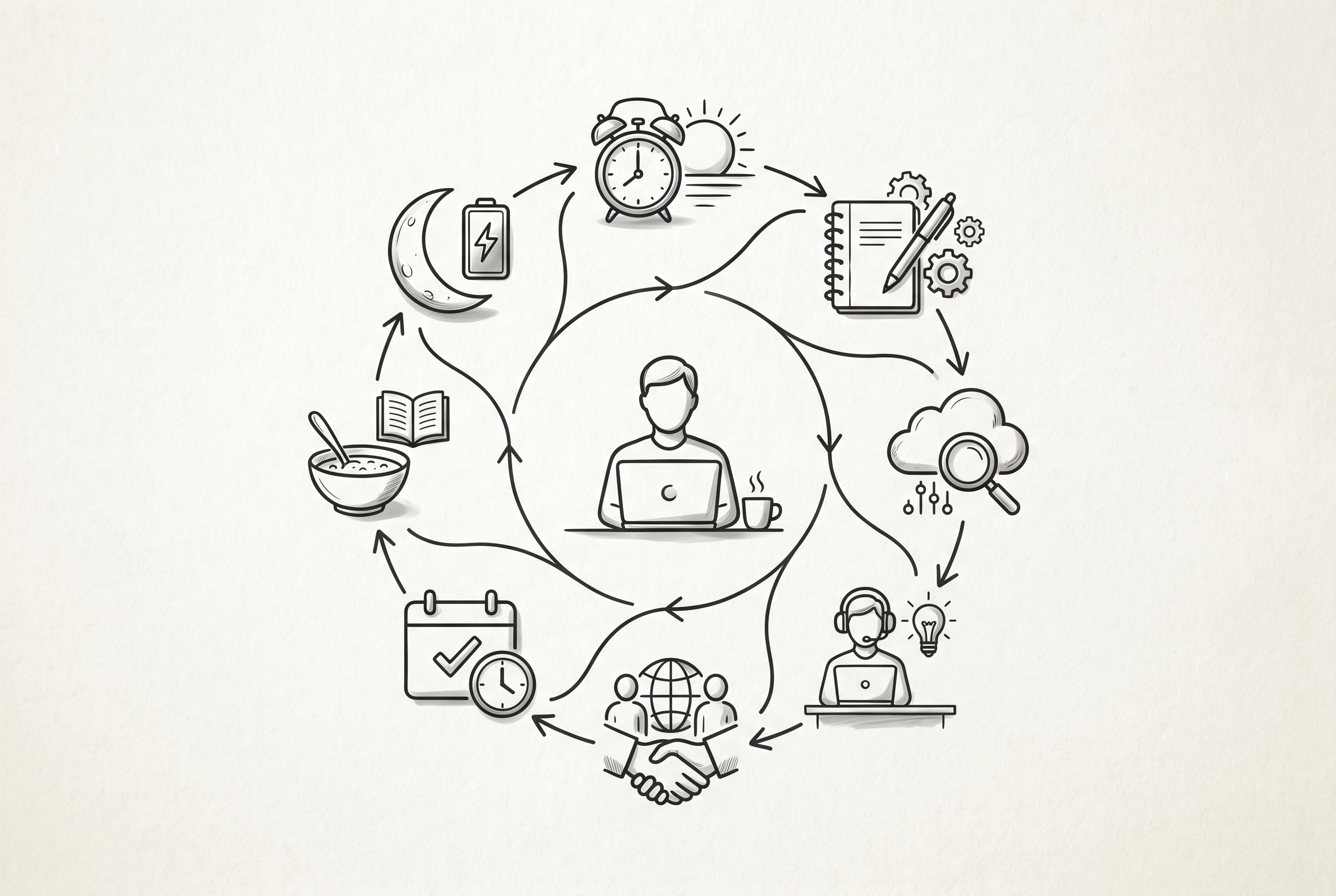
Building a company from scratch demands intense focus, but working alone often leads to fragmented attention. A consistent solo founder daily routine helps early-stage entrepreneurs stay focused and avoid burnout. This guide explains the core structure of a modern schedule and how to adapt it to your specific biological rhythms.
You will gain a clear framework for creating productive days that support long-term startup growth. At Startup OG, we see firsthand how founders who master their time build sustainable momentum. The old advice of simply waking up at 5 AM no longer works. Modern solo operators need a schedule that respects human energy limits while maximizing output. Building an AI-augmented, circadian-aligned routine is the clear path forward.
What Is a Solo Founder Daily Routine
A solo founder daily routine is a structured schedule tailored specifically for independent operators managing every aspect of a startup. It balances intense product development with administrative tasks and necessary personal recharge time. This structure differs entirely from team-based routines because it relies entirely on self-accountability. You do not have a manager checking in or a team to delegate immediate problems to.
The independent path is increasingly common across the tech industry. Today, over 36% of all new global startups are launched by single founders. Yet, these same operators face an uphill battle for resources, capturing less than 15% of total venture capital funding. Surviving this resource gap requires extreme operational efficiency and strict time management.
The ultimate goal of this routine is maximizing output without accelerating exhaustion. Industry leaders anticipate the first billion-dollar company run by a single person will appear by 2026. Hitting that level of scale requires moving past brute-force work habits. A well-designed routine treats time as a strict boundary. It forces you to prioritize high-impact actions over low-value busywork.
How a Solo Founder Daily Routine Works
The mechanics of a successful schedule rely on dividing the day into focused time blocks for high-priority activities. Instead of reacting to emails or notifications as they arrive, you batch similar tasks together. This approach directly combats the cognitive drain that solo operators face daily.
Moving constantly between coding, marketing, and customer support destroys focus. In fact, up to 40% of productive time vanishes when founders rapidly switch between unrelated tasks. A smart routine locks you into one specific mode of thinking for hours at a time. You integrate tools and habits that support this consistent execution without external support.
The biological timing of these blocks matters just as much as the work itself. Aligning demanding cognitive tasks with your natural energy peaks yields massive returns. Individuals performing complex work during their biological peak times complete tasks up to 20% faster with higher quality outcomes. You must also build recurring reviews into your week. These reviews allow you to adjust your blocks based on actual progress and shifting energy levels.
Key Concepts and Terminology
Understanding a few core concepts will help you build a highly effective schedule. Energy mapping is the practice of auditing your personal energy fluctuations over a 24-hour period. You use this data to align your most difficult tasks with your biological peaks. Modern researchers can even model biobehavioral rhythms from mobile data to accurately predict when a person will hit their maximum productivity state.
Deep work blocks form the foundation of your actual output. These are uninterrupted, two-to-four-hour sessions dedicated entirely to product or strategy development. No emails. No social media. Just pure creation.
Admin sprints handle the opposite end of the spectrum. You group emails, financial updates, and operational tasks into short, high-speed sessions. This separation prevents the context-switching tax from ruining your day. Jumping between unrelated tasks causes cognitive load and time loss that costs the global economy roughly $450 billion annually. By isolating admin work, you protect your deep work windows from constant interruption.
Realistic Daily Template Examples
Concrete schedules help translate theory into daily action. While the average independent operator works about 52 hours per week, exceeding 50 hours actually correlates with a massive spike in burnout. Quality of work always beats sheer volume.
The Product Builder Template
Founders focused on coding or building physical products should heavily weight their mornings. This captures early-day mental clarity.
- 7:00 AM – 8:00 AM: Morning routine and exercise.
- 8:00 AM – 12:00 PM: Deep work block (product development).
- 12:00 PM – 1:00 PM: Lunch and mental reset.
- 1:00 PM – 2:30 PM: Admin sprint (emails, customer support).
- 2:30 PM – 4:30 PM: Secondary deep work (marketing or strategy).
- 4:30 PM – 5:00 PM: Evening review and planning for tomorrow.
The Growth-Focused Template
Founders prioritizing sales and outreach might shift their high-energy blocks to align with client availability.
- 8:00 AM – 9:00 AM: Planning and inbox zero.
- 9:00 AM – 12:00 PM: Active outreach and sales calls.
- 12:00 PM – 1:00 PM: Lunch and physical movement.
- 1:00 PM – 4:00 PM: Product tweaks and content creation.
- 4:00 PM – 5:00 PM: Follow-ups and CRM management.
Regardless of the exact hours, founders who build proactive mental health breaks into their days are twice as likely to predict strong revenue growth. The evening review routine remains non-negotiable for both templates. It clears your mind for restful sleep.
Benefits and Importance for Startup Success
A structured routine does much more than organize your calendar. It improves output consistency and drastically reduces decision fatigue. When you know exactly what you should be doing at 10:00 AM, you waste zero mental energy deciding what to tackle next.
This structure heavily supports mental health by creating clear boundaries between work and rest. Without a boss telling you to log off, work easily bleeds into your evenings and weekends. The results of this boundary-less working style are severe. Data shows 62% of startup founders experience active burnout symptoms when they fail to manage their schedules.
Burnout is not just a personal problem. It represents a massive business risk. Roughly 65% of all startup failures stem directly from founder burnout or internal conflict. Building sustainable momentum requires treating rest as a critical business input. True founder resilience is a quantifiable metric that determines success rates more accurately than general market conditions. A predictable routine builds that resilience daily.
Common Misconceptions About Solo Routines
Many early-stage entrepreneurs resist scheduling because they believe rigid routines kill creativity. The opposite is true. By automating your administrative tasks and basic decisions, you actually free up cognitive bandwidth for high-level strategy. Structure protects your creative time from being eaten by urgent but unimportant tasks.
Another dangerous myth is the belief that successful founders must work 16-hour days without breaks. This toxic hustle culture ignores human biology. Pushing through exhaustion leads to shadow burnout. This is a state where you maintain high output but experience persistent cynicism and reduced effectiveness. It is a hidden crisis, contributing to the reality that nearly 88% of entrepreneurs struggle with at least one mental health issue.
Finally, avoid the assumption that one single template works for every solo founder regardless of industry. A developer building a SaaS product needs entirely different time blocks than an e-commerce brand owner managing physical inventory. Your routine must match your specific business model and personal biology.
How to Customize and Optimize Your Routine
Building your perfect schedule starts with observation. Track your energy patterns for two weeks before finalizing your time blocks. Note when you feel most alert and when you naturally hit an afternoon slump. This data forms the baseline for your energy-mapped routine.
If you find yourself struggling to sleep because your mind will not turn off, you are not alone. Roughly 22% of entrepreneurs report insomnia or sleep disorders caused by poor work boundaries. To fix this, create a hard cutoff time for screen use and business planning. Lean on communities like Startup OG to hold yourself accountable to these new boundaries.
Modern founders also use technology to optimize their days. Implementing an AI-agent buffer allows you to delegate administrative tasks to autonomous workflows. These systems handle low-level technical tasks, acting as a digital buffer that keeps you in a deep work state for six or more hours. The proper use of AI tools now explains up to 60% of the variance in individual productivity among solo operators.
Lastly, consider your physical needs. If you are movement-oriented, incorporating physical activity into your learning or admin blocks can drastically reduce emotional exhaustion. Research shows that kinesthetic learning and movement improve performance for hands-on business builders. Iterate on your schedule monthly to ensure it grows alongside your company.
Conclusion
A realistic solo founder daily routine provides the exact structure needed to achieve consistent progress. It transforms chaotic, reactive days into predictable systems for growth. By mapping your energy, protecting your deep work, and leveraging modern AI tools, you remove the friction from building a company alone.
Success as a solo operator does not come from working the longest hours. It comes from working the smartest hours. Take the templates provided, adjust them to your biological rhythms, and start executing with renewed clarity. Your startup's future depends entirely on how well you manage your time today.
Loved this? Get more in your inbox.
Founder reads, weekly. Curated tools and growth tactics.
Get your tool featured in Growth & Marketing.
Sponsor a pillar block, get listed in the directory, or write a guest post. Pricing by inquiry.
Work with us →