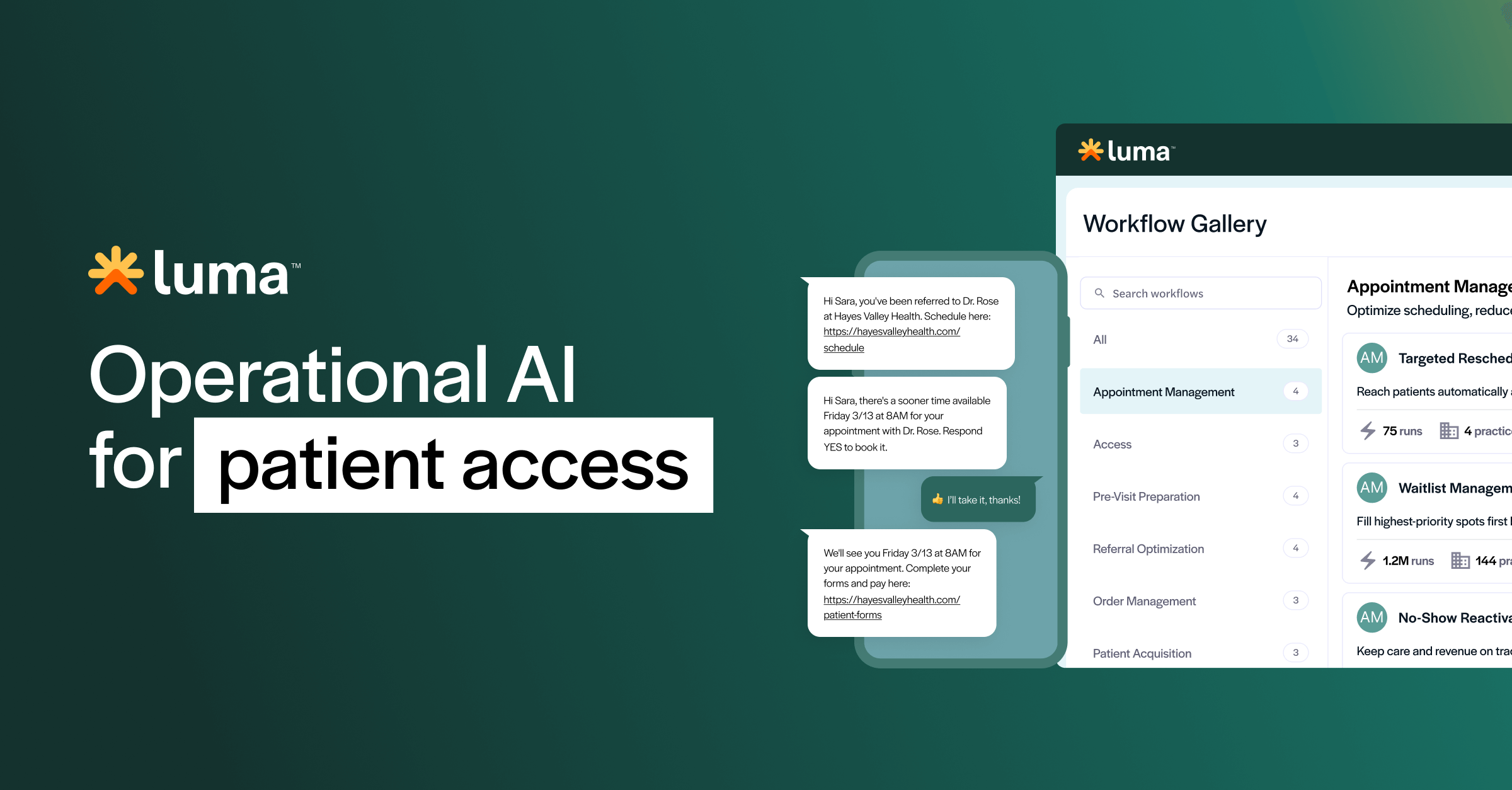
Luma Health alternatives
8 products to explore · 2026
Your shortlist, at a glance.
Read the comparisons ↓
Check each product’s website for current pricing and features. A verified badge indicates a verified listing, not a ranking.
About Luma Health and its alternatives
Healthcare leaders searching for Luma Health alternatives typically need robust operational AI that automates patient access, engagement, intake, and payments while maintaining deep EHR integrations. Luma Health stands out for its Spark AI core, conversational agents that recover visits from no-shows, and Fax Transform that processes inbound faxes automatically. Alternatives range from point solutions focused on reminders or scheduling to broader platforms that emphasize revenue cycle or population health. Decision makers often compare these options on EHR compatibility, ability to handle complex enterprise workflows, staff time savings, and measurable reductions in time-to-care. Evaluating Luma Health alternatives requires assessing how each tool manages two-way patient conversations, waitlist automation, eligibility verification, and post-fax order orchestration without adding manual steps for clinical staff.
Explore the alternatives

1.CareMessage
HealthcarePatient engagement for low-income populations

2.Athenahealth
HealthcareHealthcare technology for medical practices and providers.
3.Epic
HealthcareWith the patient at the heart
4.OhMD
HealthcareAI voice and HIPAA texting that cuts patient call volume for physician practices

5.Phreesia
HealthcarePatient intake software that automates registration, payments and engagement for healthcare providers

6.Relatient
HealthcareAI-powered patient scheduling and engagement platform for healthcare

7.Solutionreach
HealthcareAll-in-One Patient Engagement Software for Healthcare Practices

8.TigerConnect
Healthcare#1 Healthcare Collaboration Platform for hospitals and care teams
See more comparisons in Healthcare alternatives.
Questions about Luma Health alternatives
What are the best Luma Health alternatives for large health systems with Epic EHR?
Organizations using Epic often evaluate platforms with proven bidirectional Epic integration that can automate referrals, waitlists, and after-hours calls while reducing call center volume. Top alternatives provide similar conversational AI and analytics but may differ in fax automation depth or no-code workflow flexibility compared to Luma's Spark core.
How does Luma Health compare to alternatives on reducing no-show rates?
Luma Health uses outbound conversational AI to convert no-shows into recovered visits and reports average revenue increases of 47 percent. Competing solutions may focus more on reminders or self-scheduling but often lack Luma's combination of inbound fax processing and agentic access orchestration across multiple EHRs.
Which Luma Health alternatives offer strong fax automation capabilities?
Few alternatives match Luma's Fax Transform for automatically closing care gaps from inbound faxes. Most competitors handle patient messaging or scheduling but require more manual intervention for faxed orders, making Luma preferable for high-volume specialty practices receiving frequent external referrals.
Are there affordable Luma Health alternatives for regional hospitals?
Regional hospitals seeking lower-cost options may consider narrower tools focused on reminders or payments, though these typically sacrifice enterprise-grade EHR depth and Spark-style AI coordination. Luma's contact-based enterprise pricing reflects its full operational AI scope across access, intake, and revenue functions.
What long-tail search intent drives comparisons between Luma Health and its competitors?
Buyers frequently search for tools that automate after-hours call handling, reduce time-to-care by 60 days, or integrate with MEDITECH and Oracle Health while providing measurable staff time savings. Luma Health alternatives are evaluated on these specific outcomes plus conversational AI accuracy and two-way translation support.