
DuckDB alternatives
12 products compared · Updated November 2, 2026
The short answer
For real-time analytics on streaming data, ClickHouse is the strongest alternative, especially for teams needing a managed cloud service. Materialize suits teams that want continuously updated SQL views for live applications. For time-series workloads like IoT and monitoring, InfluxData and QuestDB are the top choices, with InfluxData offering a free core version and QuestDB focusing on ultra-low latency ingestion.
Your shortlist, at a glance
Read the comparisons ↓- SSQLiteNot publishedDevelopers building mobile apps, desktop tools, or small web services that need a reliable, file-based database with no server setup.
- PPolarsNot publishedPython and Rust developers who need a fast, in-memory DataFrame library for data wrangling and analysis.
- PPandasNot publishedPython developers doing interactive data analysis and cleaning on datasets that fit in memory.
 Apache AirflowNot publishedData engineering teams that need to schedule and monitor Python-defined workflows across cloud services.
 ClickHouseFrom $0.125/unit/hrTeams running real-time dashboards, observability pipelines, or AI applications that need sub-second queries on massive datasets and prefer a managed cloud deployment.
 Apache DruidNot publishedTeams building real-time analytics applications on high-cardinality streaming data that need consistent sub-second query performance at massive scale.
 QuestDBCustom quoteTeams in capital markets, energy, or IoT that need to capture and query high-cardinality time-series data in real time.
 Apache PinotNot publishedTeams building user-facing analytics dashboards or AI agents that need sub-second SQL on live streaming data at high concurrency.
 CrateDBFrom $0.073/hrTeams in Europe that need a self-managed or cloud database for real-time IoT, telemetry, or log analytics with high ingestion and low-latency queries.
 ElasticsearchNot publishedTeams building search experiences, log analytics, or security monitoring that need a scalable, distributed datastore with built-in vector and full-text capabilities.
 InfluxDataFrom $18k/yr (EnterpriTeams building real-time monitoring, IoT, or physical AI systems that need to capture and analyze millions of time series data points per second.
 MaterializeFrom $1.50/credit/hrTeams building real-time AI agents, search pipelines, or operational dashboards that need up-to-the-second SQL views over data from OLTP systems.
About DuckDB and its alternatives
DuckDB is an in-process SQL OLAP database that queries files and cloud data directly. It is known for being simple, fast, and open source, with support for formats like CSV, JSON, Parquet, and Iceberg. It runs anywhere from edge devices to servers and integrates with major programming languages.
When comparing alternatives, weigh pricing structure (free vs. usage-based vs. custom), deployment options (cloud, self-managed, or embedded), and whether you need real-time ingestion or batch analytics. Consider regions for cloud services, integrations with your existing stack, and support or contract terms, especially for enterprise features.
Explore the alternatives
- SNot published
1.SQLite
Best for: Developers building mobile apps, desktop tools, or small web services that need a reliable, file-based database with no server setup.
- Pricing
- Not published
- Category
- Other
SQLite is a lightweight, embedded SQL database that stores data in a single file. It is ideal for local applications, mobile devices, and small-scale projects where simplicity and zero configuration matter more than analytical query performance. Choose SQLite over DuckDB when you need a dependable transactional database for an app, not an analytical engine for large datasets.
Where it is strong
- Public-domain, free to use for any purpose
- Self-contained, no server or configuration needed
- Works on virtually every platform, including mobile phones
Where it falls short
- Not designed for heavy analytical queries on large datasets
- Limited concurrency and write performance compared to DuckDB
- Pricing:
- Pricing is not published on the site.
- PNot published
2.Polars
Best for: Python and Rust developers who need a fast, in-memory DataFrame library for data wrangling and analysis.
- Pricing
- Not published
- Category
- Other
Polars is a DataFrame library for Python and Rust, built on Apache Arrow. It is a good choice when you need high-performance data wrangling in code rather than SQL. If your team works primarily in Python or Rust and wants a pandas replacement, Polars is a strong alternative to DuckDB.
Where it is strong
- Up to 30x faster than pandas in benchmarks
- Streaming API for datasets larger than memory
- Open source under MIT license
Where it falls short
- No SQL interface, requires code
- Cloud features are not open source
- Pricing:
- Pricing is not published on the site.
- Switching from DuckDB:
- Moving from DuckDB to Polars means rewriting SQL queries as DataFrame expressions in Python or Rust.
- PNot published
3.Pandas
Best for: Python developers doing interactive data analysis and cleaning on datasets that fit in memory.
- Pricing
- Not published
- Category
- Other
Pandas is a Python library for data manipulation and analysis, working with data in memory as DataFrames. You would choose it over DuckDB when you need to stay entirely within Python and do row-wise operations, transformations, or exploratory work that fits in RAM, rather than running SQL queries on large datasets.
Where it is strong
- Rich API for data manipulation and reshaping
- Integrates tightly with the Python ecosystem (NumPy, scikit-learn)
- Free and open source under a permissive license
Where it falls short
- Requires data to fit in memory, unlike DuckDB's out-of-core processing
- No built-in SQL interface. You write Python code instead of queries
- Pricing:
- Pricing is not published on the site.
- Switching from DuckDB:
- Moving from DuckDB to Pandas means rewriting SQL queries as Python operations and loading data fully into memory, which may not scale to large datasets.
- Not published
4.Apache Airflow
Best for: Data engineering teams that need to schedule and monitor Python-defined workflows across cloud services.
- Pricing
- Not published
- Category
- Analytics & Data
Apache Airflow is a workflow orchestration platform for scheduling and monitoring data pipelines, not a query engine. You would choose it over DuckDB when you need to coordinate complex, multi-step data tasks across different systems, rather than run analytical SQL queries directly.
Where it is strong
- Dynamic pipelines defined in Python with templating.
- Scalable via a message queue for many workers.
- Extensible with custom operators and integrations.
Where it falls short
- Not an analytical database. No SQL query engine.
- Requires managing a separate orchestration infrastructure.
- Pricing:
- Pricing is not published on the site.
- From $0.125/unit/hr
5.ClickHouse
Best for: Teams running real-time dashboards, observability pipelines, or AI applications that need sub-second queries on massive datasets and prefer a managed cloud deployment.
- Pricing
- From $0.125/unit/hr
- Category
- Analytics & Data
ClickHouse is a column-oriented OLAP database built for real-time analytics on very large datasets, often at petabyte scale. You would choose it over DuckDB when you need a server-based system that handles high-concurrency queries from many users, with millisecond response times on billions of rows. It also offers a managed cloud service, which DuckDB does not.
Where it is strong
- Extremely fast queries on billions of rows with vectorized execution
- Scales horizontally and separates compute from storage in the cloud
- Open source with a free local version for querying files without a server
Where it falls short
- Requires a server for full use, unlike DuckDB's in-process simplicity
- Pricing for cloud is metered and can be complex to estimate
- Pricing:
- ClickHouse Cloud starts free with $300 in credits for 30 days, then compute and storage are metered separately from $0.125 per unit per hour. Self-managed open source is free.
- Switching from DuckDB:
- Moving from DuckDB to ClickHouse means shifting from an embedded library to a client-server architecture, so you'll need to set up and manage a ClickHouse server or cloud instance and adapt your data loading workflows.
- Not published
6.Apache Druid
Best for: Teams building real-time analytics applications on high-cardinality streaming data that need consistent sub-second query performance at massive scale.
- Pricing
- Not published
- Category
- Analytics & Data
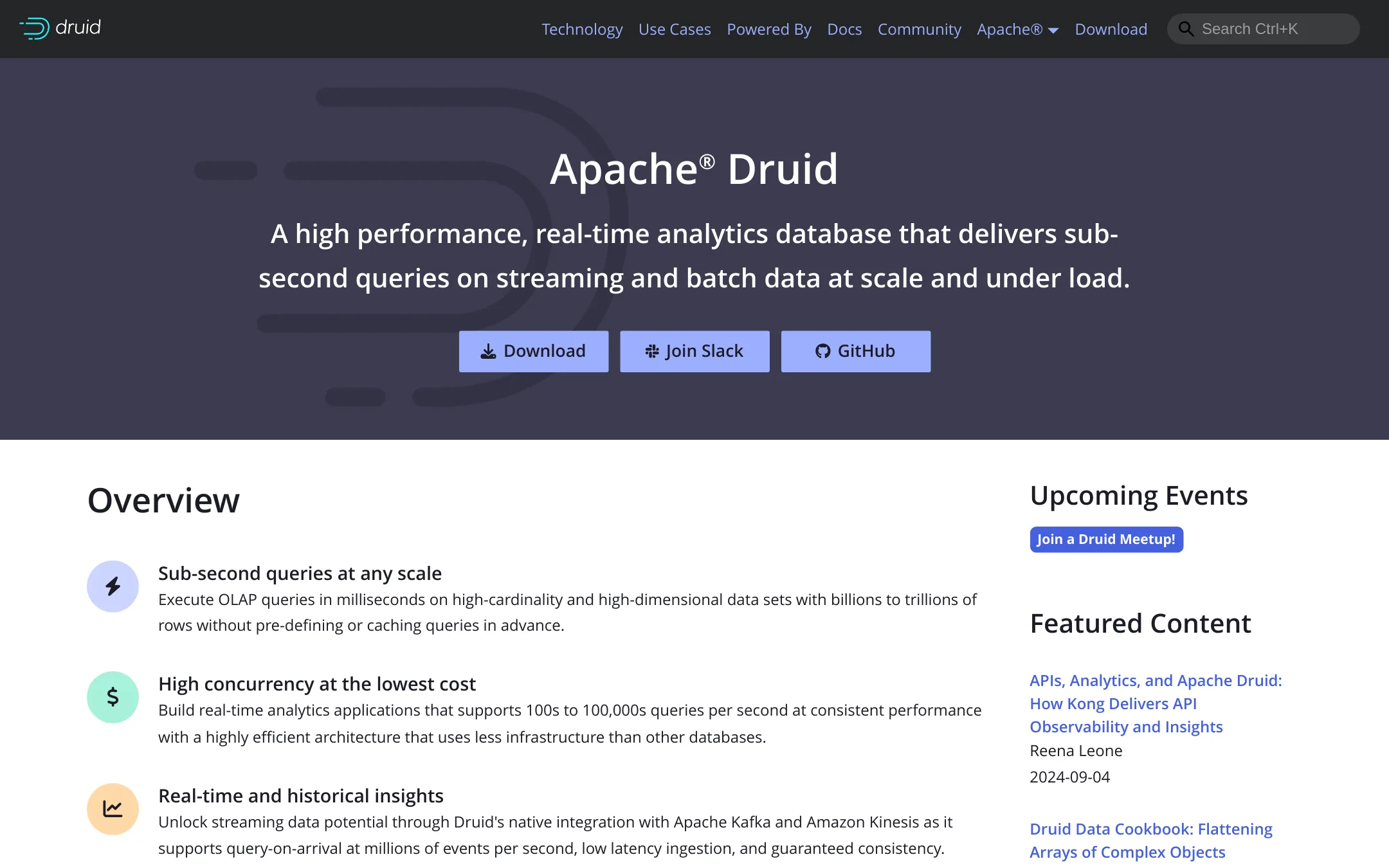
Apache Druid is a distributed real-time analytics database built for sub-second queries on billions to trillions of rows. You would choose it over DuckDB when you need a standalone server that handles streaming ingestion from Kafka or Kinesis and serves hundreds of thousands of queries per second to many users, rather than an in-process library.
Where it is strong
- Sub-second queries on billions of rows without pre-defined queries
- Native streaming ingestion from Kafka and Kinesis with query-on-arrival
- Automatic columnarization, indexing, and compression of ingested data
Where it falls short
- Requires a cluster of servers, not an in-process embeddable database
- Joins are fastest when pre-joined during ingestion, limiting ad-hoc query flexibility
- Pricing:
- Pricing is not published on the site.
- Custom quote
7.QuestDB
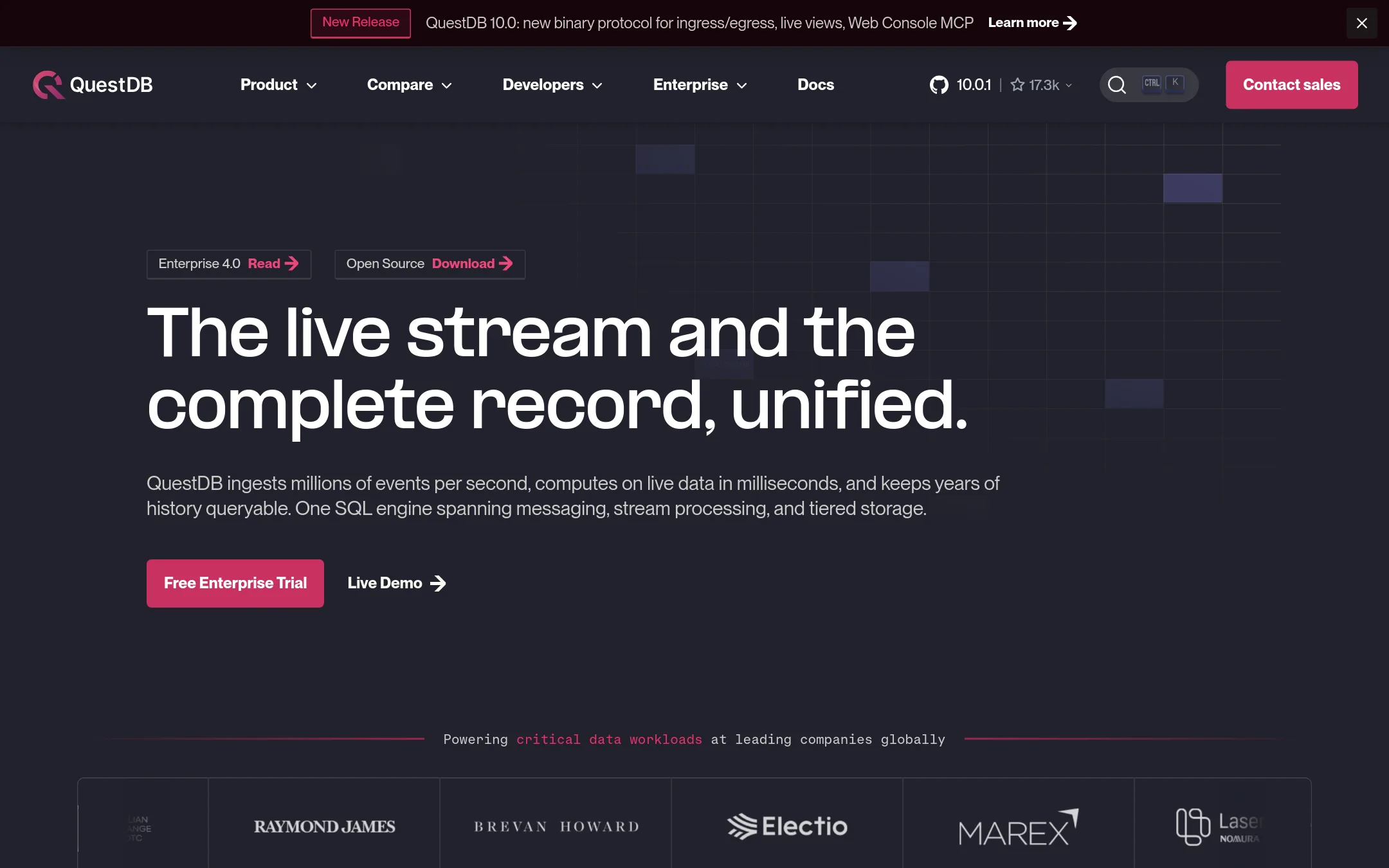
Best for: Teams in capital markets, energy, or IoT that need to capture and query high-cardinality time-series data in real time.
- Pricing
- Custom quote
- Category
- Analytics & Data
QuestDB is a time-series database built for high-frequency data like market ticks, sensor readings, and trades. It ingests millions of events per second and runs SQL queries across live and historical data with low latency. Choose it over DuckDB when you need a server-based database that handles continuous, time-ordered writes and real-time analytics at scale.
Where it is strong
- Ultra-low latency ingestion with built-in deduplication and out-of-order correction
- Unified SQL over hot data and Parquet cold storage, no separate query engine
- Open source under Apache 2.0 with PGWire support
Where it falls short
- Designed for time-series workloads, not general-purpose OLAP on arbitrary data
- Enterprise features like replication and SSO require a paid plan
- Pricing:
- Pricing is not published on the site. Enterprise features like high availability, SSO, and tiered storage are available through a custom quote.
- Switching from DuckDB:
- Moving from DuckDB to QuestDB means shifting from an embedded, file-based query engine to a client-server database with its own ingestion pipeline and time-series SQL extensions.
- Not published
8.Apache Pinot
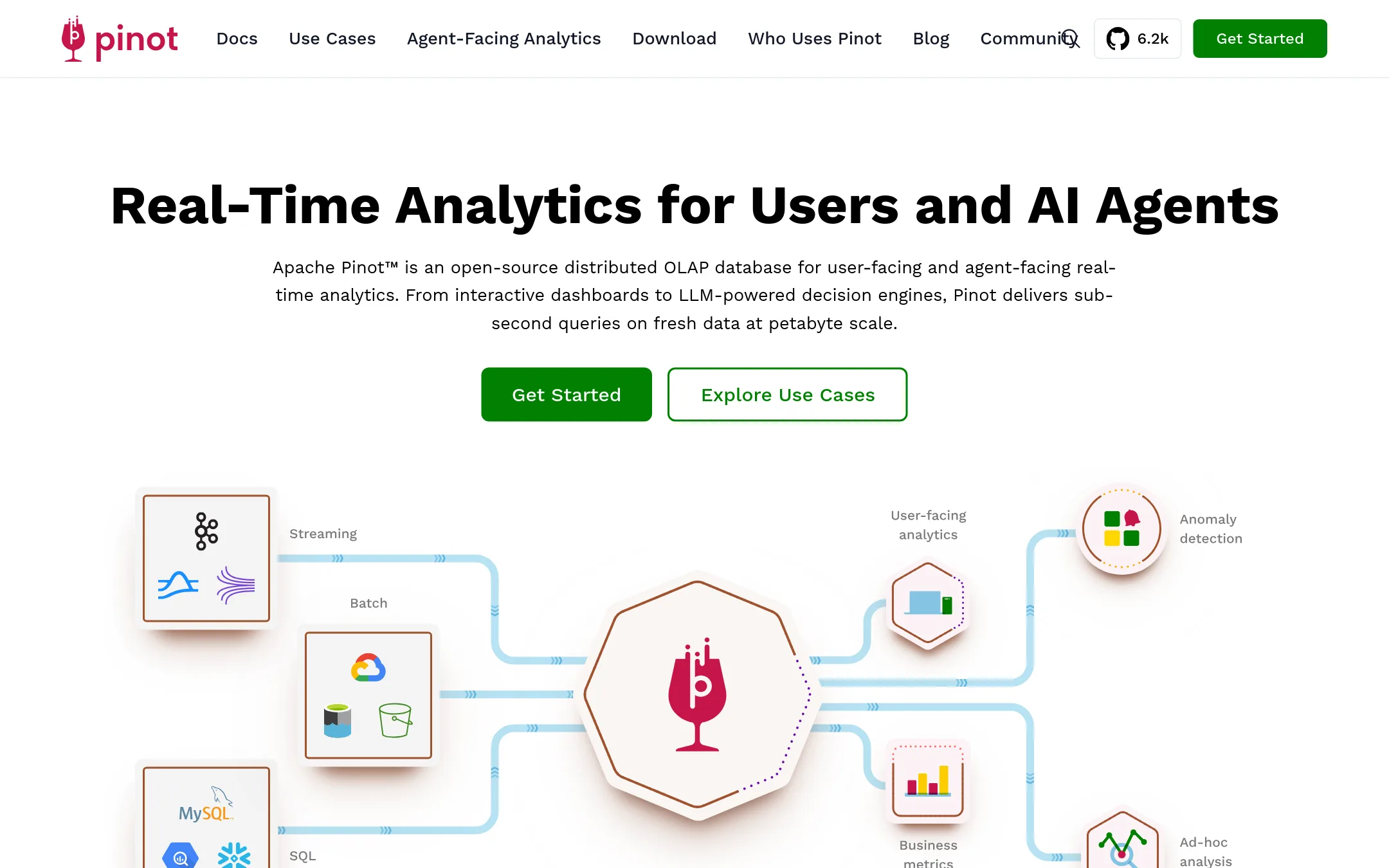
Best for: Teams building user-facing analytics dashboards or AI agents that need sub-second SQL on live streaming data at high concurrency.
- Pricing
- Not published
- Category
- Analytics & Data
Apache Pinot is a distributed OLAP database built for sub-second queries on fresh streaming data at high concurrency. You would choose it over DuckDB when you need to serve real-time analytics to many users or AI agents at petabyte scale, not just run in-process queries on local files.
Where it is strong
- Sub-second queries on petabyte-scale data with P90 latencies in tens of milliseconds
- High concurrency, serving hundreds of thousands of queries per second
- Real-time streaming ingestion from Kafka, Pulsar, and Kinesis with built-in upserts
Where it falls short
- Requires a distributed cluster, not an in-process embedded database
- No pricing information available, so total cost of ownership is unclear
- Pricing:
- Pricing is not published on the site.
- Switching from DuckDB:
- Moving from DuckDB to Pinot means deploying and managing a distributed cluster, and redesigning your data ingestion to stream into Pinot rather than querying files directly.
- From $0.073/hr
9.CrateDB
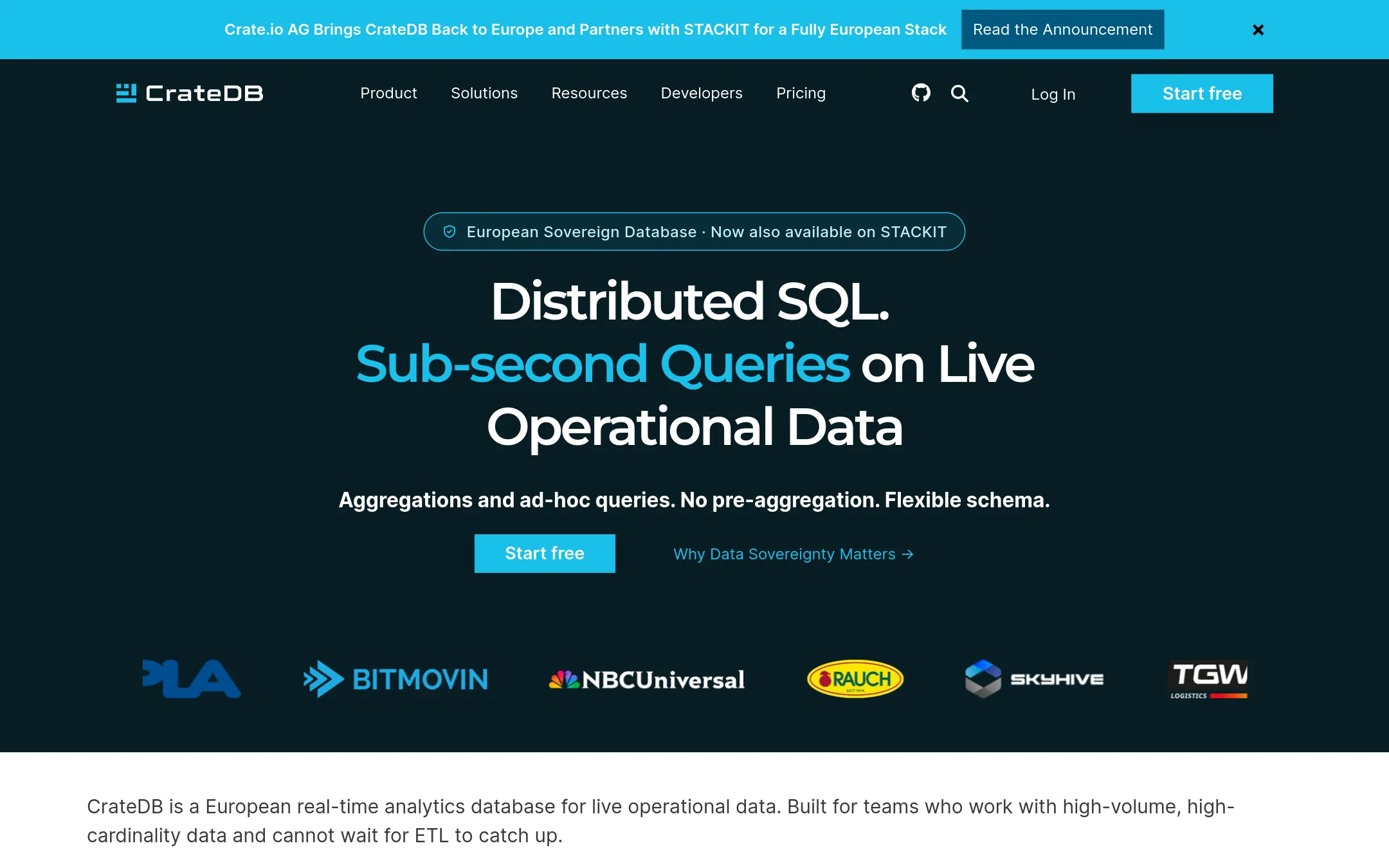
Best for: Teams in Europe that need a self-managed or cloud database for real-time IoT, telemetry, or log analytics with high ingestion and low-latency queries.
- Pricing
- From $0.073/hr
- Category
- Analytics & Data
CrateDB is a distributed SQL database built for real-time analytics on live operational data, handling time-series, JSON, full-text, vector, and geospatial data in one engine. Choose it over DuckDB when you need horizontal scaling, high ingestion rates, and sub-second queries on streaming data without pre-aggregation, especially in a European-hosted environment.
Where it is strong
- Distributed architecture scales horizontally by adding nodes
- Supports SQL with joins, aggregations, and window functions on billions of rows
- Built-in replication and automatic failover
Where it falls short
- Requires cluster management unless using the cloud service
- Not an in-process library like DuckDB. Heavier to embed
- Pricing:
- CrateDB Cloud starts from $0.073/hour for a shared single-node environment, with a free plan of 2 vCPUs, 2 GB RAM, and 8 GB storage. Dedicated environments start from $0.246/hour.
- Switching from DuckDB:
- Moving from DuckDB involves setting up a CrateDB cluster and adapting queries to its distributed SQL, which may require schema and connection changes.
- Not published
10.Elasticsearch
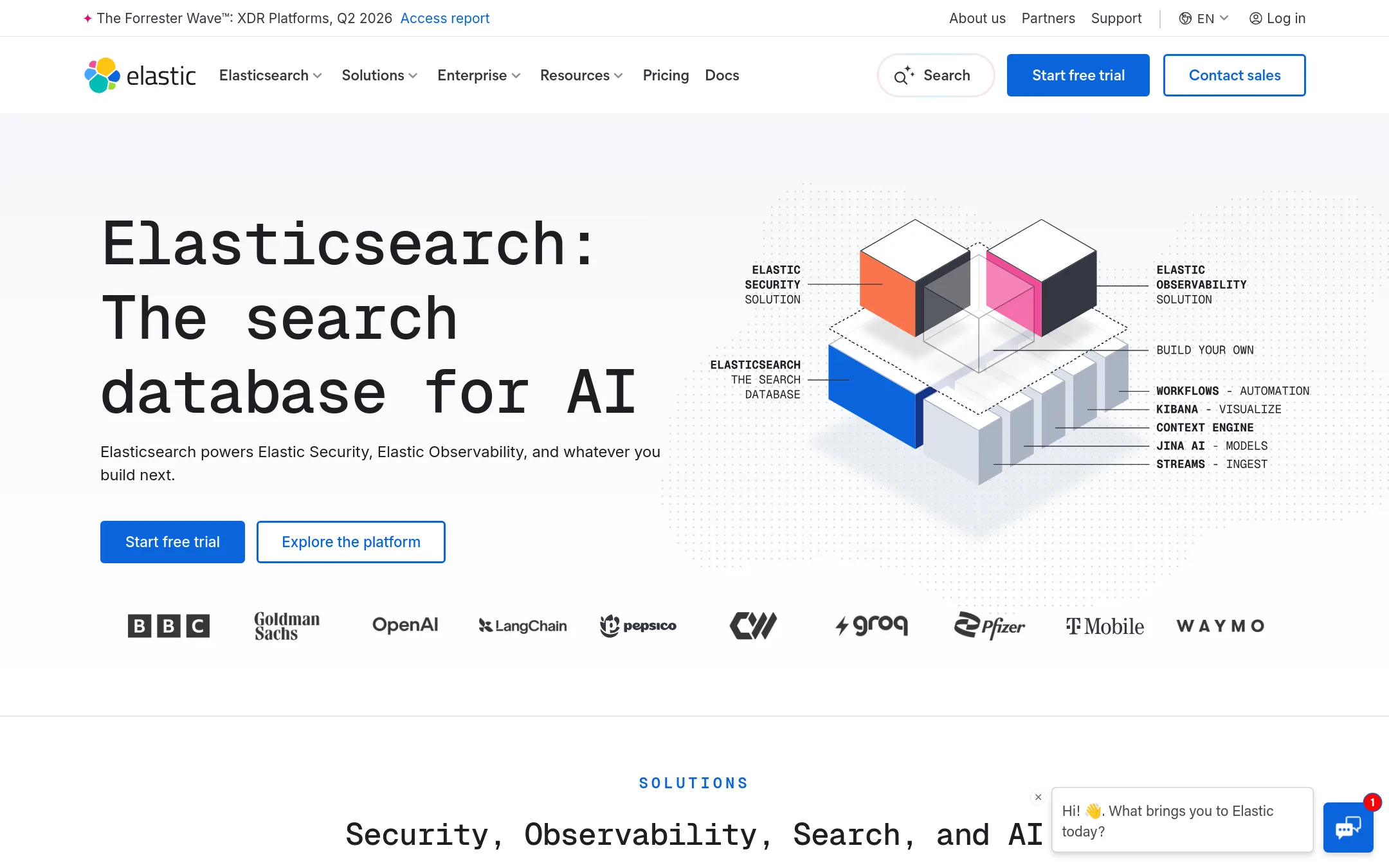
Best for: Teams building search experiences, log analytics, or security monitoring that need a scalable, distributed datastore with built-in vector and full-text capabilities.
- Pricing
- Not published
- Category
- Analytics & Data
Elasticsearch is a distributed search and analytics database built for full-text search, vector search, and log analysis at scale. Choose it over DuckDB when you need a server-based system for real-time search, observability, or security use cases, not an in-process library for local analytical queries.
Where it is strong
- Distributed architecture scales horizontally across clusters
- Built-in full-text, vector, and hybrid search capabilities
- Strong ecosystem for observability and security use cases
Where it falls short
- Requires server infrastructure and cluster management, unlike DuckDB's in-process simplicity
- Pricing is opaque and depends on deployment type and scale
- Pricing:
- Pricing is not published on the site. Elastic offers hosted, serverless, and self-managed options, with a free trial and contact sales for custom plans.
- From $18k/yr (Enterpri
11.InfluxData
Best for: Teams building real-time monitoring, IoT, or physical AI systems that need to capture and analyze millions of time series data points per second.
- Pricing
- From $18k/yr (Enterpri
- Category
- Analytics & Data
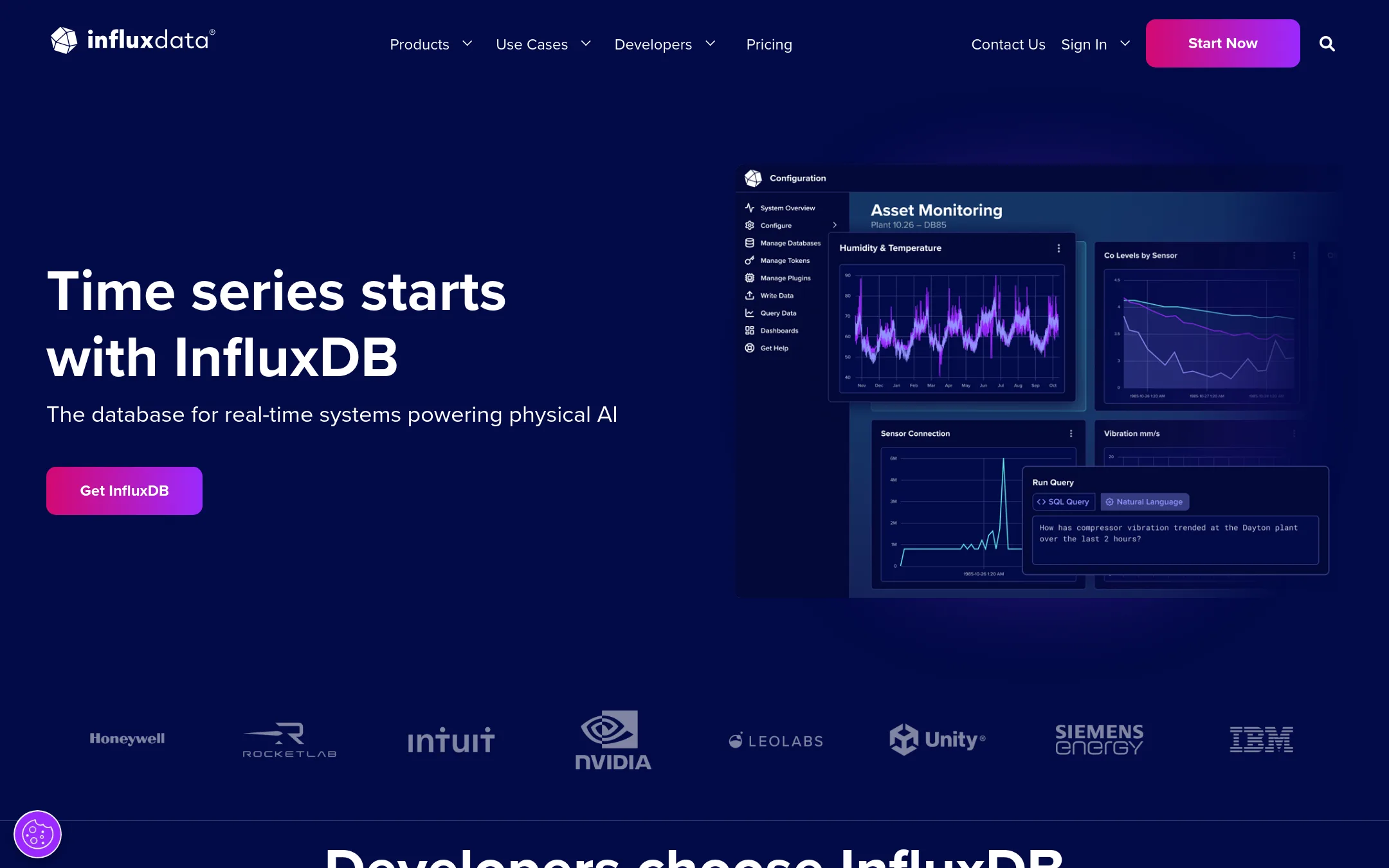
InfluxDB is a time series database built for high-velocity, high-resolution operational data like sensor telemetry, infrastructure metrics, and real-time analytics. Choose it over DuckDB when you need continuous ingest, downsampling, and eviction of cold data to lakes, rather than ad-hoc analytical queries on static files.
Where it is strong
- Purpose-built for time series with high-speed ingest and compression
- Deploy on-prem, edge, or cloud with a single engine
- Open source Core version free for local dev and prototyping
Where it falls short
- Not a general-purpose SQL OLAP database like DuckDB
- Cloud Serverless has service quotas and no high availability
- Pricing:
- InfluxDB 3 Enterprise is custom priced, Cloud Serverless starts with a $250 free credit then usage-based, and InfluxDB 3 Core is free forever. Telegraf Enterprise plans start at $18,000 per year.
- From $1.50/credit/hr
12.Materialize
Best for: Teams building real-time AI agents, search pipelines, or operational dashboards that need up-to-the-second SQL views over data from OLTP systems.
- Pricing
- From $1.50/credit/hr
- Category
- Analytics & Data
Materialize is a managed SQL engine that continuously ingests operational data and incrementally maintains live views, so queries return fresh results in about a second. Choose it over DuckDB when you need real-time context for AI agents, search, or microservices, and you want a fully managed or self-hosted service rather than an in-process library. DuckDB is for batch and interactive analytics on files. Materialize is for serving live data products to applications.
Where it is strong
- Incremental computation keeps views fresh with minimal work, so queries return in about a second.
- Deploy as fully managed SaaS, self-managed, or locally via a Docker emulator.
- Integrates with dbt, Prometheus, Datadog, and Grafana for monitoring and transformations.
Where it falls short
- Pricing is usage-based and can get expensive for large workloads. No published flat rate.
- Cloud availability is limited to AWS regions us-east-1, us-west-2, and eu-west-1.
- Pricing:
- Cloud On-Demand costs $1.50 per compute credit per hour, storage $0.00004110 per GB per hour, and networking $0.12 per GB. Self-Managed Community License is free within 24GiB memory and 48GiB disk limits.
- Switching from DuckDB:
- Moving from DuckDB means replacing in-process SQL queries with a client-server service, and you will need to set up continuous ingestion from your source systems rather than reading files directly.
See more comparisons in Analytics & Data alternatives.
FAQ
Questions about DuckDB alternatives
What is the best DuckDB alternative for real-time analytics on large datasets?
ClickHouse is the strongest choice for real-time analytics on very large datasets. It is a server-based column-oriented database that handles high-concurrency queries with sub-second response times, and it offers a managed cloud service.
Which alternative is best for teams that need continuously updated SQL views?
Materialize is built for this. It incrementally maintains live views from operational data, so queries return fresh results in about a second. It is fully managed or self-hosted, with cloud availability limited to three AWS regions.
Are there free options among the alternatives?
Yes. InfluxDB 3 Core is free forever, ClickHouse self-managed is free, and Materialize has a free self-managed community license within memory and disk limits. CrateDB offers a free plan with limited resources.
Which alternative is best for time-series data like IoT or monitoring?
InfluxData and QuestDB are both purpose-built for time series. InfluxData handles high-velocity sensor telemetry and offers a free core version, while QuestDB focuses on ultra-low latency ingestion for market ticks and trades.
Do any alternatives work without a server, like DuckDB?
No. Most alternatives require a server or cluster. ClickHouse has a free local version for querying files, but full use needs a server. Polars and Pandas are in-memory libraries but are not SQL databases.
Last updated November 2, 2026.