
InfluxData alternatives
12 products compared · Updated October 19, 2026
The short answer
QuestDB is the strongest alternative for teams needing ultra-low latency and high throughput with open formats and no lock-in. ClickHouse suits teams running real-time analytics on petabyte-scale data with SQL. TimescaleDB is best for teams already on PostgreSQL that want time-series capabilities without a separate database. VictoriaMetrics is a strong option for large-scale monitoring and observability workloads.
Your shortlist, at a glance
Read the comparisons ↓ TimescaleDBFrom $30/mo + $0.177/GTeams already on PostgreSQL that need time-series capabilities for industrial IoT, telemetry, or machine data without introducing a separate database.
 ClickHouseFrom $50/mo + usageTeams running real-time analytics, observability, or AI workloads on large datasets who prefer a general-purpose OLAP database with SQL.
 QuestDBCustom quoteTeams in capital markets, energy, or aerospace that need to capture every tick or sensor event and query it in real time with standard SQL.
 Apache DruidNot publishedTeams building real-time analytics applications that require sub-second queries on high-cardinality, high-dimensional datasets with billions of rows.
 VictoriaMetricsNot publishedTeams running large-scale monitoring and observability workloads that need a fast, efficient, and Prometheus-compatible time series database.
 AWS ParallelClusterPay-as-you-goTeams running HPC workloads on AWS that need cluster orchestration, not time series storage.
 ElasticsearchNot publishedTeams that need a unified platform for search, observability, and security with time series capabilities, not just time series storage.
 Apache PinotNot publishedTeams building user-facing analytics dashboards or AI agents that need sub-second SQL queries on live streaming data at high concurrency.
 CrateDBFrom $0.073/hrEuropean teams needing a self-managed or cloud SQL database for high-cardinality operational data with time-series, search, and geospatial in one engine.
 DuckDBNot publishedData teams and developers who want a lightweight, embeddable SQL engine for querying files and cloud object storage without running a separate database server.
 MaterializeFrom $1.50/credit/hrEngineering teams building AI agents, interactive search, or live dashboards that need fresh context from multiple operational databases.
TDengineFrom $5,000/yr (self-hIndustrial companies in manufacturing, energy, and utilities that need high-performance time-series storage plus AI-driven operational insights.
About InfluxData and its alternatives
InfluxData makes InfluxDB, a time series database for building and operating time series applications. It is known for high-speed ingest, real-time analytics, and deployment options across cloud, on-prem, and edge. Its pricing ranges from a free open source core to custom-priced enterprise and fully managed cloud plans.
When comparing alternatives, weigh pricing structure, deployment options, and integrations. Some products are open source with no published pricing, while others offer transparent cloud plans. Consider whether you need a managed service, self-managed deployment, or a specific cloud provider. Also check for features like continuous queries, downsampling, and eviction to lakehouses, which are core to InfluxDB.
Explore the alternatives
- From $30/mo + $0.177/G
1.TimescaleDB
Best for: Teams already on PostgreSQL that need time-series capabilities for industrial IoT, telemetry, or machine data without introducing a separate database.
- Pricing
- From $30/mo + $0.177/G
- Category
- Analytics & Data
TimescaleDB is a PostgreSQL-based time-series database that handles sensor and machine data at petabyte scale. Choose it over InfluxData if you want to stay in the Postgres ecosystem, use standard SQL, and need to combine time-series with relational data in one system.
Where it is strong
- Postgres-native: use SQL, existing tools, and integrations
- Automatic partitioning and columnar compression for fast queries
- Tiered storage moves cold data to low-cost object storage
Where it falls short
- Requires PostgreSQL expertise, not a standalone time-series engine
- No serverless option. You manage or pay for compute instances
- Pricing:
- Compute starts at $30/month and storage at $0.177/GB-month on the Performance plan. Scale plan starts at $36/month with storage at $0.212/GB-month. Enterprise pricing is custom.
- Switching from InfluxData:
- Migrating from InfluxData means converting your data model to PostgreSQL tables and rewriting queries in SQL, but you can keep your existing Postgres setup.
- From $50/mo + usage
2.ClickHouse
Best for: Teams running real-time analytics, observability, or AI workloads on large datasets who prefer a general-purpose OLAP database with SQL.
- Pricing
- From $50/mo + usage
- Category
- Analytics & Data
ClickHouse is a column-oriented OLAP database built for real-time analytics on very large datasets, with millisecond query performance and strong compression. Choose it over InfluxData when your primary need is analytical SQL queries on petabyte-scale data rather than time series-specific features like continuous queries or downsampling.
Where it is strong
- Very fast query performance on large datasets due to columnar storage and vectorized execution.
- Open source core with a free self-managed option, plus a cloud service with a 30-day trial and $300 credits.
- Supports many integrations and can be deployed on AWS, GCP, or Azure, or in your own VPC.
Where it falls short
- Not purpose-built for time series workloads, so features like continuous queries or time series-specific functions may be missing.
- Pricing for cloud is usage-based and can be complex to estimate. Enterprise features like SAML SSO and HIPAA compliance are only on the Ente
- Pricing:
- Cloud plans start at $50/month. Compute and storage are metered separately, with compute from $0.125 per unit per hour and data transfer egress starting at $0.1152/GB.
- Switching from InfluxData:
- Moving from InfluxData to ClickHouse requires re-architecting your data model and queries from InfluxDB's line protocol and Flux/InfluxQL to SQL, and setting up new ingestion pipelines.
- Custom quote
3.QuestDB
Best for: Teams in capital markets, energy, or aerospace that need to capture every tick or sensor event and query it in real time with standard SQL.
- Pricing
- Custom quote
- Category
- Analytics & Data
QuestDB is an open source time series database focused on ultra-low latency and high throughput, with SQL on open formats like Parquet and Iceberg. Choose it over InfluxData when you need to ingest and query market data, sensor telemetry, or other high-cardinality streams with sub-millisecond response times and no vendor lock-in.
Where it is strong
- Faster ingestion than InfluxDB in open source TSBS benchmarks
- Open formats (Parquet, Iceberg) and SQL with PGWire, no lock-in
- Built-in tiered storage from hot WAL to cold Parquet on object storage
Where it falls short
- No managed cloud offering listed. Enterprise requires self-managed or BYOC
- Smaller ecosystem and community than InfluxData's 2,800+ contributors
- Pricing:
- Pricing is not published on the site. QuestDB Enterprise is available with custom pricing. The open source core is free under Apache 2.0.
- Switching from InfluxData:
- Migrating from InfluxDB means rewriting queries from Flux or InfluxQL to SQL and adjusting ingestion pipelines, since QuestDB uses a different data model and wire protocol.
- Not published
4.Apache Druid
Best for: Teams building real-time analytics applications that require sub-second queries on high-cardinality, high-dimensional datasets with billions of rows.
- Pricing
- Not published
- Category
- Analytics & Data
Apache Druid is a high-performance real-time analytics database designed for sub-second queries on billions to trillions of rows. Choose it over InfluxData when you need to run complex OLAP queries on streaming and batch data at massive scale, rather than focusing on time series-specific workloads.
Where it is strong
- Sub-second queries on billions to trillions of rows without pre-defining queries.
- Native integration with Apache Kafka and Amazon Kinesis for query-on-arrival at millions of events per second.
- Loosely coupled components allow easy scale-up and scale-out with deep storage.
Where it falls short
- No managed cloud offering. You must self-manage or use third-party services.
- Not purpose-built for time series workloads, so it may lack specialized time series features like downsampling or eviction policies.
- Pricing:
- Pricing is not published on the site.
- Switching from InfluxData:
- Moving from InfluxData to Druid involves re-architecting your data pipeline and queries, as Druid uses a different ingestion model and SQL dialect, and you'll need to manage your own infrastructure.
- Not published
5.VictoriaMetrics
Best for: Teams running large-scale monitoring and observability workloads that need a fast, efficient, and Prometheus-compatible time series database.

- Pricing
- Not published
- Category
- Analytics & Data
VictoriaMetrics is a high-performance time series database and monitoring stack that is often chosen as a drop-in replacement for Prometheus and InfluxDB. It is a good fit for teams that need to handle large volumes of metrics with lower compute and storage costs, especially in Kubernetes or cloud-native environments.
Where it is strong
- Drop-in replacement for Prometheus, so existing queries and code work without changes.
- Highly efficient storage and compute, leading to significantly lower infrastructure costs.
- Strong open source community with 1B+ Docker pulls and 17K+ GitHub stars.
Where it falls short
- Pricing is not transparent, requiring contact with sales for enterprise or cloud plans.
- Less mature than InfluxData for non-monitoring time series use cases like IoT or sensor data.
- Pricing:
- Pricing is not published on the site.
- Switching from InfluxData:
- Switching from InfluxData to VictoriaMetrics is straightforward if you use Prometheus-compatible queries, but you may need to rewrite InfluxQL or Flux queries and adjust data ingestion pipelines.
- Pay-as-you-go
6.AWS ParallelCluster
Best for: Teams running HPC workloads on AWS that need cluster orchestration, not time series storage.
- Pricing
- Pay-as-you-go
- Category
- Developer Tools
AWS ParallelCluster is a cluster management tool for running high-performance computing workloads on AWS, not a time series database. Choose it when you need to orchestrate compute clusters for simulations or batch processing, and you already use AWS for infrastructure. It is not a replacement for InfluxData's time series analytics.
Where it is strong
- Manages cluster lifecycle on AWS with auto-scaling
- Integrates with AWS services like EC2 and S3
- Free to use. You pay only for underlying AWS resources
Where it falls short
- Not a time series database. Lacks InfluxDB's query and storage features
- Requires AWS expertise and setup. No managed time series analytics
- Pricing:
- Pricing is not published on the site. AWS services are billed pay-as-you-go, but ParallelCluster itself has no separate fee.
- Not published
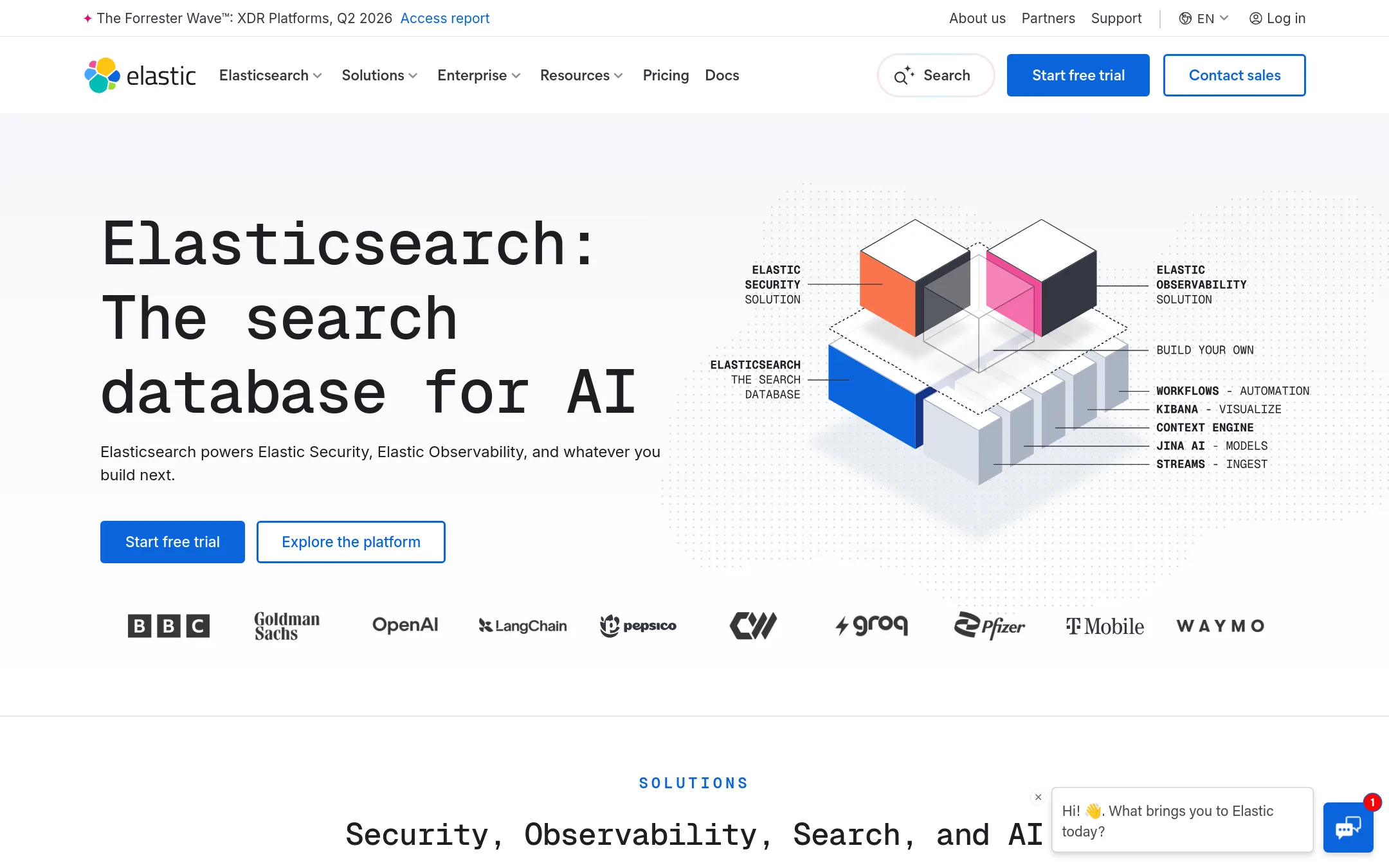
7.Elasticsearch
Best for: Teams that need a unified platform for search, observability, and security with time series capabilities, not just time series storage.
- Pricing
- Not published
- Category
- Analytics & Data
Elasticsearch is a general-purpose search database that also handles observability and security workloads. Choose it over InfluxData when you need full-text search, vector search, or log analytics alongside time series data, rather than a dedicated time series engine.
Where it is strong
- Handles full-text, vector, and time series data in one system
- Queries up to 30x faster than Prometheus for observability workloads
- Deploy in cloud, on-premises, or serverless
Where it falls short
- Not purpose-built for high-resolution time series ingest like InfluxDB
- Pricing is not transparent. Requires contacting sales
- Pricing:
- Pricing is not published on the site. Elastic offers hosted, serverless, and self-managed options, with a free trial and contact sales for details.
- Switching from InfluxData:
- Moving from InfluxData means re-modeling your time series data into Elasticsearch indices and adapting queries to Elastic's query DSL, which is a significant change.
- Not published
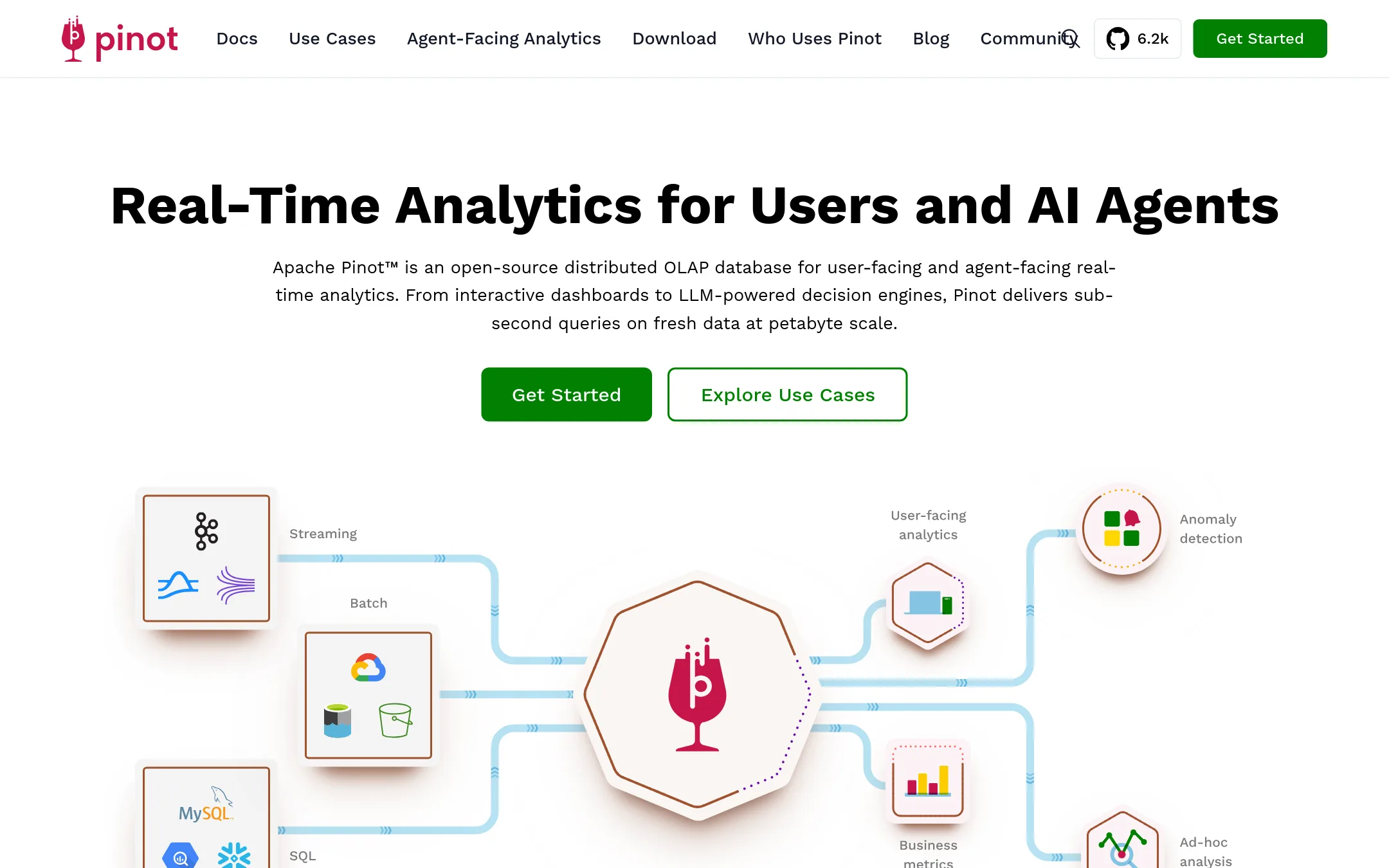
8.Apache Pinot
Best for: Teams building user-facing analytics dashboards or AI agents that need sub-second SQL queries on live streaming data at high concurrency.
- Pricing
- Not published
- Category
- Analytics & Data
Apache Pinot is an open-source distributed OLAP database built for sub-second queries on fresh streaming data at petabyte scale. Choose it over InfluxData when you need to serve interactive analytics to millions of end users or feed real-time context to AI agents, not just store and query time series telemetry.
Where it is strong
- Sub-second query latency on petabyte-scale data, proven at LinkedIn, Uber, and Walmart.
- Built-in streaming ingestion from Kafka, Pulsar, and Kinesis with upserts and joins.
- Open source with a strong community and production deployments at major companies.
Where it falls short
- Requires significant operational expertise to deploy and manage a distributed cluster.
- No managed cloud offering. You run and scale it yourself.
- Pricing:
- Pricing is not published on the site.
- Switching from InfluxData:
- Moving from InfluxData means rearchitecting your data model from time series to OLAP tables and setting up Pinot's ingestion pipelines, which is a substantial migration effort.
- From $0.073/hr
9.CrateDB
Best for: European teams needing a self-managed or cloud SQL database for high-cardinality operational data with time-series, search, and geospatial in one engine.
- Pricing
- From $0.073/hr
- Category
- Analytics & Data
CrateDB is a distributed SQL database for real-time analytics on live operational data. You would choose it over InfluxData when you need to query time-series, JSON, full-text, and geospatial data together in one SQL query without pre-aggregation, especially if European data sovereignty matters.
Where it is strong
- Full SQL with JOINs and aggregations over billions of rows without pre-aggregation.
- One engine handles time-series, JSON, full-text, vector, and geospatial data.
- Apache 2.0 licensed, deploy on-prem, edge, or any cloud with no lock-in.
Where it falls short
- No built-in eviction to lakehouse or data lake integration like InfluxDB's.
- Cloud pricing is per-hour, which may be less predictable for spiky workloads.
- Pricing:
- CrateDB Cloud starts at $0.073/hour for a shared single node and $0.246/hour for a dedicated environment, with a free plan offering 2 vCPUs, 2 GB RAM, and 8 GB storage.
- Switching from InfluxData:
- Moving from InfluxData to CrateDB means rewriting queries from Flux or InfluxQL to SQL and reconfiguring data ingestion pipelines, but you can keep using Grafana for visualization.
- Not published
10.DuckDB
Best for: Data teams and developers who want a lightweight, embeddable SQL engine for querying files and cloud object storage without running a separate database server.
- Pricing
- Not published
- Category
- Analytics & Data
DuckDB is an in-process analytical SQL database that runs inside your application and queries files like Parquet, CSV, and Iceberg directly. Choose it over InfluxData when you need fast local analytics on batch data, not a time series server for streaming telemetry.
Where it is strong
- Runs in-process, no separate server to manage
- Directly reads and writes Parquet, CSV, JSON, and Iceberg
- MIT-licensed and free to use anywhere
Where it falls short
- Not designed for high-velocity time series ingest or real-time streaming
- No built-in clustering or replication for high availability
- Pricing:
- Pricing is not published on the site.
- From $1.50/credit/hr
11.Materialize
Best for: Engineering teams building AI agents, interactive search, or live dashboards that need fresh context from multiple operational databases.
- Pricing
- From $1.50/credit/hr
- Category
- Analytics & Data
Materialize is a SQL-based streaming engine that continuously transforms operational data into live, queryable context. Choose it over InfluxData when you need real-time data products for AI agents and applications, not just time series metrics.
Where it is strong
- Incremental computation keeps results fresh with minimal work
- SQL-based, so any engineer can build real-time data products
- Integrates with MCP endpoints and vector indexes for AI
Where it falls short
- Pricing is usage-based and can be unpredictable for large workloads
- Not designed for high-cardinality time series metrics like InfluxDB
- Pricing:
- Cloud On-Demand is $1.50 per compute credit per hour, storage at $0.00004110 per GB per hour, and networking at $0.12 per GB. Self-managed Community License is free within 24GiB memory and 48GiB disk limits.
- Switching from InfluxData:
- Moving from InfluxData means replacing time series-specific queries with SQL transformations and setting up new data pipelines for operational sources.
- From $5,000/yr (self-h
12.TDengine
Best for: Industrial companies in manufacturing, energy, and utilities that need high-performance time-series storage plus AI-driven operational insights.
- Pricing
- From $5,000/yr (self-h
- Category
- Analytics & Data
TDengine is a time-series database built for industrial data, with an AI-native platform that includes asset modeling, event management, and root cause analysis. Choose it over InfluxData if you run manufacturing, energy, or utility operations and want a modern replacement for traditional data historians like the PI System.
Where it is strong
- 10x performance and up to 90% storage cost reduction compared to general-purpose databases.
- Includes industrial ontology, AI agents, and no-code analysis tools for root cause investigation.
- Open source core with clustering, plus connectors for MQTT, Kafka, OPC, and PI System.
Where it falls short
- TSDB plans exclude dashboards, asset models, and alerting UI. Those require the All-in-One platform.
- Per-core capacity estimates vary with workload, so sizing may require vendor guidance.
- Pricing:
- Self-hosted annual licenses start at $5,000 for 4 cores, with perpetual licenses from $12,500 plus 15% annual support. Fully managed cloud plans start at $600 per month for 4 GB memory and 200 GB storage.
- Switching from InfluxData:
- Migrating from InfluxData involves moving time-series data and rewriting queries to TDengine's SQL dialect, but TDengine provides connectors for PI System and other industrial sources to ease the transition.
See more comparisons in Analytics & Data alternatives.
FAQ
Questions about InfluxData alternatives
What is the best free alternative to InfluxData?
QuestDB and ClickHouse both offer open source cores that are free to use. QuestDB is Apache 2.0 licensed, and ClickHouse has a free self-managed option. DuckDB is also free and MIT-licensed, but it is not designed for high-velocity time series ingest.
Which alternative is easiest to migrate to from InfluxDB?
VictoriaMetrics is often chosen as a drop-in replacement for InfluxDB, especially for monitoring workloads. It supports existing Prometheus queries and code without changes. TimescaleDB is easier if you are already on PostgreSQL, as it uses standard SQL.
Which alternative has the most transparent pricing?
ClickHouse publishes cloud pricing starting at $50 per month with metered compute and storage. TimescaleDB lists compute from $30 per month and storage from $0.177 per GB-month. Materialize and CrateDB also publish per-hour or per-credit rates. QuestDB, VictoriaMetrics, and others do not publish pricing.
Which alternative is best for industrial IoT or sensor data?
TDengine is built for industrial data and includes asset modeling and root cause analysis. TimescaleDB handles sensor and machine data at petabyte scale. QuestDB is also strong for sensor telemetry with sub-millisecond query times.
Which alternative supports managed cloud deployments?
ClickHouse, TimescaleDB, Materialize, and CrateDB all offer managed cloud services. QuestDB, VictoriaMetrics, Apache Druid, and Apache Pinot do not list managed cloud offerings. AWS ParallelCluster is not a time series database and does not provide managed time series analytics.
Last updated October 19, 2026.