QuestDB alternatives
11 products compared · Updated October 17, 2026
The short answer
For most teams, the strongest QuestDB alternatives are TimescaleDB for PostgreSQL users who want time-series without a new database, ClickHouse for general-purpose analytics at petabyte scale, and InfluxData for managed monitoring and IoT workloads. Each fits a different need: TimescaleDB for Postgres familiarity, ClickHouse for large-scale OLAP, and InfluxData for a mature, flexible time-series platform.
Your shortlist, at a glance
Read the comparisons ↓ InfluxDataCustom quoteTeams building real-time monitoring, IoT, and operational analytics applications that need a proven time series database with flexible deployment options.
 TimescaleDBFrom $30/mo + $0.177/GTeams already invested in PostgreSQL that need time-series analytics on machine or sensor data and want to avoid a separate database.
 ClickHouseFrom $50/mo + usageTeams running real-time dashboards, observability pipelines, or AI/ML workloads that need fast SQL queries over billions of rows and want a managed cloud option.
 Apache PinotNot publishedTeams building user-facing analytics dashboards or AI agents that need sub-second queries on fresh streaming data at high concurrency and petabyte scale.
 DuckDBNot publishedData teams and analysts who want a lightweight, embeddable SQL engine for querying files and lakehouse data directly, without managing a time-series server.
 Apache DruidNot publishedTeams building real-time analytics applications that require sub-second queries on high-cardinality, high-dimensional data at scale.
 Materialize$1.50/credit + storageTeams building AI agents or real-time data products that need continuously updated context from operational databases.
 CrateDBFrom $0.073/hrTeams in Europe that need a self-hosted or cloud database combining time-series, search, and vector analytics in one SQL engine.
TDengineFrom $5,000/yr (self-hIndustrial teams replacing traditional data historians like AVEVA PI System who need high-throughput ingestion, asset hierarchies, and AI-driven analytics in one platform.
 ElasticsearchNot publishedTeams that need a unified platform for search, observability, and security, with time-series data as one of several workloads rather than the core focus.
 VictoriaMetricsNot publishedTeams running large-scale Prometheus or Grafana monitoring stacks that need a drop-in replacement with better efficiency and lower storage costs.
About QuestDB and its alternatives
QuestDB is an open-source time series database built for ultra-low latency and high throughput. It is known for fast SQL on open formats like Parquet and Iceberg, with tiered storage and a focus on capital markets and industrial monitoring.
When comparing alternatives, weigh pricing structure (published vs. contact sales), deployment regions, integrations with your existing stack, support options, and contract terms. Some tools are open source with paid enterprise tiers, while others are fully managed with usage-based pricing. Consider whether you need a general-purpose analytics database or a specialized time-series engine.
Explore the alternatives
- Custom quote
1.InfluxData
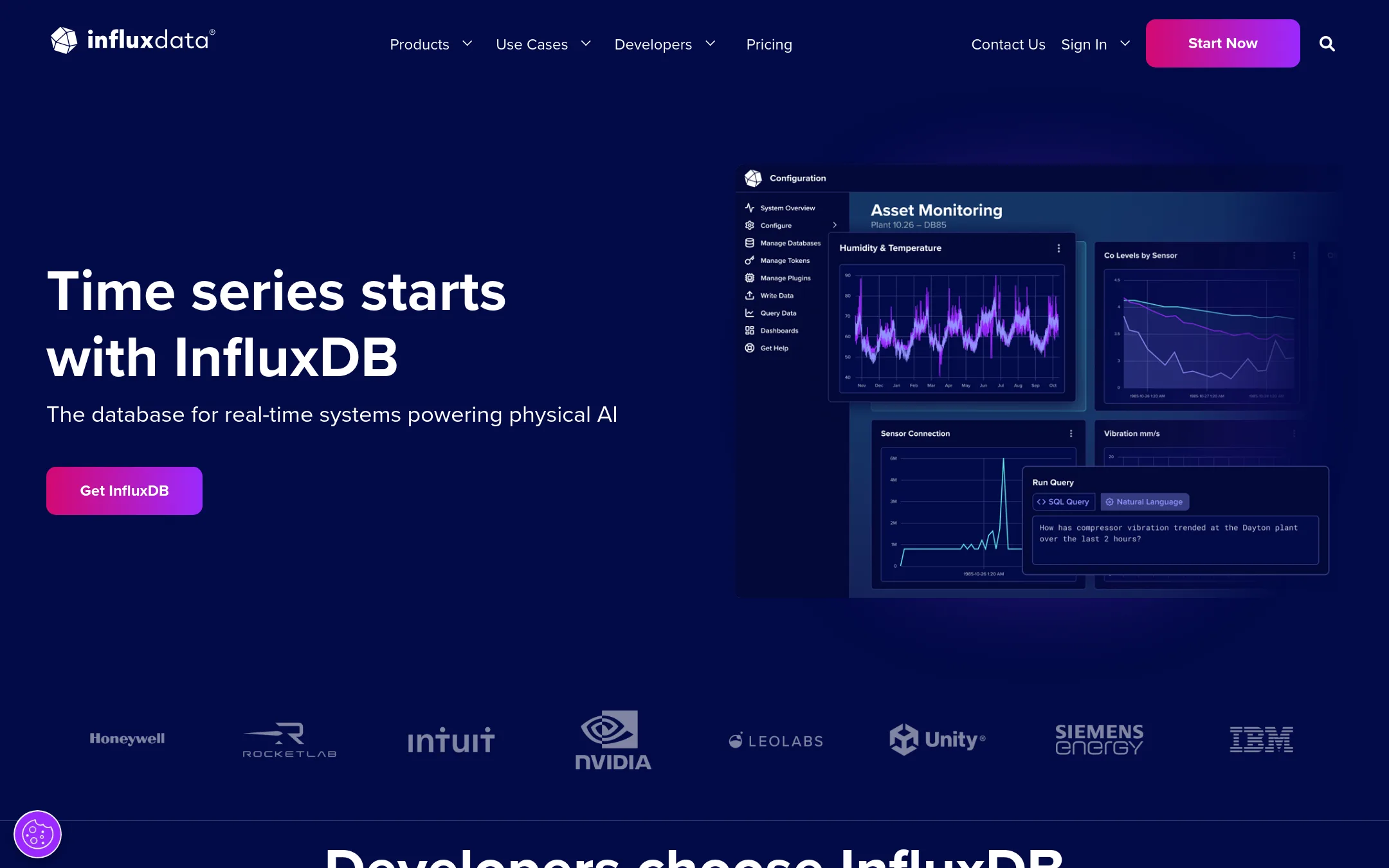
Best for: Teams building real-time monitoring, IoT, and operational analytics applications that need a proven time series database with flexible deployment options.
- Pricing
- Custom quote
- Category
- Analytics & Data
InfluxData is a mature time series platform with a large community and a broad ecosystem, including Telegraf for data collection and integrations with Grafana. You would choose it over QuestDB if you need a managed cloud option with flexible deployment models, or if you want a well-established tool with extensive client libraries and a large user base.
Where it is strong
- Large community and ecosystem with 1B+ downloads and 2,800+ contributors.
- Flexible deployment: self-managed, cloud, or AWS native via Amazon Timestream.
- Telegraf offers 400+ plugins for easy data collection and integration.
Where it falls short
- Enterprise features like high availability and SSO are not in the free open source tier.
- Cloud Serverless has service quotas and no high availability, which may limit production use.
- Pricing:
- Pricing is not published on the site. Plans start at $18,000/year for Telegraf Enterprise, and Cloud Serverless offers a $250 free credit with usage-based pricing.
- Switching from QuestDB:
- Moving from QuestDB to InfluxDB involves rewriting queries and data models, as InfluxDB uses Flux or SQL with a different schema and ingestion API.
- From $30/mo + $0.177/G
2.TimescaleDB
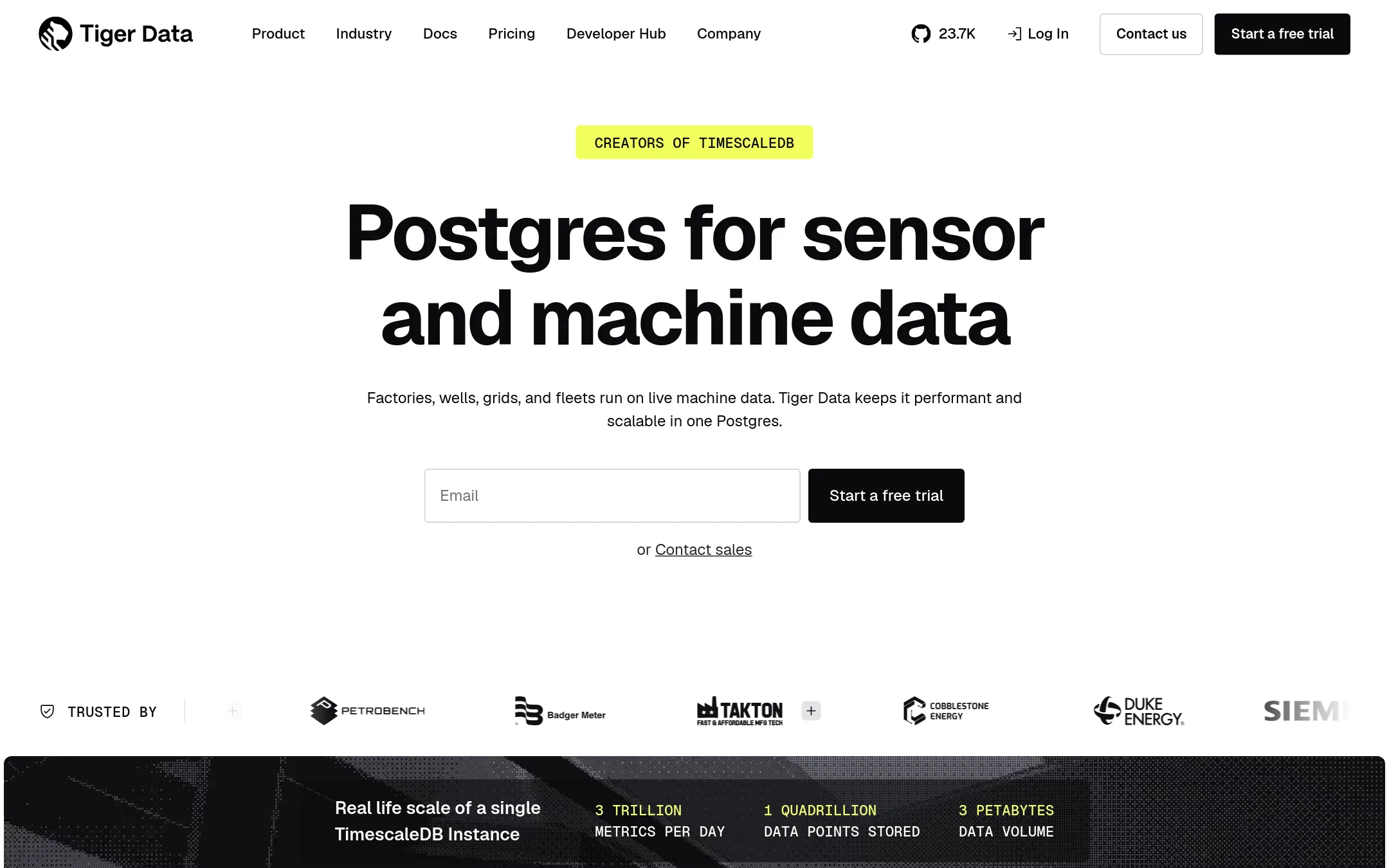
Best for: Teams already invested in PostgreSQL that need time-series analytics on machine or sensor data and want to avoid a separate database.
- Pricing
- From $30/mo + $0.177/G
- Category
- Analytics & Data
TimescaleDB is a PostgreSQL extension for time-series data, so you get SQL and the Postgres ecosystem without learning a new query language. Choose it over QuestDB if you already run Postgres and want to add time-series capabilities, or if you need to keep all your data in one familiar database.
Where it is strong
- Postgres-native SQL and tools, so no new query language
- Automatic partitioning and compression reduce storage costs
- Tiered storage moves cold data to object storage automatically
Where it falls short
- Not built for ultra-low-latency market data like QuestDB
- Enterprise features like SSO and HIPAA require a custom plan
- Pricing:
- Compute starts at $30/month and storage at $0.177/GB-month on the Performance plan. The Scale plan starts at $36/month with storage at $0.212/GB-month.
- Switching from QuestDB:
- Moving from QuestDB means migrating your data to PostgreSQL and rewriting time-series queries to use TimescaleDB's functions, but the SQL overlap makes it straightforward.
- From $50/mo + usage
3.ClickHouse
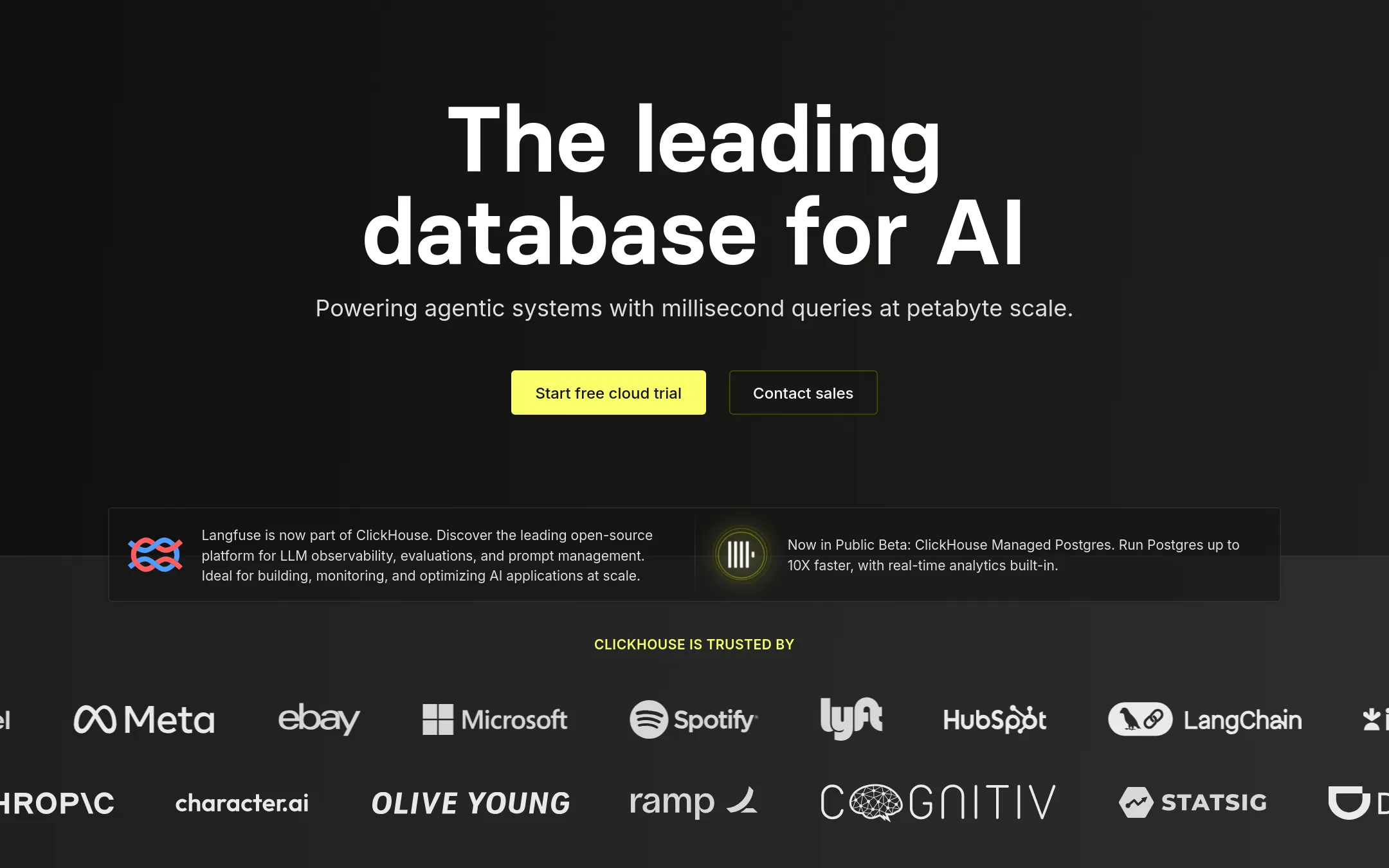
Best for: Teams running real-time dashboards, observability pipelines, or AI/ML workloads that need fast SQL queries over billions of rows and want a managed cloud option.
- Pricing
- From $50/mo + usage
- Category
- Analytics & Data
ClickHouse is a column-oriented OLAP database built for real-time analytics on very large datasets. Choose it over QuestDB when you need a general-purpose analytics warehouse that handles logs, metrics, and business intelligence, not just time-series data, and you want to scale to petabyte volumes with a mature cloud offering.
Where it is strong
- Column-oriented storage gives fast aggregations and high compression on large datasets.
- Cloud plans scale compute and storage independently, with autoscaling down to zero.
- Open source with 100+ integrations for ingestion, visualization, and language clients.
Where it falls short
- Not specialized for time-series features like SAMPLE BY or ASOF JOIN that QuestDB offers natively.
- Self-managed setup requires more tuning for low-latency ingestion compared to QuestDB's WAL-based writes.
- Pricing:
- ClickHouse Cloud starts at $50/month, with compute and storage metered separately from $0.125 per unit per hour. A free trial includes $300 in credits for 30 days.
- Switching from QuestDB:
- Moving from QuestDB means rewriting time-series-specific SQL queries (like SAMPLE BY) into standard SQL and re-evaluating ingestion pipelines, since ClickHouse uses a different data model and partitioning strategy.
- Not published
4.Apache Pinot
Best for: Teams building user-facing analytics dashboards or AI agents that need sub-second queries on fresh streaming data at high concurrency and petabyte scale.
- Pricing
- Not published
- Category
- Analytics & Data
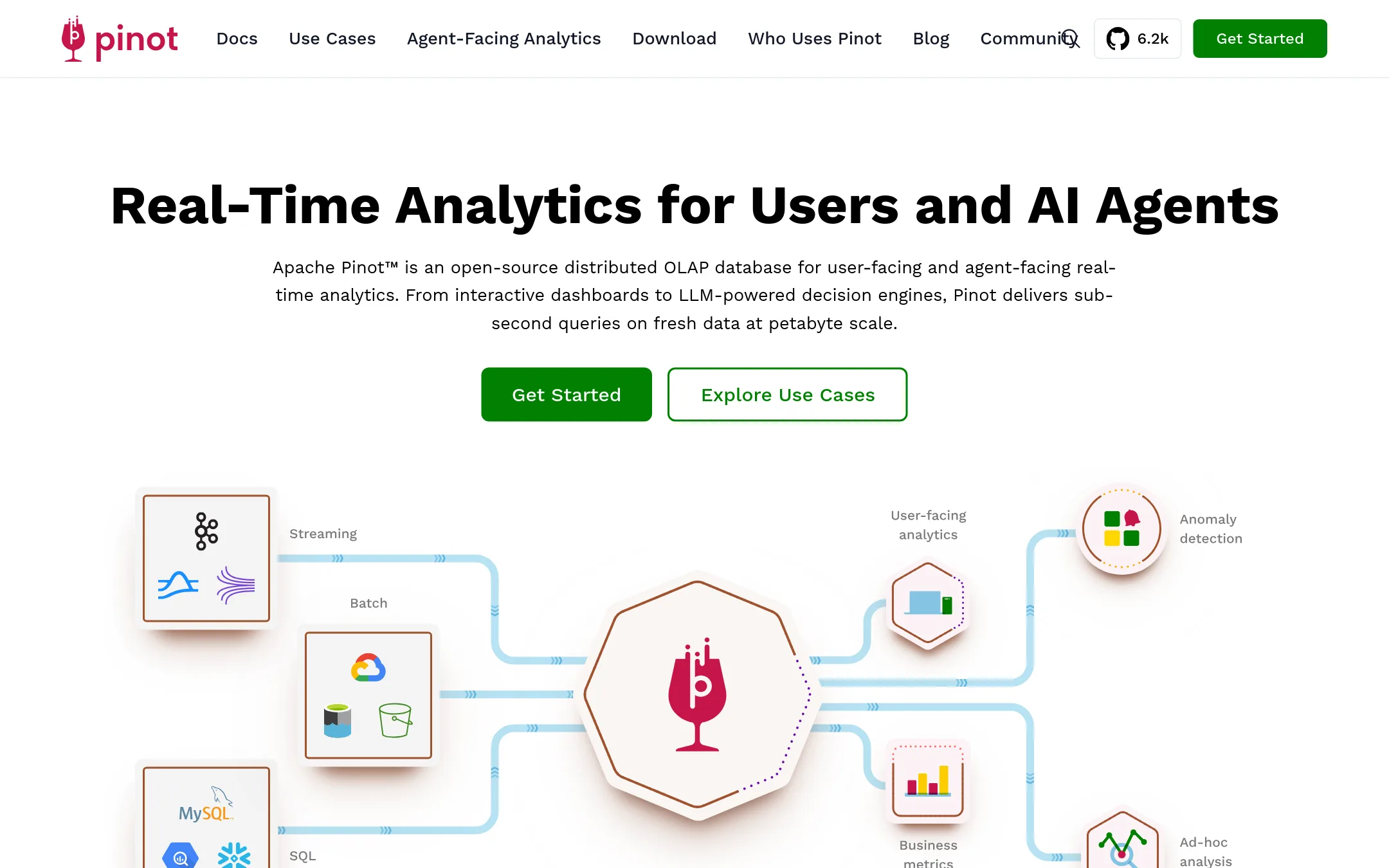
Apache Pinot is a distributed OLAP database built for sub-second queries on fresh streaming data at very high concurrency. You would choose it over QuestDB when you need to serve real-time analytics directly to end users or AI agents at petabyte scale, with features like upserts, joins, and rich indexing.
Where it is strong
- Sub-second query latency at petabyte scale, proven at LinkedIn, Stripe, and Uber.
- Built-in upserts and versatile joins on large datasets.
- Rich indexing options including StarTree, Bloom filter, and geospatial.
Where it falls short
- No built-in tiered storage to object storage like QuestDB's hot/cold setup.
- Requires managing a distributed cluster, which is more complex than a single QuestDB instance.
- Pricing:
- Pricing is not published on the site.
- Switching from QuestDB:
- Moving from QuestDB means rearchitecting your data pipeline to Pinot's streaming ingestion from Kafka, Pulsar, or Kinesis, and rewriting queries to Pinot's SQL dialect.
- Not published
5.DuckDB
Best for: Data teams and analysts who want a lightweight, embeddable SQL engine for querying files and lakehouse data directly, without managing a time-series server.
- Pricing
- Not published
- Category
- Analytics & Data
DuckDB is an in-process analytical SQL database that queries files and cloud data directly, making it a strong choice when you need fast, local analytics on Parquet, CSV, JSON, or Iceberg without running a separate server. Choose it over QuestDB when your workload is interactive analysis and data wrangling rather than continuous, high-throughput time-series ingestion.
Where it is strong
- Runs in-process, no separate server to manage
- Reads and writes Parquet, CSV, JSON, and Iceberg directly
- MIT-licensed and governed by an independent foundation
Where it falls short
- Not designed for real-time, high-throughput time-series ingestion
- No built-in replication or high availability for production serving
- Pricing:
- Pricing is not published on the site.
- Not published
6.Apache Druid
Best for: Teams building real-time analytics applications that require sub-second queries on high-cardinality, high-dimensional data at scale.
- Pricing
- Not published
- Category
- Analytics & Data
Apache Druid is a high-performance real-time analytics database designed for sub-second OLAP queries on streaming and batch data at massive scale. You would choose it over QuestDB when you need to run complex analytical queries on billions to trillions of rows with high concurrency, especially with native Kafka and Kinesis integration.
Where it is strong
- Sub-second OLAP queries on trillions of rows without pre-defined queries
- Native integration with Apache Kafka and Amazon Kinesis for query-on-arrival
- Loosely coupled components for easy scale-out and high availability
Where it falls short
- Requires significant infrastructure and operational expertise to deploy and tune
- Joins are fastest when pre-joined during ingestion, which adds complexity
- Pricing:
- Pricing is not published on the site.
- $1.50/credit + storage
7.Materialize
Best for: Teams building AI agents or real-time data products that need continuously updated context from operational databases.
- Pricing
- $1.50/credit + storage
- Category
- Analytics & Data
Materialize is a live data layer that uses SQL to continuously transform operational data into real-time data products. You would choose it over QuestDB when you need to offload complex queries from OLTP databases and serve fresh context to AI agents and applications, rather than focusing on time-series analytics.
Where it is strong
- Incremental computation keeps results fresh with minimal work.
- SQL-based, so any engineer can build data products quickly.
- Offloads complex queries from OLTP databases, reducing load.
Where it falls short
- Not designed for high-throughput time-series ingestion like QuestDB.
- Cloud availability limited to AWS regions us-east-1, us-west-2, eu-west-1.
- Pricing:
- Cloud On-Demand is $1.50 per compute credit per hour, storage at $0.00004110 per GB per hour, and networking at $0.12 per GB. Self-Managed Community License is free within limits of 24GiB memory and 48GiB disk.
- Switching from QuestDB:
- Moving from QuestDB involves replacing time-series SQL with Materialize's incremental computation model, which is better suited for operational data joins rather than tick data analytics.
- From $0.073/hr
8.CrateDB
Best for: Teams in Europe that need a self-hosted or cloud database combining time-series, search, and vector analytics in one SQL engine.
- Pricing
- From $0.073/hr
- Category
- Analytics & Data
CrateDB is a distributed SQL database for real-time analytics on live operational data. It handles time-series, JSON, full-text, vector, and geospatial data in one engine. Choose it over QuestDB if you need multi-model queries or European data sovereignty.
Where it is strong
- One SQL engine for time-series, full-text, vector, and geospatial data
- Apache 2.0 licensed, deploy on-prem, edge, or any cloud
- PostgreSQL wire protocol and native Kafka, Spark, dbt connectors
Where it falls short
- No built-in tiered storage to object storage like QuestDB's Parquet tiering
- Cloud pricing only for shared and dedicated plans. Enterprise requires contacting sales
- Pricing:
- CrateDB Cloud shared plan starts at $0.073/hour. Dedicated plan starts at $0.246/hour. A free plan with 2 vCPUs, 2 GB RAM, and 8 GB storage is available.
- Switching from QuestDB:
- Moving from QuestDB involves rewriting time-series queries to CrateDB's SQL dialect and re-ingesting data, since CrateDB does not support QuestDB's SAMPLE BY or ASOF JOIN syntax.
- From $5,000/yr (self-h
9.TDengine
Best for: Industrial teams replacing traditional data historians like AVEVA PI System who need high-throughput ingestion, asset hierarchies, and AI-driven analytics in one platform.
- Pricing
- From $5,000/yr (self-h
- Category
- Analytics & Data
TDengine is a time-series database with an industrial data management platform, designed for high-volume sensor data from manufacturing, energy, and utility operations. Choose it over QuestDB when you need built-in asset modeling, AI agents, and zero-code connectors for OPC, MQTT, and Kafka, rather than a general-purpose time-series engine.
Where it is strong
- 10x performance and 90% storage cost reduction vs general-purpose databases
- Zero-code connectors for MQTT, Kafka, OPC, and PI System
- Built-in stream processing, read caching, and AI forecasting/anomaly detection
Where it falls short
- Dashboards, asset models, and alerting UI are not included in TSDB plans
- Pricing is per-core, so costs scale with ingestion capacity, not just data volume
- Pricing:
- Self-hosted annual licenses start at $5,000 for 4 cores. Perpetual licenses start at $12,500 with optional 15% annual support. Fully managed cloud plans start at $600/month for 4 GB memory and 200 GB storage.
- Switching from QuestDB:
- Migrating from QuestDB involves moving from a pure SQL time-series engine to TDengine's industrial ontology and connector ecosystem, which may require re-modeling assets and adapting to its SQL extensions.
- Not published
10.Elasticsearch
Best for: Teams that need a unified platform for search, observability, and security, with time-series data as one of several workloads rather than the core focus.
- Pricing
- Not published
- Category
- Analytics & Data
Elasticsearch is a general-purpose search and analytics database, not a time-series database. You would choose it over QuestDB when your primary need is full-text search, log analysis, or observability, and you also need to store and query time-stamped events. It is a strong fit for teams already invested in the Elastic stack for security or monitoring.
Where it is strong
- Mature full-text search and vector search capabilities
- Strong ecosystem for observability and security use cases
- Flexible deployment options: cloud, on-prem, or serverless
Where it falls short
- Not optimized for high-throughput time-series ingestion compared to QuestDB
- Pricing is opaque and requires contacting sales
- Pricing:
- Pricing is not published on the site. Elastic offers hosted, serverless, and self-managed options with a free trial, but specific prices require contacting sales.
- Switching from QuestDB:
- Moving from QuestDB to Elasticsearch means reworking your data model and queries, as Elasticsearch uses inverted indexes and a different query DSL, not SQL.
- Not published
11.VictoriaMetrics
Best for: Teams running large-scale Prometheus or Grafana monitoring stacks that need a drop-in replacement with better efficiency and lower storage costs.
- Pricing
- Not published
- Category
- Analytics & Data
VictoriaMetrics is a high-performance time series database built for monitoring and observability, handling metrics, logs, and traces. You would choose it over QuestDB when your primary need is Prometheus-compatible monitoring at scale, with lower resource usage and cost.
Where it is strong
- Drop-in replacement for Prometheus, so existing queries and code keep working
- Handles millions of metrics per second on modest hardware, cutting storage costs
- Open source with enterprise options for support and advanced features
Where it falls short
- Focused on observability, not general-purpose time series analytics like market data
- Pricing for enterprise and cloud is not transparent on the site
- Pricing:
- Pricing is not published on the site.
See more comparisons in Analytics & Data alternatives.
FAQ
Questions about QuestDB alternatives
Which alternative is best if I already use PostgreSQL?
TimescaleDB is the strongest choice because it extends PostgreSQL, so you keep your existing SQL and tools. It adds automatic partitioning, compression, and tiered storage for time-series data. You avoid learning a new query language and can stay in one database.
What is the cheapest option for a small team?
ClickHouse Cloud starts at $50 per month, which is the lowest published entry point among the alternatives. TimescaleDB starts at $30 per month for compute, but storage is billed separately. InfluxData offers a free tier with $250 in credits for Cloud Serverless, though pricing is not fully published.
Which alternative handles the largest data volumes?
ClickHouse and Apache Pinot both scale to petabyte volumes with sub-second queries. ClickHouse is a general-purpose OLAP database, while Pinot is built for high-concurrency, user-facing analytics. Both require more infrastructure management than a single QuestDB instance.
Are there alternatives with transparent pricing?
Yes. ClickHouse, TimescaleDB, Materialize, CrateDB, and TDengine all publish pricing on their sites. InfluxData, Apache Druid, VictoriaMetrics, Elasticsearch, Apache Pinot, and DuckDB do not publish pricing, so you must contact sales for quotes.
Which alternative is best for monitoring and observability?
VictoriaMetrics is a drop-in replacement for Prometheus, so it fits existing monitoring stacks with lower resource usage. InfluxData also has a large ecosystem with Telegraf plugins and Grafana integration. Both are strong for metrics and operational analytics, but VictoriaMetrics is more cost-efficient at scale.
Last updated October 17, 2026.