8 Best AI Accounting Tools in 2026
Updated November 7, 2026
The short answer
The three strongest AI accounting tools on this list are Combinely, Cranston AI, and Finto. Combinely suits accounting practices that want an AI agent to handle bookkeeping, VAT, and payroll inside Xero or QuickBooks with staff keeping final sign-off. Cranston AI suits CPA firms and tax preparers who want AI to handle document intake and return preparation in their existing tax software. Finto suits enterprise finance teams with high invoice volumes running SAP, Microsoft Dynamics, DATEV, or another industry ERP.
The shortlist, at a glance
Read the comparisons ↓ GlimpseNot publishedCPG brands selling into retailers that take deductions and need to recover invalid ones without adding headcount
 Rima AI (formerly Garage)Not publishedTax resolution firms and enrolled agents who prepare 433-F, 433-B, or OIC cases and want less manual data entry.
CifratoNot publishedAccounting firms handling bookkeeping for dozens of clients who want the agent to absorb invoice volume while staff keep client work.
 CombinelyFrom £180/user/moAccounting practices and firms that want an AI agent to handle bookkeeping, VAT and payroll preparation while staff keep final sign-off.
 IronLedger.aiNot publishedCommercial real estate managers and developers who process high invoice and card volumes across many properties
 FintoNot publishedEnterprise finance teams with high invoice volumes that run SAP, Microsoft Dynamics, DATEV or another industry ERP
 Cranston AI$10,000/season, flat rCPA firms and tax preparers who want AI to handle document intake and data entry in their existing tax software while their reviewers keep final sign-off
 FullSeamNot publishedFinance teams on an existing ERP such as Microsoft Dynamics 365, Workday, or Acumatica that want automation without replacing their system
About AI Accounting Tools
AI accounting tools use software agents to do routine accounting work such as recording invoices, reconciling accounts, preparing returns, and chasing missing documents. A person reviews the output and approves it before it is posted or filed. The aim is to cut manual data entry and close time without changing the system a team already uses.
The products on this list differ mainly in the job they target and the scale they serve. Some cover general bookkeeping and practice workflows, such as Combinely and Cifrato. Others focus on a narrow area, such as Cranston AI for tax returns, Rima AI for IRS collection forms, Glimpse for retail deductions, or IronLedger.ai for property accounting. Pricing models also vary, from per-user subscriptions and flat per-return fees to quotes issued only after a sales conversation.
The 8 best AI Accounting Tools, compared
- Not published
1.Glimpse
Best for: CPG brands selling into retailers that take deductions and need to recover invalid ones without adding headcount
- Pricing
- Not published
- Category
- Finance & Accounting
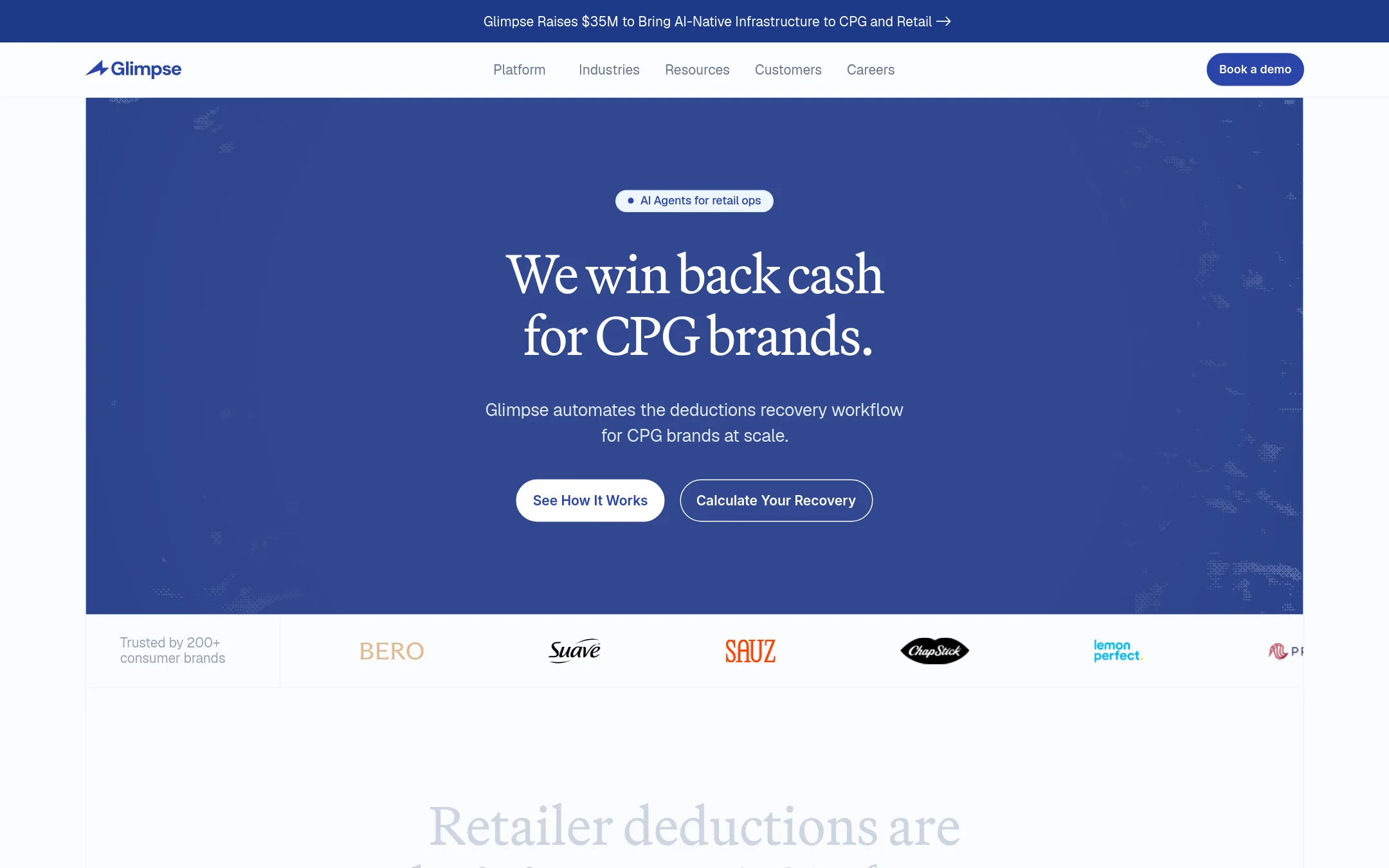
Glimpse automates deductions recovery for CPG brands. It pulls deduction data from retailer portals, syncs it to your ERP, and uses AI agents to validate transactions and start disputes. Its focus on retail deductions rather than general bookkeeping makes it a specific option for consumer goods brands.
Where it is strong
- Pulls deduction data from retailer portals automatically, so teams log in once
- Syncs deduction data to your ERP as a central record
- Starts disputes on both historical and live deductions
Where it falls short
- Built for CPG and retail deductions, so it does not cover general accounting needs
- Onboarding takes about 45 days, and cost is only known after a scoping call
- Pricing:
- Pricing is not published on the site. Access starts with a 45-minute scoping call and a multi-month audit of historic deductions that produces a recovery estimate.
- Not published
2.Rima AI (formerly Garage)
Best for: Tax resolution firms and enrolled agents who prepare 433-F, 433-B, or OIC cases and want less manual data entry.

- Pricing
- Not published
- Category
- Finance & Accounting
Rima reads client documents such as bank statements, tax transcripts, and loan statements, then fills IRS forms 433-F, 433-B, and 433-A (OIC) using the firm's own rules. It flags missing documents and low-confidence fields so case managers and enrolled agents can verify the source records before approving the work. The site reports that prep time for each 433 form drops from 90 minutes to 30 minutes.
Where it is strong
- Fills 433-F, 433-B, and 433-A (OIC) drafts from uploaded client documents
- Case completeness checklist catches missing documents and incomplete fields before submission
- Task-level audit trails and a run timeline record how each case progressed
Where it falls short
- Pricing is not published, so cost has to be checked directly with the vendor
- Supports tax resolution forms and workflows only, so it is not a general bookkeeping or accounting tool
- Pricing:
- Pricing is not published on the site.
- Not published
3.Cifrato
Best for: Accounting firms handling bookkeeping for dozens of clients who want the agent to absorb invoice volume while staff keep client work.
- Pricing
- Not published
- Category
- Finance & Accounting
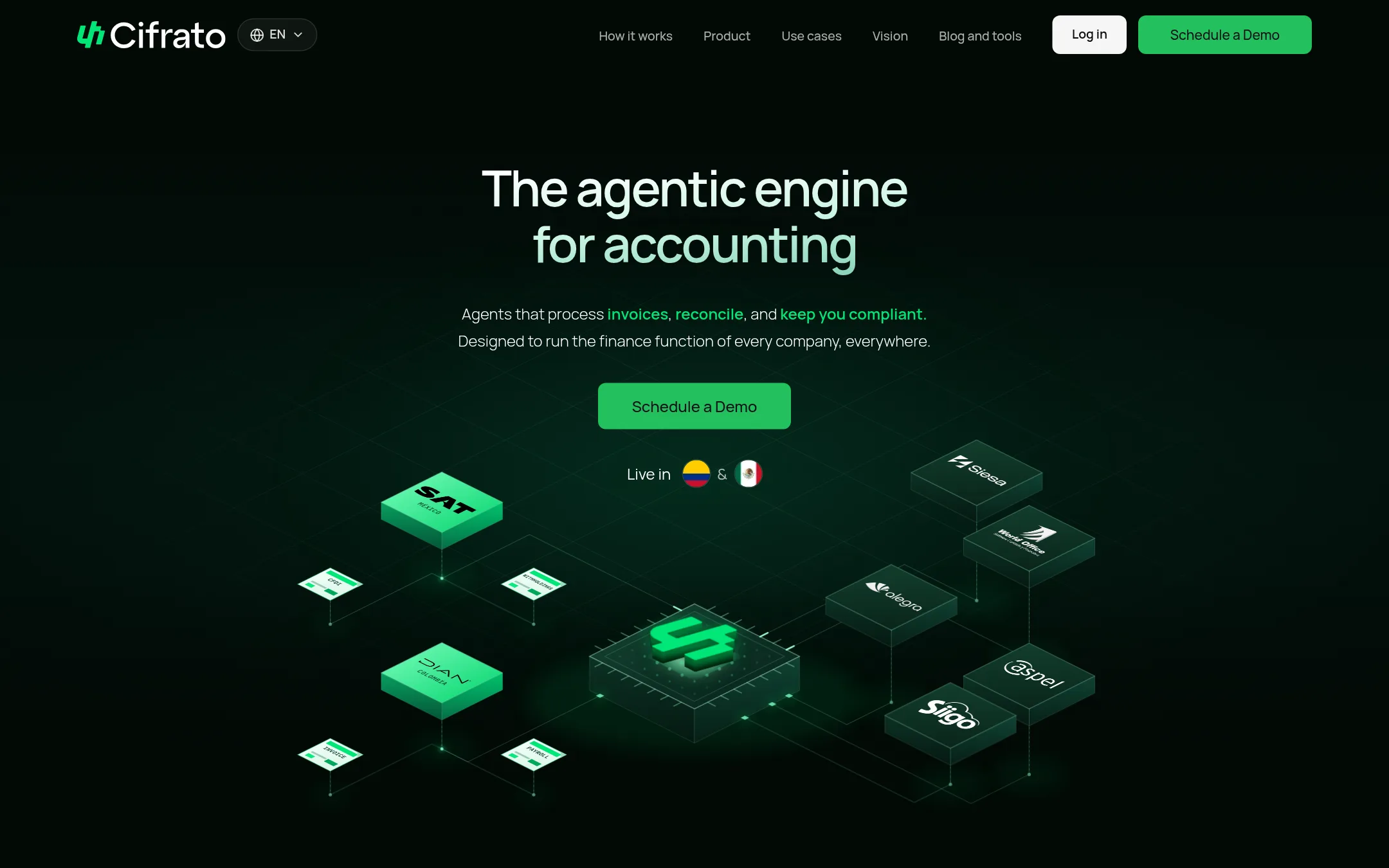
Cifrato runs accounting workflows with agents that pull invoices from the tax authority and email as they arrive, classify them against the right accounts and taxes, and post the finished entries into the ERP a team already uses. It only surfaces entries that need a human decision, and every entry stays traceable to its source. The site reports over 3.5k companies and a Colombian deployment as evidence of real use.
Where it is strong
- Pulls invoices directly from the tax authority and email
- Posts entries into the ERP already in use
- Only flags entries that need a human decision, and every entry traces to its source
Where it falls short
- Pricing is not published, so cost has to come from a sales conversation
- The site does not list which ERPs are supported, so confirm your system before committing
- Pricing:
- Pricing is not published on the site.
- From £180/user/mo
4.Combinely
Best for: Accounting practices and firms that want an AI agent to handle bookkeeping, VAT and payroll preparation while staff keep final sign-off.
- Pricing
- From £180/user/mo
- Category
- AI & Machine Learning
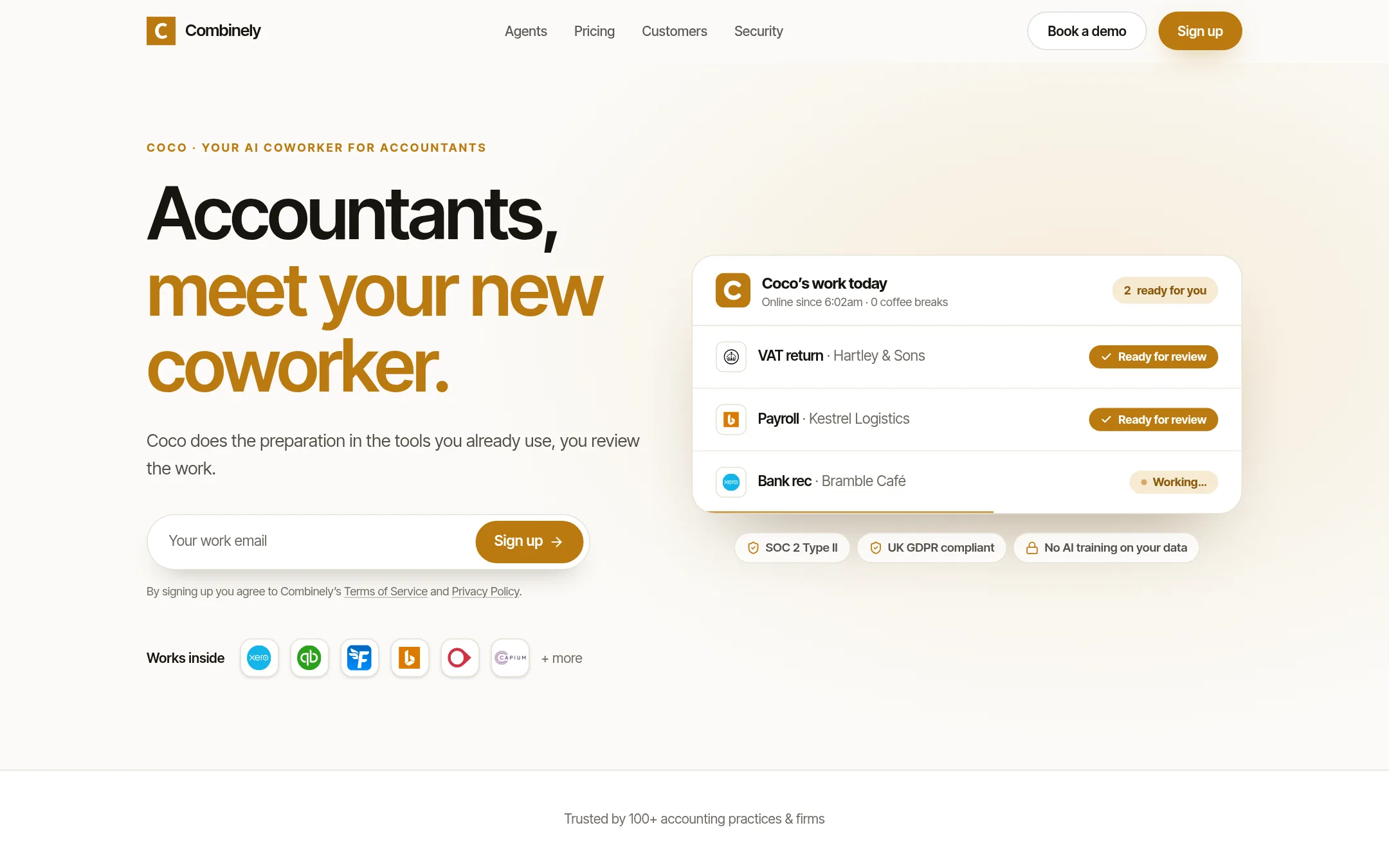
Combinely's product, Coco, is an AI coworker that prepares accounting work such as bookkeeping, VAT returns, payroll and year-end accounts inside tools like Xero and QuickBooks. It is credible because the company states SOC 2 Type II audit status and a no-training data policy, and it names customers such as LedgerPlus, which reports 20 hours a month saved on payroll.
Where it is strong
- Covers 50+ workflows across bookkeeping, VAT, payroll, tax and accounts under one license.
- Works inside Xero, QuickBooks, Gusto and UltraTax CS, so teams keep their current software.
- Holds SOC 2 Type II status and states that client data is never used to train models.
Where it falls short
- The site does not publish a free trial, so you need a demo or sign-up to test it on your own work.
- Monthly billing costs more per user than annual billing, which may push smaller firms toward a longer commitment.
- Pricing:
- The UK price is from £180 per user per month, and the site lists US pricing from $225 per user per month on annual billing, $250 on an annual commitment paid monthly, or $275 monthly with no commitment.
- Not published
5.IronLedger.ai
Best for: Commercial real estate managers and developers who process high invoice and card volumes across many properties
- Pricing
- Not published
- Category
- Finance & Accounting
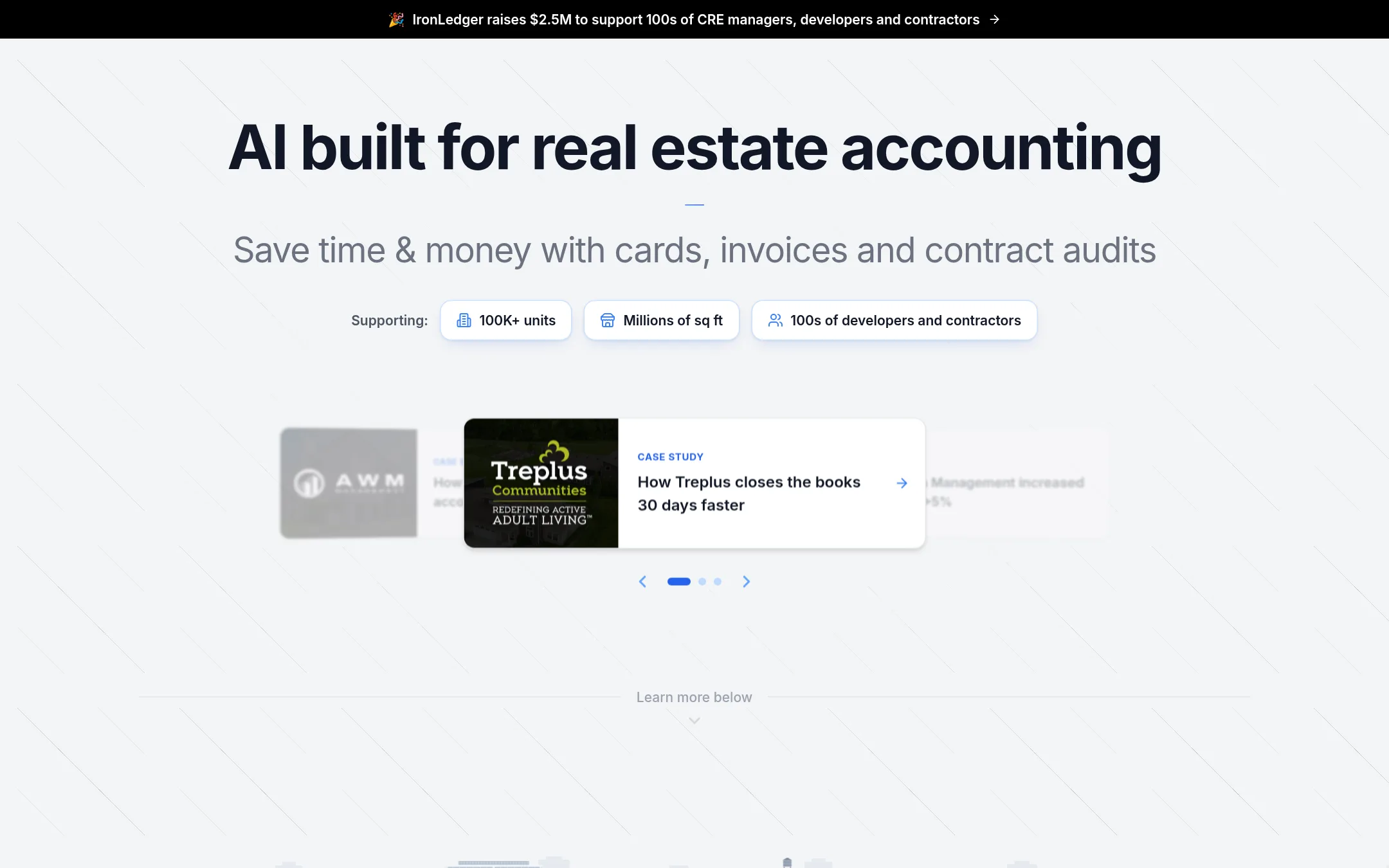
IronLedger.ai uses AI agents to handle accounts payable, cards, invoices and contract audits for commercial real estate managers, developers and contractors. It is built for property accounting specifically, not general bookkeeping, and its case studies report a 30-day faster book close at Treplus and $70K in saved accounting costs at AWM.
Where it is strong
- Built specifically for property and real estate accounting
- Covers cards, invoices and contract audits in one platform
- Case studies cite a 30-day faster book close and over 5% profit gain
Where it falls short
- Pricing is not published, so cost must be confirmed by contacting sales
- Less relevant for businesses outside real estate, such as software or retail companies
- Pricing:
- Pricing is not published on the site.
- Not published
6.Finto
Best for: Enterprise finance teams with high invoice volumes that run SAP, Microsoft Dynamics, DATEV or another industry ERP
- Pricing
- Not published
- Category
- Finance & Accounting
Finto runs AI agents that take an invoice from receipt through validation to a verified journal entry in the ERP, without staff clicking through each step. It reads PDF, scan, XML and ZUGFeRD invoices and integrates with SAP, Microsoft Dynamics, DATEV and industry ERPs. The company publishes metrics such as no-touch rate and cost per invoice, which gives buyers something concrete to check during evaluation.
Where it is strong
- Handles PDF, scan, XML and ZUGFeRD invoice formats
- Connects directly to SAP, Dynamics, DATEV and industry ERPs
- GDPR compliant, and states it does not train LLMs on customer data
Where it falls short
- No pricing is listed, so you must book a demo to learn the cost
- Built for enterprise finance teams, so it is a poor fit for small businesses with light invoice volumes
- Pricing:
- Pricing is not published on the site.
- $10,000/season, flat r
7.Cranston AI
Best for: CPA firms and tax preparers who want AI to handle document intake and data entry in their existing tax software while their reviewers keep final sign-off
- Pricing
- $10,000/season, flat r
- Category
- Finance & Accounting
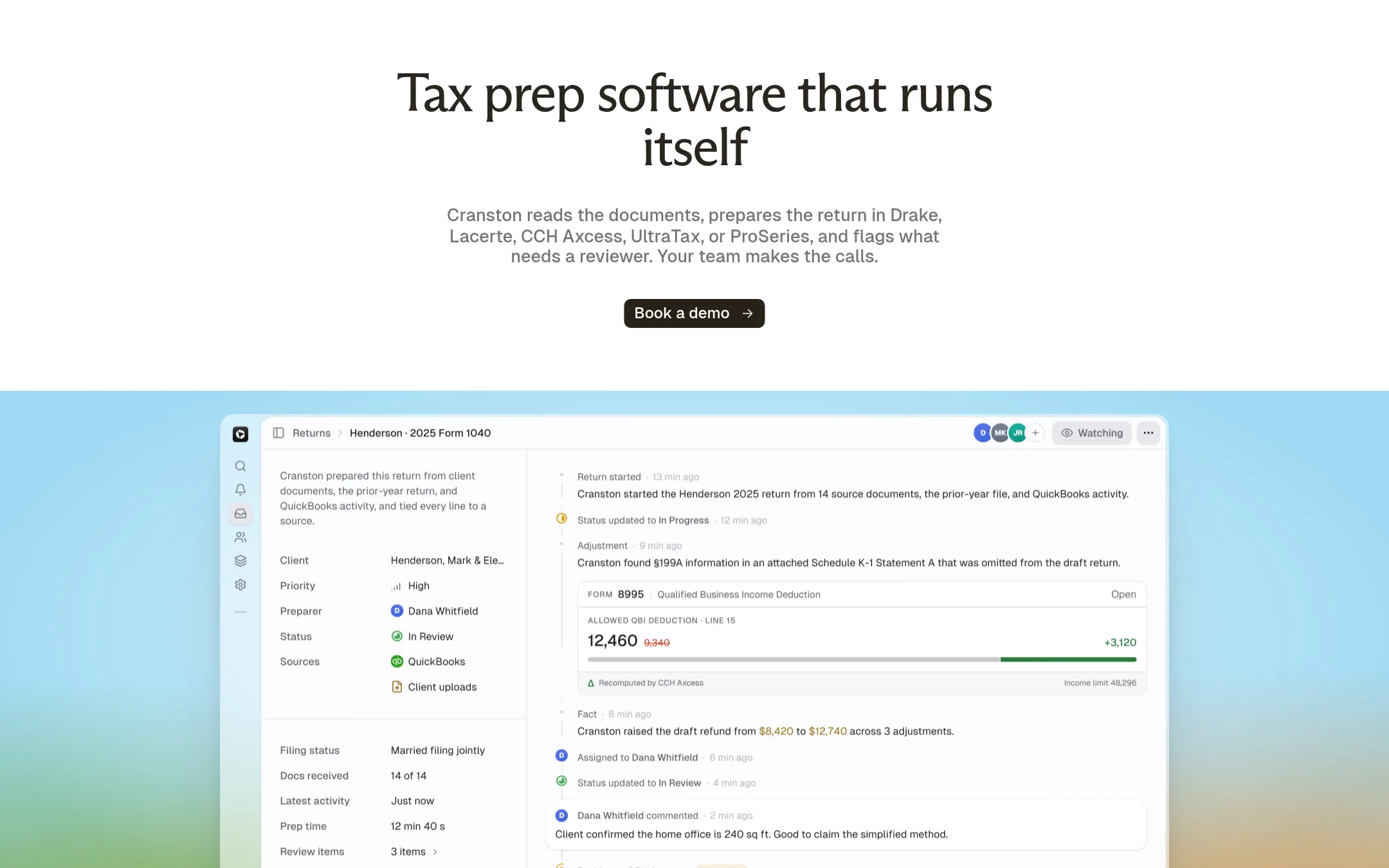
Cranston prepares tax returns inside the tax software a firm already uses, including Drake, Lacerte, CCH Axcess, UltraTax, and ProSeries. It reads client documents, compares them against last year's return to flag missing or wrong items, and drafts the client follow-up emails. A reviewer approves everything before anything is sent or filed.
Where it is strong
- Keys returns directly into Drake, Lacerte, CCH Axcess, UltraTax, or ProSeries, so firms keep their current software and data
- Checks each document package against last year's return and drafts the client follow-up emails for approval
- Prepares federal and state returns together in one workpaper, including 1065, 1120, and 1120-S business returns
Where it falls short
- Its SOC 2 Type II examination is still in progress, so firms with strict audit requirements should ask for current status
- Tax planning, research, and bookkeeping are not priced on the site and require a call with the team
- Pricing:
- Tax prep is billed at one flat rate per prepared return with no platform, seat, or onboarding fees, and a growing firm plan is listed at $10,000 per season.
- Not published
8.FullSeam
Best for: Finance teams on an existing ERP such as Microsoft Dynamics 365, Workday, or Acumatica that want automation without replacing their system
- Pricing
- Not published
- Category
- Finance & Accounting
FullSeam adds AI agents on top of the ERP, billing system, and spreadsheets a finance team already uses, so it does not require a migration. It covers close management, account reconciliations, cash application, and custom reporting, and every agent action is logged and auditable. Its cash application agent shows the reasoning behind each payment match and sends only exceptions to the team.
Where it is strong
- Works with your existing ERP and billing tools, with no migration or retraining needed
- Every match and agent action comes with its reasoning and an audit trail
- Lets teams build custom agents by describing the task in plain English
Where it falls short
- Pricing is not published, so you need to request a quote to compare costs
- Best suited to teams that already run a supported ERP and want to keep it, rather than those looking to replace their system
- Pricing:
- Pricing is not published on the site.
How to choose AI Accounting Tools
Start with pricing structure. Some tools publish per-user rates, such as Combinely, and others publish a flat fee per return, such as Cranston AI. Many do not publish prices at all, so you should expect a demo or scoping call before you know the cost. Compare the total cost to your current process, not just the headline number.
Check who the product is built for. Glimpse, IronLedger.ai, and Rima AI each serve a specific industry or task. A general bookkeeping tool will not cover those needs, and a specialist tool will not cover general accounting. Match the product to the work you actually do.
Confirm integrations before you commit. Combinely works inside Xero, QuickBooks, Gusto, and UltraTax CS. Cranston AI keys returns into Drake, Lacerte, CCH Axcess, UltraTax, and ProSeries. Finto connects to SAP, Dynamics, and DATEV. Cifrato does not list its supported ERPs on its site, so check that yours is covered before signing.
Review data handling and compliance. Combinely states SOC 2 Type II status and a no-training data policy. Finto states GDPR compliance and that it does not train LLMs on customer data. Cranston AI says its SOC 2 Type II examination is still in progress, so ask for current status if your firm has strict audit requirements.
Finally, look at support and contract terms. Some vendors publish a free trial or a monthly option with no commitment, while others require a demo or a longer commitment. Ask how the product handles exceptions, who reviews the output, and what happens to your data if you leave.
FAQ
Questions about AI Accounting Tools
What do AI accounting tools do?
They automate routine accounting work such as capturing invoices, reconciling accounts, preparing tax returns, and collecting missing documents. Most keep a human reviewer in the loop to approve entries before they are posted or filed. Cranston AI and Combinely both follow this model.
Are AI accounting tools priced the same way?
No. Combinely lists per-user monthly and annual rates, Cranston AI charges a flat fee per prepared return, and several products such as Finto, FullSeam, and IronLedger.ai do not publish prices. Expect to request a quote for most enterprise-focused tools.
Which AI accounting tool fits a small accounting practice?
Combinely is a strong fit for accounting practices that want help with bookkeeping, VAT, and payroll inside Xero or QuickBooks, with staff keeping final sign-off. Its published per-user pricing makes it easier to estimate costs before a demo.
Do these tools replace my existing accounting software?
Generally no. Combinely works inside Xero, QuickBooks, and Gusto, Cranston AI works inside Drake, Lacerte, and ProSeries, and FullSeam adds agents on top of an existing ERP. Confirm the integration you need before buying, since Cifrato does not list its supported ERPs on its site.
How should I check a vendor's security before buying?
Ask for its current compliance status and data policy in writing. Combinely states SOC 2 Type II status and a no-training policy, Finto states GDPR compliance, and Cranston AI notes its SOC 2 Type II examination is still in progress. Request current evidence from any vendor before you share client data.
Last updated November 7, 2026.