6 Best AI Insurance Software in 2026
Updated November 8, 2026
The short answer
The strongest picks for AI insurance software are Adaptional, Vantel, and Health Harbor. Adaptional suits insurance carriers that want to review every claim instead of a small sample. Vantel suits commercial insurance brokerages placing mid-market and corporate programs. Health Harbor suits healthcare clinics that need insurance eligibility and claims calls handled.
The shortlist, at a glance
Read the comparisons ↓ TractableNot publishedInsurers and claims teams that process high volumes of motor claims and want faster photo-based damage estimates.
 AccendNot publishedCredit and compliance teams at lenders and payment platforms that onboard businesses and need faster financial spreading and KYB checks.
 Health HarborCustom quoteHealthcare clinics that spend staff time on eligibility checks, claims status, and prior authorization calls to insurers.
 VantelNot publishedCommercial insurance brokerages placing mid-market and corporate programs in Europe or globally
 AegisShare of recovered revHospitals, health systems and DME companies that have a backlog of unworked denials and want recovery without adding staff
 AdaptionalNot publishedInsurance carriers that rely on sampled claims QA and want full-file review of their claims book.
About AI Insurance Software
AI insurance software uses machine learning and generative AI to automate parts of insurance work. Common jobs include assessing claims, checking policy documents, reviewing claim quality, working denials, and handling payer calls.
The products on this list differ in their core job and buyer. Tractable focuses on photo-based vehicle damage estimates for claims, salvage and fleet work. Accend and Aegis serve financial and healthcare workflows, with Accend focused on credit and business onboarding and Aegis focused on denial recovery for hospitals. Adaptional, Vantel and Health Harbor each target a specific insurance task, and pricing models range from quote-only to per-call and revenue share.
The 6 best AI Insurance Software, compared
- Not published
1.Tractable
Best for: Insurers and claims teams that process high volumes of motor claims and want faster photo-based damage estimates.
- Pricing
- Not published
- Category
- AI & Machine Learning
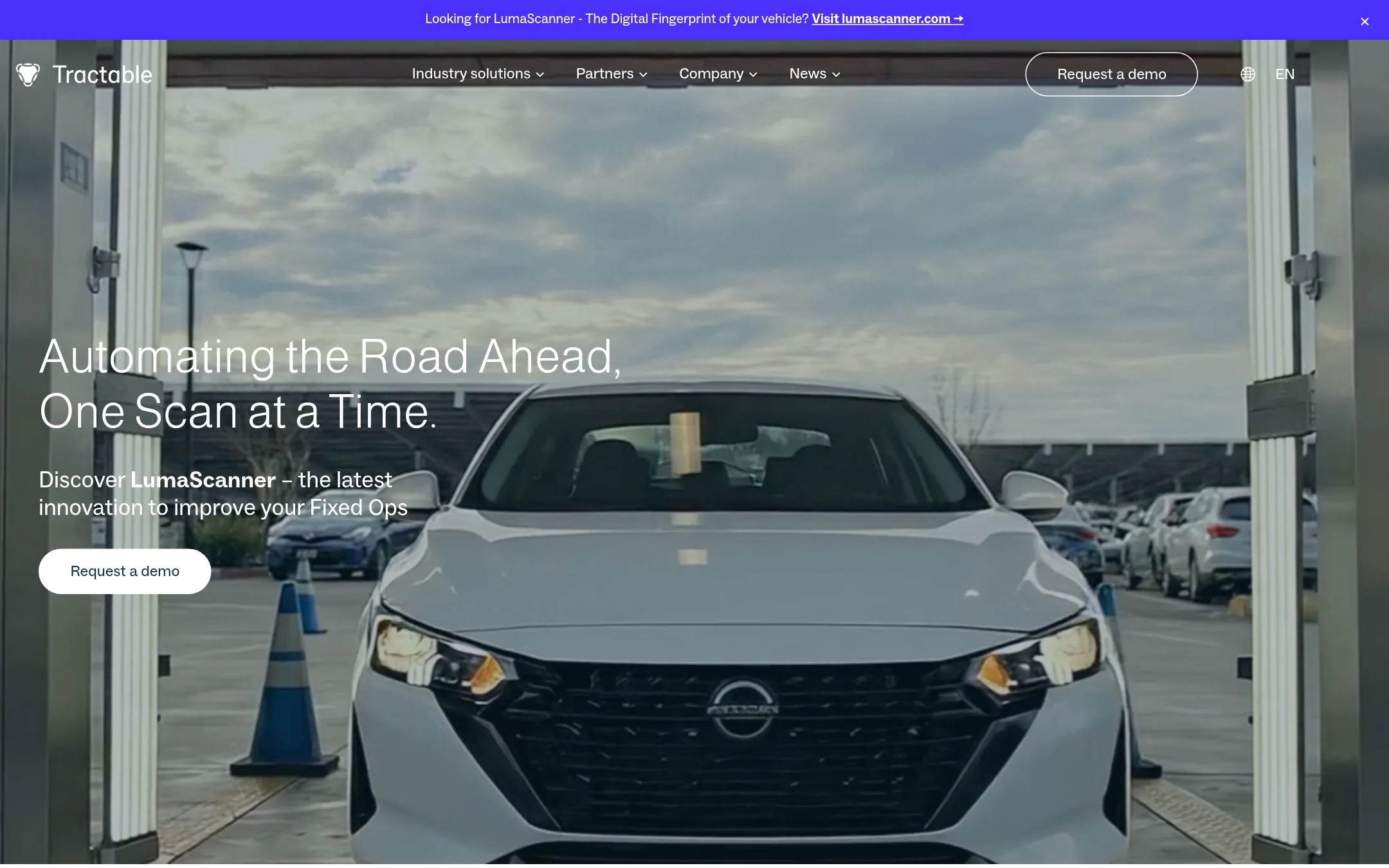
Tractable uses AI to assess vehicle damage from images, analysing them down to the pixel and attaching a certainty score to each estimate. It serves insurers, repairers, recyclers, dealerships and fleet operators, so the same core model supports claims, salvage and check-ins. Its open APIs let it plug into existing claims systems rather than replace them.
Where it is strong
- Certainty scores come with every damage estimate, so adjusters can see how confident the model is.
- Open APIs connect it to existing claims and fleet systems.
- Covers several parts of the auto ecosystem, including insurers, repairers, recyclers and rental fleets.
Where it falls short
- No pricing is published, so small teams will need to request a quote to compare costs.
- It is built for vehicle and property damage workflows, so it does not suit general insurance back-office needs.
- Pricing:
- Pricing is not published on the site.
- Not published
2.Accend
Best for: Credit and compliance teams at lenders and payment platforms that onboard businesses and need faster financial spreading and KYB checks.
- Pricing
- Not published
- Category
- Finance & Accounting
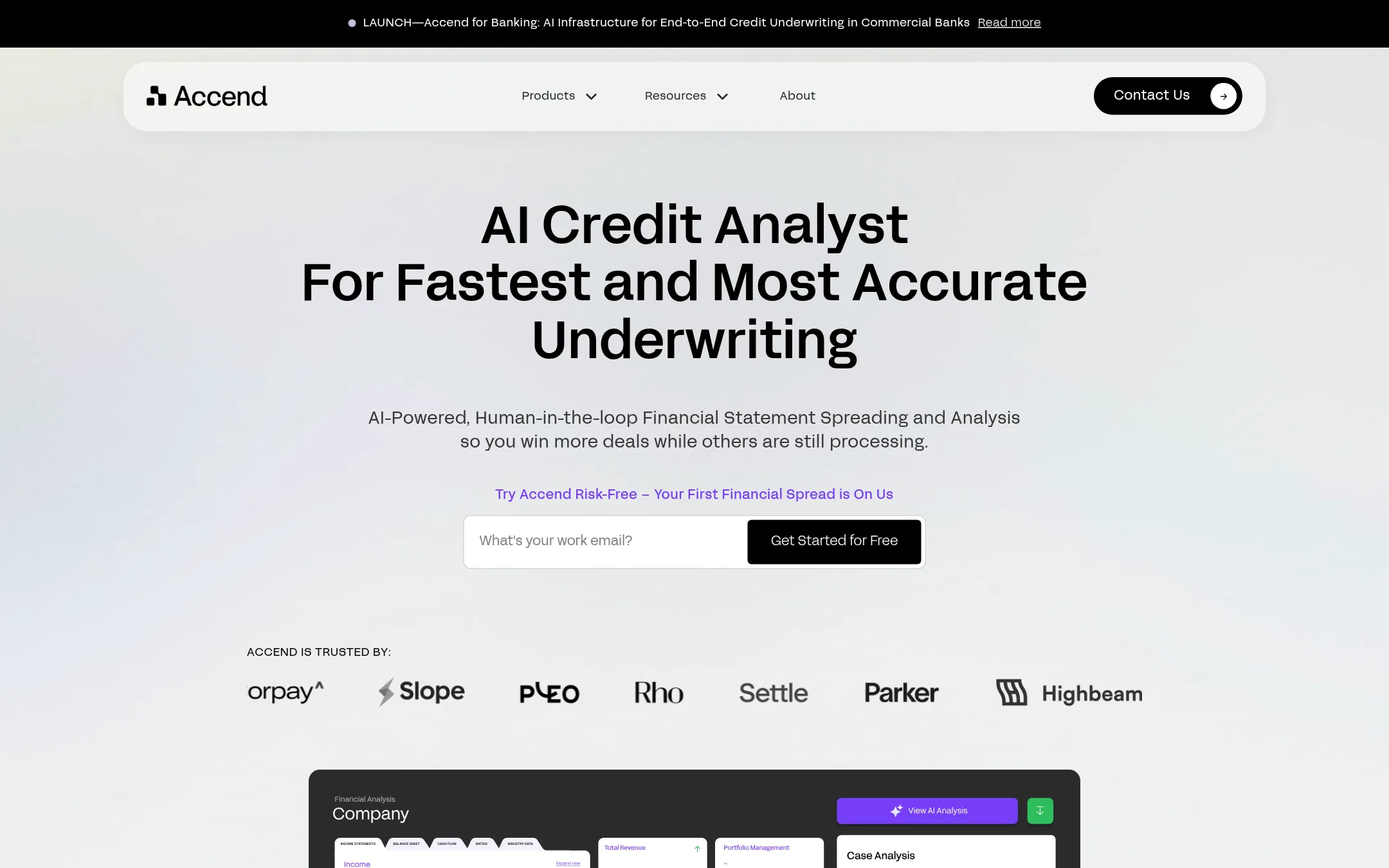
Accend uses AI agents to pull data from financial statements, run ratio analysis, and check a business's nature and industry risk in real time, with human review kept in the loop. Customers say it speeds financial reviews more than 4x and cut manual effort by over 80% at one firm. Its API and onshore support make it a practical option for teams that need it inside their own onboarding stack.
Where it is strong
- Extracts and spreads data from financial statements with ratio analysis
- Automates business nature and industry risk checks across languages and jurisdictions
- API integration and onshore time zone support, as described by customers
Where it falls short
- Built for credit and KYB workflows, so it is a poor fit for general insurance policy administration
- No public pricing, so buyers must request a quote to compare costs
- Pricing:
- Pricing is not published on the site.
- Custom quote
3.Health Harbor
Best for: Healthcare clinics that spend staff time on eligibility checks, claims status, and prior authorization calls to insurers.
- Pricing
- Custom quote
- Category
- Healthcare
Health Harbor uses generative AI to place insurance calls for healthcare clinics. The AI works through the payor's phone tree, waits on hold, and speaks with a live representative, then returns the results through an API or web portal. It also compares results against historical data and calls again when something looks off.
Where it is strong
- Handles the full call, including IVR menus, hold time, and talking to a live agent
- Returns results by webhook or web portal and flags inconsistencies with a follow-up call
- States HIPAA compliance and SOC 2 Type II requirements for health data
Where it falls short
- Published pricing does not show dollar figures, so budgeting requires a sales conversation
- Coverage is limited to the payors and specialties it supports, so check your insurers before committing
- Pricing:
- Pricing is per call based on complexity and volume, with Standard and Enterprise tiers and no long-term contracts, but no specific dollar amounts are published.
- Not published
4.Vantel
Best for: Commercial insurance brokerages placing mid-market and corporate programs in Europe or globally
- Pricing
- Not published
- Category
- Finance & Accounting
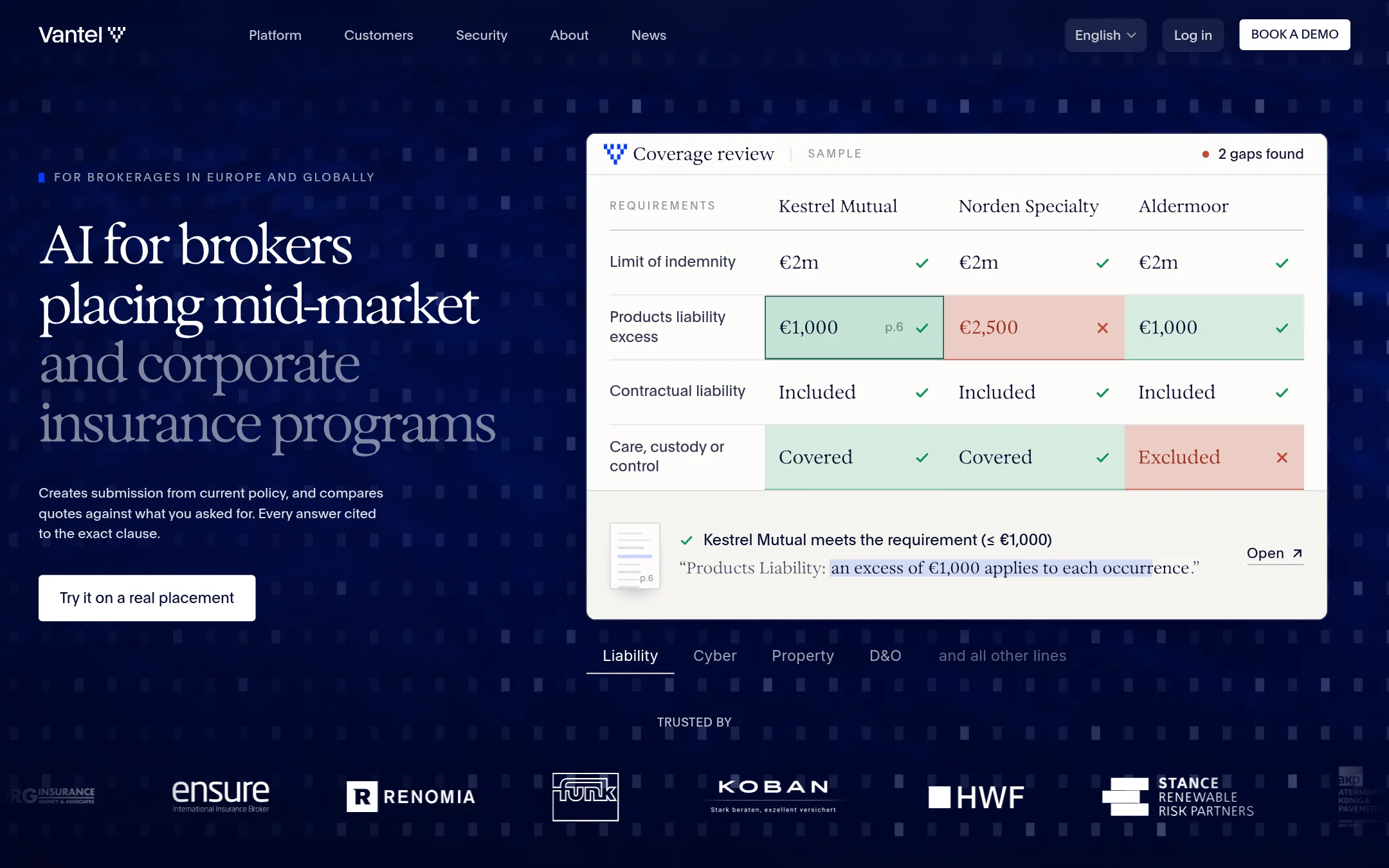
Vantel is an AI platform for commercial insurance brokers that turns complex policy documents into structured data. It builds submissions from a client's current policy and checks incoming quotes against what was requested. Every answer links back to the exact clause it came from, which makes its output easy to verify.
Where it is strong
- Builds submissions directly from a client's current policy documents
- Compares quotes against the coverage that was requested
- Cites each answer to the exact clause, so results can be checked
Where it falls short
- Built for commercial brokers, so it is not a fit for personal lines or small agencies
- No pricing is listed, so cost has to be confirmed directly with the vendor
- Pricing:
- Pricing is not published on the site.
- Share of recovered rev
5.Aegis
Best for: Hospitals, health systems and DME companies that have a backlog of unworked denials and want recovery without adding staff
- Pricing
- Share of recovered rev
- Category
- Healthcare
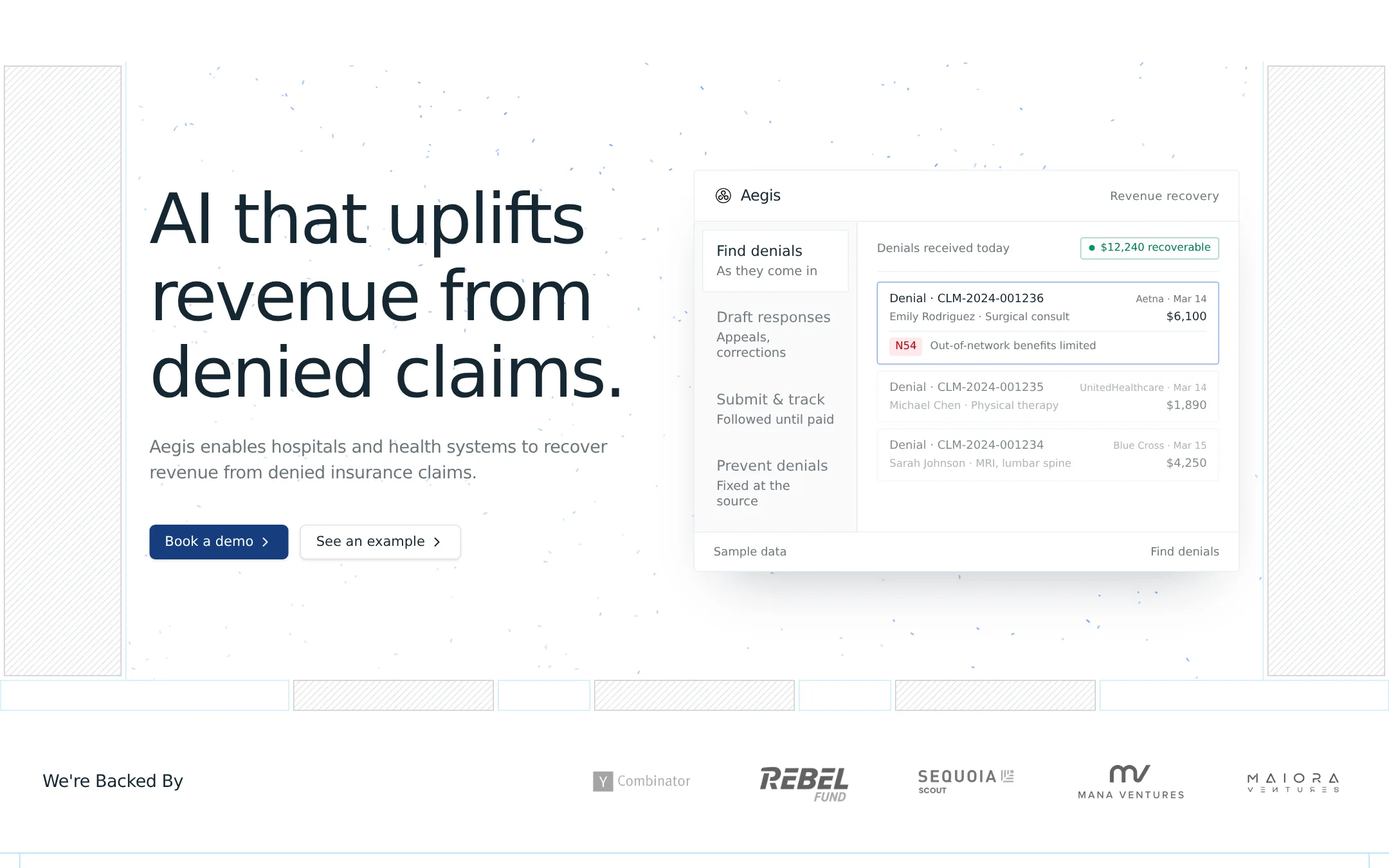
Aegis is AI that works denied insurance claims for hospitals, health systems and DME companies. It connects to the EHR, clearinghouse and payer portals, ranks denials by dollar value and odds of overturn, and follows each claim until it is paid. It also catches underpayments against contracts and aims to stop repeat denials before they happen.
Where it is strong
- Works from your oldest unworked denials first, so money can come back before other changes are made
- Ranks denials by dollar value and odds of overturn so staff focus on the best claims
- Pays only on revenue recovered, with no subscription or seat fees
Where it falls short
- The share model means your total cost rises with how much Aegis recovers, and the rate is set in a custom agreement
- Pricing details and integration specifics are only described at a high level on the public site, so you will need a sales conversation to co
- Pricing:
- Aegis has no subscription and takes a share of what it recovers, with the share agreed up front based on denial volume and payer mix, and the site's illustrative example shows $75,000 paid on $500,000 recovered.
- Not published
6.Adaptional
Best for: Insurance carriers that rely on sampled claims QA and want full-file review of their claims book.
- Pricing
- Not published
- Category
- Finance & Accounting
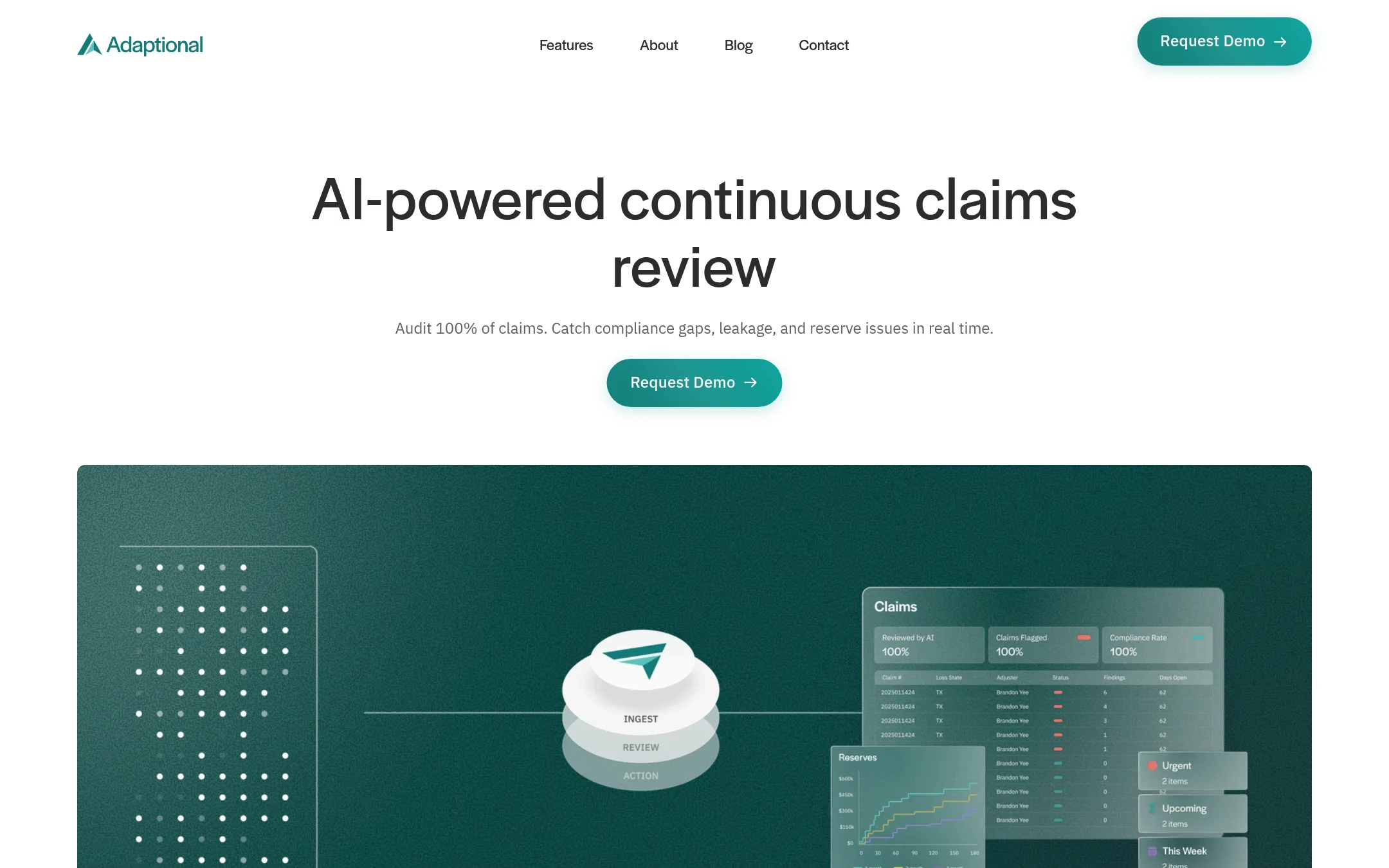
Adaptional is an AI platform that reviews 100% of insurance claims instead of the 3-5 files per adjuster that manual QA samples. It connects to claims systems such as Guidewire and Duck Creek, then checks each file against a custom scorecard covering compliance, coverage, leakage, reserves, service quality, and subrogation. Its team includes a former CTO of insurance brokerage Savvy and an early xAI team member, which gives it a credible claim to insurance and AI depth.
Where it is strong
- Reviews every claim continuously rather than a small random sample
- Works with Guidewire, Duck Creek, or other claims systems, with files, notes, and documents ingested
- Sends real-time alerts to managers on open files and tracks whether issues get resolved
Where it falls short
- Pricing is not published, so you will need a call to compare costs
- Built for carriers handling claims, so it is not relevant to brokers, agencies, or other non-claims teams
- Pricing:
- Pricing is not published on the site.
How to choose AI Insurance Software
Start with the pricing structure. Several products on this list do not publish prices, so you will need a quote to compare costs. Health Harbor charges per call, while Aegis takes a share of what it recovers and has no subscription, so your total cost will rise or fall with the value it delivers.
Check who the product is built for. Tractable, Adaptional and Vantel are built for insurers and brokers, and they are not a fit for general back-office or personal lines work. Accend is aimed at credit and compliance teams, not policy administration.
Confirm integrations before you commit. Tractable offers open APIs, Adaptional connects to Guidewire and Duck Creek, and Health Harbor returns results by API or web portal. Check that the product fits your existing claims, EHR or onboarding systems.
Review data handling and compliance. Health Harbor states HIPAA compliance and SOC 2 Type II requirements for health data. Ask any vendor for its security and compliance documents, especially if you handle personal or health data.
Finally, ask about support and contract terms. Aegis's fees depend on a custom agreement, and Accend cites onshore support as a benefit, so confirm service levels and exit terms in writing before you sign.
FAQ
Questions about AI Insurance Software
What is AI insurance software?
AI insurance software uses machine learning and generative AI to automate insurance tasks such as assessing damage from photos, checking policy documents, reviewing claims and handling payer calls. The right product depends on whether your work is in claims, brokerage, healthcare billing or credit. Matching the tool to your core workflow matters more than general features.
How do AI insurance tools price their products?
Pricing varies widely across this list. Health Harbor charges per call based on complexity and volume, Aegis takes a share of recovered revenue with no subscription, and most others do not publish prices and require a quote. Expect to request pricing directly from most vendors.
Which AI insurance software suits a small brokerage?
Vantel is built for commercial insurance brokers placing mid-market and corporate programs, so it suits brokerages doing that work. It is not designed for personal lines or small agencies. A small agency should confirm fit with the vendor before buying.
Does AI insurance software handle healthcare data securely?
Health Harbor states HIPAA compliance and SOC 2 Type II requirements for health data. Other vendors on this list do not publish the same detail on their sites. Ask any vendor for its security and compliance documentation before sending health or personal data.
How do I compare AI insurance software options?
Compare the core job each product does, the buyer it is built for, its integrations and its pricing model. Some products, such as Tractable and Adaptional, depend on connecting to existing claims systems, while others, such as Health Harbor, work through phone calls. Request quotes from shortlisted vendors and confirm integrations and contract terms before deciding.
Last updated November 8, 2026.