6 Best Identity Verification Software in 2026
Updated November 8, 2026
The short answer
The three strongest identity verification software picks on this list are Didit, Veriff and Jumio. Didit suits developer teams and crypto or fintech platforms that want KYC, KYB and AML checks in one API on public, usage-based pricing. Veriff suits payments, lending and ride-hailing companies that verify users across many countries and need fast decisions. Jumio suits regulated fintechs and gaming operators that need liveness detection and AML screening in one platform.
The shortlist, at a glance
Read the comparisons ↓ OnfidoNot publishedFintech and regulated onboarding teams that need document, biometric and data checks plus compliance support for standards such as eIDAS 2.0.
 JumioNot publishedFintechs, gaming operators and other regulated businesses that need identity checks and AML screening against sanctions and PEP lists in one platform.
 VeriffFrom $0.80/verif.Payments, buy now pay later, lending, and ride-hailing companies that onboard users across many countries and need fast KYC decisions.
Prembly (formerly Identitypass)Not publishedFintechs, lenders, and payments platforms in Africa and beyond that need KYC, KYB, and AML checks under one platform.
 AuthologicNot publishedRegulated businesses in Europe that need eIDAS 2.0-ready identity checks across several national eID schemes and wallets.
 DiditFree tier, then usageFintechs, crypto platforms, and developer teams that need KYC, KYB, and AML checks in one API and want to start on usage-based pricing.
About Identity Verification Software
Identity verification software confirms that a person is who they claim to be during onboarding or account actions. Most products check identity documents, compare a selfie or live video against the document photo, and screen the result against databases and watchlists. Many also add anti-money laundering checks, fraud signals and ongoing monitoring.
The products on this list differ in approach, scale and pricing. Some are built as a single API for developers, such as Didit, while others offer no-code journey builders or hosted pages. Some focus on a region, such as Authologic on European eID schemes and wallets, and others cover hundreds of countries. Pricing ranges from fully published per-check rates and self-serve plans to custom enterprise quotes that require a sales conversation.
The 6 best Identity Verification Software, compared
- Not published
1.Onfido
Best for: Fintech and regulated onboarding teams that need document, biometric and data checks plus compliance support for standards such as eIDAS 2.0.
- Pricing
- Not published
- Category
- Security & Privacy
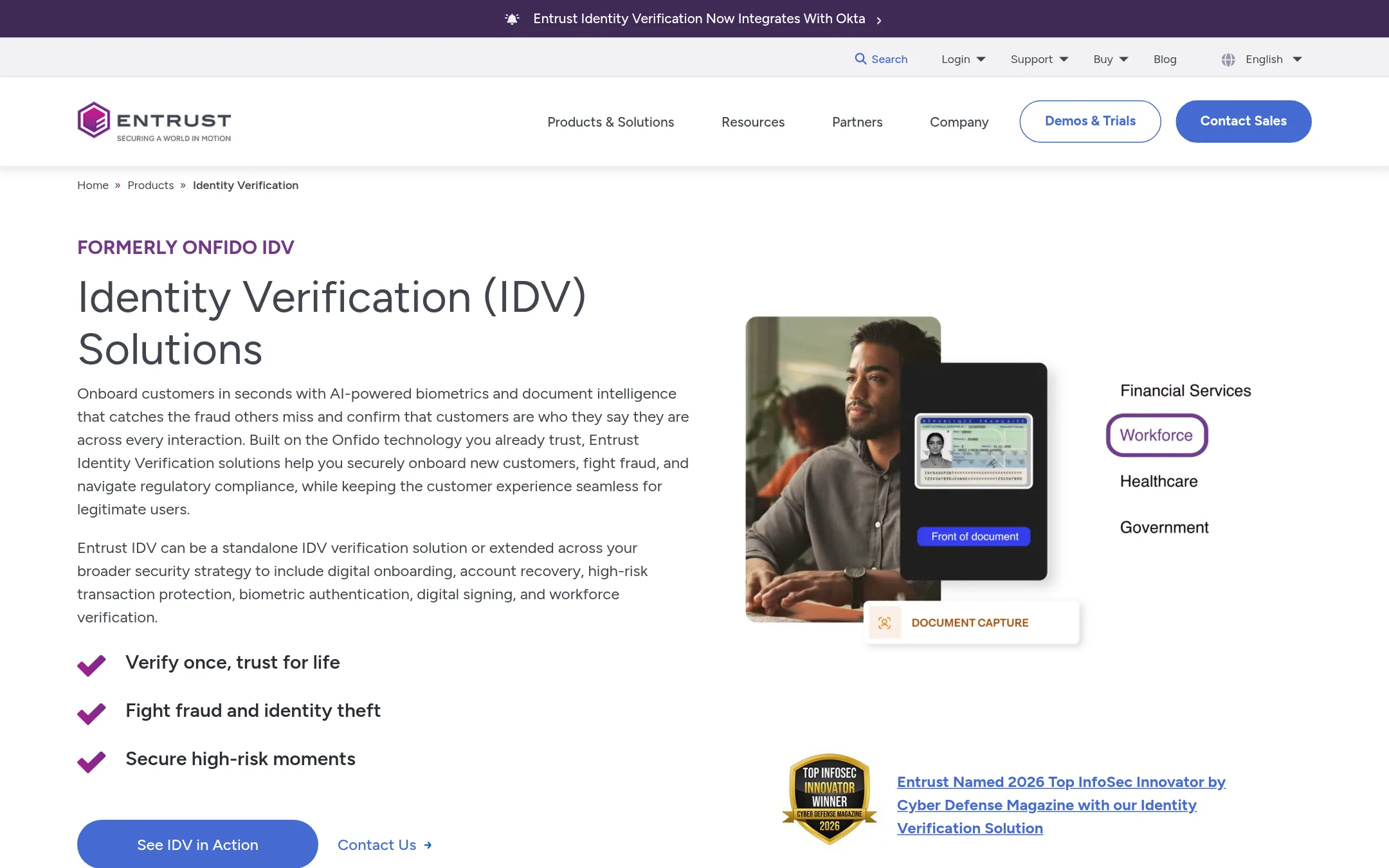
Entrust's identity verification product, formerly sold as Onfido, checks documents, biometrics and data to confirm who a user is during digital onboarding. Its Workflow Studio lets teams build onboarding journeys without writing code, and adaptive AI fraud detection is aimed at spotting deepfakes and high-risk behavior.
Where it is strong
- Covers document, biometric and data verification in one flow
- Workflow Studio allows journey design without coding
- Adaptive AI fraud detection targets deepfakes and high-risk behavior
Where it falls short
- Pricing is not published, so cost must be confirmed through sales
- The site lists many product lines, which can make the identity verification offering harder to find and evaluate on its own
- Pricing:
- Pricing is not published on the site.
- Not published
2.Jumio
Best for: Fintechs, gaming operators and other regulated businesses that need identity checks and AML screening against sanctions and PEP lists in one platform.
- Pricing
- Not published
- Category
- Security & Privacy
Jumio verifies identity with AI, biometrics and liveness detection, and it checks new users against the Jumio Identity Graph, a network of 30M+ identities that includes known fraudsters. Its directory listing says it supports 5K+ global ID types and processes over 1B transactions, which speaks to its reach across markets.
Where it is strong
- Liveness detection checks for deepfakes, face morphing and similar spoofing attacks.
- AML screening covers global and regional sanctions, PEP lists and adverse media.
- Cross-transaction risk lets it recognize returning trusted users and block repeat fraudsters.
Where it falls short
- Without published pricing, small teams will need a sales conversation to learn the cost.
- The feature set is built for regulated and high-fraud use cases, so a simple sign-up flow may not need most of it.
- Pricing:
- Pricing is not published on the site.
- From $0.80/verif.
3.Veriff
Best for: Payments, buy now pay later, lending, and ride-hailing companies that onboard users across many countries and need fast KYC decisions.
- Pricing
- From $0.80/verif.
- Category
- Security & Privacy
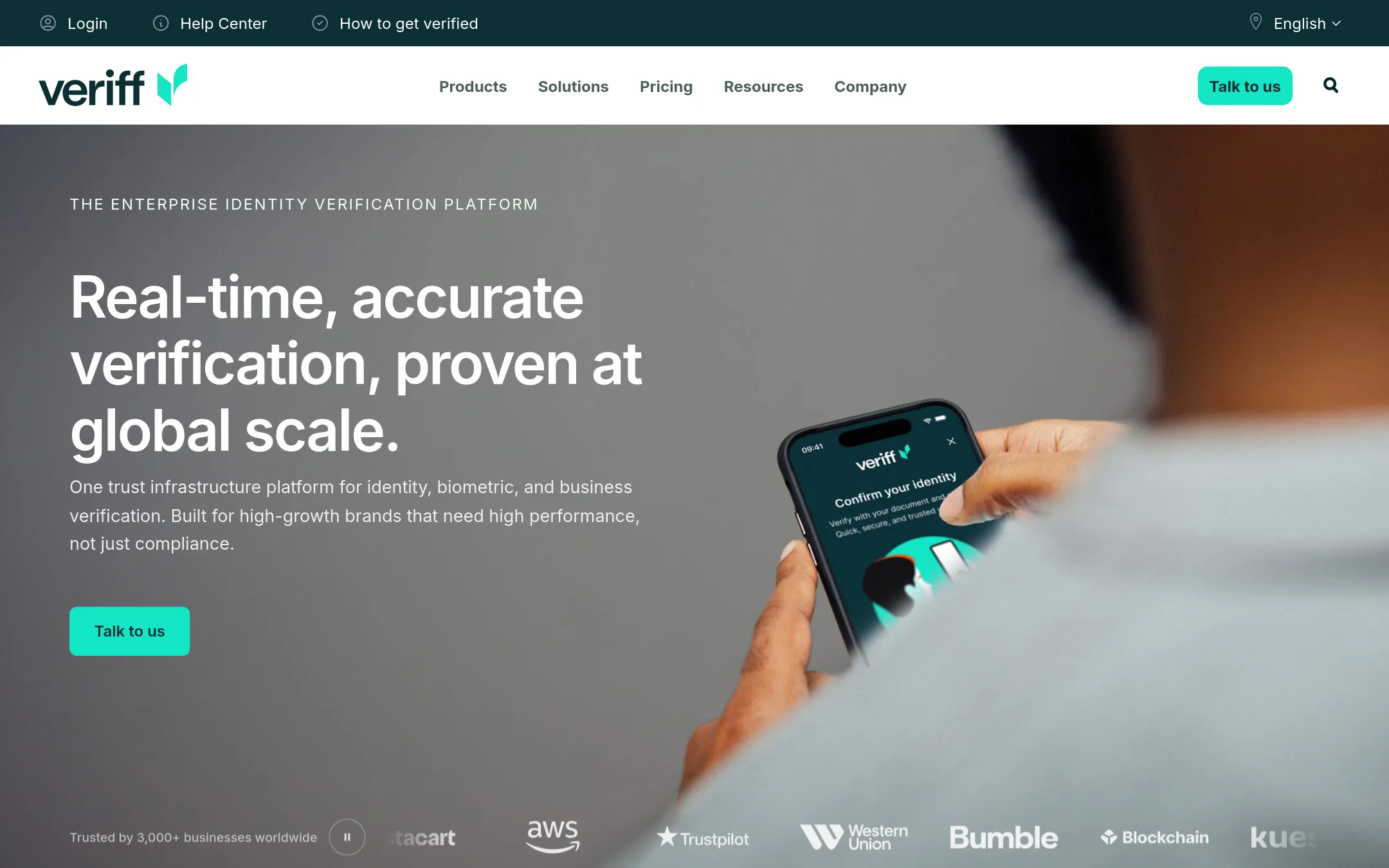
Veriff checks identity documents, face biometrics, and databases for users in more than 230 countries and territories, and returns decisions in about six seconds. What makes it a credible pick is that it builds its core verification models in-house rather than reselling third-party tech, and it names the specialist partners it uses for adjacent checks like AML screening.
Where it is strong
- Covers documents from 230+ countries and territories, with about 12,500 document specimens.
- Passive liveness detection needs no head turns or extra selfies, which eases the user flow.
- Hosted no-code verification page and pre-built SDKs for iOS, Android, and web speed up setup.
Where it falls short
- Self-serve plans carry monthly minimums of $49 to $209, which can cost more than pay-as-you-go for very low volumes.
- The site notes that automated-only decisions are on Essential, while human review needs Plus or higher, so higher-accuracy review costs more
- Pricing:
- Self-serve plans are priced per verification at $0.80 (Essential), $1.39 (Plus), and $1.89 (Premium), with monthly minimums of $49, $99, and $209, and a 15-day free trial. Enterprise pricing is custom.
- Not published
4.Prembly (formerly Identitypass)
Best for: Fintechs, lenders, and payments platforms in Africa and beyond that need KYC, KYB, and AML checks under one platform.
- Pricing
- Not published
- Category
- Security & Privacy
Prembly is an identity verification platform that combines KYC, KYB, AML screening, and fraud checks into one product. It also builds a unified customer view with real-time risk profiles, and it offers an SDK widget so teams can embed verification directly into an app or website.
Where it is strong
- Covers KYC, KYB, AML, and fraud checks in one platform
- Embeddable SDK widget plus APIs and webhooks for custom setups
- Includes a Fraud Bank of verified fraud reports and customizable compliance workflows
Where it falls short
- Pricing is not published, so you need to request a quote to compare costs
- The listing does not say which countries or ID document types are covered, so check that against your markets before committing
- Pricing:
- Pricing is not published on the site.
- Not published
5.Authologic
Best for: Regulated businesses in Europe that need eIDAS 2.0-ready identity checks across several national eID schemes and wallets.
- Pricing
- Not published
- Category
- Security & Privacy
Authologic routes each user to the best available verification method, from EUDI and Apple, Google or Samsung Wallets to government eIDs, biometrics and document checks, through one API. It is built around eIDAS 2.0 and GDPR, and its zero-knowledge proofs can confirm age or humanity without exposing the underlying data. A live example is the Paynow rollout for mBank Group's marketplace merchants, which the site says was live in five minutes of B2B onboarding.
Where it is strong
- One API covers wallets, BankIDs and national eIDs across markets
- Zero-knowledge proofs verify age and humanity without exposing personal data
- Configurable data retention rules, with automatic purging of data you no longer need
Where it falls short
- Pricing is not published, so you need a demo to learn costs
- The site does not list an SDK or integration catalogue beyond the SDK and WebSDK, so check fit with your stack before committing
- Pricing:
- Pricing is not published on the site.
- Free tier, then usage
6.Didit
Best for: Fintechs, crypto platforms, and developer teams that need KYC, KYB, and AML checks in one API and want to start on usage-based pricing.
- Pricing
- Free tier, then usage
- Category
- Security & Privacy
Didit runs identity and fraud checks through one open API, covering user verification, business verification (KYB), AML screening, and transaction monitoring. It is built for developers and AI agents, and its listing reports coverage of 220+ countries and 14,000+ document types. The 500 free verifications each month make it easy to test before committing money.
Where it is strong
- One open API covers KYC, KYB, AML, and transaction monitoring, so you avoid stitching several vendors together.
- Public per-module prices, with no sales call needed to see what a check costs.
- Integration is quick, with SDKs for major platforms and documented webhooks that are HMAC-signed.
Where it falls short
- Enterprise features such as annual contracts, custom legal terms, the 99.99% uptime SLA, and data residency sit behind a sales conversation.
- Availability of individual methods varies by country and environment, so you need to check the workflow catalog before relying on a specific
- Pricing:
- Pricing is public and usage-based: 500 full KYC verifications free each month, then ID verification at $0.15, passive liveness at $0.10, AML screening from $0.07, and wallet screening at $0.15 per check, with automatic volume discounts.
How to choose Identity Verification Software
Start with pricing structure. Some vendors publish per-check rates, and Veriff and Didit both list them, so you can model cost at your expected volume. Others, including Onfido, Jumio, Prembly and Authologic, keep pricing off the public site, so plan for a sales conversation and compare quotes on the same volume assumptions.
Check who the product is built for. Developer-first APIs suit engineering teams that want to control the user flow, while no-code tools such as Onfido's Workflow Studio suit operators who want to change journeys without a release. Products built for regulated markets, such as Authologic for eIDAS 2.0, may be more than a simple sign-up flow needs.
Confirm that the product covers your markets and document types. Veriff lists coverage across more than 230 countries and territories, Didit reports 220+ countries, and Prembly does not state which countries it covers, so verify that against your user base before committing.
Look at integrations and data handling. Confirm the SDKs and webhooks match your stack, and check how long the vendor keeps personal data. Authologic describes configurable retention with automatic purging, which matters for GDPR-bound teams.
Finally, review support and contract terms. Uptime commitments, data residency and annual contracts are often reserved for enterprise plans, so ask about them early if you need them.
FAQ
Questions about Identity Verification Software
What does identity verification software do?
It confirms that a user is the person they claim to be. Most tools check an identity document, match a selfie or live video to it, and screen the result against databases. Many also run anti-money laundering checks and fraud detection.
How is identity verification priced?
Pricing models vary. Veriff and Didit publish per-verification rates, with Veriff using monthly minimums on its self-serve plans and Didit using usage-based pricing with free monthly checks. Several others, including Onfido, Jumio and Prembly, do not publish prices and require a quote.
Which products cover the most countries?
Veriff reports document coverage across more than 230 countries and territories, and Didit reports 220+ countries. Jumio cites support for 5K+ global ID types. Coverage varies by method, so confirm your specific markets before choosing.
Do I need a no-code tool or an API?
It depends on your team. Developer teams usually prefer an API with SDKs, such as Didit, while operators who want to change onboarding flows often prefer a no-code builder such as Onfido's Workflow Studio. Veriff also offers a hosted no-code verification page for faster setup.
What should I check for regulatory compliance?
Check the product against the rules that apply to your business, such as GDPR or eIDAS 2.0 in Europe, and AML requirements for financial services. Authologic is built around eIDAS 2.0 and GDPR, Jumio includes AML screening against sanctions and PEP lists, and Didit offers KYC, KYB and AML checks in one API.
Last updated November 8, 2026.