6 Best Open Banking Platforms in 2026
Updated November 15, 2026
The short answer
The three strongest open banking platforms on this list are Token, Salt Edge and TrueLayer. Token suits UK and European merchants and fintechs that want Pay by Bank checkout and recurring bank payments. Salt Edge suits lenders, banks and merchants that need bank data or pay-by-bank across many countries through one integration. TrueLayer suits ecommerce, iGaming and travel merchants that want to cut card fees and fraud by moving checkout to bank payments.
The shortlist, at a glance
Read the comparisons ↓ TrueLayerNot publishedEcommerce, iGaming and travel merchants that want to cut card fees and fraud by moving checkout to Pay by Bank.
 TinkCustom quoteFintechs and lenders in Europe that need bank data connections for lending decisions, account-to-account payments or Pay by Bank checkout.
 Salt EdgeNot publishedLenders, banks, e-commerce merchants, treasury teams and automotive companies that need bank data or pay-by-bank across many countries from one integration.
 TokenNot publishedMerchants, fintechs and payment companies in the UK and Europe that want to accept Pay by Bank at checkout without interchange fees or chargebacks.
 FlinksNot publishedLenders and fintechs in North America that need instant bank data for income checks, underwriting, and onboarding.
 YapilyCustom quoteFintechs and payment providers in Europe that want Pay by Bank and bank data through a single open banking integration
About Open Banking Platforms
Open banking platforms give software teams a single API to connect to customers' bank accounts. They are used to read account and transaction data, to start payments directly from a bank account, and to confirm identity or income. Teams use them to replace card checkout, to run lending decisions and to verify users during onboarding.
The products on this list differ in where they operate and what they do first. Some focus on payments, such as TrueLayer and Token, which both build Pay by Bank checkout. Others focus on data, such as Flinks, which covers North American institutions for underwriting. Salt Edge and Yapily combine data and payments in one integration. Tink offers data and payment tools under its own PSD2 license. Pricing models also vary, with some plans based on usage and others quoted only after a sales conversation.
The 6 best Open Banking Platforms, compared
- Not published
1.TrueLayer
Best for: Ecommerce, iGaming and travel merchants that want to cut card fees and fraud by moving checkout to Pay by Bank.
- Pricing
- Not published
- Category
- Finance & Accounting
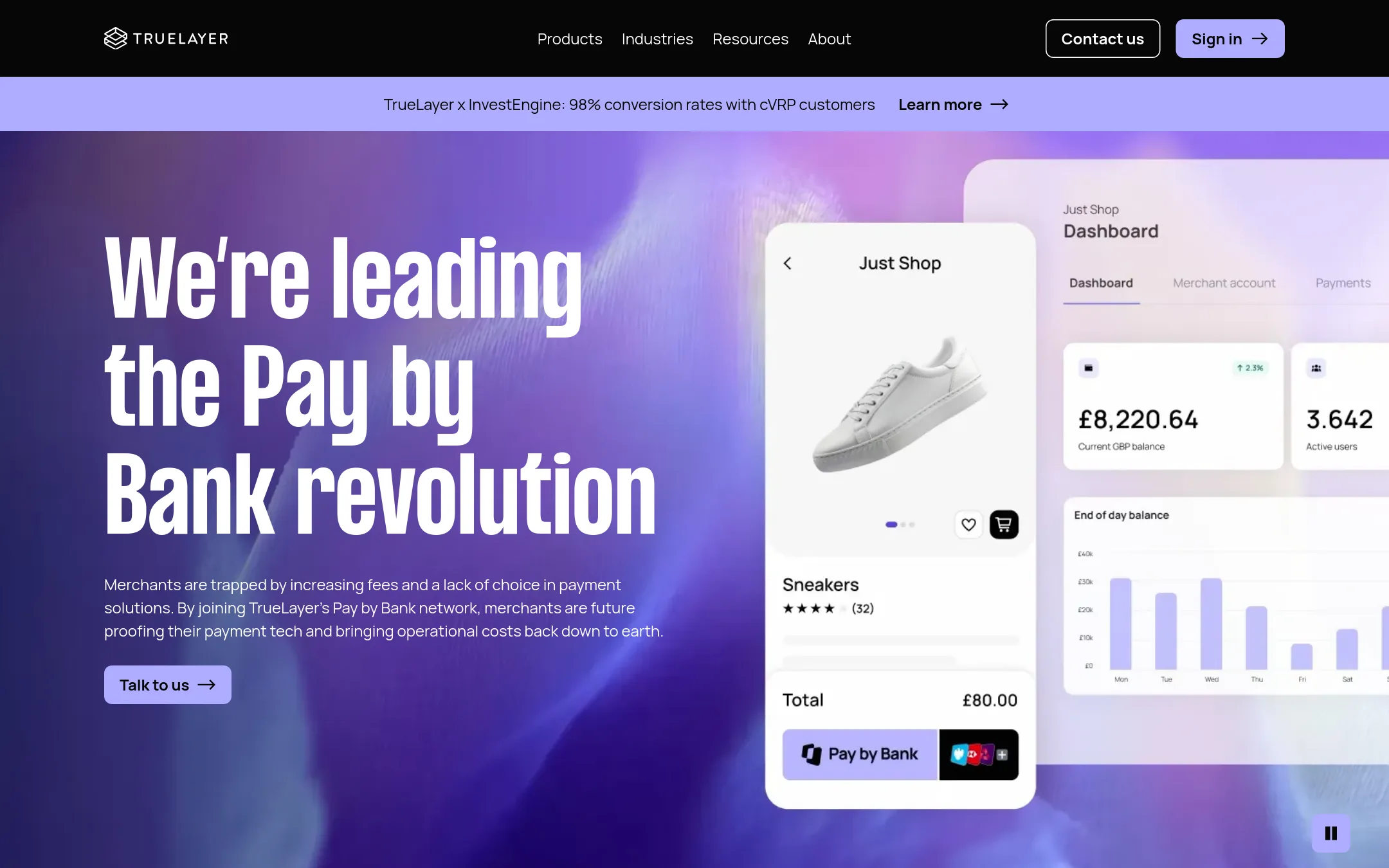
TrueLayer runs an open banking payments network that lets customers pay straight from their bank account, confirmed in their banking app instead of by card number. Its directory listing says the network serves 24M+ consumers and handles 47% of UK Pay by Bank transactions, which gives it real scale among open banking platforms.
Where it is strong
- Customers confirm payments in their own banking app, so no card details are needed
- Covers instant payouts for refunds, winnings and withdrawals, plus bank on file for subscriptions and bills
- Add-ons for real-time data, customer verification and credit checks sit on the same API
Where it falls short
- Pricing is not published, so cost comparison requires a sales conversation
- Its strongest reach is in the UK and Europe, so it may matter less for merchants selling mainly elsewhere
- Pricing:
- Pricing is not published on the site.
- Custom quote
2.Tink
Best for: Fintechs and lenders in Europe that need bank data connections for lending decisions, account-to-account payments or Pay by Bank checkout.
- Pricing
- Custom quote
- Category
- Finance & Accounting
Tink is a European open banking platform with more than 6000 connections to banks and financial institutions, delivering enriched and categorised financial data through one API. Because it operates under its own PSD2 license, teams can use its ready-made authentication flows instead of obtaining that license themselves. Adyen, Revolut and Bank Norwegian are among the companies named as customers.
Where it is strong
- One API covers more than 6000 European bank and institution connections
- Can run under Tink's PSD2 license, so you may not need your own
- SOC 2 Type II compliant for security and availability
Where it falls short
- New prospects must contact sales, so cost is unclear before a conversation
- Guaranteed support response times and several products are limited to Enterprise customers
- Pricing:
- Pricing is not published on the site. Prices shown are for existing customers, and new prospects are directed to contact sales for a custom quote.
- Not published
3.Salt Edge
Best for: Lenders, banks, e-commerce merchants, treasury teams and automotive companies that need bank data or pay-by-bank across many countries from one integration.
- Pricing
- Not published
- Category
- Finance & Accounting
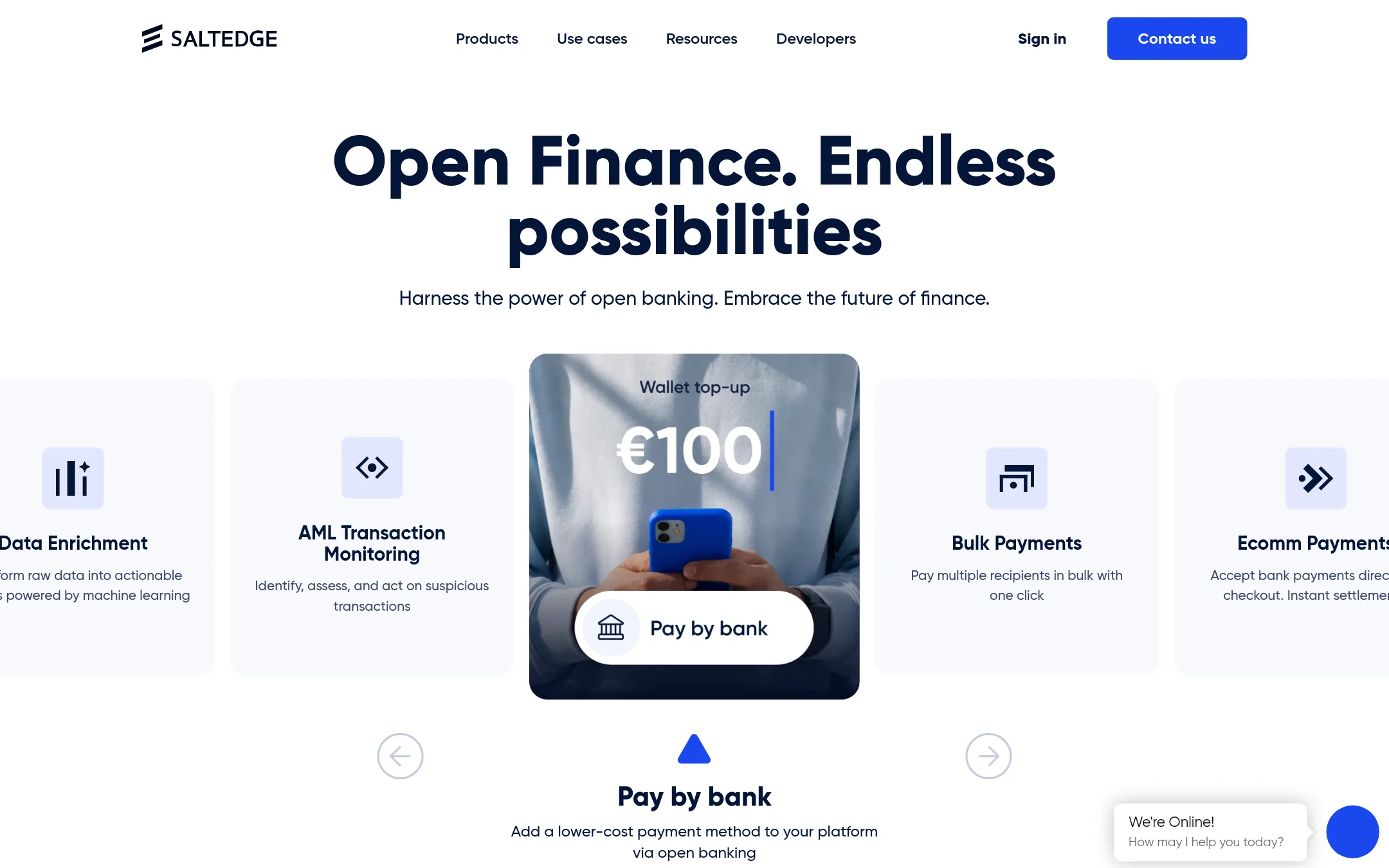
Salt Edge is a global open banking platform that connects to over 5,000 banks in more than 50 countries through a single API. It covers data aggregation, data enrichment, open banking payments including pay-by-bank and bulk payments, AML transaction monitoring, and TPP verification. Its reach across that many banks is the main reason it earns a place on this list.
Where it is strong
- Connects to over 5,000 banks in 50+ countries through one API
- Covers both data aggregation and open banking payments, including bulk payments
- Includes AML transaction monitoring and TPP verification for compliance work
Where it falls short
- Pricing is not published, so budgeting requires a sales conversation
- Broad feature set may be more platform than a small team needs if they only want basic account data
- Pricing:
- Pricing is not published on the site.
- Not published
4.Token
Best for: Merchants, fintechs and payment companies in the UK and Europe that want to accept Pay by Bank at checkout without interchange fees or chargebacks.
- Pricing
- Not published
- Category
- Finance & Accounting
Token.io is an A2A payments infrastructure platform that powers Pay by Bank checkout, recurring VRP payments and real-time payouts. Its credibility comes from live deployments at HSBC, Santander, BNP Paribas and Paysafe, and reach into more than 567 million bank accounts across the UK and Europe.
Where it is strong
- Connects to over 567 million bank accounts across the UK and Europe
- Offers flexible PISP/AISP licensing as a service, so teams can launch faster
- Supports VRP for one-click, recurring and automated bank payments
Where it falls short
- Pricing is not published, so you need to talk to sales to compare costs
- The site focuses on UK and European markets, so it is less relevant for teams operating elsewhere
- Pricing:
- Pricing is not published on the site.
- Not published
5.Flinks
Best for: Lenders and fintechs in North America that need instant bank data for income checks, underwriting, and onboarding.
- Pricing
- Not published
- Category
- Finance & Accounting
Flinks connects users to bank accounts at more than 15,000 financial institutions across North America, and it reports a connection rate above 95%. It also covers document fraud checks, data enrichment into 4,500+ attributes, and account-to-account payments through Interac and EFT.
Where it is strong
- Connects to 15,000+ North American financial institutions
- Reports a connection rate above 95%
- Turns raw bank data into 4,500+ attributes for underwriting
Where it falls short
- No self-serve plan or free trial, only a sandbox
- Monthly minimums and one-year terms may not suit small or early-stage teams
- Pricing:
- Pricing is not published on the site, though plans run on usage with a monthly minimum and a one-year standard term.
- Custom quote
6.Yapily
Best for: Fintechs and payment providers in Europe that want Pay by Bank and bank data through a single open banking integration
- Pricing
- Custom quote
- Category
- Finance & Accounting
Yapily gives developers one API for both bank payments and bank account data, covering consumer and business accounts across many European countries. Its Pay by Bank and recurring payment products sit on the same integration as its real-time data tools, which matters if you want both in one stack. The site cites broad coverage with about 2,000 banks and institutions and states that most banks in the UK and Germany are covered.
Where it is strong
- Payments and account data in one integration, covering both Pay by Bank and real-time data
- Business and SME account connectivity alongside consumer accounts
- API docs designed so AI coding agents can look up endpoints and steps
Where it falls short
- Pricing is only available by speaking with sales, so budgeting before a call is hard
- Coverage is strongest in Europe and the UK, so it is a poor fit for teams that need banks outside those 19 countries
- Pricing:
- Pricing is not published on the site.
How to choose Open Banking Platforms
Start with pricing structure. Most platforms on this list do not publish prices, so budgeting depends on a sales call. Ask whether costs are per connection, per payment, per data call, or a mix, and whether there is a monthly minimum. Flinks, for example, uses usage-based plans with a monthly minimum and a one-year standard term.
Next, check who the product is built for. Some platforms target merchants that want checkout, while others target lenders that want underwriting data. Match the platform to the job you need done first, since a payments-first tool may not give you the data features a lender needs, and the reverse is also true.
Check the integrations and geography. Bank coverage is the main limit. Flinks covers more than 15,000 North American institutions, Tink more than 6000 European connections, and Salt Edge more than 5,000 banks in over 50 countries. If you sell outside the regions a platform covers, it will not serve your customers.
Review data handling and compliance. Look for the certifications and licences the platform holds, such as SOC 2 Type II or a PSD2 licence, and ask whether you need your own licence or can use the provider's. Salt Edge includes AML transaction monitoring and TPP verification, which can matter for regulated teams.
Finally, read the support and contract terms. Some platforms limit guaranteed support response times to enterprise customers, and some require annual terms. Confirm these before you sign, and ask for a sandbox or test environment so your team can evaluate the integration first.
FAQ
Questions about Open Banking Platforms
What is an open banking platform?
An open banking platform gives software teams one API to connect to customers' bank accounts. Teams use it to read account data, start payments directly from a bank, or verify identity and income. Each platform covers a set of banks, usually in a defined region.
Which open banking platform is best for Pay by Bank checkout?
Token and TrueLayer both focus on Pay by Bank checkout. Token reports reach into more than 567 million bank accounts across the UK and Europe, and TrueLayer reports 24M+ consumers and a 47% share of UK Pay by Bank transactions. Both are strongest in the UK and Europe.
Which open banking platform covers the most banks?
Salt Edge reports connections to over 5,000 banks in more than 50 countries, which is the widest global reach on this list. Flinks covers more than 15,000 financial institutions, but only across North America. Tink reports more than 6000 connections, all in Europe.
Do open banking platforms publish their pricing?
Most of the platforms on this list do not publish their pricing on their websites. Buyers generally need to contact sales for a quote. Flinks is one exception that describes its plans as usage-based with a monthly minimum and a one-year standard term.
Do I need my own licence to use open banking?
It depends on the platform and your business. Tink can run under its own PSD2 licence, so teams may not need one. Token offers flexible PISP and AISP licensing as a service, which can help teams launch faster. Check the terms of each platform before assuming you are covered.
Last updated November 15, 2026.