The founder reading list
GST Invoice Checklist: What to Include Before Sending
In this guide
Blog ad spot 1
Your product. Their next discovery.
One booking. Your ad across every blog article.
Book this spotA GST tax invoice should contain accurate supplier and recipient details, a unique invoice number and date, clear line-item and tax information, and transaction-specific details such as place of supply, reverse-charge status, delivery address and, where applicable, an IRN and QR code.
GST does not prescribe one visual invoice layout. It prescribes the particulars that must appear where they apply. A tax invoice is also more than a payment request: it evidences the supply and is important evidence for the recipient’s input tax credit claim. CBIC invoice rules CBIC taxpayer flyer
Educational disclaimer: This checklist is general information, not legal or tax advice. GST treatment can depend on the exact transaction, customer, location and applicable notifications. Get professional advice for unusual or high-risk supplies.
GST invoice checklist before sending
Use this as a two-stage review: first choose the right GST document, then validate the invoice fields.
Stage 1: Choose the document
- Correct document type: Use a tax invoice for a taxable supply by a registered supplier. A composition taxpayer or a registered supplier making only exempt supplies generally issues a bill of supply instead.
Stage 2: Validate the invoice fields
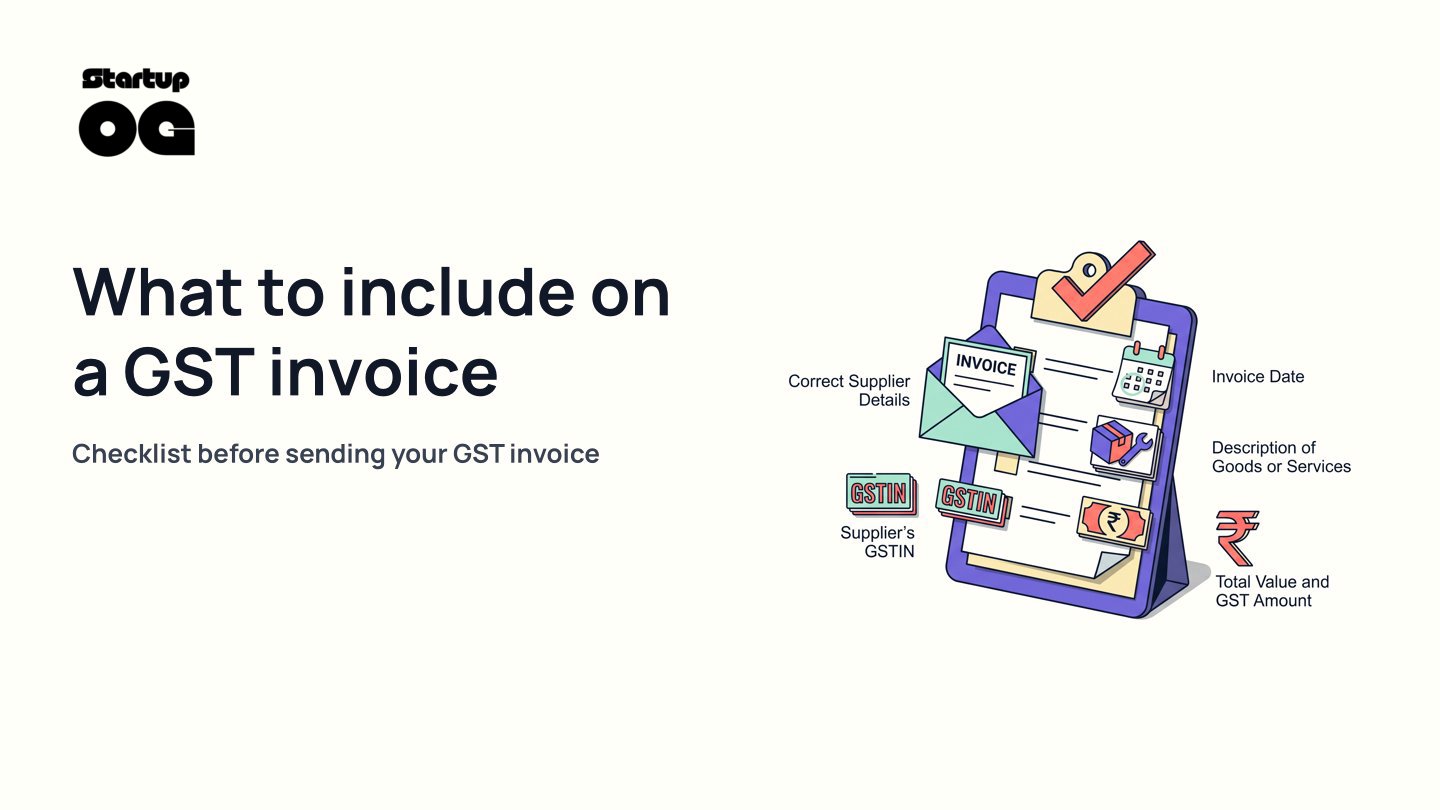
- Supplier details: Confirm the legal name, business address and GSTIN.
- Invoice reference: Check that the invoice number is consecutive, unique for the financial year and correctly dated.
- Recipient details: Confirm the customer’s name, address and GSTIN or UIN where the recipient is registered.
- Unregistered customer check: For a taxable supply of ₹50,000 or more to an unregistered recipient, include the recipient’s name and address, delivery address, state name and state code.
- Supply details: Include the HSN for goods or SAC for services, a clear description and, for goods, the quantity and unit or UQC.
- Values reconcile: Check the total value, discounts or abatements, taxable value, tax rate, tax amounts and final invoice total.
- Tax treatment: Show CGST and SGST or UTGST for an intra-State supply, or IGST for an inter-State supply, together with applicable cess.
- Place of supply: For an inter-State supply, show the place of supply and state name. Check this before selecting IGST or CGST and SGST.
- Delivery address: Include the delivery address where it differs from the place of supply.
- Reverse charge: State whether tax is payable under reverse charge.
- Authorisation: Add the supplier’s or authorised representative’s signature or digital signature where required. Electronic invoices and documents issued under the Information Technology Act are exempt from this signature requirement.
- E-invoice status: If e-invoicing applies, report the document through an authorised Invoice Registration Portal, obtain the IRN and QR code, and then share the final invoice.
- Commercial payment details: Add the purchase order reference, payment due date, payment method and billing contact where useful.
The last group of details can improve payment collection and internal controls, but commercial fields do not replace GST-required invoice particulars. The required tax-invoice particulars and their conditional application are set out in Rule 46 of the CGST Rules. CBIC invoice rules
First decision: are you using the correct GST document?
Do not begin by filling in a template. First identify what the transaction requires.
Tax invoice
A registered person making a taxable supply will generally issue a tax invoice. The invoice should describe the goods or services, show their value and the tax charged, and include the other applicable particulars under the invoice rules.
Bill of supply
A composition taxpayer or a registered person dealing only in exempt supplies generally issues a bill of supply instead of a tax invoice. A bill of supply has its own required fields, including supplier details, a unique financial-year invoice number, date, recipient details where applicable, HSN or SAC, description, value and signature or digital signature. CBIC taxpayer flyer
Receipt voucher and refund voucher
When a registered person receives an advance for a supply, the registered person must issue a receipt voucher with the prescribed particulars. If no supply follows and no tax invoice is issued, a refund voucher may be issued against the advance. CBIC invoice rules
Credit note, debit note or supplementary invoice
If the value or tax needs correction after invoicing, do not simply overwrite the original invoice. Consider whether a credit note, debit note, supplementary tax invoice or revised invoice is appropriate.
These documents need to identify the corresponding tax invoice or bill of supply by its serial number and date, along with the other prescribed details. For a non-routine correction, ask a GST professional which document and reporting treatment applies. CBIC invoice rules
High-risk GST invoice fields to validate
Some fields are easy to copy incorrectly or automate incorrectly. Give these a separate review before sending.
1. Verify supplier, recipient and GSTIN details
Use verified registration records rather than copying an address from an email signature.
During customer onboarding, collect:
- Billing legal name
- GSTIN or UIN, if applicable
- Billing and delivery addresses
- State and state code
- Purchase order requirements
- Billing contact and accounts-payable email
Before the first invoice—and whenever the customer says its details have changed—use the GST Portal’s Search Taxpayer function. It can be used without logging in to search a GSTIN or UIN and view details such as the legal name, trade name, registration status and principal place of business. GST Portal Search Taxpayer manual
Save the verified information in your invoicing system. This reduces repeated manual entry, but you should still review the populated fields when issuing an invoice.
2. Use the correct HSN or SAC and a usable description
Goods use HSN classifications; services use SAC classifications. The required code length depends on the taxpayer and invoice context. The CBIC guidance states that taxpayers with preceding-financial-year turnover above ₹5 crore must furnish six-digit HSN or SAC codes on invoices for taxable goods and services. Taxpayers with turnover up to ₹5 crore must furnish four-digit HSN codes on B2B invoices. CBIC HSN/SAC release
Do not rely on a vague description such as “consulting” or “services rendered.” Pair the verified classification with a plain-English description, for example:
Product strategy consulting — September 2026
The description should help the customer connect the invoice to the engagement, purchase order or contract. If you need a starting point for a code, use Startup OG’s HSN code finder, then confirm the classification and current tax treatment before issuing the invoice. The finder is a catalogue lookup tool; it does not decide your classification or GST rate.
3. Determine place of supply before choosing the tax type
Use this sequence:
Determine place of supply → identify whether the supply is intra-State or inter-State → apply the appropriate tax components → display the required place-of-supply information.
For an inter-State supply, the invoice must state the place of supply along with the name of the State. CBIC has specifically instructed registered persons making inter-State supplies to include these details on the tax invoice. CBIC Circular No. 90/09/2019-GST
Do not assume that the customer’s state always determines the place of supply. Rules can differ for supplies involving immovable property, events, SEZs, exports, cross-border services and certain digital or specialised services. The applicable provisions of the IGST Act should be checked for the transaction rather than relying only on the customer’s billing address. IGST Act material IGST Act, Section 12 IGST Act, Section 7
4. Reconcile the numbers
Before sending, compare the invoice with the quote, contract or purchase order:
- Quantity multiplied by unit price
- Discount or abatement
- Taxable value
- Tax rate for each line
- CGST, SGST, UTGST or IGST amount
- Cess, if applicable
- Rounding differences
- Final amount payable
Do not use a single tax rate across the entire invoice if different lines have different applicable treatments. Also avoid presenting a GST rate as universal for consulting, software or another service category; the applicable rate depends on the classification and transaction.
E-invoice is a reporting process, not just an invoice sent by email
A PDF sent by email is not automatically an e-invoice under GST.
Businesses continue to create invoices in their accounting, billing or ERP systems. E-invoicing means reporting specified document details to a government-authorised Invoice Registration Portal, or IRP, and obtaining an Invoice Reference Number, or IRN. The IRP returns a digitally signed e-invoice with the IRN and QR code. GSTN e-invoicing overview
The current GSTN e-invoice guidance states that:
- E-invoicing applies to taxpayers with annual aggregate turnover of more than ₹5 crore in any preceding financial year, subject to notified exemptions.
- Covered documents include B2B invoices, invoices for supplies to SEZs, exports, deemed exports, and relevant credit notes and debit notes.
- A covered B2B invoice is valid only with a valid IRN.
- The invoice should be reported through an authorised IRP before the IRN-bearing invoice is issued to the recipient.
Check the current enablement position and official updates on the GSTN e-invoice portal. The rules, exemptions and reporting requirements are time-sensitive.
E-invoice success check
Before sharing the invoice, confirm that:
- The document number, date, supplier and recipient details are correct.
- The taxable value and tax amounts match the final invoice.
- The IRN and QR code appear on the shared copy where e-invoicing applies.
- The invoice has not been cancelled.
- The IRN can be verified through the GSTN e-invoice portal or QR verification process.
Hypothetical example: B2B consulting invoice
Hypothetical example—not tax or classification advice.
Bengaluru-based Alpha Studio Pvt. Ltd. invoices a registered customer in Maharashtra for September 2026 consulting. The supplier has verified the service classification and tax treatment with its adviser.
- Supplier: Alpha Studio Pvt. Ltd., Bengaluru address, GSTIN
- Recipient: Bright Retail Pvt. Ltd., Mumbai billing address, GSTIN
- Invoice number:
AS/2026-27/0142- Issue date: 25 September 2026
- Description: “Product strategy consulting — September 2026”
- SAC: Verified SAC for the service
- Taxable value: ₹50,000
- Place of supply: Maharashtra
- Tax treatment: Inter-State; show the applicable IGST rate and amount, after confirming the rate for the actual transaction
- Total: Taxable value plus IGST
- Calculation: IGST = ₹50,000 × the applicable IGST rate; total = ₹50,000 + IGST. Confirm the applicable rate for the actual transaction before issuing.
- Reverse charge: “No,” if not applicable
- Payment terms: “Pay by 10 October 2026 via bank transfer”
- E-invoice: If applicable, obtain the IRN and QR code before sending
This example shows the structure without assuming a GST rate for consulting. The relevant invoice and place-of-supply requirements are set out in the CBIC invoice rules and CBIC inter-State supply circular.
Why this invoice passes the pre-send review
- The customer’s GSTIN and billing information have been verified.
- The invoice number is unique and follows the financial-year series.
- The service description and SAC are traceable to the engagement.
- The taxable value, tax and total can be reconciled.
- The inter-State place of supply is shown.
- Reverse-charge treatment is stated.
- The e-invoice step is completed if the supplier is covered.
Common GST invoice mistakes and a better operating routine
Common mistakes
- Incorrect legal name or GSTIN: Verify the customer’s registration details and update the saved customer record.
- Automatic CGST and SGST selection: Pause and check the place of supply before choosing the tax components.
- Duplicate invoice number: Maintain a controlled series that is unique for the financial year.
- Altering an issued invoice: Preserve the original record and use the appropriate correction document instead of silently changing it.
- Generic description or incorrect HSN/SAC: Confirm the classification and record the basis internally.
- Covered B2B invoice sent without an IRN or QR code: Report it through an authorised IRP before sharing the compliant invoice copy.
- Relying on commercial information alone: A PO number, payment link or due date does not replace mandatory GST particulars.
Recommended operating routine
- Collect supplier and customer details during onboarding.
- Verify GSTIN and address information before the first invoice and after any change.
- Store approved customer and product or service information in the billing system.
- Review place of supply, tax type, HSN or SAC and reverse-charge status before each send.
- Reconcile the invoice to the PO, contract or approved quote.
- Retain the final invoice and relevant supporting records.
- Use a second reviewer for a new customer, high-value transaction, inter-State supply or e-invoice-covered document.
For ordinary domestic forward-charge billing, the Startup OG GST invoice generator can prepare tax-exclusive invoices with CGST plus SGST or UTGST, or IGST. It does not issue an IRN, file GST returns, verify registration status, or handle cess, reverse charge, exports or SEZ workflows. Complete those checks and processes separately where they apply.
Frequently asked questions
What should a GST invoice include?
A GST tax invoice generally includes supplier details, a unique financial-year invoice number and date, recipient details, HSN or SAC, description, quantity for goods, total and taxable values, discounts or abatements, tax rates and amounts, place of supply for inter-State supplies, delivery address where different, reverse-charge status and signature or digital signature where required. Some fields are conditional, so not every invoice needs every possible field. CBIC invoice rules
Is a PDF invoice an e-invoice under GST?
No. A PDF is only a format for sharing an invoice. Where e-invoicing applies, the specified document details must be reported to an authorised IRP and the invoice must carry the resulting IRN and QR code. GSTN e-invoicing overview
Do I need HSN or SAC on my GST invoice?
You need the applicable HSN for goods or SAC for services, with the required code length depending on the applicable turnover and invoice rules. CBIC guidance states that taxpayers above ₹5 crore in preceding-financial-year turnover must furnish six-digit HSN or SAC, while taxpayers up to ₹5 crore must furnish four-digit HSN on B2B invoices. CBIC HSN/SAC release
When do I use IGST instead of CGST and SGST?
Use IGST when the supply is inter-State, after determining the place of supply under the applicable IGST provisions. For an intra-State supply, the invoice generally shows CGST with SGST or UTGST. Do not decide solely from the customer’s mailing address, because special place-of-supply rules can apply to particular goods and services. CBIC Circular No. 90/09/2019-GST
Blog ad spot 2
Your product. Their next discovery.
One booking. Your ad across every blog article.
Book this spotPut it into practice
- Download the goal-setting template →
A CSV worksheet with metrics, owners, milestones and review dates.
- Create an invoice →
Add your business details and logo, then save a PDF for your client.
- Explore productivity tools →
Compare tools for organizing work and reducing repetitive tasks.
Keep a good thing going
A little founder fuel.
Tools, stories, and useful reads. One email a week.