The founder reading list
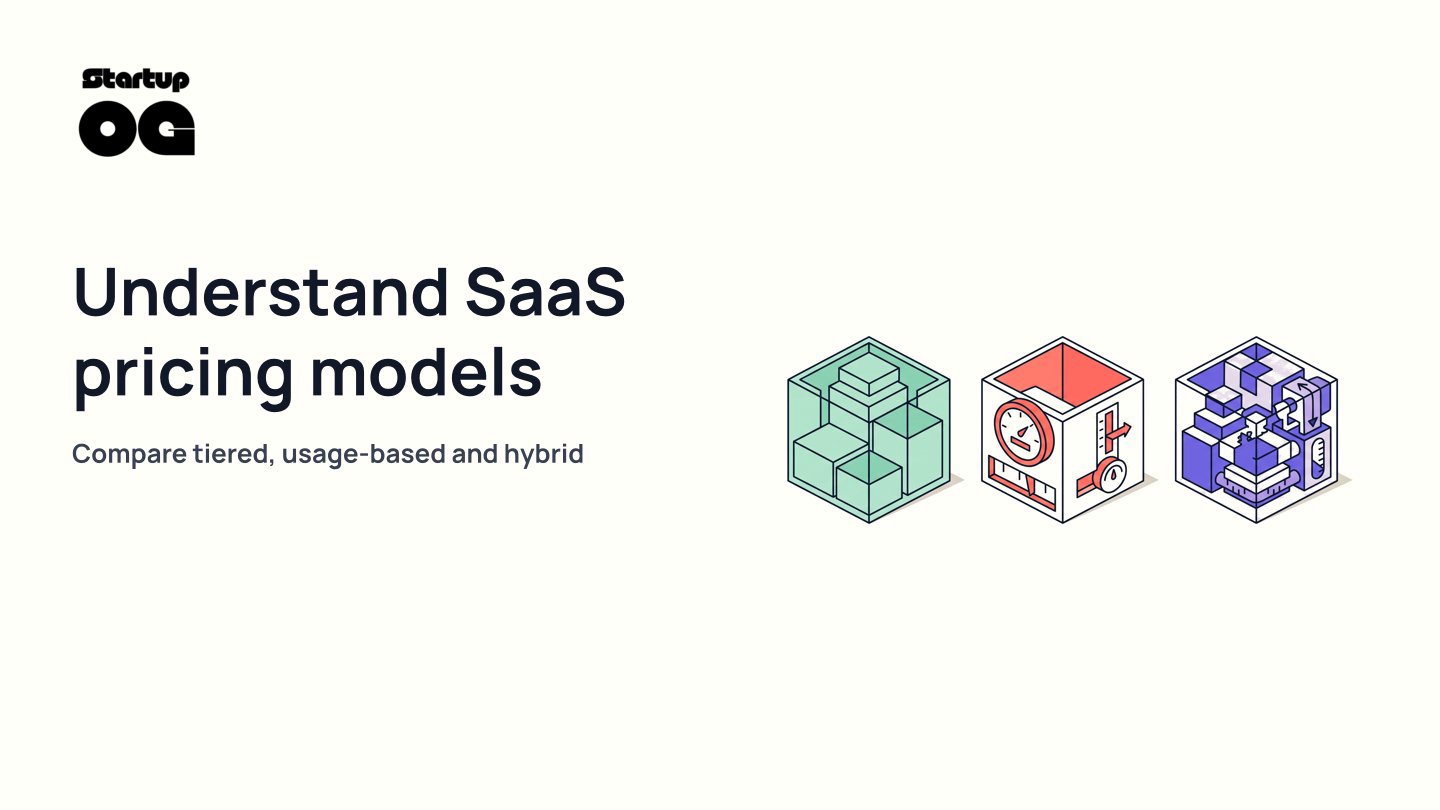
SaaS Pricing Models Explained: Tiered, Usage-Based and Hybrid
In this guide
Blog ad spot 1
Your product. Their next discovery.
One booking. Your ad across every blog article.
Book this spotUnderstanding saas pricing models is essential for early-stage founders aiming to build sustainable revenue streams. Pricing is not a set-and-forget mechanism; it is the most powerful growth lever in your entire business. Yet, nearly 40% of SaaS companies haven't revisited their pricing structure in the last 18 months, despite evidence that regular optimization leads to 30% higher growth.
Founders often default to what their competitors are doing without understanding the underlying mechanics. This guide breaks down the core options available in 2026. You will learn how to transition from simple flat-rate models to complex hybrid structures without losing customer trust. At Startup OG, we see founders wrestle with these decisions daily. By mastering these frameworks, you can align your pricing perfectly with the actual value your product delivers.
What Are SaaS Pricing Models
A pricing model determines exactly how a software company charges its customers for access and usage. The model you choose dictates your cash flow predictability, customer acquisition cost, and long-term scalability. The industry has evolved significantly from the early days of simple flat-rate subscriptions. Today, successful transitions to subscription models require pricing elasticity analysis to balance accessibility with profitability.
Choosing a pricing model is the wrong starting point. The model is downstream of three harder decisions: what metric you charge on, how you structure what’s included, and what price points hold up in real deals. You must first identify your value metric. This is the specific unit of consumption (like API calls, active projects, or gigabytes of storage) that most closely aligns with the value a customer receives from your software.
The rise of artificial intelligence has completely disrupted traditional models. Nearly a third of recent venture capital investments went to AI-native companies. These companies cannot rely on outdated pricing structures. When an AI agent performs the work of five humans, charging "per seat" makes zero mathematical sense for the founder. The market is shifting rapidly to accommodate this new reality.
How Tiered Pricing Works
Tiered pricing is the most recognizable structure in the SaaS industry. It involves offering multiple packages (typically Basic, Pro, and Enterprise) at different price points. Each tier unlocks additional features, higher usage limits, or premium support. The median entry-level price for B2B SaaS recently hit $29 per user per month, representing an 11% increase year-over-year.
This model works by segmenting your customer base based on their willingness to pay and their specific needs. A solo freelancer does not need SAML SSO or dedicated account management, but a Fortune 500 company demands them. Tiers allow you to capture revenue from both groups without alienating either.
The psychological design of these tiers is critical. Most companies use the "Goldilocks" principle, designing three tiers where the middle option appears to be the most logical choice. By placing strict feature limits on the lowest tier, you create natural upgrade paths. When a growing company hits a feature ceiling, they are forced to upgrade to the next tier, driving automatic revenue expansion for your startup.
How Usage-Based Pricing Works
Usage-based pricing (UBP) ties billing directly to consumption metrics. Customers pay exactly for what they use, similar to a utility bill. This model has exploded in popularity because it offers ultimate flexibility for customers with highly variable needs. Currently, 61% of SaaS companies now utilize usage-based pricing, up massively from previous years.
The financial benefits of this model are staggering. Companies employing usage-based pricing achieve 38% faster revenue growth and 54% higher growth rates at scale compared to traditional subscription models. When your customer's business grows and they consume more of your product, your revenue scales instantly without requiring a sales conversation.
However, implementing UBP requires sophisticated tracking and metering systems. You must be able to track every API call, gigabyte transferred, or transaction processed with absolute accuracy. This model also introduces revenue unpredictability. If a major client experiences a slow month, your revenue drops immediately. Despite this, the upside is massive. For example, Snowflake projected an incredible increase of $21 million in product revenue for a single quarter solely due to its tiered consumption-based model.
How Hybrid Pricing Models Work
Hybrid pricing models represent the "Goldilocks" zone for 2026 startups. They combine a predictable base subscription fee with variable charges based on consumption. This approach provides the predictability of tiers with the expansion potential of usage.
In a typical hybrid setup, a customer pays a flat $500 monthly fee which includes access to the core platform and up to 10,000 API calls. If they exceed that limit, they are billed a few cents for every additional call. This guarantees a baseline Monthly Recurring Revenue (MRR) for the founder while allowing the contract to expand automatically as the client scales.
The transition to this model can transform a company's trajectory. New Relic achieved a 44% increase in annual revenue run-rate after pivoting to a consumption-based billing model. Designing a hybrid structure requires careful balance. If the base tier includes too much usage, you will never trigger overage fees. If it includes too little, customers will feel nickel-and-dimed.
Key Concepts and Terminology
Mastering pricing requires understanding the metrics that investors and board members track. Monthly Recurring Revenue (MRR) and Annual Recurring Revenue (ARR) measure the predictable revenue your subscriptions generate. Average Revenue Per User (ARPU) tells you exactly how much cash each client brings in.
Expansion revenue is the holy grail of SaaS. This is the additional revenue generated from existing customers through upsells, cross-sells, or increased usage. For established companies, 70-80% of revenue growth comes from existing customers. Patrick Campbell notes that segmentation is the difference between a vanity metric and an actionable one. Your overall expansion rate might look healthy, but segment-level analysis often reveals critical improvement opportunities.
Transparency is also a critical concept. B2B buyers hate hidden fees. In fact, 72% of financial institutions report that pricing transparency significantly influences their vendor selection decisions. If your pricing page requires a Ph.D. to understand, potential buyers will simply choose a competitor with a clearer model.
Real-World Examples and Use Cases
Looking at successful companies reveals how these models operate in the wild. Slack and Notion masterfully execute the tiered model. They offer robust free tiers to acquire users, then restrict enterprise-grade security features and unlimited history to their highest-paid tiers. This forces growing teams to upgrade as their internal collaboration needs mature.
Amazon Web Services (AWS) and Stripe define pure usage-based pricing. AWS charges you for the exact compute time and storage you consume. Stripe takes a percentage of every transaction processed. There are no massive upfront licensing fees. The barrier to entry is zero, but the lifetime value of a successful customer is astronomical.
Modern startups frequently launch with hybrid models. An AI copywriting tool might charge a flat $49 monthly subscription for the interface and team collaboration features, but charge per "token" for the actual AI generation. This protects the company from heavy server costs if a power user generates thousands of articles in a single day.
Benefits and Importance for Startups
Your pricing model directly impacts your cash flow, customer retention, and ability to scale. The median impact on Net Dollar Retention (NDR) from changing pricing is a +14% increase among expansion-stage companies. Adjusting your prices is often the fastest way to increase revenue without acquiring a single new customer.
At Startup OG, we see community members leverage transitionary pricing frameworks to scale smoothly. They start with simple flat-rate models to acquire their first 100 users, then introduce usage limits as their server costs rise. Companies using AI-driven pricing strategies generate 5-10% higher returns than competitors using traditional approaches.
High-growth companies review and optimize their pricing every 6 to 12 months. The market changes, your product improves, and your prices must reflect that new reality. Stagnant pricing signals a stagnant product.
Common Misconceptions About SaaS Pricing Models
The most dangerous myth is that one model fits all business types. A model that works for a developer API will fail miserably for a consumer productivity app. You must align the model with how your specific users perceive value.
Founders also frequently fall into the "Grandfathering Trap." Keeping early customers on low-priced plans forever out of a sense of loyalty can prevent a startup from scaling from $10M to $100M ARR. You must eventually migrate legacy users to current pricing tiers to maintain healthy margins.
Finally, many founders completely overlook the psychological impact of seat-based fatigue. Buyers are exhausted by paying $20 per month for every single employee who needs basic access to a tool. AI-native pricing is actively shifting from "seats" to "outcomes" or "tokens" because AI agents perform the work of multiple users. Furthermore, 27% of companies do not track their back-office costs associated with complex billing. If your pricing model requires three full-time accountants to manage, it is too complex for an early-stage startup.
Conclusion
Selecting the appropriate saas pricing models positions your startup for sustainable growth and stronger customer relationships. You must move past the idea of simple flat rates and embrace the flexibility of tiered, usage-based, or hybrid structures. Align your pricing metric with the exact value your customer receives. Review your pricing strategy every six months, and do not be afraid to adjust it as your product matures. By applying these frameworks, you ensure your revenue scales perfectly in tandem with the value you deliver to the market.
Blog ad spot 2
Your product. Their next discovery.
One booking. Your ad across every blog article.
Book this spotPut it into practice
- Audit a landing page →
Check titles, indexing, headings and links before sending more traffic.
- Calculate acquisition cost →
Compare marketing spend with the customers acquired in the same period.
- Explore marketing and sales tools →
Build a shortlist for outreach, CRM and customer acquisition.
- Compare marketing software alternatives →
Review alternatives to marketing and sales products.
Keep a good thing going
A little founder fuel.
Tools, stories, and useful reads. One email a week.