BuildBuddy alternatives
10 products compared · Updated October 16, 2026
The short answer
For teams needing Bazel-specific remote execution and caching, EngFlow is the strongest alternative, built by Bazel experts for large codebases. If you want a general-purpose CI/CD platform with broad language support and predictable pricing, CircleCI or Semaphore are solid choices. Gradle Enterprise suits teams using multiple build systems who need deep build analytics.
Your shortlist, at a glance
Read the comparisons ↓ EngFlowCustom quoteLarge engineering organizations with massive Bazel or Soong codebases that need expert-led build acceleration and detailed performance analysis.
 Gradle EnterpriseNot publishedEngineering teams using Gradle or multiple build systems who need deep build analytics and AI-assisted optimization across their entire toolchain.
 CircleCIFree / from $15 per 25Teams that want a hosted CI/CD service with broad language and platform support, including Docker, Windows, macOS, and GPU resources.
JenkinsNot publishedTeams that want a free, self-hosted CI/CD server with extensive plugin support and are comfortable managing their own infrastructure.
 GitHub ProjectsFree. Team $4/user/moTeams already using GitHub that want simple issue tracking and project boards without adopting a separate tool.
 AWS ParallelClusterPay-as-you-goTeams already on AWS that need flexible, pay-as-you-go HPC cluster management for diverse workloads, not just Bazel builds.
 Google Cloud HPCNot publishedTeams running AI training or scientific simulations on Google Cloud that need flexible, scalable compute resources.
- GGitLabFrom $12/user/moTeams that need an end-to-end DevOps platform with integrated security and compliance, especially those moving beyond Bazel-specific build acceleration.
 TeamCityNot publishedTeams that want a self-hosted CI/CD server with broad language support and don't need Bazel-specific remote execution.
 SemaphoreFrom $0.003/minTeams using AI coding agents that want a fast, affordable CI/CD platform with predictable per-minute pricing and no per-user fees.
About BuildBuddy and its alternatives
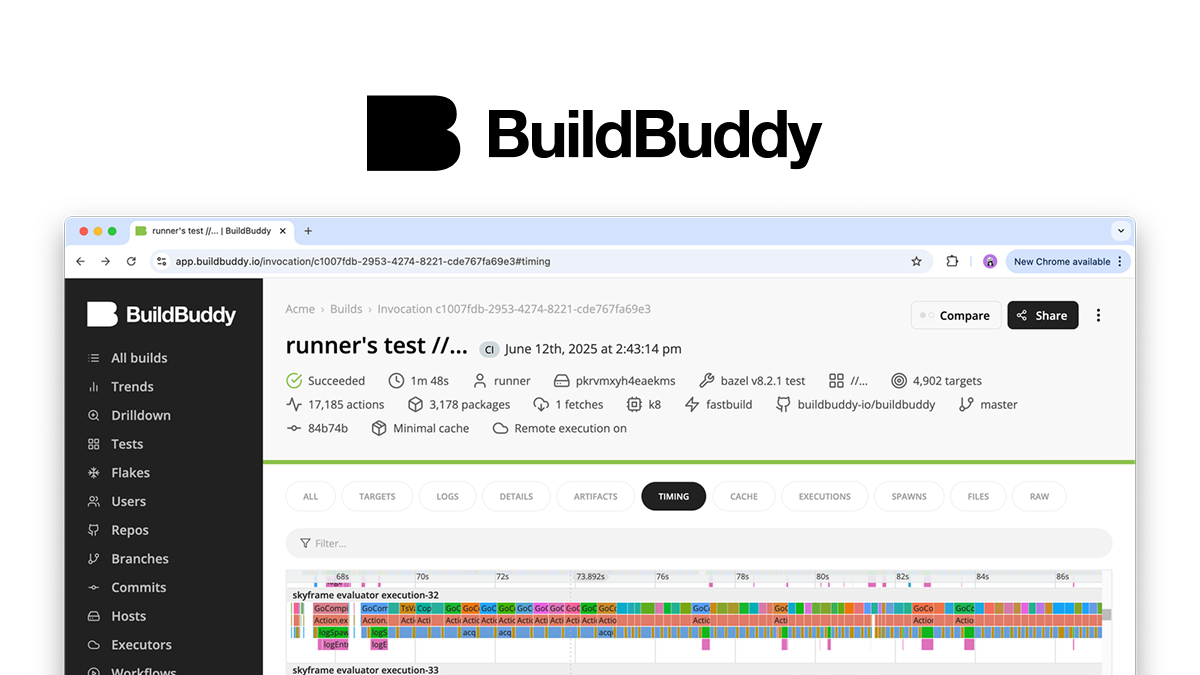
BuildBuddy is an enterprise Bazel platform that provides remote build execution, caching, and a results UI to speed up software builds. It is known for cutting build times dramatically, integrating with GitHub, and offering flexible cloud or on-prem deployment.
When comparing alternatives, weigh pricing structure (per-user, per-minute, or credits), regional availability, integrations with your existing CI and code hosting, support options, and contract terms. Some tools are Bazel-specific, while others are general-purpose CI/CD platforms.
Explore the alternatives
- Custom quote
1.EngFlow
Best for: Large engineering organizations with massive Bazel or Soong codebases that need expert-led build acceleration and detailed performance analysis.
- Pricing
- Custom quote
- Category
- Developer Tools
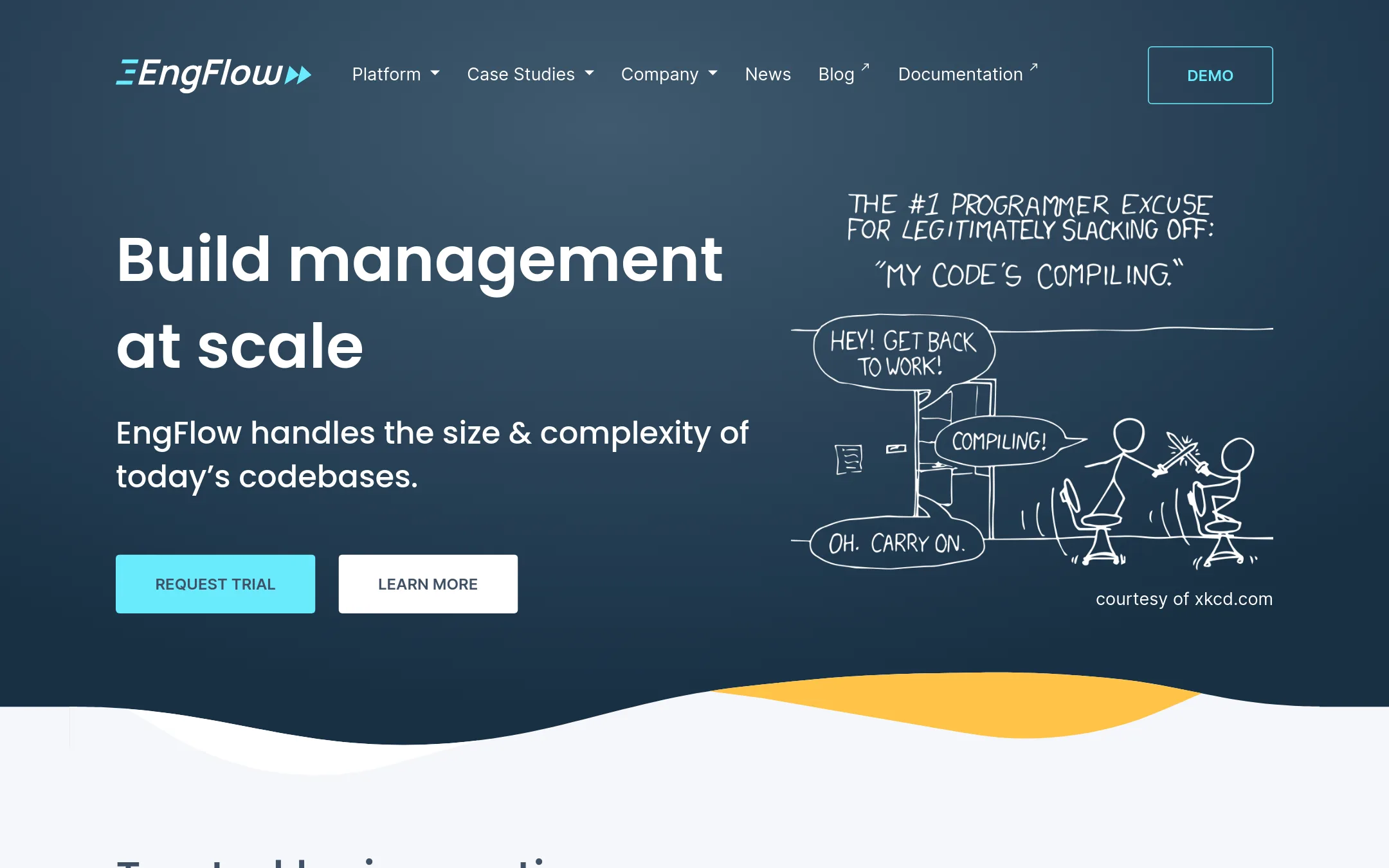
EngFlow is a build acceleration platform for Bazel, Goma, and Soong, created by Bazel experts. Choose it when you need expert-led remote execution and caching for very large codebases, with a focus on deep Bazel performance analysis.
Where it is strong
- Built by Bazel experts, including the founder
- Supports Bazel, Goma, and Soong
- Includes a free Bazel Invocation Analyzer tool
Where it falls short
- No published pricing, requires contacting sales
- No self-serve free tier mentioned on the site
- Pricing:
- Pricing is not published on the site.
- Switching from BuildBuddy:
- Moving from BuildBuddy to EngFlow involves migrating your remote execution and caching endpoints, and likely a sales conversation to set up a trial.
- Not published
2.Gradle Enterprise
Best for: Engineering teams using Gradle or multiple build systems who need deep build analytics and AI-assisted optimization across their entire toolchain.
- Pricing
- Not published
- Category
- Developer Tools
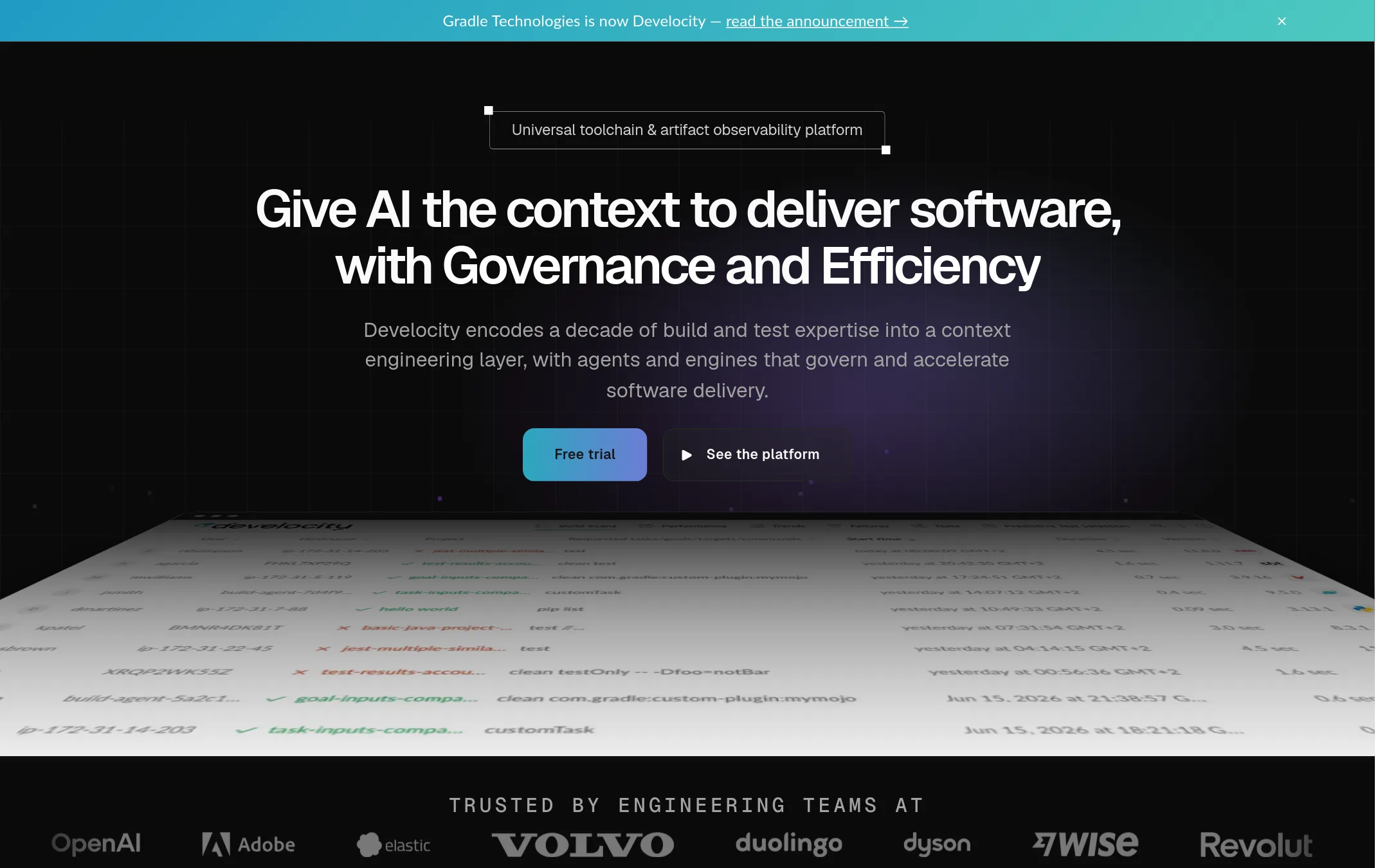
Gradle Enterprise, now Develocity, is a build and test observability platform that unifies signals across many toolchains, not just Bazel. Teams using Gradle, Maven, or other build systems would choose it over BuildBuddy for broader coverage and AI-driven context.
Where it is strong
- Works with many build systems and CI tools, not just Bazel
- Includes Predictive Test Selection and failure analytics
- Offers MCP servers for AI coding agents
Where it falls short
- No public pricing. Requires contacting sales
- May be overkill for small teams or Bazel-only users
- Pricing:
- Pricing is not published on the site.
- Switching from BuildBuddy:
- Moving from BuildBuddy means adopting a different platform with broader toolchain support, but you'll need to migrate your build cache and results UI workflows.
- Free / from $15 per 25
3.CircleCI
Best for: Teams that want a hosted CI/CD service with broad language and platform support, including Docker, Windows, macOS, and GPU resources.
- Pricing
- Free / from $15 per 25
- Category
- Developer Tools
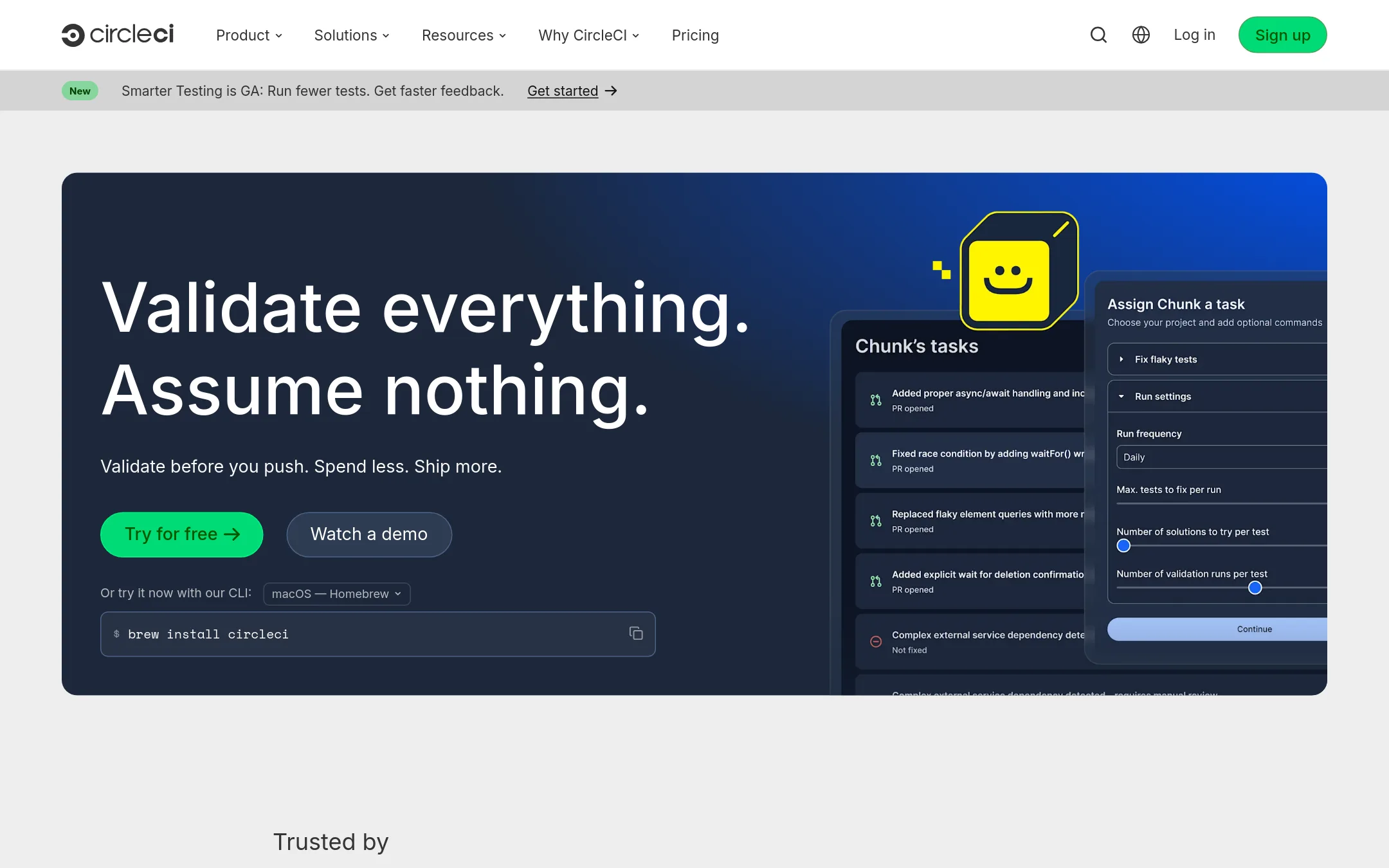
CircleCI is a general-purpose CI/CD platform that runs your builds, tests, and deployments across many languages and environments. Choose it over BuildBuddy if your team needs a flexible, credit-based CI system that supports a wide range of stacks, not just Bazel.
Where it is strong
- Supports many languages and platforms, including Docker, Windows, macOS, and GPU.
- Usage-based credits let you pay only for what you use.
- Smarter Testing features like test selection and flaky test detection are available on paid plans.
Where it falls short
- Not designed specifically for Bazel, so you may miss BuildBuddy's deep Bazel integration.
- Credit system can be complex to estimate costs for large teams.
- Pricing:
- Free plan includes up to 6,000 build minutes and 5 active users. Performance plan starts with 30,000 credits per month, with additional credits at $15 per 25,000. Scale plan is custom-priced, billed annually.
- Switching from BuildBuddy:
- Moving from BuildBuddy means reconfiguring your CI pipelines to use CircleCI's YAML config and credit-based model, which may require adapting Bazel-specific build steps.
- Not published
4.Jenkins
Best for: Teams that want a free, self-hosted CI/CD server with extensive plugin support and are comfortable managing their own infrastructure.
- Pricing
- Not published
- Category
- Developer Tools
Jenkins is a general-purpose open-source automation server for CI/CD, not tied to Bazel. Choose it if you need a self-hosted, plugin-driven pipeline tool that works with any language or build system, and you prefer to manage your own infrastructure rather than adopt a Bazel-specific platform.
Where it is strong
- Open source and free to self-host
- 2300+ plugins for integrating with nearly any tool
- Runs on Windows, Linux, macOS, and Unix-like systems
Where it falls short
- No built-in remote build execution or caching for Bazel
- Requires manual setup and maintenance of servers and agents
- Pricing:
- Pricing is not published on the site.
- Switching from BuildBuddy:
- Moving from BuildBuddy means replacing Bazel-specific remote execution and caching with Jenkins' generic build steps, so you'll need to configure your own build agents and caching strategy.
- Free. Team $4/user/mo
5.GitHub Projects
Best for: Teams already using GitHub that want simple issue tracking and project boards without adopting a separate tool.

- Pricing
- Free. Team $4/user/mo
- Category
- Productivity & Project Management
GitHub Projects is a project management layer inside GitHub for planning and tracking work alongside code. Choose it over BuildBuddy if your team already lives in GitHub and needs lightweight issue tracking, not Bazel-specific build acceleration.
Where it is strong
- Integrates natively with GitHub issues and pull requests.
- Free plan covers unlimited repositories and basic project management.
- Team plan adds Codespaces and repository rules at a low per-user cost.
Where it falls short
- No Bazel-specific features like remote build execution or caching.
- Project management is basic compared to dedicated tools like BuildBuddy's build analytics.
- Pricing:
- Free plan includes unlimited public/private repositories and 2,000 CI/CD minutes per month. Team plan is $4 per user per month for the first 12 months.
- Switching from BuildBuddy:
- Moving from BuildBuddy means giving up Bazel build acceleration and analytics. You'd rely on GitHub Actions for CI and GitHub Projects for tracking, which is a different workflow.
- Pay-as-you-go
6.AWS ParallelCluster
Best for: Teams already on AWS that need flexible, pay-as-you-go HPC cluster management for diverse workloads, not just Bazel builds.
- Pricing
- Pay-as-you-go
- Category
- Developer Tools
AWS ParallelCluster is a general-purpose cloud computing service that lets you manage HPC clusters on AWS. Choose it over BuildBuddy if you need to run a wide range of compute workloads beyond Bazel builds, such as scientific simulations or machine learning, and you already operate on AWS.
Where it is strong
- Supports a broad range of compute workloads beyond Bazel builds.
- Pay only for the services you consume, with no long-term contracts.
- Global infrastructure with 124 availability zones across 39 regions.
Where it falls short
- No built-in Bazel-specific features like remote caching or build result UI.
- Requires AWS expertise to set up and manage clusters effectively.
- Pricing:
- Pricing is not published on the site. AWS charges per service used, with pay-as-you-go and flat-rate options, plus Savings Plans for committed use.
- Switching from BuildBuddy:
- Moving from BuildBuddy means replacing Bazel-specific features like remote execution and build analytics with your own AWS infrastructure and tooling.
- Not published
7.Google Cloud HPC
Best for: Teams running AI training or scientific simulations on Google Cloud that need flexible, scalable compute resources.
- Pricing
- Not published
- Category
- Developer Tools
Google Cloud HPC is a general-purpose high-performance computing platform with GPUs, TPUs, and scalable infrastructure for AI workloads. Choose it when you need raw compute power for large-scale simulations or AI training, rather than a Bazel-specific build acceleration tool.
Where it is strong
- Access to GPUs and TPUs for AI and HPC workloads.
- Scalable infrastructure that can handle large compute jobs.
- Part of the broader Google Cloud ecosystem with many services.
Where it falls short
- No Bazel-specific features like remote build execution or build logs.
- Requires manual setup and management of compute resources.
- Pricing:
- Pricing is not published on the site.
- GFrom $12/user/mo
8.GitLab
Best for: Teams that need an end-to-end DevOps platform with integrated security and compliance, especially those moving beyond Bazel-specific build acceleration.
GitLab is a full DevSecOps platform covering planning, source control, CI/CD, security, and AI orchestration in one place. Choose it over BuildBuddy if you want a complete software lifecycle tool with built-in security scanning and compliance, rather than a specialized Bazel acceleration layer.
Where it is strong
- One platform for source control, CI/CD, security scanning, and project management.
- Built-in compliance and governance features, including audit trails and policy enforcement.
- Flexible pricing with GitLab Flex to reallocate spend across seats and credits.
Where it falls short
- Not specialized for Bazel remote execution or caching, so Bazel users may lose deep build acceleration features.
- Compute minutes and storage limits on lower tiers may be restrictive for heavy builds.
- Pricing:
- Free plan includes 5 users and 400 compute minutes per month. Premium starts at $12 per user/month with 10,000 compute minutes. Ultimate starts at $24 per user/month with 50,000 compute minutes.
- Switching from BuildBuddy:
- Moving from BuildBuddy to GitLab means replacing Bazel-specific remote execution with GitLab's CI/CD runners, which may require reconfiguring build pipelines and losing Bazel-specific optimizations.
- Not published
9.TeamCity
Best for: Teams that want a self-hosted CI/CD server with broad language support and don't need Bazel-specific remote execution.

- Pricing
- Not published
- Category
- Developer Tools
TeamCity is a self-hosted CI/CD server that works with many languages and build tools, not just Bazel. Choose it if you need a general-purpose CI/CD system with on-premises control and don't require Bazel-specific remote execution or build analytics.
Where it is strong
- Self-hosted, so you control infrastructure and data.
- Supports many languages and build tools out of the box.
- Built-in CI/CD features like pipelines and build history.
Where it falls short
- No Bazel-specific remote execution or caching.
- Requires you to manage your own server and maintenance.
- Pricing:
- Pricing is not published on the site.
- From $0.003/min
10.Semaphore
Best for: Teams using AI coding agents that want a fast, affordable CI/CD platform with predictable per-minute pricing and no per-user fees.
- Pricing
- From $0.003/min
- Category
- Developer Tools
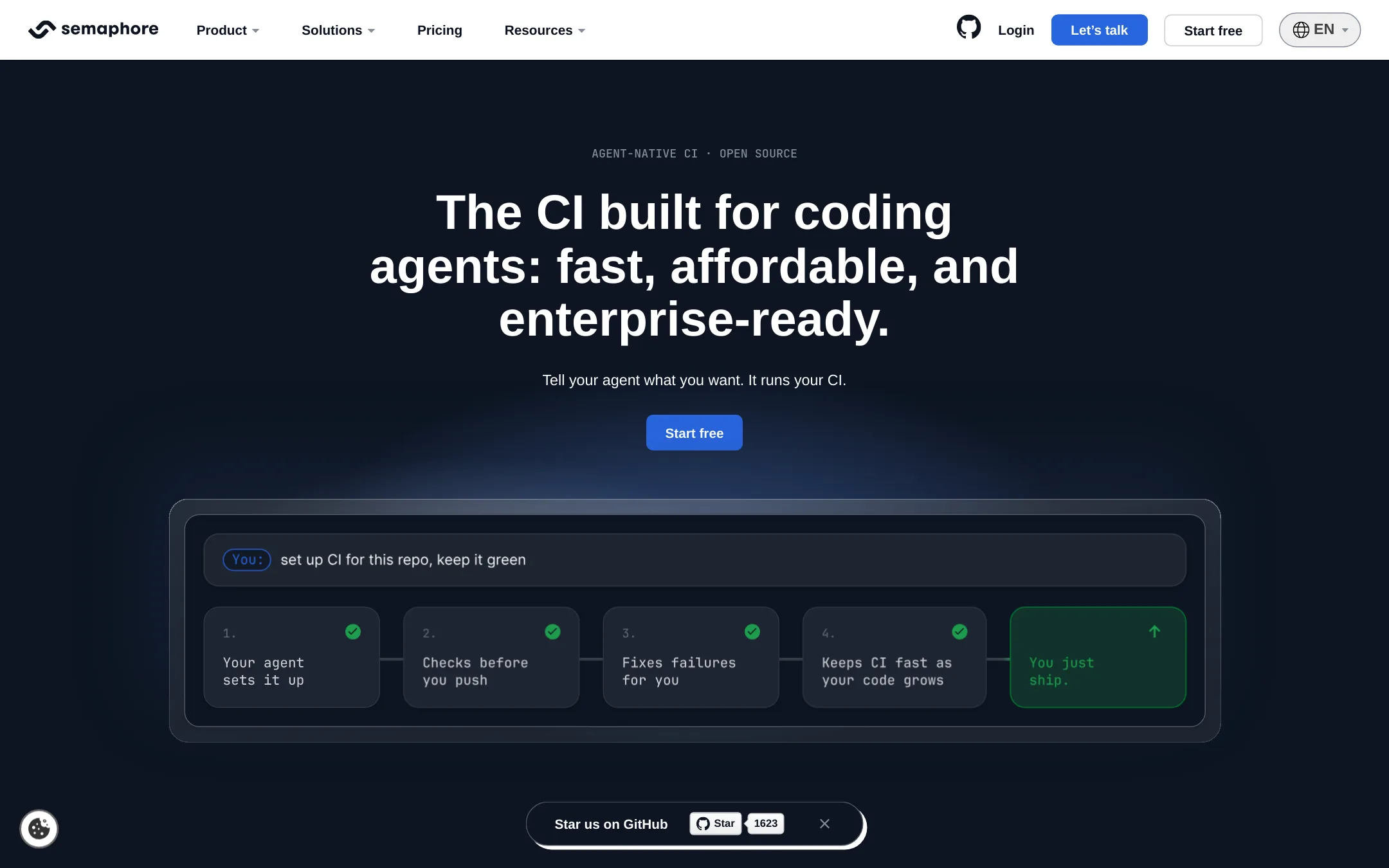
Semaphore is a CI/CD platform built for coding agents, with pay-as-you-go compute pricing and no per-seat fees. Choose it over BuildBuddy if you want an agent-native CI that your AI coding agent can set up and maintain, rather than a Bazel-specific remote execution platform.
Where it is strong
- Agent-native: your coding agent can set up and run CI without manual configuration.
- Pay-as-you-go compute with no per-seat fees or idle costs.
- Fully open source and self-hostable.
Where it falls short
- Not built for Bazel remote execution like BuildBuddy.
- Support plans with guaranteed SLAs cost extra.
- Pricing:
- Compute starts at $0.003/min for Ubuntu ARM 2vCPU, $0.0075/min for Ubuntu x64 2vCPU, and $0.09/min for macOS. Every org gets $15 free usage per month. Support plans start at $50/month.
- Switching from BuildBuddy:
- Moving from BuildBuddy means replacing Bazel remote execution with Semaphore's standard CI/CD pipelines, so you'll need to adapt your build configuration.
See more comparisons in Developer Tools alternatives.
FAQ
Questions about BuildBuddy alternatives
Which alternative is best for teams already using AWS?
AWS ParallelCluster is the best fit if you need flexible HPC cluster management on AWS. It supports diverse workloads beyond Bazel, but it lacks Bazel-specific features like remote caching or build result UI.
What is the most cost-effective option for small teams?
GitHub Projects is free for unlimited repositories and basic project management, but it is not a build tool. For CI/CD, Semaphore offers pay-as-you-go compute starting at $0.003 per minute with no per-seat fees, and every org gets $15 free usage per month.
Which alternative provides the deepest Bazel integration?
EngFlow is built by Bazel experts and supports Bazel, Goma, and Soong. It offers remote execution and caching for very large codebases, but pricing is not published and requires contacting sales.
Are there any self-hosted options?
Jenkins is a free, open-source automation server that you can self-host, with 2300+ plugins. TeamCity is also self-hosted and supports many languages, but neither has Bazel-specific remote execution.
Which alternative works with multiple build systems?
Gradle Enterprise (now Develocity) works with Gradle, Maven, and other build systems, not just Bazel. It includes predictive test selection and AI-assisted optimization, but pricing is not public.
Last updated October 16, 2026.