
Bytebot alternatives
5 products compared · Updated November 16, 2026
The short answer
The three strongest alternatives to Bytebot are Simular, Browserbase, and Anthropic. Simular suits operators with heavy repetitive screen work who want an agent on their own Mac or Windows machine. Browserbase suits engineering teams building web agents that log in, fill forms, or scrape data at high concurrency. Anthropic suits individuals and teams who need a capable AI model for coding, finance, and research rather than a sandboxed desktop agent.
Your shortlist, at a glance
Read the comparisons ↓ AnthropicFrom $0 / $17 per moIndividuals and teams that need a capable AI model for coding, finance, and research work rather than a sandboxed desktop agent
 ChatGPTNot publishedFounders and operators who want a general AI assistant for writing, research and coding rather than automating UI work across desktop apps
- BBrowserbaseNot publishedEngineering teams building web agents that log in to sites, fill forms, or scrape data at high concurrency
- AAdept AINot publishedEngineering teams building custom web automation agents on top of a multimodal model API
- SSimularFrom $0 · $50/moMultitaskers and operators with heavy repetitive screen work who want an agent on their own Mac or Windows machine
About Bytebot and its alternatives
Bytebot is an open source container for AI desktop agents. You describe a task, and it boots a fresh, sandboxed computer where the agent works across apps by looking at the screen and clicking and typing through the UI. According to its site, it can scale from one agent to hundreds running in parallel, and it can run locally with Docker Compose, on Railway, or on AWS, GCP, or Azure.
When comparing alternatives in this category, weigh the pricing structure first, since some tools charge per seat, some by usage credits, and some by the hour a cloud computer runs. Check which regions and operating systems a tool supports, whether it integrates with the apps your work depends on, what support and service levels are offered, and what the contract terms say about data use and minimum commitments.
Explore the alternatives
- From $0 / $17 per mo
1.Anthropic
Best for: Individuals and teams that need a capable AI model for coding, finance, and research work rather than a sandboxed desktop agent
- Pricing
- From $0 / $17 per mo
- Category
- AI & Machine Learning
Anthropic builds the Claude family of AI models, which can run coding and knowledge work through chat, desktop, and developer tools. Someone would pick it over Bytebot when they need a model for reasoning, coding, or analysis rather than a sandboxed computer that an agent drives through the screen. Bytebot runs the desktop, while Anthropic supplies the underlying model.
Where it is strong
- Free tier lets you try Claude without a card
- Plans range from individual Pro to Max and Ultra for heavy use
- Claude Code and API credits included on higher tiers for building
Where it falls short
- Usage limits reset every 5 hours and every week, and heavier plans are needed for all-day work
- Does not provide a sandboxed desktop environment for agents to operate the UI the way Bytebot does
- Pricing:
- Free plan has limited usage, Pro is $17 per month on annual billing or $20 monthly, Max is $100 per month, and Ultra is $200 per month.
- Not published
2.ChatGPT
Best for: Founders and operators who want a general AI assistant for writing, research and coding rather than automating UI work across desktop apps

- Pricing
- Not published
- Category
- AI & Machine Learning
ChatGPT is a general AI chatbot for answering questions, writing, making images, and coding. Teams pick it over Bytebot when they need help thinking through a problem or producing text and code, not an agent that operates a sandboxed desktop to click through software.
Where it is strong
- Works in a chat window with no setup or infrastructure to run
- Handles writing, image creation, file uploads and coding in one place
- Free access is available to start, with a sign-up for saved chats and file uploads
Where it falls short
- It does not operate a computer or click through software the way Bytebot does
- Chats may be reviewed and used to improve its AI models, according to the site
- Pricing:
- Pricing is not published on the site.
- BNot published
3.Browserbase
Best for: Engineering teams building web agents that log in to sites, fill forms, or scrape data at high concurrency
- Pricing
- Not published
- Category
- Other
Browserbase gives agents a real cloud browser they can drive like a person, along with Search and Fetch APIs for pulling web content. A team would pick it over Bytebot when the work lives on websites that have no API, such as login-gated portals, forms, or sites that need captcha handling. Bytebot runs a full desktop, while Browserbase focuses on the browser layer.
Where it is strong
- Browser sessions run at scale, with up to 250+ concurrent browsers on the enterprise plan
- Search and Fetch APIs return web content for agents in HTML, JSON or markdown
- Built-in captcha solving and stealth options for sites that block automation
Where it falls short
- Browser-only, so it cannot run desktop apps or a full operating system the way Bytebot does
- The site does not publish a self-hosted option like Bytebot's Docker deployment
- Pricing:
- Pricing is not published on the site.
- ANot published
4.Adept AI
Best for: Engineering teams building custom web automation agents on top of a multimodal model API
- Pricing
- Not published
- Category
- Other
Adept AI is an ML research lab that builds multimodal models and agent tooling, including the Adept Workflow Language for composing web interactions on top of its models. Teams would look at it when they want to build their own agents on a research-grade model stack rather than run a ready-made desktop agent container like Bytebot.
Where it is strong
- Builds its own multimodal models designed for digital agents, such as Fuyu-Heavy
- Offers Adept Workflow Language for composing multimodal web interactions
- Has published open-source models, including Fuyu-8B and Persimmon-8B
Where it falls short
- The site describes research and models, not a packaged desktop agent you can run yourself like Bytebot
- Pricing and access details are not published on the site
- Pricing:
- Pricing is not published on the site.
- SFrom $0 · $50/mo
5.Simular
Best for: Multitaskers and operators with heavy repetitive screen work who want an agent on their own Mac or Windows machine
- Pricing
- From $0 · $50/mo
- Category
- Other
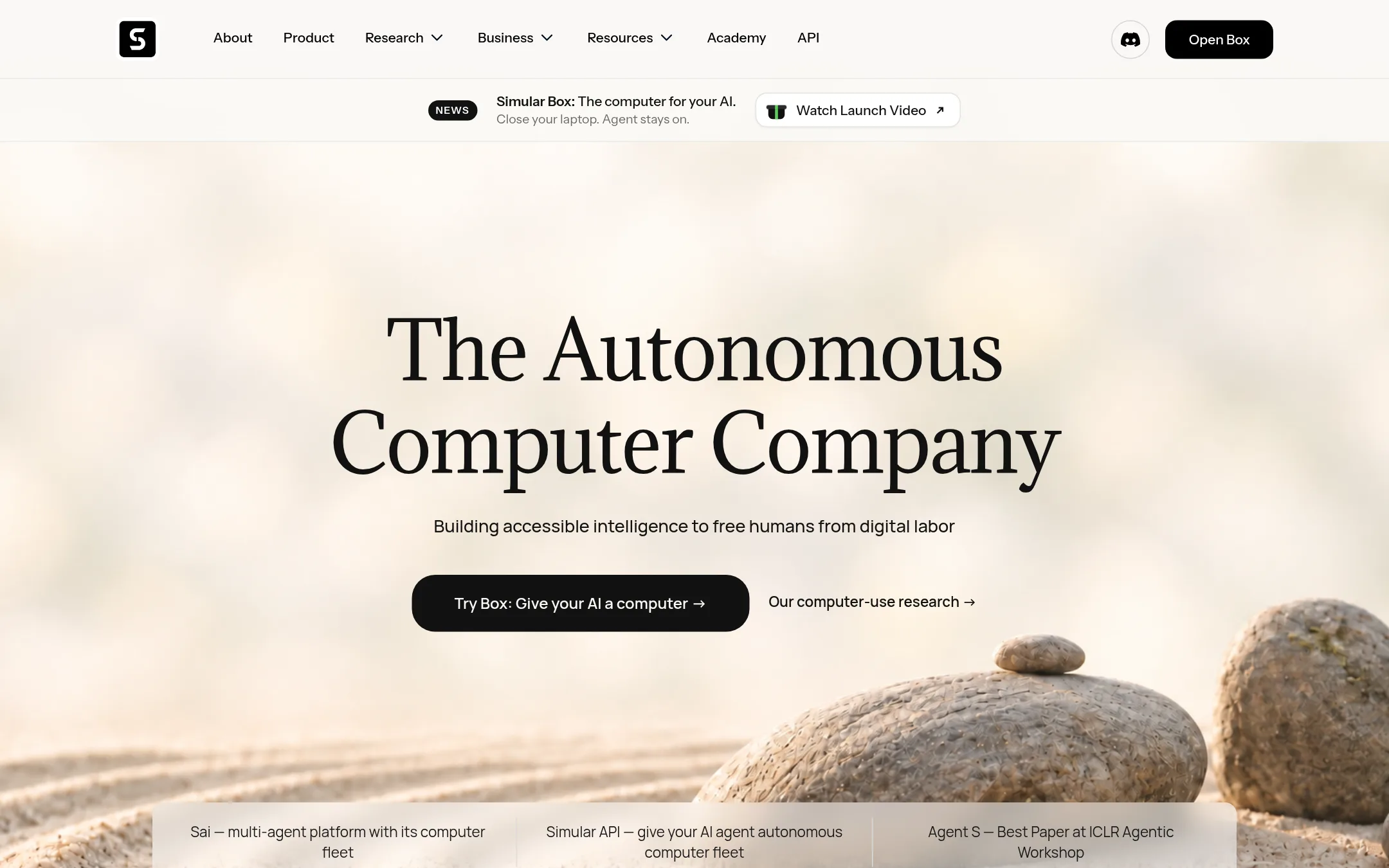
Simular builds Sai, a computer-use agent that runs on your own Mac or Windows machine or on a cloud Windows or Linux computer. It is built on research from ex-DeepMind scientists and uses a neurosymbolic approach meant to make multi-step tasks more reliable and cheaper over time. Pick it over Bytebot if you want to run an agent on your own laptop or need a plan with a cloud computer billed only while it runs.
Where it is strong
- Runs on your own Mac or Windows device, with no computer cost for that mode
- Free plan lets you try it and build workflows before paying
- Offers Windows and Linux cloud computers billed only while they run
Where it falls short
- The site does not state a Bytebot-style open source container, so self-hosting is not described
- Enterprise pricing and SLAs are only available through a sales contact
- Pricing:
- The free plan is $0 with daily credits, Pay as you go is $50 a month for 50,000 credits and up to 5 cloud computers, Sai Unlimited is $500, and Enterprise is custom.
See more comparisons in Developer Tools alternatives.
FAQ
Questions about Bytebot alternatives
What is Bytebot best known for?
According to its site, Bytebot is an open source container for AI desktop agents. It boots a sandboxed computer for each task and completes work across apps by working through the screen. It can run locally with Docker Compose or be deployed on Railway or AWS, GCP, or Azure.
Which alternative should I pick if I want an agent on my own computer?
Simular is the closest fit for that case. It runs its Sai agent on your own Mac or Windows machine, and it also offers cloud Windows and Linux computers that are billed only while they run. Its free plan lets you try it before paying.
Which alternative works best for web tasks with no API?
Browserbase is built for that. It gives agents real cloud browsers that can log in to sites, fill forms, and handle captchas, and it supports high concurrency. It is browser-only, so it cannot run desktop apps the way Bytebot does.
Can I use a general AI assistant instead of a desktop agent?
Yes, for writing, research, and coding help. ChatGPT and Anthropic's Claude work in a chat window with no infrastructure to run, but neither operates a sandboxed computer or clicks through software the way Bytebot's agents do.
How should I compare pricing across these options?
Compare the billing model, not just the headline price. Simular lists a $50 monthly plan with 50,000 credits and cloud computers, Anthropic lists individual and heavier tiers with usage limits, and Browserbase and Adept AI do not publish pricing on their sites, so you will need to ask their sales teams for quotes.
Last updated November 16, 2026.