
CTGT alternatives
7 products compared · Updated November 22, 2026
The short answer
The three strongest alternatives to CTGT are Fiddler AI, Arthur AI and Credo AI. Fiddler AI suits regulated enterprises such as financial services, healthcare and government that want one platform to monitor and govern many AI agents, with inline guardrails under 80ms. Arthur AI suits enterprise security and audit teams that need to find and govern agents across a large, mixed environment, including unsanctioned ones. Credo AI suits regulated enterprises that need one registry and audit trail for all their AI systems, with policy packs for the EU AI Act and NIST AI RMF.
Your shortlist, at a glance
Read the comparisons ↓- GGuardrails AINot publishedEngineering teams building production GenAI apps that need runtime guardrails and eval datasets across any LLM
 NVIDIA Base Command PlatformNot publishedAI and HPC teams that need accelerated computing capacity for training and running large models in data centers
- AArthur AIFree / Premium / CustoEnterprise security, audit and AI teams that need to find and govern agents across a large, mixed environment
- CCredo AINot publishedEnterprises in regulated sectors such as insurance, financial services, federal and healthcare that need one registry and audit trail for all their AI systems
- RRobust IntelligenceNot publishedSecurity teams looking for an AI model protection vendor to compare against CTGT
- FFiddler AINot publishedEnterprises in regulated industries such as financial services, healthcare, insurance and government that need one platform to monitor and govern many AI agents
- HHolistic AINot publishedEnterprises with many AI tools, models and agents that need one live inventory and audit evidence for regulators like the EU AI Act
About CTGT and its alternatives
CTGT is an AI security and governance company. Its site says it safeguards against reputational risk from generative AI across an organization. It is known for deterministic policy graphs that govern agent outputs at inference time, with cryptographically attestable audit trails, and it positions its work for regulated domains.
When comparing alternatives in this category, weigh what each tool actually controls: compute capacity, runtime guardrails for your own app, enterprise-wide monitoring, or compliance documentation. Check pricing structure, since some vendors publish tiers and others quote custom enterprise pricing. Also consider regional and hosting options such as VPC or on-premises deployment, the integrations your stack already uses, the level of vendor support, and contract terms.
Explore the alternatives
- GNot published
1.Guardrails AI
Best for: Engineering teams building production GenAI apps that need runtime guardrails and eval datasets across any LLM
- Pricing
- Not published
- Category
- Other
Guardrails AI is an open framework for adding runtime guardrails to LLM apps. It detects policy violations, hallucinations and data leakage and blocks bad outputs before they reach users. It also generates synthetic datasets for evals and fine-tuning. A team would pick it over CTGT when they want to build and test their own agent reliability checks across any LLM and deployment setup, rather than buy a managed layer for regulated, high-stakes use.
Where it is strong
- Runtime guardrails catch policy violations, hallucinations and data leakage before output reaches users
- Synthetic data generation helps build eval sets for edge cases and risky outcomes
- Works across any LLM and deployment environment
Where it falls short
- The site does not describe the deterministic policy graphs or cryptographic audit trails that CTGT emphasizes
- Positioned as a developer toolkit, so teams without engineers to wire it in may find it heavier to adopt
- Pricing:
- Pricing is not published on the site.
- Not published
2.NVIDIA Base Command Platform
Best for: AI and HPC teams that need accelerated computing capacity for training and running large models in data centers
- Pricing
- Not published
- Category
- AI & Machine Learning
NVIDIA Base Command Platform is NVIDIA's offering for AI computing, aimed at data centers and accelerated workloads such as training and running large models. A team would pick it over CTGT when the problem is raw compute capacity for building or training models, not controlling what a deployed AI model outputs.
Where it is strong
- Built on NVIDIA's accelerated computing hardware and software stack
- Covers data center, HPC, networking and AI workloads in one vendor
- Ships with open models and agent tooling such as Nemotron and NVIDIA Agent Toolkit
Where it falls short
- Focused on compute infrastructure, not on governing AI outputs for reputational risk
- The site shows no detail on how it handles audit trails or policy enforcement at inference time
- Pricing:
- Pricing is not published on the site.
- AFree / Premium / Custo
3.Arthur AI
Best for: Enterprise security, audit and AI teams that need to find and govern agents across a large, mixed environment
- Pricing
- Free / Premium / Custo
- Category
- Other
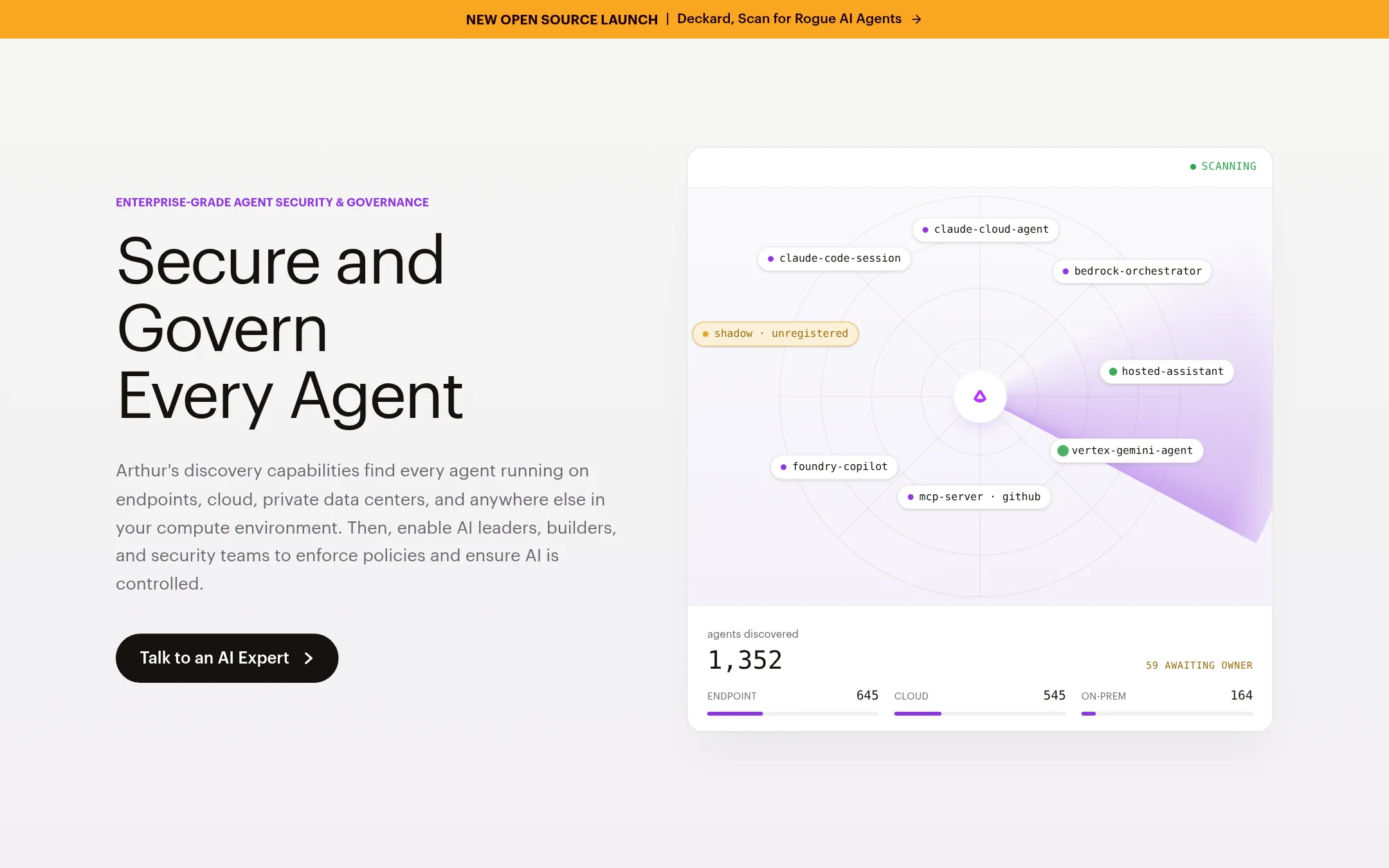
Arthur is an enterprise platform for discovering, monitoring and governing AI agents across endpoints, cloud and private data centers. It offers step-level tracing, runtime security with anomaly alerts, and token cost tracking. Pick Arthur over CTGT when your main concern is seeing and controlling every agent already running in the company, including unsanctioned ones, rather than governing the outputs of a model at inference time.
Where it is strong
- Discovers agents on endpoints, cloud and private data centers, including shadow agents
- Traces each reasoning step, tool call and retrieval for audit and debugging
- Tracks token spend by team and reroutes simple requests to cheaper models
Where it falls short
- Its focus is observability and runtime security, so it does not offer CTGT's deterministic policy graphs or cryptographically attestable aud
- Full governance features, dedicated VPC and SSO sit behind the Enterprise tier
- Pricing:
- Pricing is published for three tiers: a Free plan that monitors up to 4 use cases, a Premium plan that covers up to 100 use cases, and an Enterprise plan with custom pricing for dedicated VPC and SSO.
- CNot published
4.Credo AI
Best for: Enterprises in regulated sectors such as insurance, financial services, federal and healthcare that need one registry and audit trail for all their AI systems
- Pricing
- Not published
- Category
- Other
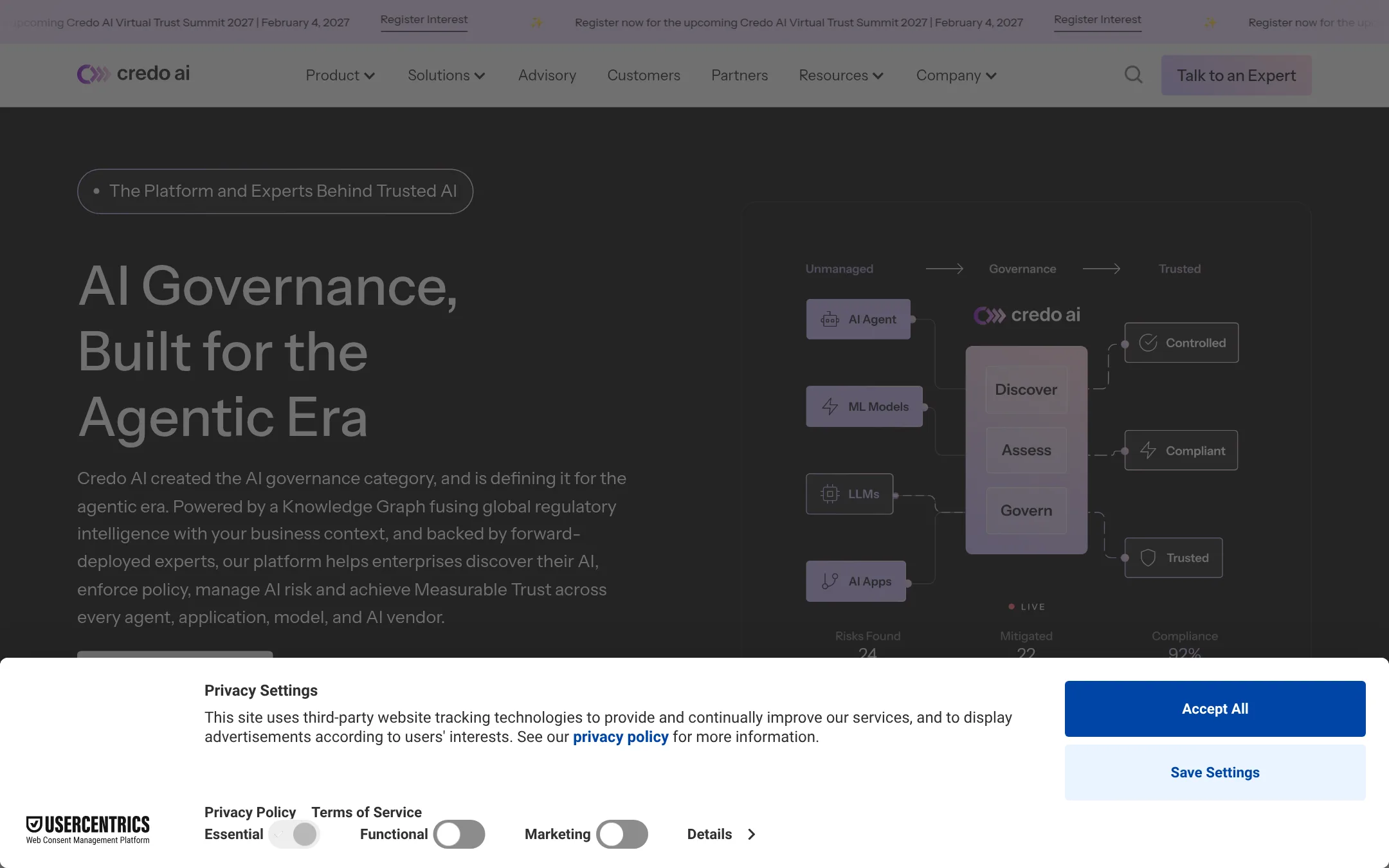
Credo AI is a governance platform for enterprises deploying AI and agents. It keeps a registry of every model, agent, app and vendor, runs risk assessments, and turns regulations like the EU AI Act and NIST AI RMF into policy packs with audit evidence. Choose it over CTGT when the main need is organization-wide oversight and compliance paperwork across the whole AI portfolio, rather than enforcing rules on agent outputs at inference time.
Where it is strong
- Registry covers agents, models, applications and vendors, including shadow AI detection
- Ships with pre-built policy packs for the EU AI Act, NIST AI RMF and ISO 42001
- Connects to existing observability and monitoring tools for continuous monitoring
Where it falls short
- Its focus is governance and documentation, so it does not describe enforcing deterministic policy on agent outputs the way CTGT does
- The site does not say whether it offers cryptographically attestable audit trails
- Pricing:
- Pricing is not published on the site.
- RNot published
5.Robust Intelligence
Best for: Security teams looking for an AI model protection vendor to compare against CTGT

- Pricing
- Not published
- Category
- Other
Robust Intelligence is an AI security vendor, but its website could not be reached when this entry was written, so its product details are unverified here. Someone might choose it over CTGT if they want a different vendor for securing and monitoring AI models, and they should check its current offering directly.
Where it is strong
- Its category is AI security, which overlaps with CTGT's focus on governing GenAI risk
- It is a separate vendor, so it gives buyers a second option to compare
- Its site is listed as a known AI security company, so it is worth a look
Where it falls short
- Its website could not be reached when this entry was written, so features are unverified
- Pricing details are not available from the source provided
- Pricing:
- Pricing is not published on the site.
- FNot published
6.Fiddler AI
Best for: Enterprises in regulated industries such as financial services, healthcare, insurance and government that need one platform to monitor and govern many AI agents
- Pricing
- Not published
- Category
- Other
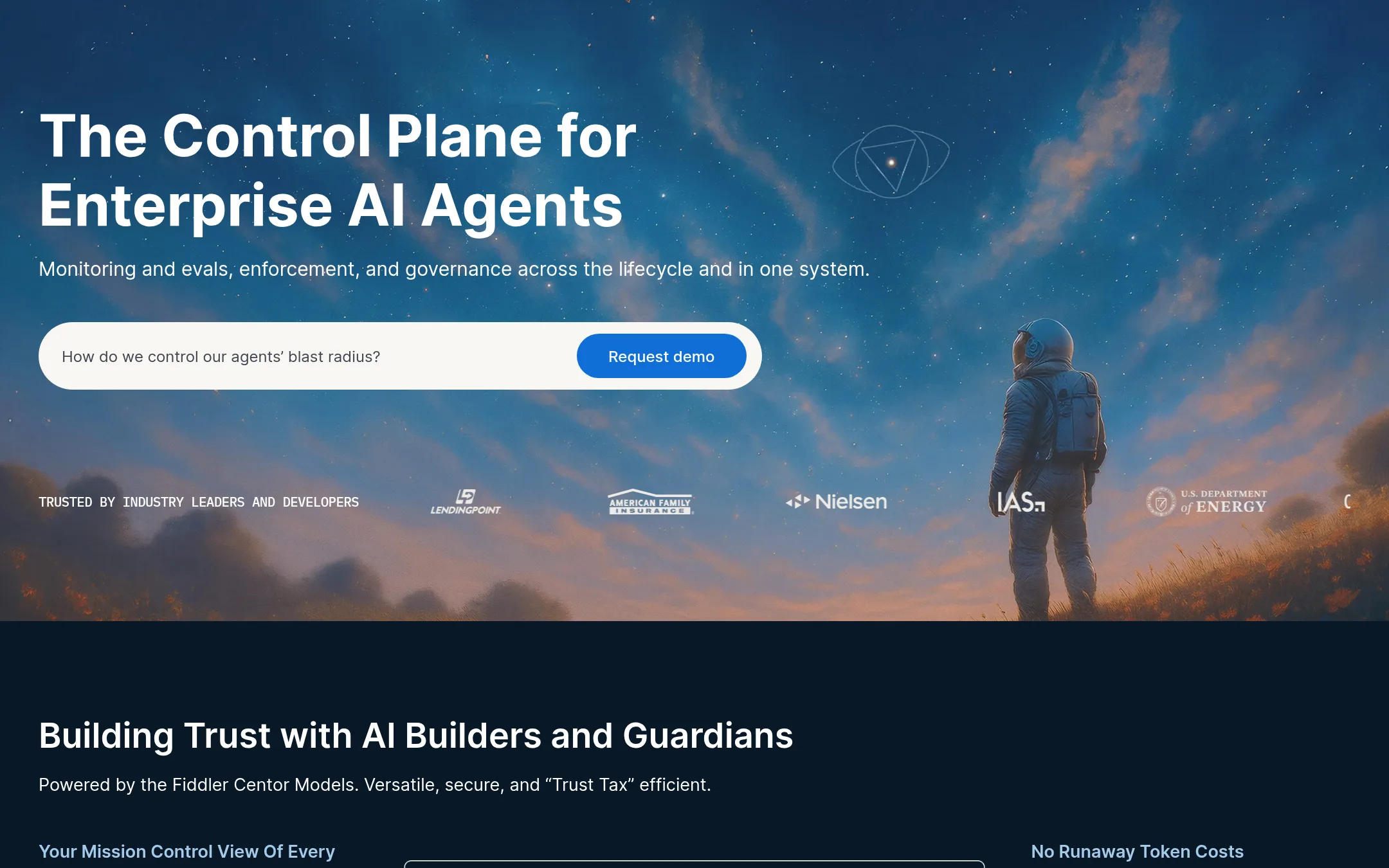
Fiddler AI is an observability and governance platform for AI agents and predictive models. It monitors, evaluates, and enforces policy on agent requests and responses, including inline guardrails that run in under 80ms. Teams pick Fiddler over CTGT when they need visibility across the full lifecycle, from coding agents through production, and want a model- and cloud-agnostic tool that can run in their own VPC or on-premises.
Where it is strong
- Inline guardrails stop violations at the request and response path before data leaves the network
- Covers both the creation layer and the production layer of agents
- Deploys as SaaS, in a VPC, or on-premises, and runs on AWS GovCloud
Where it falls short
- Built around monitoring and governance dashboards, so it does not center on the deterministic inference-time policy graphs and attestable au
- Pricing is custom for enterprise use, so smaller teams need to request a quote to compare costs
- Pricing:
- Pricing is not published on the site.
- HNot published
7.Holistic AI
Best for: Enterprises with many AI tools, models and agents that need one live inventory and audit evidence for regulators like the EU AI Act
- Pricing
- Not published
- Category
- Other
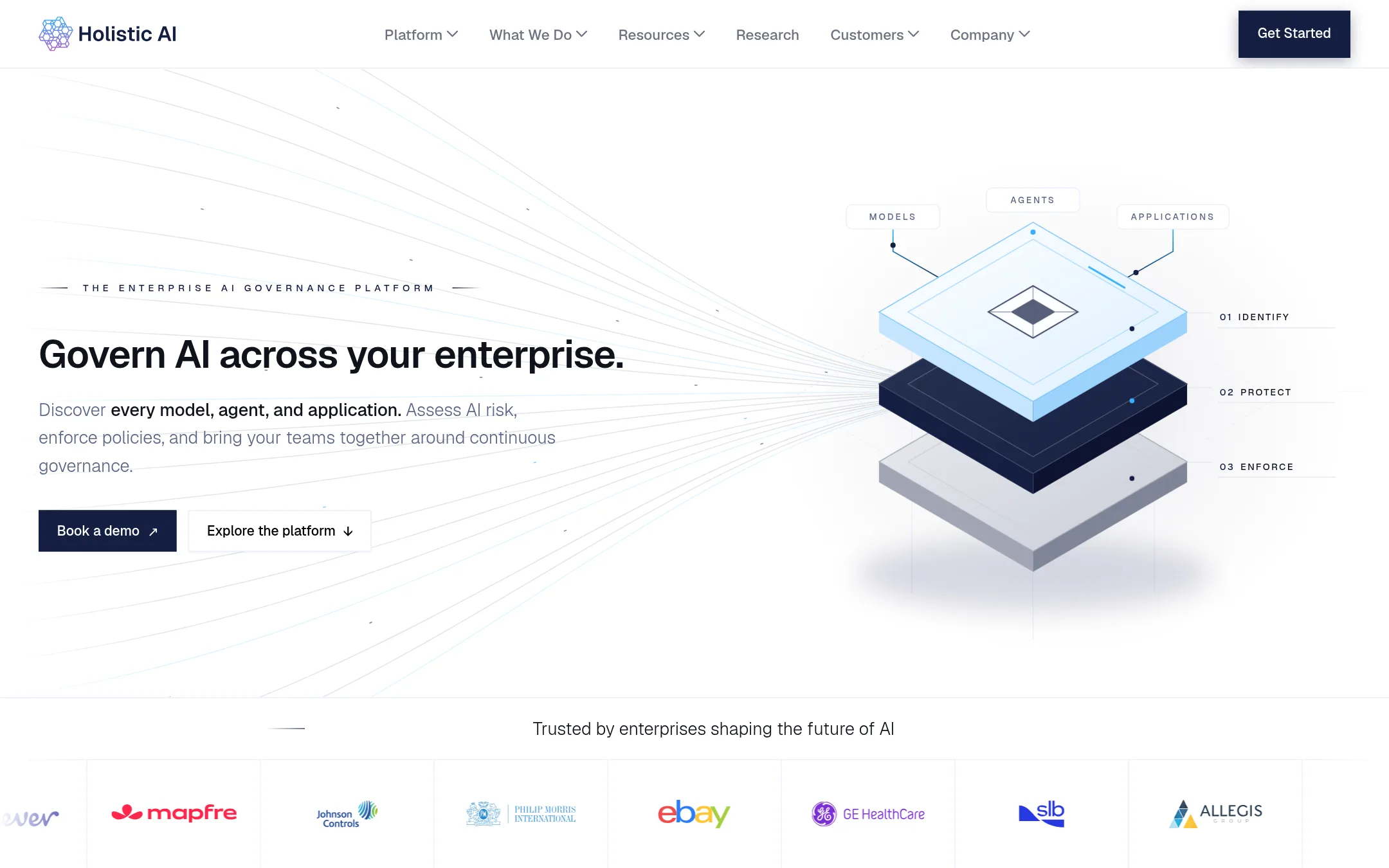
Holistic AI is an AI governance platform for enterprises. It discovers every AI system in an organization, including shadow AI, tests models and agents for security, safety and bias, and turns policies into controls with audit-ready evidence. Choose it over CTGT when the main problem is inventory, risk assessment and compliance proof across a large AI estate rather than enforcing rules on individual agent outputs at inference time.
Where it is strong
- Finds shadow AI across cloud, code and SaaS and keeps an inventory current
- Runs bias, security and safety tests on models, LLMs and agents before launch and in production
- Collects compliance evidence automatically for auditors and boards
Where it falls short
- The site describes a broad governance suite, so it may be more than a team needs if the goal is only output control
- Its emphasis is on discovery and compliance workflows rather than the deterministic policy graphs and cryptographic attestation CTGT describ
- Pricing:
- Pricing is not published on the site.
See more comparisons in Security & Privacy alternatives.
FAQ
Questions about CTGT alternatives
Which CTGT alternative is best for a regulated enterprise with many AI agents?
Fiddler AI is written up as suited to enterprises in regulated industries such as financial services, healthcare, insurance and government. It monitors, evaluates and enforces policy on agent requests and responses, and it can run as SaaS, in a VPC, or on-premises. Pricing for enterprise use is custom, so you would need to request a quote.
I need to find AI agents that employees are already running. Which tool handles that?
Arthur AI is described as discovering agents across endpoints, cloud and private data centers, including shadow agents. It also traces each reasoning step and tool call for audit and debugging. Its full governance features, including dedicated VPC and SSO, sit behind the Enterprise tier.
Which option is best for compliance documentation across the whole AI portfolio?
Credo AI keeps a registry of models, agents, applications and vendors, and it ships with policy packs for the EU AI Act, NIST AI RMF and ISO 42001. Its focus is governance and audit evidence rather than enforcing rules on individual outputs. The site does not say whether it offers cryptographically attestable audit trails.
I am building my own GenAI app and want runtime checks. Should I consider something else?
Guardrails AI is an open framework for adding runtime guardrails to LLM apps. It detects policy violations, hallucinations and data leakage, and it works with any LLM and deployment setup. It is positioned as a developer toolkit, so teams without engineers to integrate it may find it harder to adopt.
Is Robust Intelligence a verified option, and how should I evaluate it?
Robust Intelligence's website could not be reached when this entry was written, so its product details are unverified here. It is included because it works in AI security, which overlaps with CTGT. Check its current offering and pricing directly before comparing it to the other options.
Last updated November 22, 2026.