Dedalus Labs alternatives
6 products compared · Updated November 23, 2026
The short answer
The three strongest Dedalus Labs alternatives are Fly.io, E2B and Modal. Fly.io suits engineering teams deploying web apps, APIs and agent fleets across many regions. E2B suits teams running many parallel agent sessions that need strict isolation or sandboxes inside their own cloud account. Modal suits AI teams that need bursty GPU inference, training or batch jobs and want to pay only for active compute.
Your shortlist, at a glance
Read the comparisons ↓- EE2B$150/mo + per-secondEngineering teams running many parallel agent sessions that need strict isolation, or enterprises that must keep sandboxes inside their own cloud account
- DDaytona$0.0504/vCPU-hourTeams running untrusted AI-generated code who need fast, disposable sandboxes billed per second
 ModalFrom $30/mo free crediAI teams that need bursty GPU inference, training or batch jobs and want to pay only for active compute
 Fly.ioFrom $2.19/mo + usageEngineering teams deploying web apps, APIs and agent fleets across many regions that need managed Postgres and object storage
 ReplitNot publishedNon-technical founders and small product teams who want a working app or website built and published from a plain-language description
- CCodeSandboxNot publishedAI product teams that need many isolated sandboxes for running untrusted code or parallel agent evals
About Dedalus Labs and its alternatives
Dedalus Labs provides persistent virtual machines for agents. According to its site, its machines run full Linux with root and shell access, Docker and systemd, sleep when idle and wake on any command or SSH session, and can resize CPU and RAM without stopping. It also highlights that an agent can resize its own machine through an API call, and that Claude Code, Codex, vim and htop run through a real terminal.
When comparing alternatives in this category, weigh how each product bills, since some charge per second of active compute and others per machine preset. Check which regions the platform runs in, how well it connects to the tools you already use, what level of support you get, and what the contract terms are for enterprise use, including SSO, audit logs and uptime guarantees.
Explore the alternatives
- E$150/mo + per-second
1.E2B
Best for: Engineering teams running many parallel agent sessions that need strict isolation, or enterprises that must keep sandboxes inside their own cloud account

- Pricing
- $150/mo + per-second
- Category
- Other
E2B runs an isolated Firecracker microVM for each AI agent session, with APIs for code execution, networking, files, secrets, pause and fork. Teams pick it over Dedalus Labs when they need a per-session sandbox they can run in their own AWS, GCP or Azure account, or when they are running agent evaluations or reinforcement learning at high parallel volume.
Where it is strong
- Each session gets its own microVM with a dedicated kernel, booted from a snapshot.
- Can be deployed in your own AWS, GCP or Azure account, or on a single node via E2B Embed.
- Secrets vault keeps API keys out of the sandbox, and egress policy controls network access.
Where it falls short
- Enterprise pricing starts at a $2,000 per month commit, which is steep for small teams.
- Persistent and multi-day sessions are only listed on the Enterprise tier, not Pro.
- Pricing:
- The default prices are $100 in one-time credits on Hobby, $150 per month on Pro with usage billed per second, and custom Enterprise pricing starting at a $2,000 per month commit, with compute billed per second and default vCPU at $0.000014/s on Hobby and Pro.
- D$0.0504/vCPU-hour
2.Daytona
Best for: Teams running untrusted AI-generated code who need fast, disposable sandboxes billed per second
- Pricing
- $0.0504/vCPU-hour
- Category
- Other
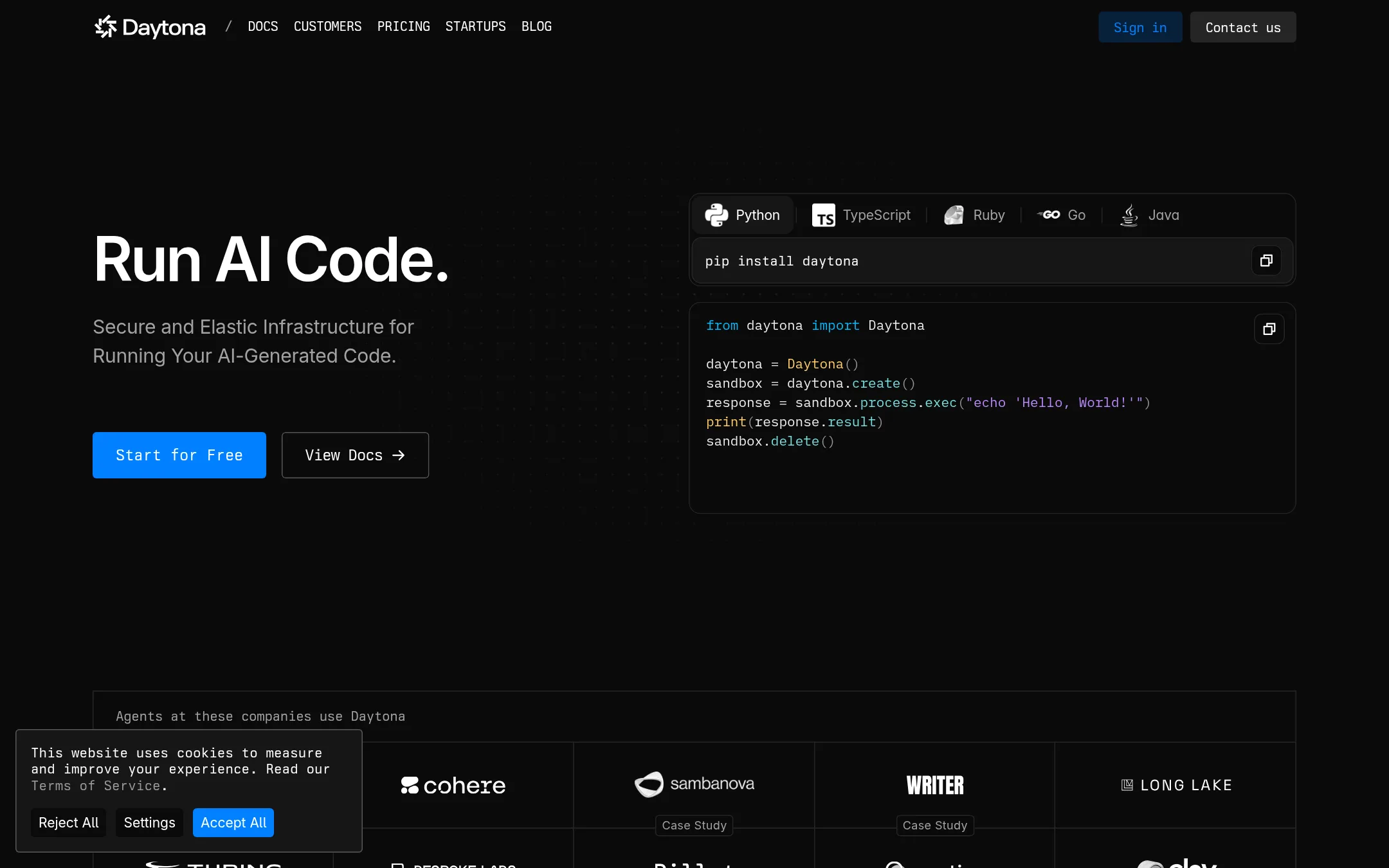
Daytona runs sandboxes for AI-generated code, spinning up isolated environments in milliseconds and shutting them down just as fast. Choose it over Dedalus Labs when you need short-lived, disposable sandboxes for agent-written code rather than long-lived persistent Linux machines. It also offers GPU instances if your workload needs them.
Where it is strong
- Sandboxes start in milliseconds and shut down just as fast
- Billing is per second, with $200 in free compute to start
- Offers GPU options from RTX 4090 up to Nvidia B300, plus Windows and macOS environments
Where it falls short
- The pricing page does not describe a persistent, sleep-and-resume machine model like Dedalus Labs
- Resizing CPU and RAM on a running machine is not mentioned on the site
- Pricing:
- Compute is $0.0504 per vCPU-hour, $0.0162 per GiB memory-hour and $0.000108 per GiB storage-hour after the first 5 GiB free, with $200 in free compute included and pay-as-you-go billing calculated per second.
- From $30/mo free credi
3.Modal
Best for: AI teams that need bursty GPU inference, training or batch jobs and want to pay only for active compute
- Pricing
- From $30/mo free credi
- Category
- AI & Machine Learning
Modal is serverless infrastructure for running AI workloads, covering inference, training, sandboxes for untrusted or agent-driven code, and general compute functions. Teams pick it over Dedalus Labs when they want to run GPU and CPU jobs that scale up and down with demand, instead of keeping persistent VMs running for an agent or developer.
Where it is strong
- Scales to thousands of GPUs and back to zero, with no quota requests for common GPU types
- Sandboxes start in under a second and can run many concurrently for agent workloads
- Enterprise plan includes SSO, audit logs, HIPAA and data residency controls
Where it falls short
- Built around serverless functions and sandboxes, so it is not a persistent VM you SSH into and leave running the way Dedalus Labs is
- Enterprise plan details such as SSO and SLAs are listed only at the enterprise tier, with pricing via custom contact
- Pricing:
- Modal bills per second for resources used, with GPU rates such as $0.001097 per second for an Nvidia H100 SXM5, a Starter plan with $30 of monthly free credits, and a Team plan with $100 of monthly free credits.
- Switching from Dedalus Labs:
- Moving from Dedalus Labs means rebuilding persistent machine workflows as Modal functions or sandboxes, because Modal does not offer the same SSH-into-a-machine model.
- From $2.19/mo + usage
4.Fly.io
Best for: Engineering teams deploying web apps, APIs and agent fleets across many regions that need managed Postgres and object storage
- Pricing
- From $2.19/mo + usage
- Category
- Developer Tools
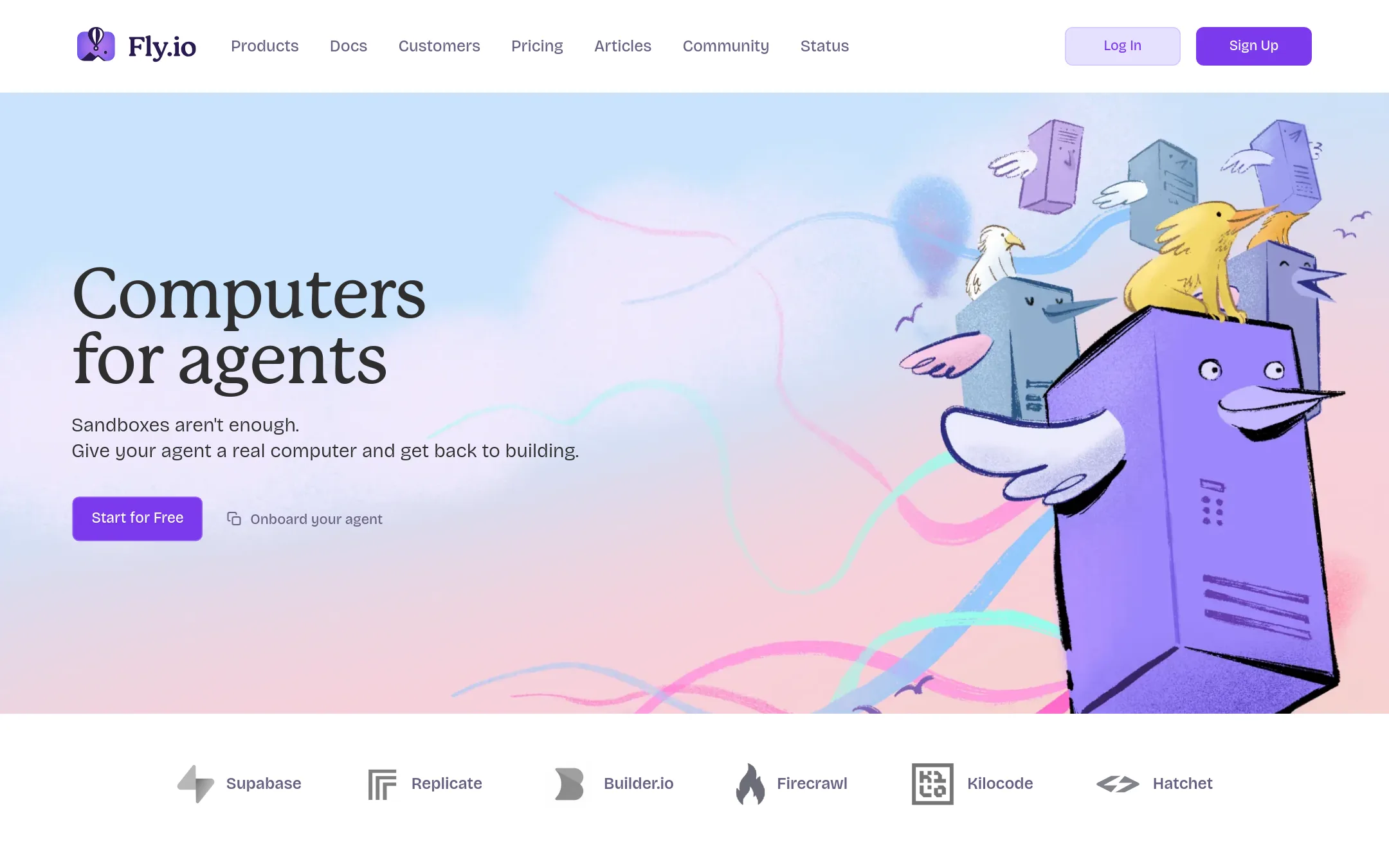
Fly.io runs apps, APIs, databases and AI agent workloads on hardware-isolated Firecracker microVMs in 18 regions. Teams choose it over Dedalus Labs when they need to deploy customer-facing web apps or APIs close to users, or run many parallel agent sandboxes that get checkpointed and discarded. Dedalus Labs centers on persistent Linux VMs you SSH into and resize, which fits a personal or single-agent workspace better.
Where it is strong
- Deploys from GitHub or the CLI with fly launch, and generates a Dockerfile for common frameworks like Rails, Django and Next.js.
- Offers managed Postgres with high availability and automated backups, plus Redis and S3-compatible object storage in the same platform.
- Each computer is its own Firecracker microVM, and a Sprite sleeps at zero compute cost until woken.
Where it falls short
- Compute is priced per machine preset rather than by dynamic CPU and RAM adjustment without stopping, which Dedalus Labs advertises.
- Enterprise features such as SSO and SLA support sit behind paid support tiers rather than a dedicated fleet option like Dedalus Labs' Enterp
- Pricing:
- Machines are billed by the second while running, with the smallest preset (shared-cpu-1x, 256MB) at $2.19 per month, and Pay As You Go has no minimum spend after a $5 monthly free allowance on the Free plan.
- Not published
5.Replit
Best for: Non-technical founders and small product teams who want a working app or website built and published from a plain-language description
- Pricing
- Not published
- Category
- Developer Tools
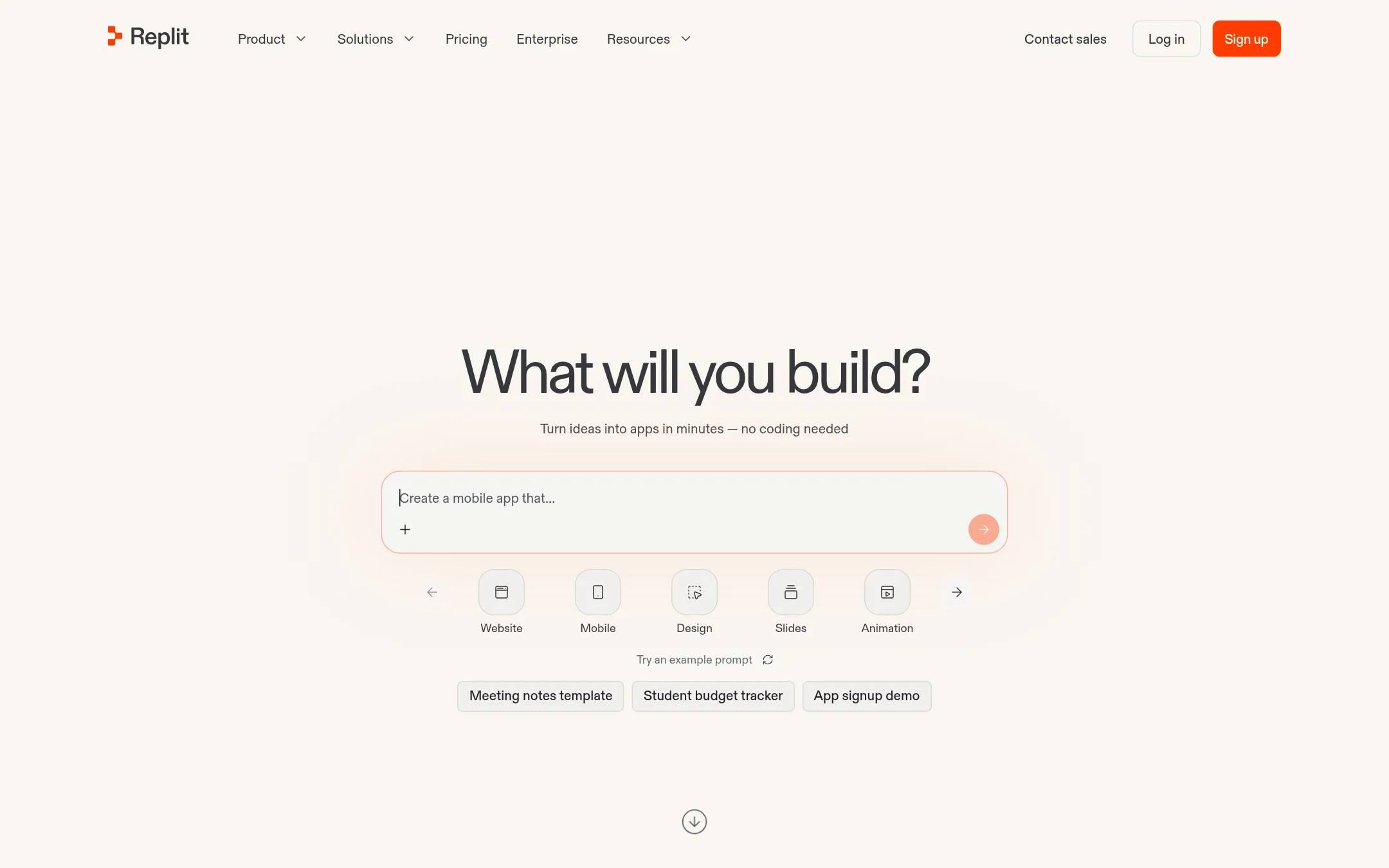
Replit is a browser-based builder where you describe an app or website and it writes, hosts and publishes the code. Founders pick it over Dedalus Labs when they want a finished app built for them rather than a raw Linux machine to run agents on. The homepage highlights built-in authentication, database, hosting and monitoring, plus integrations with services such as Stripe and OpenAI.
Where it is strong
- Builds and publishes apps from a plain description with no coding required
- Authentication, database and hosting are included with no setup
- Offers a free mode for brainstorming and creating without token costs
Where it falls short
- Gives you an app builder rather than persistent Linux VMs with root and Docker access, which Dedalus Labs offers
- Pricing details are not shown on the page, so cost is hard to compare in advance
- Pricing:
- Pricing is not published on the site.
- CNot published
6.CodeSandbox
Best for: AI product teams that need many isolated sandboxes for running untrusted code or parallel agent evals
- Pricing
- Not published
- Category
- Other
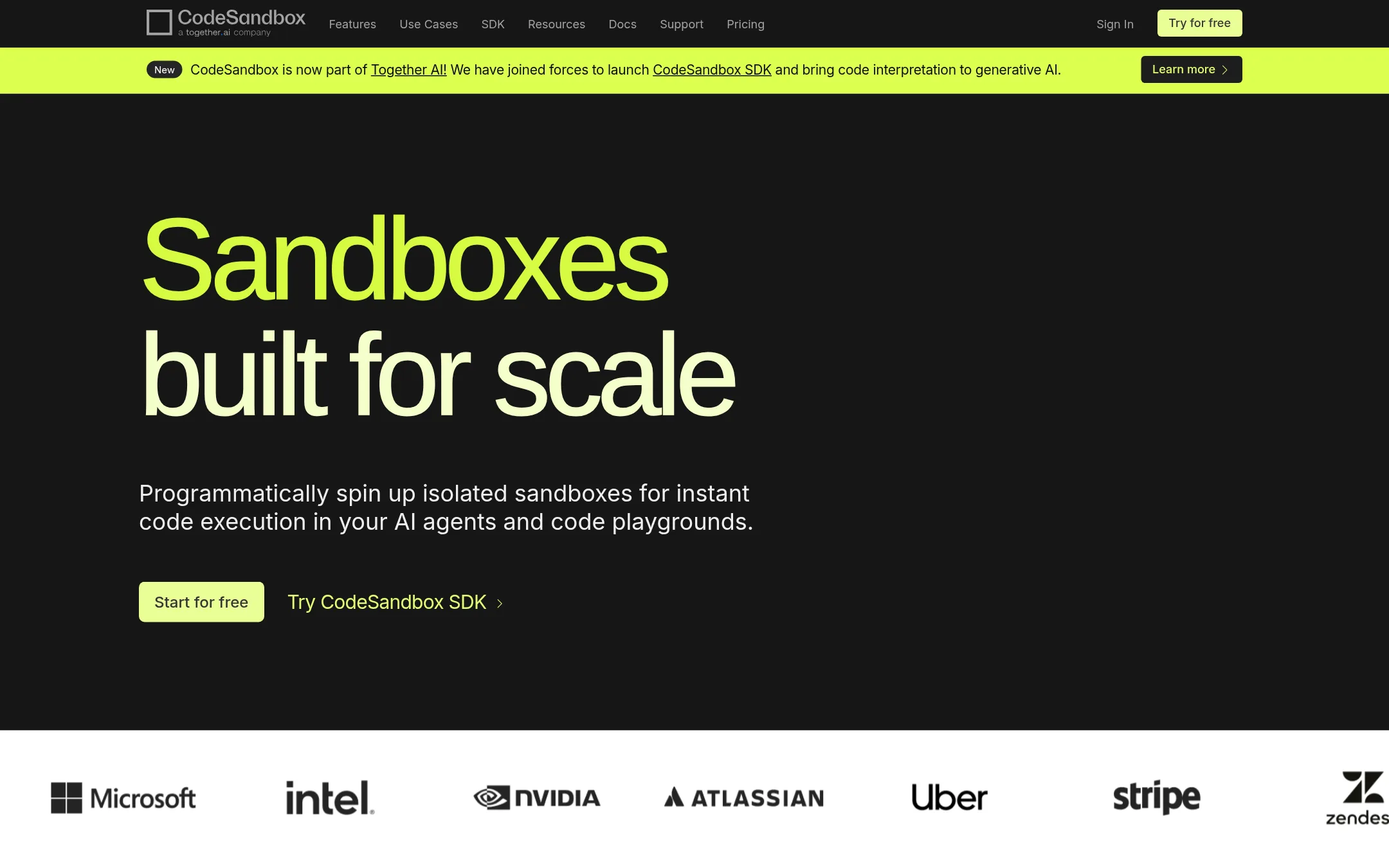
CodeSandbox runs isolated cloud sandboxes through an API, so you can spin up a VM per user or per agent run for untrusted code. It fits teams whose main need is many short-lived, parallel sandboxes for code execution or evals, rather than long-lived persistent machines. Choose it over Dedalus Labs when forking and snapshot-based restore for each sandbox matter more than full persistent Linux VMs.
Where it is strong
- Sandboxes spin up, clone and restore from snapshots within about 2 seconds
- Hibernation timing can be customized per sandbox
- Forking lets you run and A/B test several agents side by side
Where it falls short
- No published pricing to compare against Dedalus Labs' usage-based plans
- Its stated focus is on sandboxes for code execution, not long-running persistent machines with a shell for your own tools
- Pricing:
- Pricing is not published on the site.
See more comparisons in AI & Machine Learning alternatives.
FAQ
Questions about Dedalus Labs alternatives
What is the best alternative to Dedalus Labs for a persistent Linux machine?
The entries do not name a single best option for every case. Fly.io runs persistent machines that sleep at zero compute cost and wake on demand, which suits teams deploying apps and APIs across regions. E2B offers per-session sandboxes with pause and fork, which suits teams running many parallel agent sessions.
Which alternative is cheapest to start with?
Daytona includes $200 in free compute to start and bills per second. Modal's Starter plan includes $30 of monthly free credits. Dedalus Labs gives every account a one-time $20 sign-up credit and a Pro plan with $20 of monthly usage credits for $20 per month.
Which alternatives suit AI teams running GPU workloads?
Modal is built for bursty GPU inference, training and batch jobs, and lists per-second GPU rates such as $0.001097 per second for an Nvidia H100 SXM5. Daytona also offers GPU options from RTX 4090 up to Nvidia B300. Dedalus Labs' pricing page lists CPU and memory rates but no GPU options.
Which alternatives offer enterprise controls such as SSO and data residency?
Modal's enterprise plan includes SSO, audit logs, HIPAA and data residency controls. E2B can deploy sandboxes in your own AWS, GCP or Azure account, but its Enterprise pricing starts at a $2,000 per month commit. Dedalus Labs' Enterprise tier lists SSO, RBAC, audit logs, an SLA and bring-your-own-cloud.
Which alternative is better for untrusted agent-written code?
E2B gives each session its own Firecracker microVM with a dedicated kernel and a secrets vault that keeps API keys out of the sandbox. Daytona creates disposable sandboxes that start in milliseconds for AI-generated code. CodeSandbox offers isolated sandboxes with snapshot-based restore, though its pricing is not published.
Last updated November 23, 2026.