Deepnote alternatives
12 products compared · Updated November 6, 2026
The short answer
The three strongest Deepnote alternatives are Mito, Hex and Jupyter. Mito suits analysts in enterprises who must keep data on their own infrastructure and already work in Jupyter. Hex suits data teams at growing companies that want business users to self-serve trusted answers from AI agents and governed models. Jupyter suits research labs, classrooms and engineering teams that want a free, self-hosted notebook they run themselves.
Your shortlist, at a glance
Read the comparisons ↓ HexNot publishedData teams at growing companies that want business users to self-serve trusted answers from AI agents and governed semantic models
 JupyterNot publishedResearch labs, classrooms and engineering teams that want a free, self-hosted notebook they run on their own infrastructure
- RRecordBookNot publishedSmall businesses that want to track records and workflows from an Android phone without writing code
 DatabricksNot publishedEnterprise data teams that need governed ETL, warehousing and AI on one platform
 ObservableSee websiteDeveloper Tools
 ModeNot publishedData teams that need to hand self-service reporting to business users, with analysis and sharing kept on one platform
 Google ColabSee websiteSign in to access Google Colab notebooks
 Mito$20/user/mo (Pro)Analysts and data scientists in enterprises that must keep data on their own infrastructure and already work in Jupyter
 AlteryxFrom $250/user/moFinance and operations teams at larger enterprises that need governed, repeatable data workflows with audit trails
 Apache AirflowNot publishedEngineering teams that already write Python and need dynamic, scheduled data pipelines they can extend with their own operators
 KNIMECustom quoteBusiness and domain analysts who need data work done without writing code, and data teams that want a visual, open source workflow tool
 LookerNot publishedEnterprise data teams that need one governed set of metrics shared across dashboards and embedded analytics inside a product.
About Deepnote and its alternatives
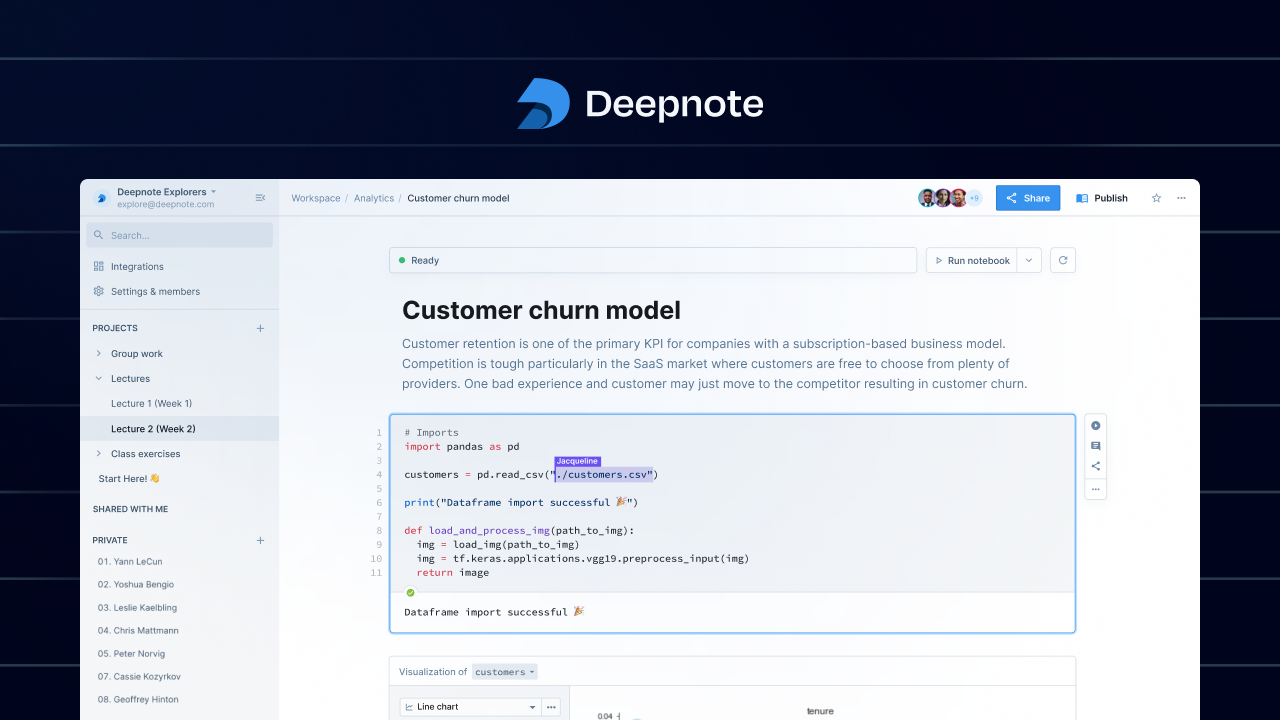
Deepnote is a collaborative data science notebook. According to its site, it is known for letting teams explore data with Python and SQL, share work with colleagues, and turn analyses into dashboards, apps and scheduled pipelines, with more than 100 integrations and a cloud-hosted workspace.
When comparing alternatives, weigh the pricing structure first, since many tools here do not publish prices and per-user, per-compute or enterprise-quote models differ a lot. Also check where your data and code can run, which integrations you need, how much vendor support you get, and what the contract terms look like for your team size.
Explore the alternatives
- Not published
1.Hex
Best for: Data teams at growing companies that want business users to self-serve trusted answers from AI agents and governed semantic models
- Pricing
- Not published
- Category
- Analytics & Data
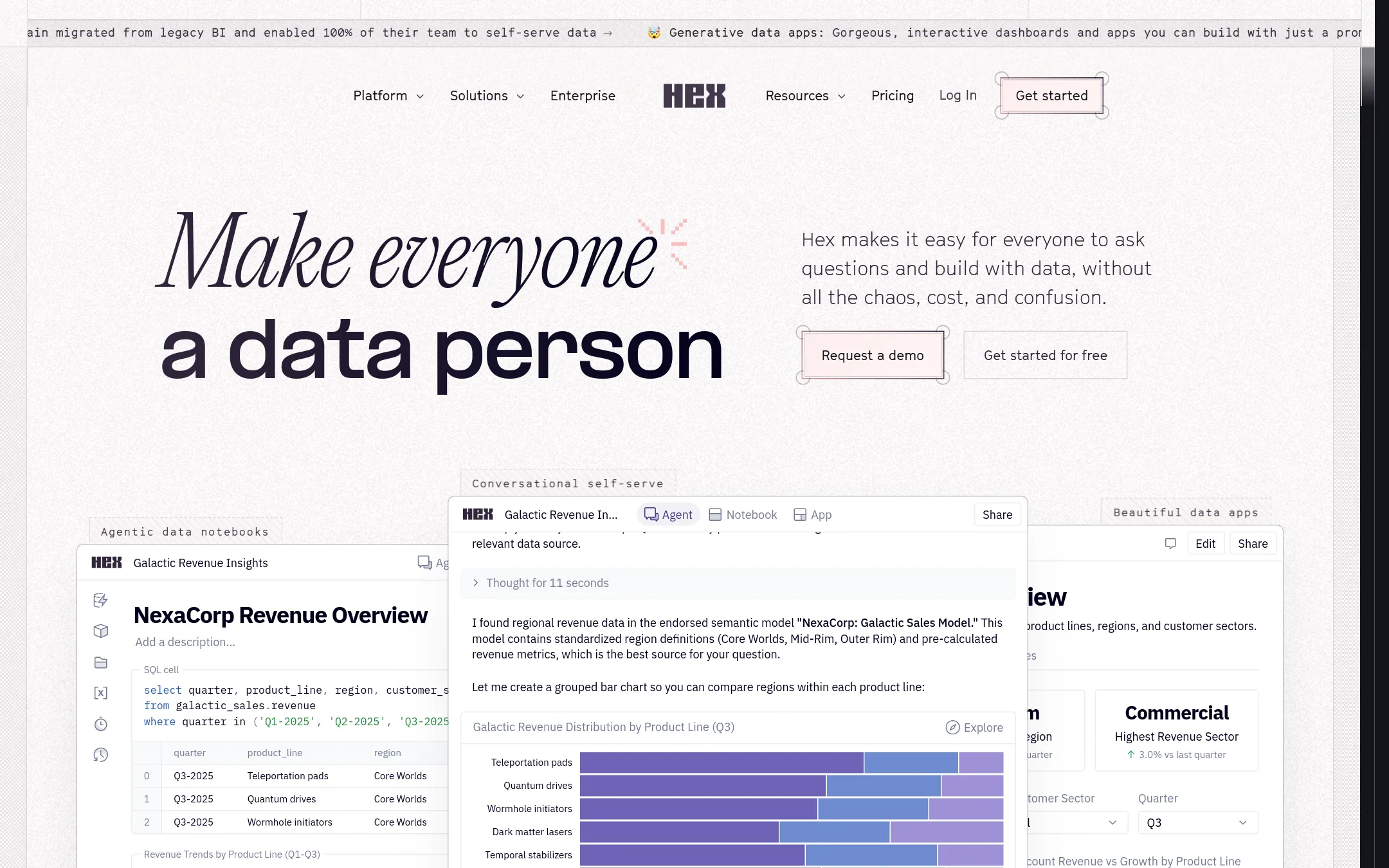
Hex is an analytics platform that combines notebooks, dashboards, data apps and a semantic layer, with AI agents that answer business questions and track context and evals. A team would pick Hex over Deepnote when the main goal is self-serve analytics for non-technical users, governed answers across the company, or moving off a traditional BI tool.
Where it is strong
- Agents answer questions from a semantic model and show their reasoning, so answers can be checked.
- Context Studio and Evals show what people ask and whether the answers are right.
- Works with a choice of AI models, including open source models, with token spend tracking per thread.
Where it falls short
- Its published pricing is mostly plan tiers and compute rates, so total cost is hard to estimate before a sales conversation.
- Its feature set leans toward governed business analytics, so it is a less natural fit for teams whose main work is open-ended notebook resea
- Pricing:
- Pricing is not published in the source for Hex's paid plan rates, but compute is priced per hour, from $0.32/hr for Large up to $4.06/hr for an A10G GPU, and Team and Enterprise can opt in to pay-as-you-go compute.
- Not published
2.Jupyter
Best for: Research labs, classrooms and engineering teams that want a free, self-hosted notebook they run on their own infrastructure
- Pricing
- Not published
- Category
- Developer Tools
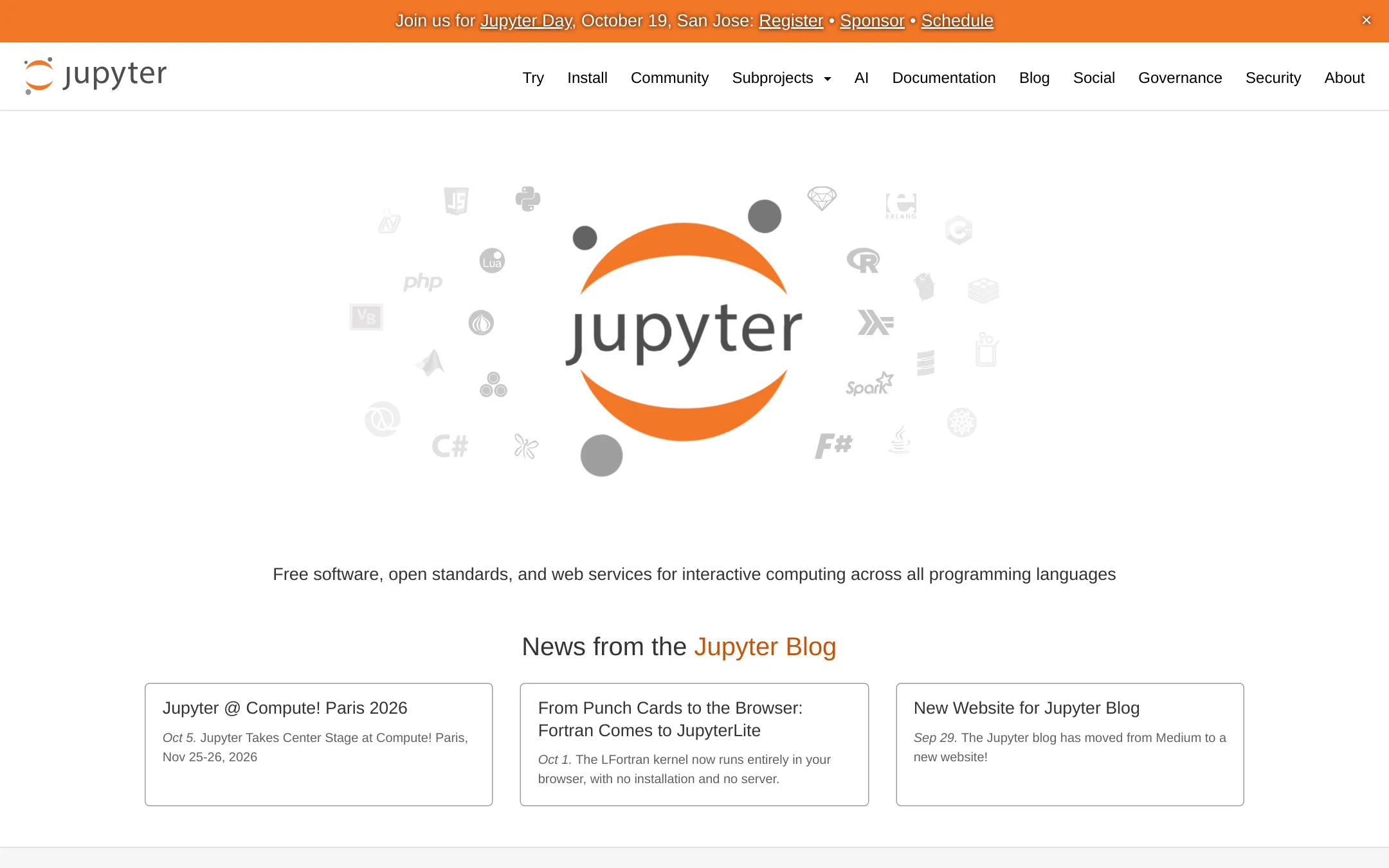
Jupyter is an open-source notebook environment that runs code in over 40 languages, with JupyterLab as its modern interface. Teams pick it over Deepnote when they want a free, self-hosted tool they control, and can run it on their own infrastructure with pluggable authentication and container support.
Where it is strong
- Free and open source under a permissive license, with no per-seat fees
- Supports over 40 programming languages, including Python, R, Julia and Scala
- Can be deployed on your own servers or containers with pluggable authentication
Where it falls short
- No built-in managed cloud, scheduling or hosted GPU machines like Deepnote offers
- Real-time multiplayer editing and commenting are not part of the core product
- Pricing:
- Pricing is not published on the site.
- Switching from Deepnote:
- Notebooks use an open JSON-based format, and Deepnote supports importing and exporting .ipynb files, so existing notebooks can move across.
- RNot published
3.RecordBook
Best for: Small businesses that want to track records and workflows from an Android phone without writing code
- Pricing
- Not published
- Category
- Productivity & Project Management
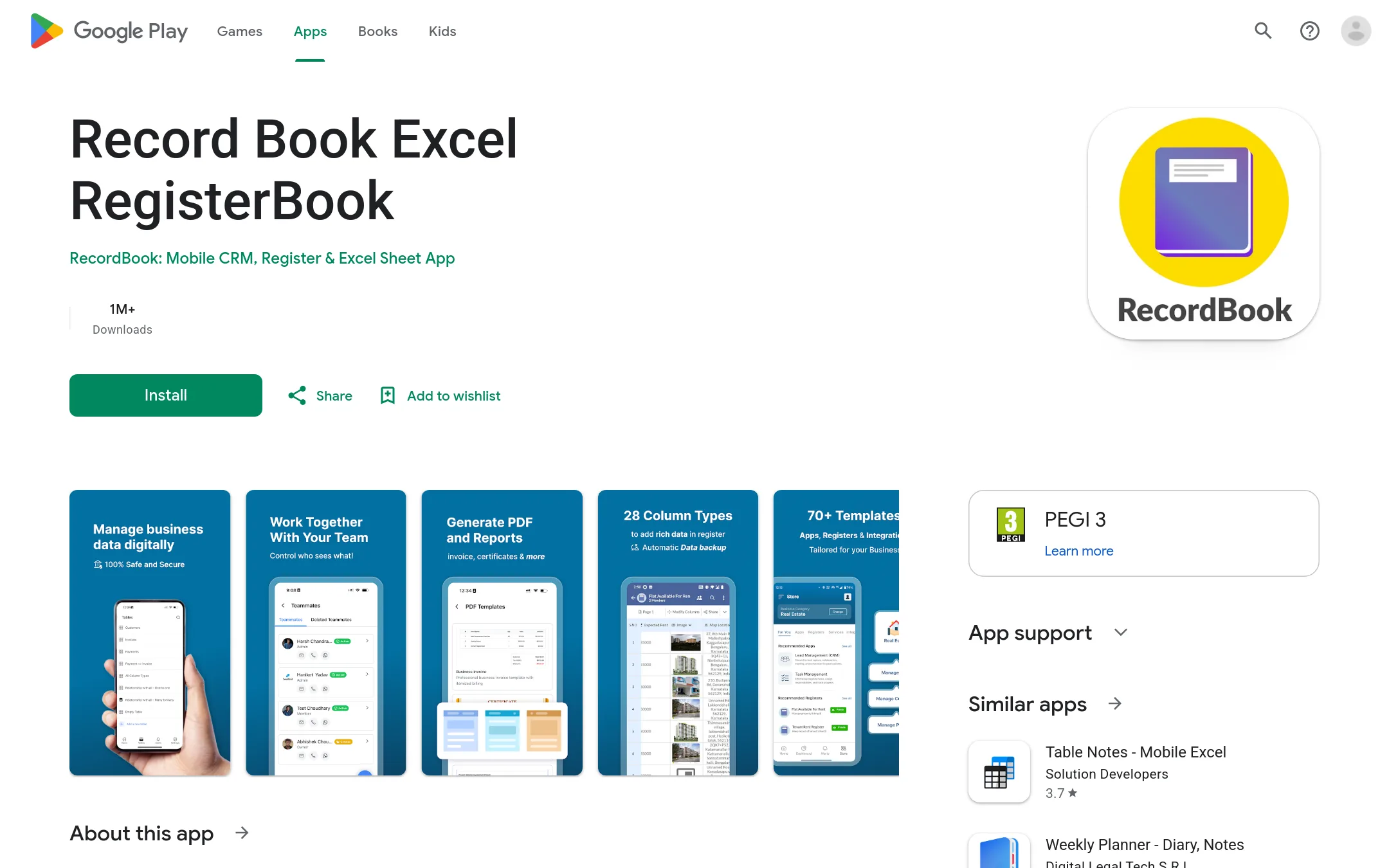
RecordBook is a Google Play app that aims to replace spreadsheets and Airtable-style record tracking for small businesses. Someone would pick it over Deepnote when they need a simple, mobile-first database for everyday business records rather than a notebook for data analysis and code.
Where it is strong
- Built as an Android app available on Google Play
- Aimed at small and medium businesses rather than data teams
- Lets non-technical staff organise records without learning SQL or Python
Where it falls short
- Does not run Python or SQL notebooks, so it cannot replace Deepnote for data analysis
- No pricing or plan details are available from the listing supplied
- Pricing:
- Pricing is not published on the site.
- Not published
4.Databricks
Best for: Enterprise data teams that need governed ETL, warehousing and AI on one platform
- Pricing
- Not published
- Category
- Analytics & Data
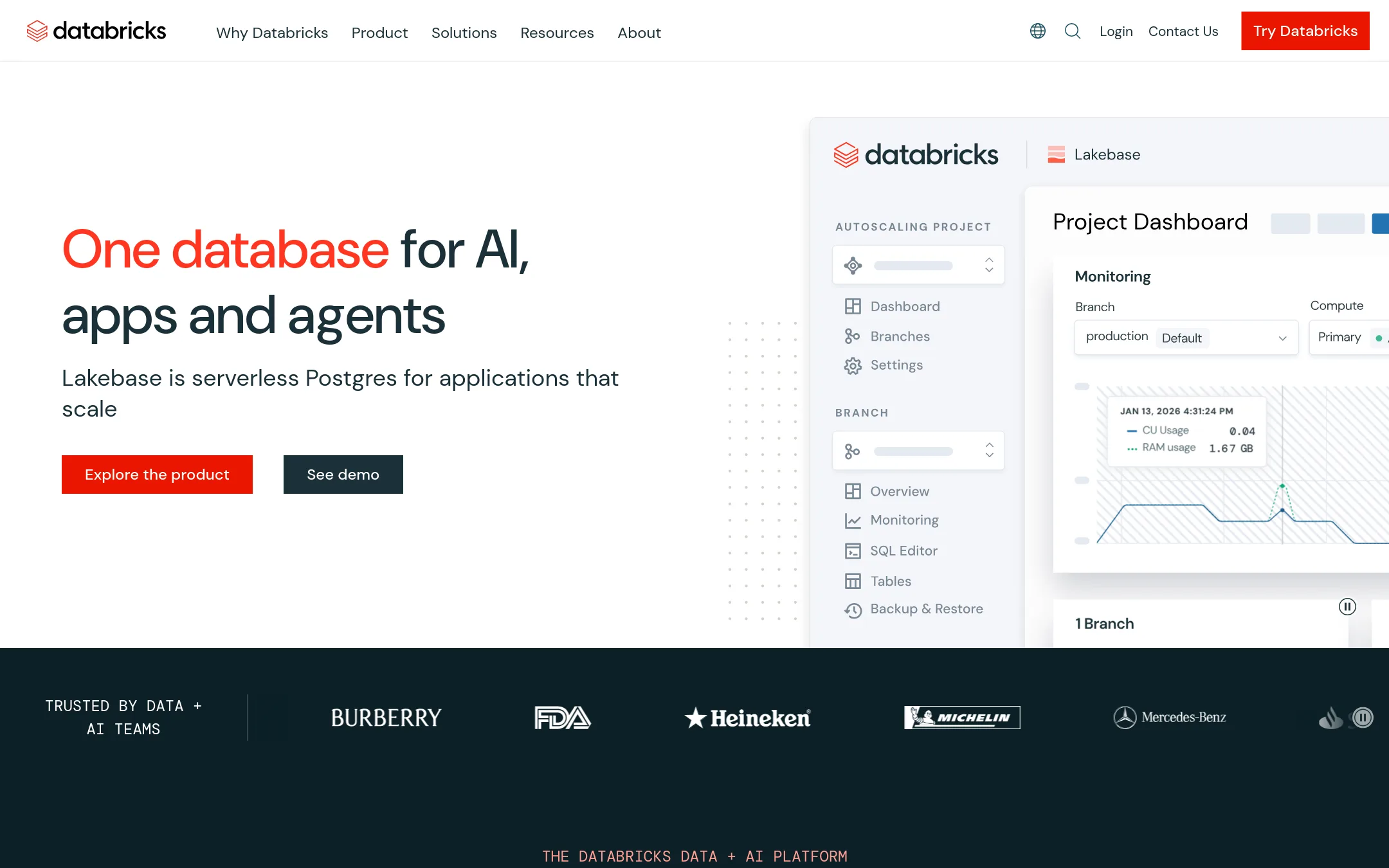
Databricks is a unified platform for data engineering, analytics and AI, with governance and warehousing built in. Teams pick it over Deepnote when they need to run ETL, model training and governed data at enterprise scale, not just interactive notebooks and apps.
Where it is strong
- Covers data engineering, warehousing, governance and AI in one platform
- Built for large data volumes and production pipelines
- Positioned for enterprise governance and AI workloads
Where it falls short
- Pricing is not published, so cost has to come from a sales conversation
- The homepage text supplied describes a broad platform rather than a lightweight notebook experience like Deepnote
- Pricing:
- Pricing is not published on the site.
- See website
5.Observable
Developer Tools
A collaborative platform for building interactive data visualizations and notebooks, overlapping with Deepnote's visualization and app features.
- Not published
6.Mode
Best for: Data teams that need to hand self-service reporting to business users, with analysis and sharing kept on one platform
- Pricing
- Not published
- Category
- Analytics & Data
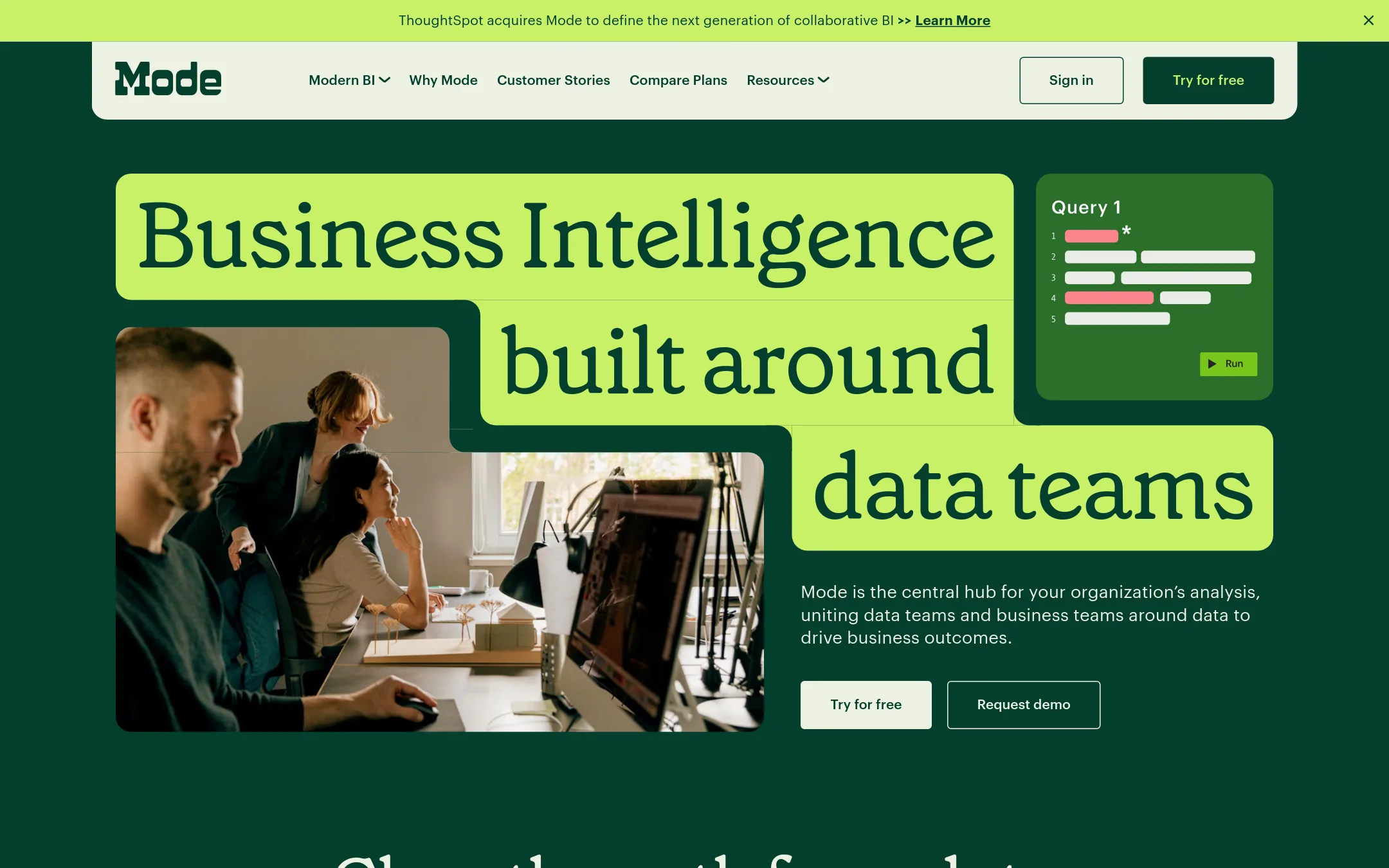
Mode is a business intelligence platform where SQL, R, Python and visual analytics sit together, so data teams can run ad hoc analysis and then share self-service reports from the same place. A team would pick it over Deepnote when the main job is building reports and dashboards for business users, rather than working in notebooks as the core tool.
Where it is strong
- SQL, R, Python and data viz work together in one place
- Business teams can get reports without a long setup
- Mode positions itself as a central hub for analysis across teams
Where it falls short
- The site does not publish pricing, so cost has to be checked directly with the vendor
- The homepage notes ThoughtSpot has acquired Mode, so the product direction may change
- Pricing:
- Pricing is not published on the site.
- See website
7.Google Colab
Developer Tools
Sign in to access Google Colab notebooks
- $20/user/mo (Pro)
8.Mito
Best for: Analysts and data scientists in enterprises that must keep data on their own infrastructure and already work in Jupyter
- Pricing
- $20/user/mo (Pro)
- Category
- Analytics & Data
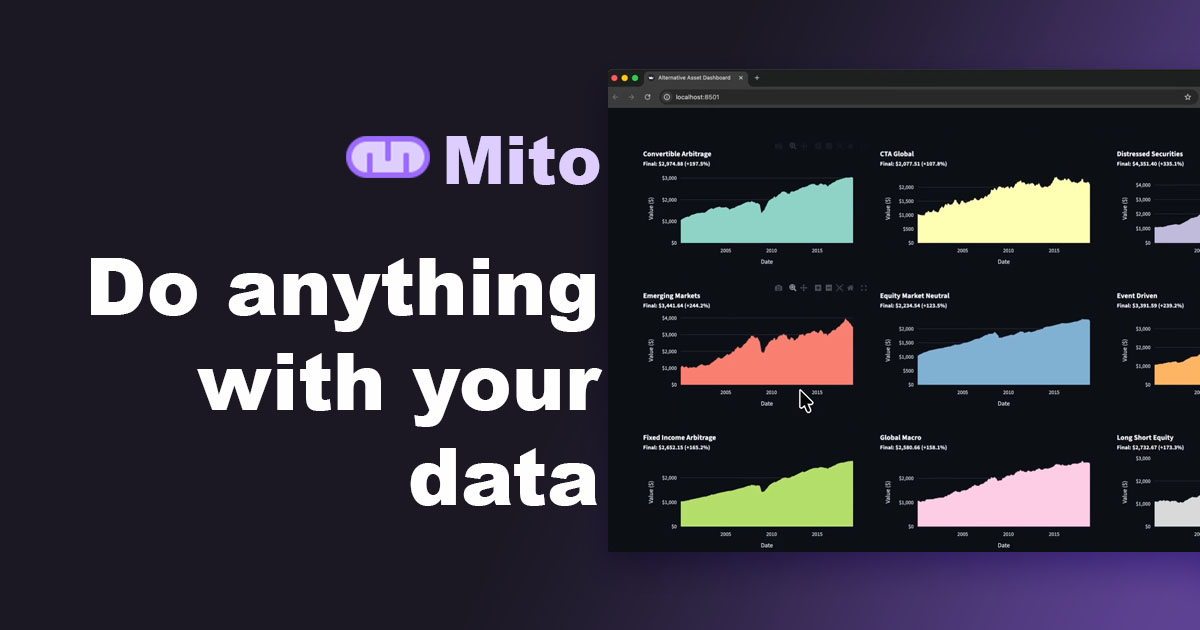
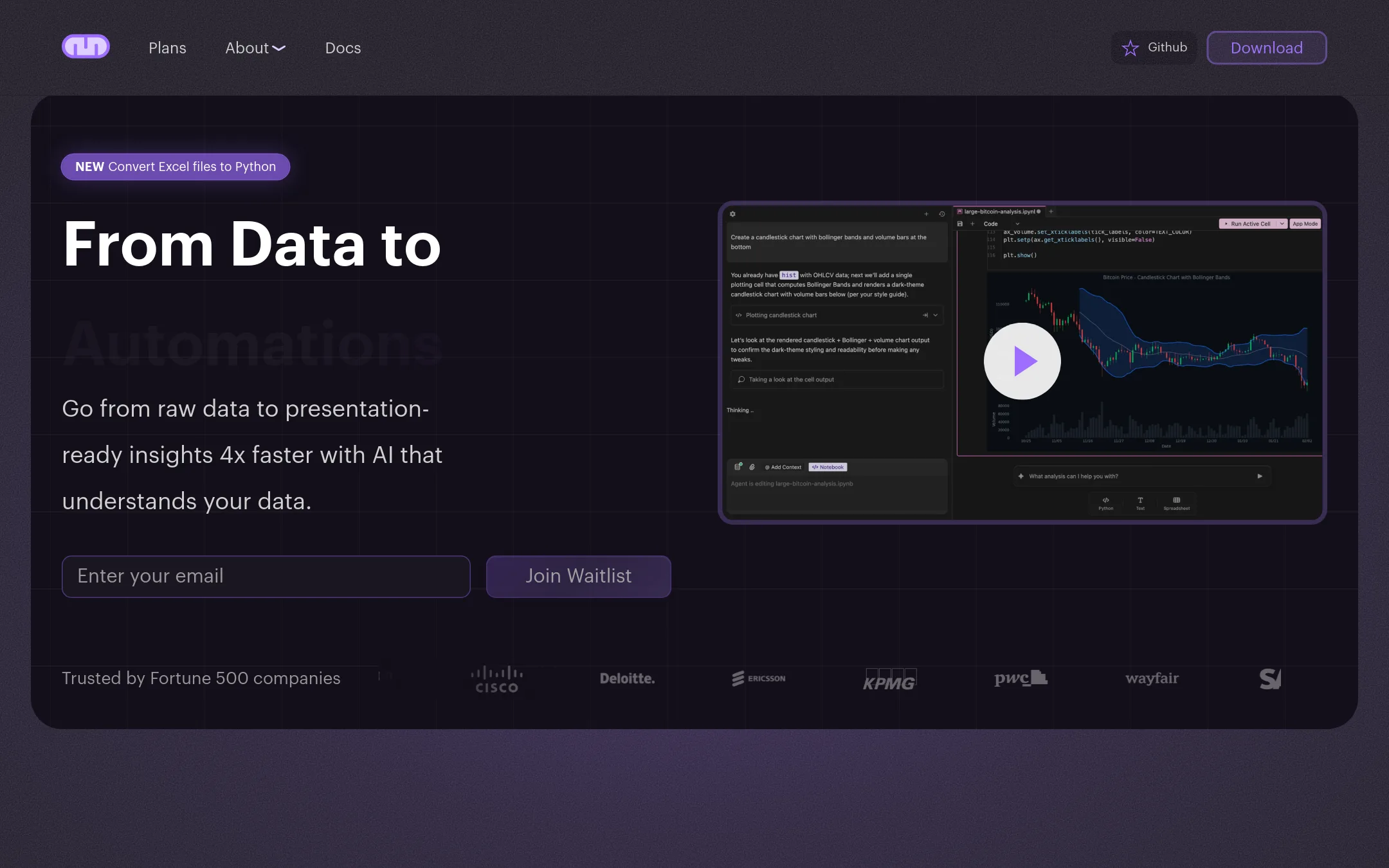
Mito is a Jupyter extension that adds an AI agent, an Excel-style spreadsheet, and point-and-click charts to notebooks you already run on your own infrastructure. Pick it over Deepnote if your analysts live in local JupyterLab or JupyterHub and you need data to stay on your machines, with your own LLM keys.
Where it is strong
- Runs inside your existing JupyterLab, JupyterHub or other Jupyter setup, with no hosted workspace to move into
- Bring your own API keys for Azure, AWS, LiteLLM or other LLM providers, and run an on-prem model on Pro
- Excel-like spreadsheet and point-and-click charts that export as Python, so non-coders can automate repeat reports
Where it falls short
- Its feature list centers on Jupyter and Streamlit, with no hosted real-time multiplayer notebooks like Deepnote offers
- Shareable notebooks with embedded Mito and script scheduling are listed as coming soon
- Pricing:
- Open Source is free with 150 AI completions per month, Pro is $20 per user per month with unlimited AI completions, and Enterprise is quoted on request.
- Switching from Deepnote:
- Mito installs with a single pip install into an existing Jupyter environment, so moving over means keeping your current notebook files rather than migrating to a new workspace.
- From $250/user/mo
9.Alteryx
Best for: Finance and operations teams at larger enterprises that need governed, repeatable data workflows with audit trails
- Pricing
- From $250/user/mo
- Category
- Analytics & Data
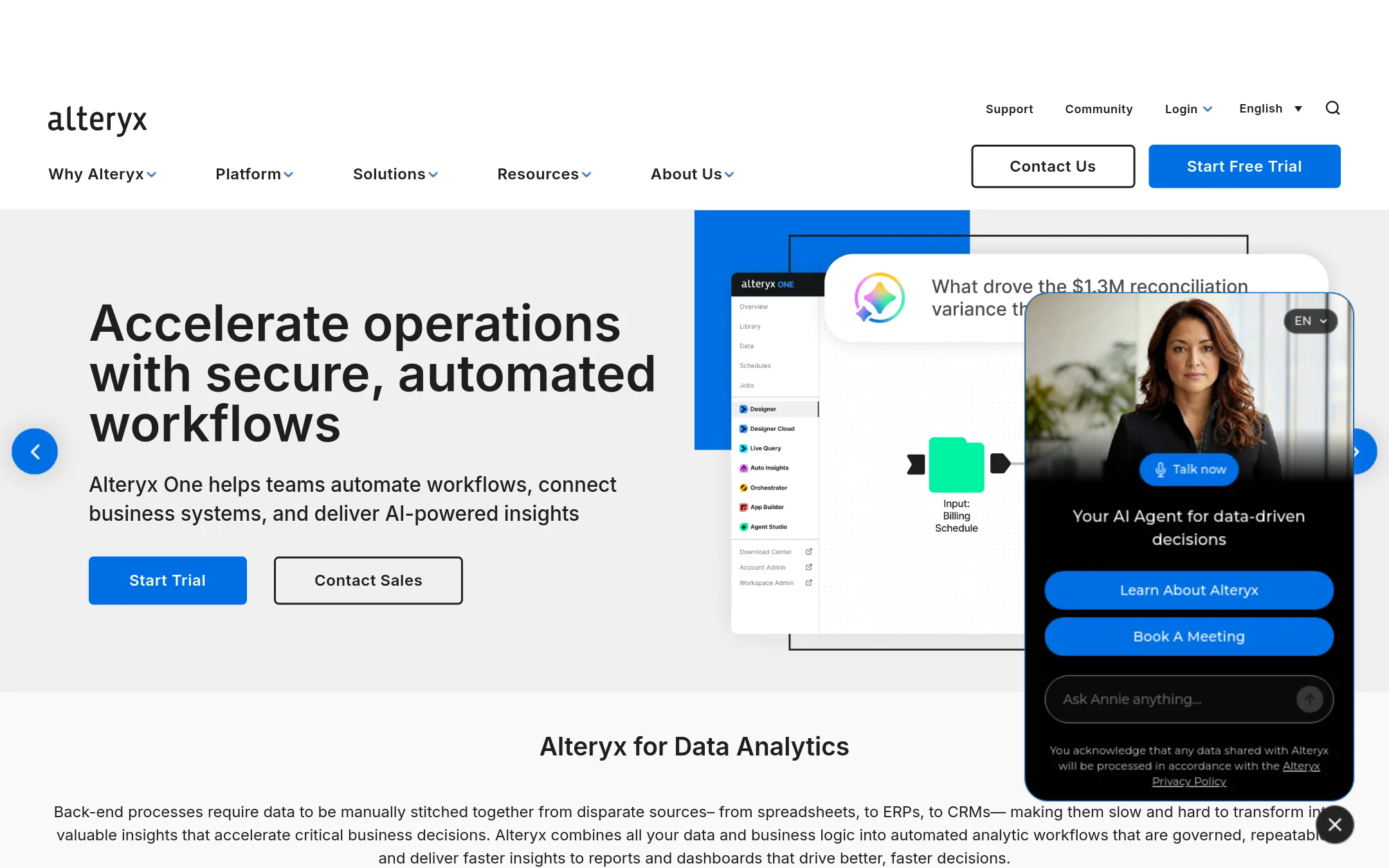
Alteryx is a data prep and analytics automation platform built around governed, repeatable workflows that business teams can build without code. Teams pick it over Deepnote when the work is mostly blending spreadsheets and databases into scheduled, auditable processes, such as month-end close or reconciliations, rather than open-ended notebook exploration.
Where it is strong
- Drag-and-drop workflows let non-coders build data prep and reporting logic
- Connects to 100+ data sources, including Snowflake and Databricks
- Workflows are shareable and repeatable, with enterprise governance on higher tiers
Where it falls short
- Entry pricing is per user and the higher editions require a sales conversation
- Built around workflow automation rather than the notebook-based coding and open exploration that Deepnote offers
- Pricing:
- The Essential edition starts at $250 per user per month billed annually, with the Professional and Enterprise editions available through sales.
- Not published
10.Apache Airflow
Best for: Engineering teams that already write Python and need dynamic, scheduled data pipelines they can extend with their own operators
- Pricing
- Not published
- Category
- Analytics & Data
Apache Airflow is an open source platform for writing, scheduling and monitoring data workflows as Python code. Teams pick it over Deepnote when they need scheduled, dependency-driven pipelines that run on their own infrastructure, rather than an interactive notebook for exploration and sharing.
Where it is strong
- Pipelines are defined in pure Python, so dynamic task generation is possible
- Open source with an active community and contributions via pull request
- Plug-and-play operators for Google Cloud, Amazon Web Services, Microsoft Azure and other services
Where it falls short
- Built for scheduled workflows, not interactive notebook exploration and sharing like Deepnote
- Setup and monitoring fall on your team, since the site describes it as a platform you run
- Pricing:
- Pricing is not published on the site.
- Switching from Deepnote:
- Moving from Deepnote means rewriting notebook work as Python workflow definitions, so the switch suits pipeline jobs more than ad hoc analysis.
- Custom quote
11.KNIME
Best for: Business and domain analysts who need data work done without writing code, and data teams that want a visual, open source workflow tool
- Pricing
- Custom quote
- Category
- Analytics & Data
KNIME is a visual workflow builder for ETL, analytics and predictive AI, where you connect nodes instead of writing code. Someone would pick it over Deepnote when the team includes business or domain experts who need to build analyses without writing Python or SQL, or when they want a free, open source tool they can run themselves.
Where it is strong
- Visual workflow builder lets non-coders blend, clean and model data
- Access to 300+ connectors across data sources
- Free and open source, with extensible nodes and integrations for Python and other languages
Where it falls short
- Pricing for commercial use requires a sales conversation
- Deepnote's notebook, SQL-first and collaborative workflow is a different experience from KNIME's node-based canvas
- Pricing:
- Pricing is not published on the site. KNIME sells capacity-based plans with no per-seat licensing, and you need to request a quote.
- Switching from Deepnote:
- Moving from Deepnote means rebuilding notebook analyses as node workflows, since the two tools work in different ways.
- Not published
12.Looker
Best for: Enterprise data teams that need one governed set of metrics shared across dashboards and embedded analytics inside a product.
- Pricing
- Not published
- Category
- Analytics & Data
Looker is an enterprise BI platform built around a semantic layer, so metric definitions live in one place and every dashboard and report reads from them. It also offers embedded analytics for putting dashboards inside your own product and Gemini-powered conversational agents. Pick it over Deepnote when the main need is governed, company-wide reporting rather than a collaborative notebook for exploratory analysis.
Where it is strong
- Semantic layer keeps metric definitions consistent across every report.
- Embedded analytics lets you put dashboards inside your own product.
- Gemini-powered agents let business users ask questions in plain language.
Where it falls short
- Built for BI and governed reporting, so it is not a notebook for free-form Python and SQL exploration the way Deepnote is.
- Pricing is not published, so you will need to contact sales to learn the cost.
- Pricing:
- Pricing is not published on the site.
See more comparisons in Analytics & Data alternatives.
FAQ
Questions about Deepnote alternatives
What is the main reason teams look for a Deepnote alternative?
Teams often want to keep data and code on their own infrastructure, use a free or self-hosted tool, or move to a platform built for governed reporting or enterprise pipelines. Mito and Jupyter cover the self-hosted and Jupyter-based cases, while Databricks and Apache Airflow cover larger governed or scheduled workloads.
Which alternative is best for a team that needs data to stay on its own machines?
Mito runs inside your existing JupyterLab, JupyterHub or other Jupyter setup and lets you bring your own LLM keys, including an on-prem model on its Pro plan. Jupyter itself is also self-hosted and free, though it lacks the managed cloud and real-time multiplayer features Deepnote offers.
Which alternative is the strongest for business users who need self-serve answers?
Hex combines notebooks, dashboards and data apps with AI agents that answer questions from a semantic model and show their reasoning. Mode and Looker are also built for business reporting, with Looker emphasising a shared semantic layer for governed metrics.
Are the prices of these alternatives easy to compare?
Not directly. Mito publishes its tiers at $20 per user per month for Pro, and Alteryx lists its Essential edition from $250 per user per month billed annually. Many others, including Databricks, Looker and Mode, do not publish pricing, so you will need a sales conversation to compare costs.
Which alternative should a team choose if it needs scheduled, dependency-driven pipelines rather than notebooks?
Apache Airflow is built for writing, scheduling and monitoring data workflows as Python code, and it runs on your own infrastructure. Your engineering team will handle setup and monitoring, since it is a platform you run rather than a hosted notebook like Deepnote.
Last updated November 6, 2026.