
Downlink alternatives
6 products compared · Updated November 21, 2026
The short answer
The three strongest alternatives to Downlink are Helicone, LiteLLM and OpenRouter. Helicone suits AI product teams that need request logs, user analytics and provider fallbacks across several LLM vendors. LiteLLM suits platform teams that want to self-host a governed gateway to many models. OpenRouter suits teams building on several models or providers that need one API key, unified billing and automatic failover.
Your shortlist, at a glance
Read the comparisons ↓- OOpenRouter5.5% on creditsTeams building on several models or providers that need one API key, unified billing and automatic failover
- PPortkeyNot publishedEngineering orgs running many GenAI workloads that need observability, guardrails and access governance in one place
- HHeliconeUsage-based, tieredAI product teams that need request logs, user analytics and provider fallbacks across several LLM vendors
 LiteLLMFree self-hosted. QuotPlatform teams that need to give a whole company governed access to many models and want to self-host the gateway
- MMartianNot publishedTeams that need to interpret or explain how their models behave, rather than speed up model calls
- TTogether AI$1.40 in / $4.40 out /Teams running open-source models across text, image, video, or audio who want serverless, batch, or dedicated inference in one place
About Downlink and its alternatives
Downlink is a platform that continuously improves AI applications through one API. According to its site, it is known for boosting rate limits, reducing latency and raising accuracy without changing the model you call, and it works with existing OpenAI-style clients in Python, TypeScript, Go and curl.
When comparing alternatives in this category, look at how each product is priced, which regions and deployment options it supports, which integrations and providers it connects to, what support is included, and what the contract terms require. Some tools focus on observability and governance, some on routing across many models, and some on running open models on dedicated infrastructure, so match the tool to the problem you need solved.
Explore the alternatives
- O5.5% on credits
1.OpenRouter
Best for: Teams building on several models or providers that need one API key, unified billing and automatic failover
- Pricing
- 5.5% on credits
- Category
- Other
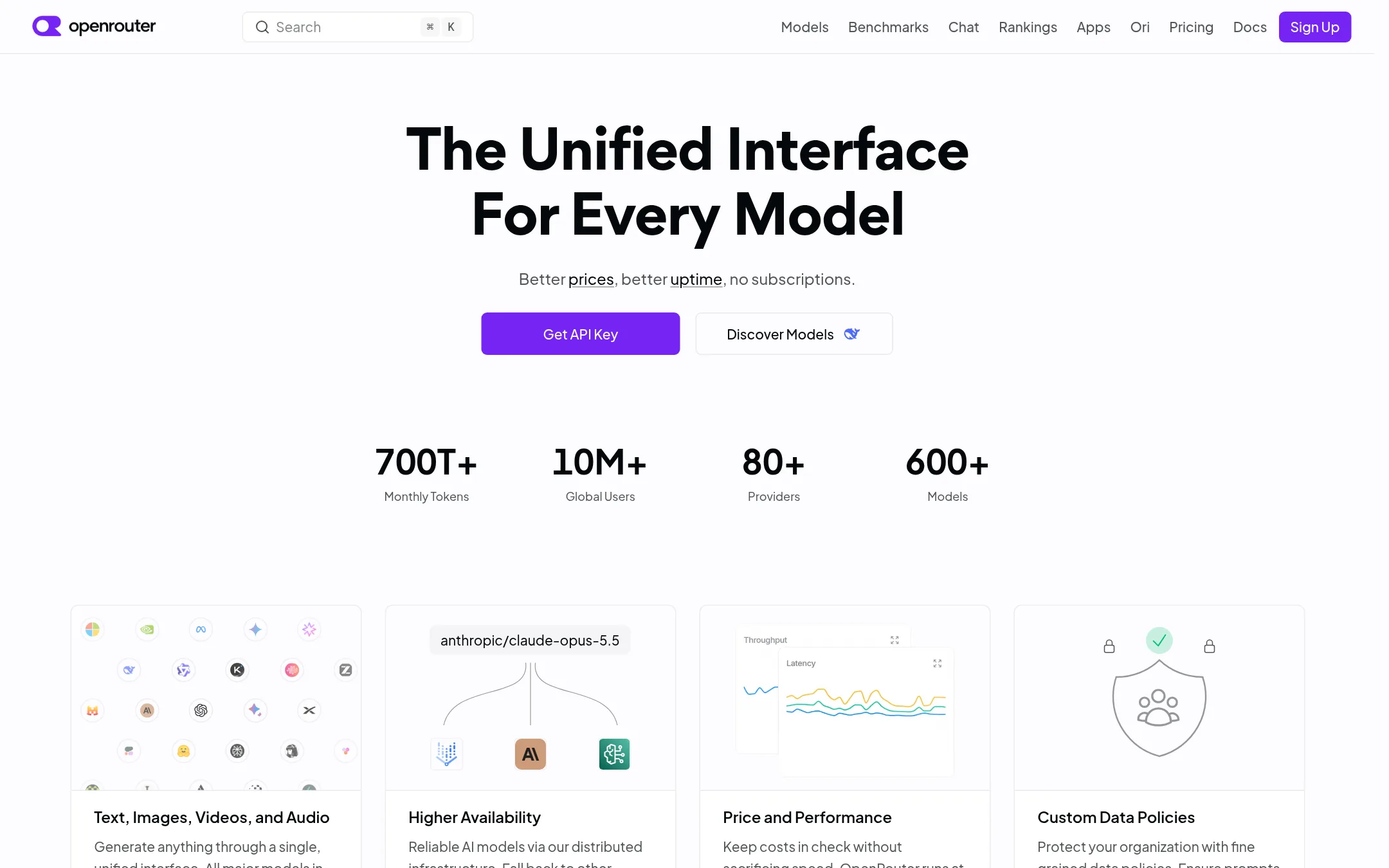
OpenRouter gives you one API key and one endpoint for 600+ models from 80+ providers, with failover on by default and a single dashboard for usage and spend across your team. Someone would pick it over Downlink when the goal is choosing and switching between many models or providers, rather than speeding up calls to a fixed model.
Where it is strong
- One API key covers 600+ models from 80+ providers
- Failover is on by default, so you don't write retry logic
- Usage, models and spend for the whole team sit in one dashboard
Where it falls short
- Standard and Business add a fee on credit purchases, and Enterprise pricing requires talking to sales
- Data residency and private endpoints are gated behind higher tiers and add-ons
- Pricing:
- Pricing is not published on the site in a way that gives a single figure, but Standard pay-as-you-go adds a 5.5% fee on credit purchases, Business adds 8%, the free tier allows 50 requests per day, and Enterprise is priced by contract.
- Switching from Downlink:
- Downlink's endpoint is OpenAI-compatible, so moving to OpenRouter would mean changing the base URL and API key in your existing client, though the facts supplied do not confirm any further migration steps.
- PNot published
2.Portkey
Best for: Engineering orgs running many GenAI workloads that need observability, guardrails and access governance in one place
- Pricing
- Not published
- Category
- Other
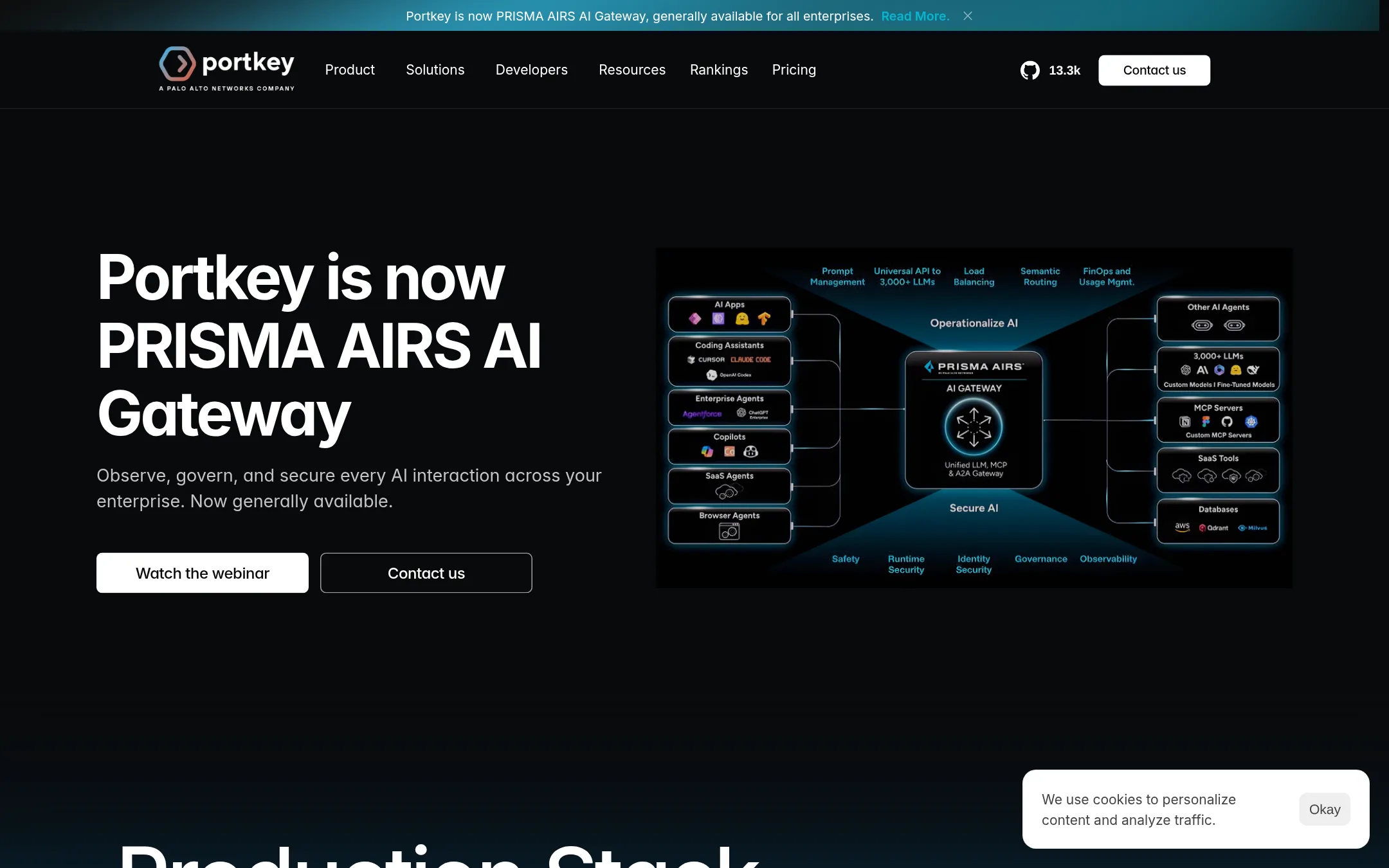
Portkey is an AI gateway and control plane that sits between your app and model providers. It covers routing, observability, guardrails, governance and prompt management in one platform. Pick it over Downlink if you need governance, guardrails and monitoring across many teams, rather than a drop-in API that aims to speed up and improve a single LLM call.
Where it is strong
- Covers gateway, observability, guardrails, governance and prompt management in one platform
- Real-time dashboard for monitoring LLM behavior and usage
- Positioned for enterprise governance and security across an organization
Where it falls short
- Its focus is governance and monitoring, not the latency and rate-limit gains Downlink advertises
- Pricing is not published, so cost has to be checked directly with the vendor
- Pricing:
- Pricing is not published on the site.
- HUsage-based, tiered
3.Helicone
Best for: AI product teams that need request logs, user analytics and provider fallbacks across several LLM vendors
- Pricing
- Usage-based, tiered
- Category
- AI & Machine Learning
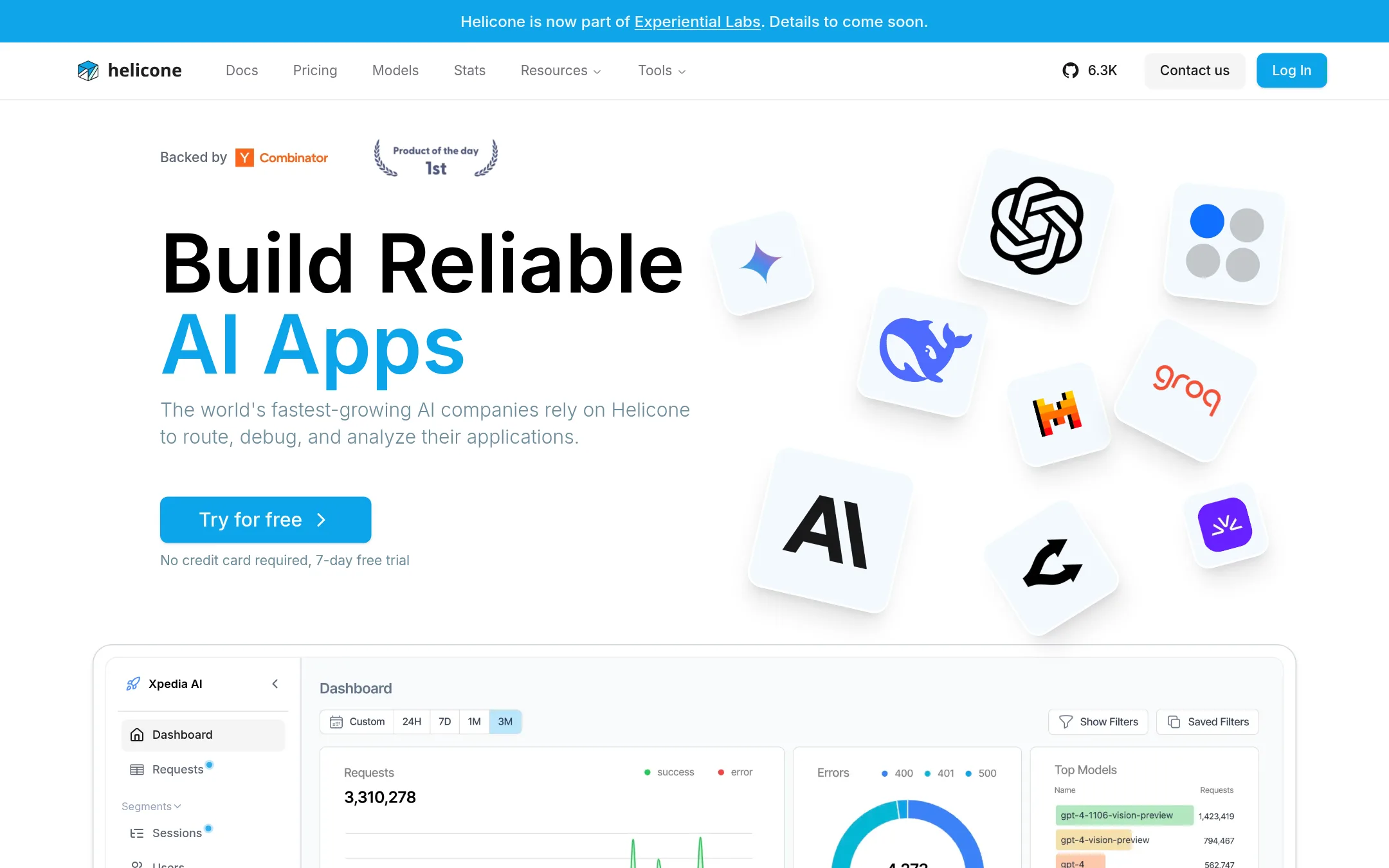
Helicone is an observability and gateway layer for LLM apps. It logs requests, tracks users and sessions, and adds caching, rate limits and automatic fallbacks, so you can debug and analyze what your AI app is doing. Choose it over Downlink when you care more about seeing and controlling your LLM traffic than about having the platform change the model or speed up responses for you.
Where it is strong
- Works with many LLM providers, so you are not locked to one vendor
- Open-source, with unlimited seats on every plan
- Covers logging, caching, rate limits and automatic fallbacks in one tool
Where it falls short
- Compliance features such as HIPAA, SOC-2 Type II and SAML SSO are reserved for higher tiers
- The site notes the company is now part of Experiential Labs, with details still to come
- Pricing:
- Pricing is published on a tiered page with Hobby, Pro, Team and Enterprise plans, a 10,000 requests per month allowance with usage-based charges beyond it, and a 50% first-year discount for startups under two years old with $5M or less in funding.
- Free self-hosted. Quot
4.LiteLLM
Best for: Platform teams that need to give a whole company governed access to many models and want to self-host the gateway
- Pricing
- Free self-hosted. Quot
- Category
- AI & Machine Learning
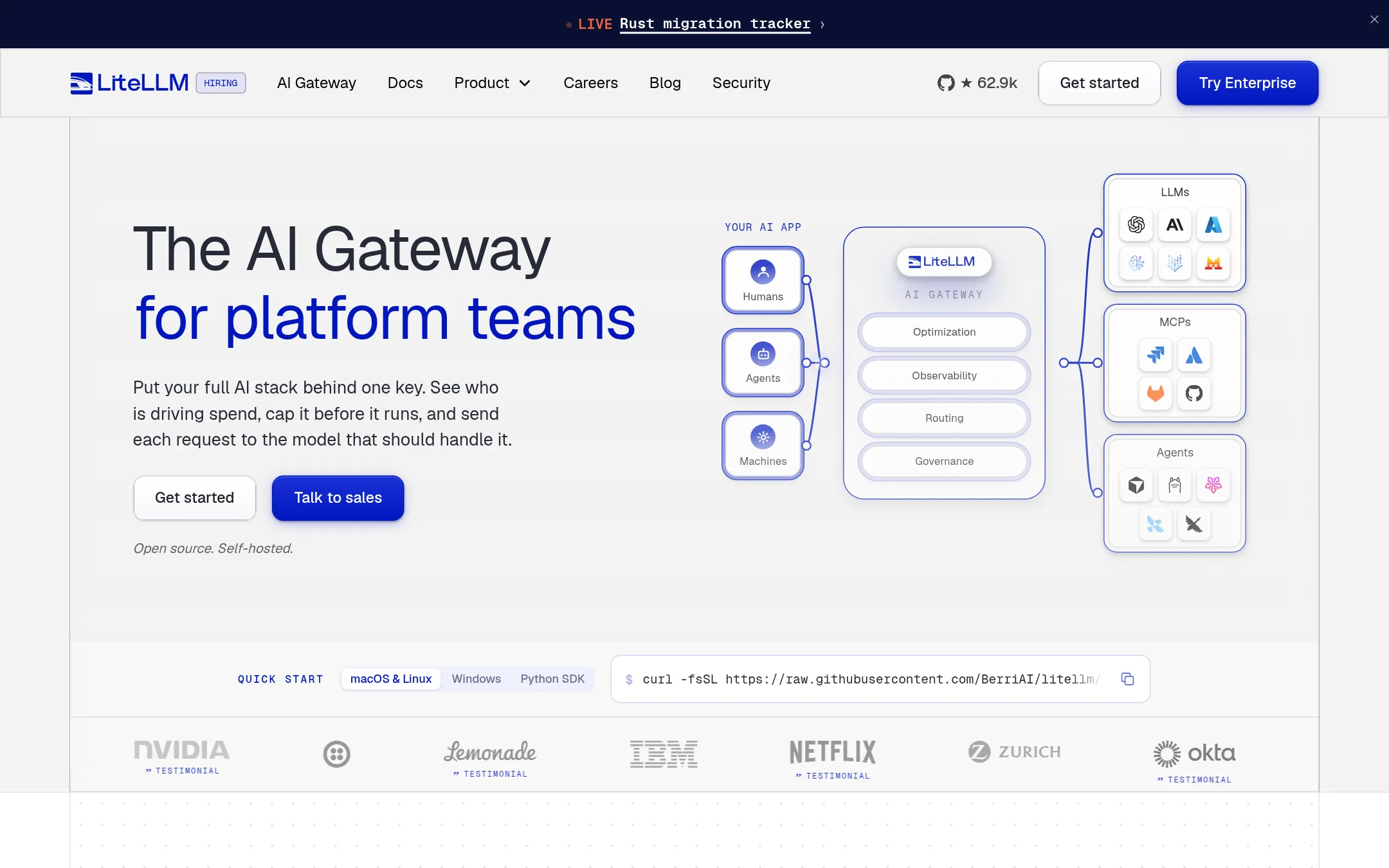
LiteLLM is an open-source gateway that you self-host, putting 100+ LLM providers and agents behind one OpenAI-compatible API with per-team budgets, rate limits and request logging. Choose it over Downlink when you want to run the gateway in your own cloud or air-gapped environment and keep your keys and traffic on your own infrastructure, rather than sending requests through a hosted service that tunes model performance for you.
Where it is strong
- Open source and self-hostable, including fully air-gapped deployment, with no telemetry sent back.
- One OpenAI-compatible API to 140+ providers, so you can swap models without changing application code.
- Per-key, per-team and per-model budgets with rate limits and an audit log on every request.
Where it falls short
- SSO, SCIM, audit logs and 24/7 support sit behind Enterprise, which is quoted rather than listed.
- Its stated focus is governance and cost control across a gateway, not the model performance tuning and fine-tuning that Downlink emphasizes.
- Pricing:
- The open-source gateway is free to self-host, and Enterprise is quoted by annual gateway request capacity, deployment architecture and support needs, with no published figures.
- MNot published
5.Martian
Best for: Teams that need to interpret or explain how their models behave, rather than speed up model calls

- Pricing
- Not published
- Category
- Other
Martian is a research group focused on understanding how machine intelligence works, with interpretability work on feature geometry and what models learn. It is a different kind of product from Downlink, which is an API that sits in front of LLMs to raise rate limits and cut latency. Someone would pick Martian over Downlink if they want to study or explain model behavior rather than make their existing LLM calls faster.
Where it is strong
- Focuses on measuring and explaining model behavior, which Downlink does not address
- Built by a team with stated work at Google DeepMind, Anthropic and Meta
- Research is tied to commercial products that are meant to scale with LLM usage
Where it falls short
- Does not offer a drop-in API for faster or higher-limit LLM calls like Downlink does
- The site does not describe specific products or integrations you can start using today
- Pricing:
- Pricing is not published on the site.
- T$1.40 in / $4.40 out /
6.Together AI
Best for: Teams running open-source models across text, image, video, or audio who want serverless, batch, or dedicated inference in one place
- Pricing
- $1.40 in / $4.40 out /
- Category
- Other
Together AI is a full AI cloud covering model inference, GPU clusters, storage, and fine-tuning, with a large catalog of open-source models across text, image, video, and audio. Choose it instead of Downlink when you want to run open models yourself at scale, or need dedicated GPUs and managed infrastructure rather than a layer that tunes calls to an existing model.
Where it is strong
- Large catalog of open models across text, image, video, and audio
- Serverless, batch, provisioned, and dedicated inference options under one account
- Offers GPU clusters, sandboxes, and fine-tuning alongside inference
Where it falls short
- Its offering is a broad cloud platform, while Downlink focuses on a single API that improves existing model calls
- Pricing spans many model types and tiers, so cost comparison takes more work
- Pricing:
- Serverless text models are listed per 1M tokens, for example GLM-5.3 at $1.40 input and $4.40 output, with cached input and a separate Batch API price, and provisioned throughput is priced in PTUs.
- Switching from Downlink:
- Moving from Downlink would mean pointing your client at Together's OpenAI-compatible endpoints and choosing a model from its catalog, since the supplied facts do not cover migration steps.
See more comparisons in AI & Machine Learning alternatives.
FAQ
Questions about Downlink alternatives
What does Downlink do that these alternatives do not?
Downlink's site describes a single API that aims to raise rate limits, cut latency and improve accuracy on calls to an existing model, and that selects and fine-tunes models for your use case. Several alternatives, such as Helicone and Portkey, focus more on logging, observability and governance than on changing how the model call performs.
Which alternative is best if I want to self-host?
LiteLLM is the option built for self-hosting. It is open source, can be deployed in your own cloud or in an air-gapped environment, and sends no telemetry back. Its Enterprise tier, which adds SSO and audit logs, is quoted rather than published.
Which tool is best for using many models from different providers?
OpenRouter gives one API key and one endpoint for 600+ models from 80+ providers, with failover on by default. Helicone and LiteLLM also support multiple providers, with LiteLLM covering 100+ providers behind one OpenAI-compatible API.
Are there any costs I should watch for with these tools?
OpenRouter's Standard and Business plans add a fee on credit purchases, at 5.5% and 8% respectively. Helicone's compliance features such as HIPAA and SSO sit in higher tiers, and Portkey and LiteLLM's Enterprise pricing is not published, so you will need to contact those vendors for a quote.
Is any alternative a different kind of product from Downlink?
Yes. Martian is a research group focused on interpreting how models work, and it does not offer a drop-in API for faster LLM calls. Together AI is a broad AI cloud for running open models, GPU clusters and fine-tuning, so it is better suited to teams that want to host and run models themselves.
Last updated November 21, 2026.