
DrDroid alternatives
6 products compared · Updated November 18, 2026
The short answer
The three strongest alternatives to DrDroid are PagerDuty, Rootly and Incident.io. PagerDuty suits organizations that need mature on-call scheduling, escalation and incident coordination across hundreds of tools. Rootly suits teams that want to run the whole incident process, from paging to retrospectives, inside Slack, Teams or Google Chat. Incident.io suits teams that want managed incident response, on-call and status pages in Slack or Teams, with a free starter tier.
Your shortlist, at a glance
Read the comparisons ↓- PPagerDutyFrom $2,800/yearEngineering organizations of any size that need mature on-call scheduling, escalation policies and incident coordination across hundreds of tools.
- IIncident.ioFrom $19/user/moEngineering teams that want managed incident response, on-call scheduling and public status pages inside Slack or Teams.
 Rootly$20/user/mo + customEngineering teams that want to replace their pager and run incidents end-to-end in Slack, Teams or Google Chat.
- SShoreline.ioNot publishedTeams comparing incident automation tools who want to verify Shoreline.io's current features on its own site before deciding
- KKomodorNot publishedPlatform and SRE teams running large Kubernetes estates that want cost control and governed custom agents
- CCleric$0.50/credit + plansEngineering teams shipping changes often that want production verified after each merge and alerts triaged before a human gets paged
About DrDroid and its alternatives
DrDroid is an AI SRE agent for incident response and root cause analysis. According to its site, it connects read-only to cloud, code and observability tools, builds a knowledge graph of the stack, and traces the blast radius when an alert fires. It is known for investigating incidents end-to-end and for a credit-based pricing model that starts at $99 per month on its Startup plan.
When comparing alternatives, look first at what problem each tool solves. Some focus on paging and incident workflow, others on AI investigation, and others on Kubernetes or deployment verification. Then check pricing structure, since some products bill per seat, some per event and some in credits. Also check regional availability, which integrations are supported, how support is delivered, and what the contract terms are, especially for self-hosting and data residency.
Explore the alternatives
- PFrom $2,800/year
1.PagerDuty
Best for: Engineering organizations of any size that need mature on-call scheduling, escalation policies and incident coordination across hundreds of tools.
- Pricing
- From $2,800/year
- Category
- Other
PagerDuty is an incident response and on-call platform used by many large engineering organizations. It routes alerts to the right people, coordinates incident response across Slack and Microsoft Teams, and now adds AI agents for triage and remediation. Pick it over DrDroid when you want a mature paging and incident workflow backed by 750+ integrations, and the investigation context matters less than the escalation and coordination layer.
Where it is strong
- Routes pages to on-call responders with escalation policies, and sits at the front of incident response for many large teams.
- Integrates with 750+ tools, so most existing monitoring and ticketing setups can connect without custom work.
- Has a long track record and a large installed base, including many Fortune 100 companies, which helps with vendor review.
Where it falls short
- Its AI agents focus on responding to incidents, and it does not build a knowledge graph of your stack the way DrDroid does.
- Pricing is tiered by seats, signal events and AI actions, so costs can be harder to predict than DrDroid's credit model.
- Pricing:
- The Starter plan is listed at $2,800 per year, Essential at $12,000 per year and Plus at $48,000 per year, with Ultimate on custom pricing, and the site lists the Plus tier and seat and event allowances for each.
- IFrom $19/user/mo
2.Incident.io
Best for: Engineering teams that want managed incident response, on-call scheduling and public status pages inside Slack or Teams.
- Pricing
- From $19/user/mo
- Category
- Other
Incident.io is an incident management platform that covers on-call routing, incident response in Slack or Teams, post-incident reviews, and status pages. Teams that already have an incident process and mainly want to coordinate people, alerts and customer communication would pick it over DrDroid. DrDroid is built more around an AI agent that investigates root cause from connected telemetry.
Where it is strong
- Incident response runs natively in Slack and Microsoft Teams.
- Includes on-call scheduling, alert routing and status pages in one product.
- Has a free Basic tier to start with single-team on-call and a status page.
Where it falls short
- Root cause analysis and the autonomous investigation agent are sold as an add-on, not part of the base plans.
- Costs add up per user, so larger teams pay for every responder.
- Pricing:
- Pricing is per user per month: Basic is free forever, Team is $19 per user per month ($15 on the annual discount), Pro is $25 per user per month, and Enterprise is custom.
- $20/user/mo + custom
3.Rootly
Best for: Engineering teams that want to replace their pager and run incidents end-to-end in Slack, Teams or Google Chat.
- Pricing
- $20/user/mo + custom
- Category
- Productivity & Project Management
Rootly is an incident management platform built around Slack, Teams and Google Chat, with on-call scheduling, alerting, AI root-cause suggestions and retrospectives. Choose it over DrDroid if your main need is running the incident process itself, such as paging, schedules, status updates and post-incident reviews, rather than an agent that investigates your infrastructure.
Where it is strong
- Covers paging, on-call schedules, incident channels and retrospectives in one product
- Offers a migration service for teams moving off PagerDuty, with contract buyout mentioned on the site
- Has a startup program with discounts for companies under 100 employees
Where it falls short
- The AI SRE investigation and autonomous agent features require a separate, unpriced conversation
- Its focus is the incident workflow rather than a knowledge graph of your stack, so it lacks DrDroid's cross-tool entity mapping as described
- Pricing:
- Incident Response is listed at $20 per user per month, On-Call at $20 per user per month, AI SRE is quoted on request, and Enterprise is custom.
- SNot published
4.Shoreline.io
Best for: Teams comparing incident automation tools who want to verify Shoreline.io's current features on its own site before deciding
- Pricing
- Not published
- Category
- Other
Shoreline.io is an alternative to DrDroid for teams that want to automate operations work. The site could not be reached when this page was checked, so no product details are confirmed here. Check its website directly before choosing it over DrDroid.
Where it is strong
- Listed as a direct alternative to DrDroid for operations automation
- Worth a look if you want a second vendor to compare against DrDroid
- Its own site will show the current feature set and plans
Where it falls short
- The website could not be reached, so features could not be confirmed
- No pricing information is available to compare with DrDroid's credit-based plans
- Pricing:
- Pricing is not published on the site.
- KNot published
5.Komodor
Best for: Platform and SRE teams running large Kubernetes estates that want cost control and governed custom agents
- Pricing
- Not published
- Category
- Other
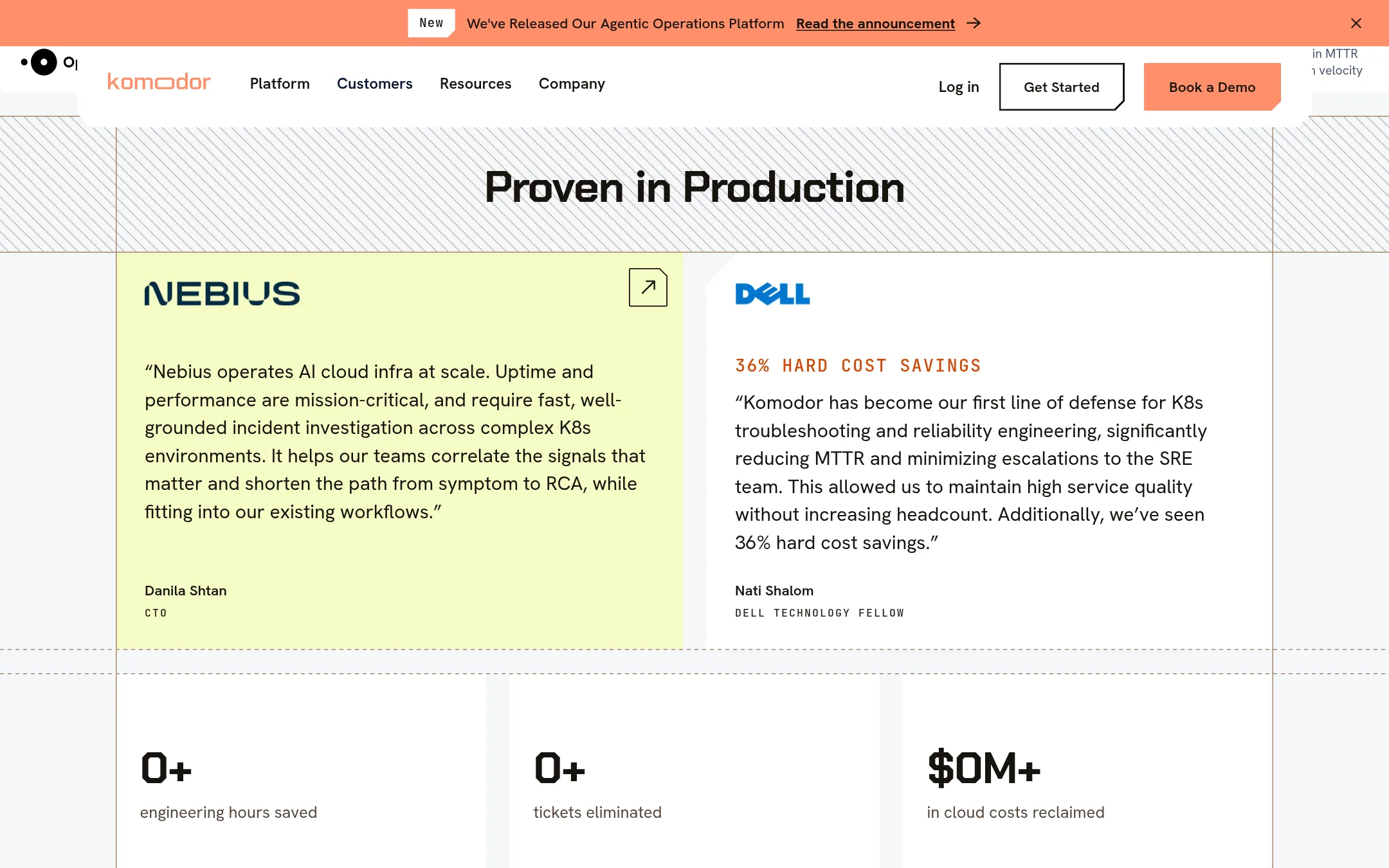
Komodor is an agentic operations platform for Kubernetes and cloud production, covering alert intelligence, incident management, troubleshooting, and cost reduction. Pick it over DrDroid when your main problem is Kubernetes reliability and cloud or Kubernetes spend, and you want to build, govern and run your own agents on top of a shared platform.
Where it is strong
- Covers Kubernetes cost, cloud cost and observability cost alongside incident response
- Lets you bring agents built with LangChain, Google ADK, Claude Agent SDK or AgentCore
- Includes guardrails, approval gates, budget caps and a full audit trail for agent actions
Where it falls short
- No published pricing, so you need to request a quote to compare costs
- Its focus is Kubernetes and cloud cost, so it covers less of the migration and deployment-tracking work DrDroid lists
- Pricing:
- Pricing is not published on the site.
- C$0.50/credit + plans
6.Cleric
Best for: Engineering teams shipping changes often that want production verified after each merge and alerts triaged before a human gets paged
- Pricing
- $0.50/credit + plans
- Category
- Other
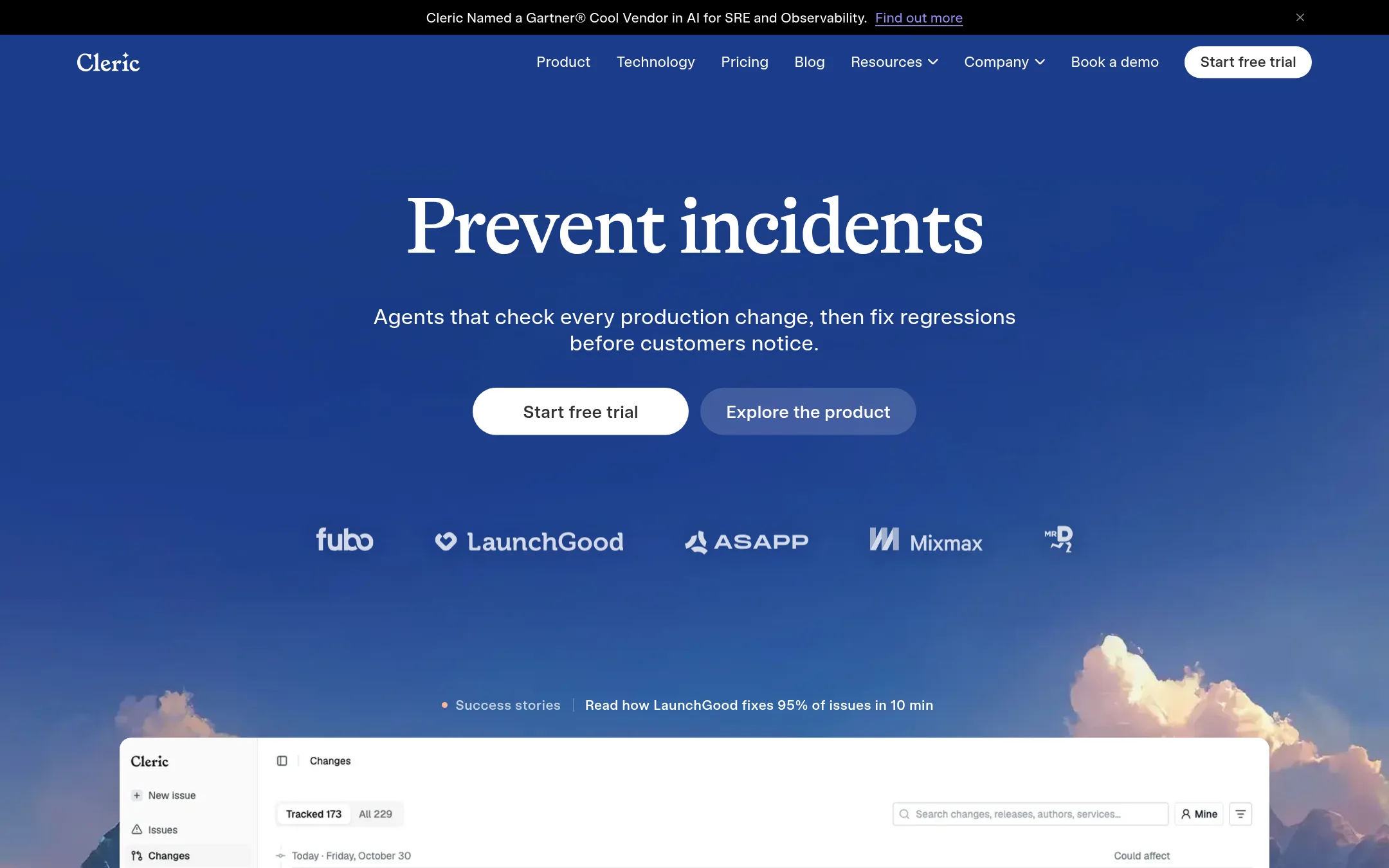
Cleric runs AI agents that watch production after each change merges, check whether the change behaves under real traffic, investigate failures, and hand over fixes for review. Teams pick it over DrDroid when the main worry is catching regressions from releases, not only responding to alerts after they fire.
Where it is strong
- Checks each production change after merge and reverifies over days of traffic
- Triages alerts and closes false positives before anyone is paged
- Read-only by default, with every action logged and SOC 2 Type II compliance stated
Where it falls short
- Pricing is metered per credit, so cost depends on how many changes and investigations a team runs
- Private resource access and Okta sign-in sit on the Pro plan, not the entry tier
- Pricing:
- Cleric bills in credits at $0.50 each, with Team at 1,400 credits per month, Pro at 3,000, Scale at 6,000, and Enterprise negotiated on annual billing, where each change verification costs 2 credits and each issue investigation costs 10.
See more comparisons in AI & Machine Learning alternatives.
FAQ
Questions about DrDroid alternatives
What is DrDroid best known for?
According to its site, DrDroid is an AI SRE agent that maps a team's stack into a knowledge graph and investigates alerts and incidents with that context. It is known for cutting time to root cause and for automated runbook remediation with human approval.
Which alternative is best if I mainly need on-call paging?
PagerDuty is the strongest fit for paging and escalation at scale, with integrations across 750+ tools. Rootly and Incident.io also cover on-call inside Slack or Teams, which can suit smaller teams that want the incident workflow in chat.
How do the pricing models compare?
DrDroid bills in investigation credits, with the Startup plan at $99 per month including 99 credits. Incident.io and Rootly bill per user per month, PagerDuty uses tiered plans with seat and event allowances, and Cleric bills per credit at $0.50 each. Per-seat pricing grows with headcount, while credit pricing grows with investigation volume.
Is there an alternative that focuses on Kubernetes?
Komodor is built around Kubernetes and cloud production, covering incident management, troubleshooting and cost reduction. Its pricing is not published, so you would need to request a quote to compare it with DrDroid.
Which alternative checks changes after they ship?
Cleric runs agents that watch production after each change merges, check behaviour under real traffic and investigate failures. This targets regressions from releases, while DrDroid's investigation focus is on responding to alerts and incidents.
Last updated November 18, 2026.