
Eventual alternatives
5 products compared · Updated November 17, 2026
The short answer
The three strongest alternatives to Eventual's Daft are Ray Data, Polars and Dask. Ray Data suits robotics and AI teams that need to curate large multimodal datasets with a Pandas or Spark style API. Polars suits teams processing large tabular datasets in Python or SQL who want a fast, free engine. Dask suits Python data teams with pandas or NumPy code that has outgrown a single machine and needs to scale without a rewrite.
Your shortlist, at a glance
Read the comparisons ↓- PPandasNot publishedAnalysts and data scientists working with structured tables that fit in a single machine's memory
 Apache AirflowNot publishedData and platform teams that already write Python and need to schedule and monitor a wide mix of workflows across cloud services
- RRay DataNot publishedRobotics and AI teams that need to curate and transform large multimodal datasets using a Pandas or Spark style API
- DDaskOpen source / freePython data teams with pandas or NumPy code that has outgrown one machine and needs to scale without a rewrite
- PPolarsFree (MIT) / $200/mo TData and engineering teams processing large tabular datasets in Python or SQL who want a fast, free engine rather than a multimodal pipeline for images, video and audio.
About Eventual and its alternatives
Eventual builds Daft, an open source data engine (Apache 2.0) for AI workloads. According to its site, Daft processes video, images, audio, sensor data and structured metadata in one Python DataFrame, runs GPU and CPU work in the same pipeline, and scales from a laptop to distributed clusters. Eventual also says it helps robotics teams curate better data for training.
When comparing alternatives in this category, weigh the pricing structure, since some tools are free to self-host while managed platforms charge by usage or seat. Check which regions and deployment options are supported, and which integrations exist with your storage, model providers and orchestration tools. Consider the quality of support and the contract terms, especially where pricing is not published and a direct conversation is needed.
Explore the alternatives
- PNot published
1.Pandas
Best for: Analysts and data scientists working with structured tables that fit in a single machine's memory
- Pricing
- Not published
- Category
- Other
Pandas is a Python library for loading, cleaning and transforming tabular data in memory. People pick it over Eventual's Daft when their data is structured and fits on one machine, and they want the most widely known DataFrame API without learning a new engine. The supplied facts describe the PyData community site, not Pandas itself, so this entry sticks to general knowledge of the library.
Where it is strong
- Free and open source to use
- Familiar API for anyone who has done tabular work in Python
- Large community and ecosystem of tutorials and libraries
Where it falls short
- Works in memory on a single machine, so very large datasets can run out of memory
- Not built for multimodal data such as video and audio as native column types
- Pricing:
- Pricing is not published on the site.
- Not published
2.Apache Airflow
Best for: Data and platform teams that already write Python and need to schedule and monitor a wide mix of workflows across cloud services
- Pricing
- Not published
- Category
- Analytics & Data
Apache Airflow is an open source platform for writing, scheduling and monitoring workflows in pure Python. Teams pick it over Eventual when they need general orchestration of many kinds of jobs, such as data transfers, infrastructure tasks or ML pipelines, rather than a dataframe engine built around multimodal data and model operators.
Where it is strong
- Pipelines are plain Python, so anyone who knows Python can build them.
- Ships with a web UI for monitoring runs, logs and task status.
- Plug-and-play operators for Google Cloud, AWS, Azure and many third-party services.
Where it falls short
- It is an orchestrator, not a dataframe engine, so it does not process video, images or audio columns the way Daft does.
- The site does not describe native model operators or GPU and CPU batching within a single pipeline.
- Pricing:
- Pricing is not published on the site.
- RNot published
3.Ray Data
Best for: Robotics and AI teams that need to curate and transform large multimodal datasets using a Pandas or Spark style API
- Pricing
- Not published
- Category
- Other
Daft is an open source Python dataframe engine built for multimodal AI data such as video, images, audio and embeddings, running from a laptop to large clusters. Teams pick it over Eventual when they want a Pandas or Spark style API for curating multimodal training data, with GPU and CPU work in one pipeline.
Where it is strong
- Open source under Apache 2.0 with over 5k GitHub stars
- Familiar Pandas and Spark style dataframe API with SQL support
- Runs the same code on a laptop or a distributed cluster
Where it falls short
- Pricing is not published, so cost comparison needs a direct conversation
- Ray Data is the broader compute framework, covering model serving and reinforcement learning, which Daft does not position itself around
- Pricing:
- Pricing is not published on the site.
- DOpen source / free
4.Dask
Best for: Python data teams with pandas or NumPy code that has outgrown one machine and needs to scale without a rewrite
- Pricing
- Open source / free
- Category
- Other
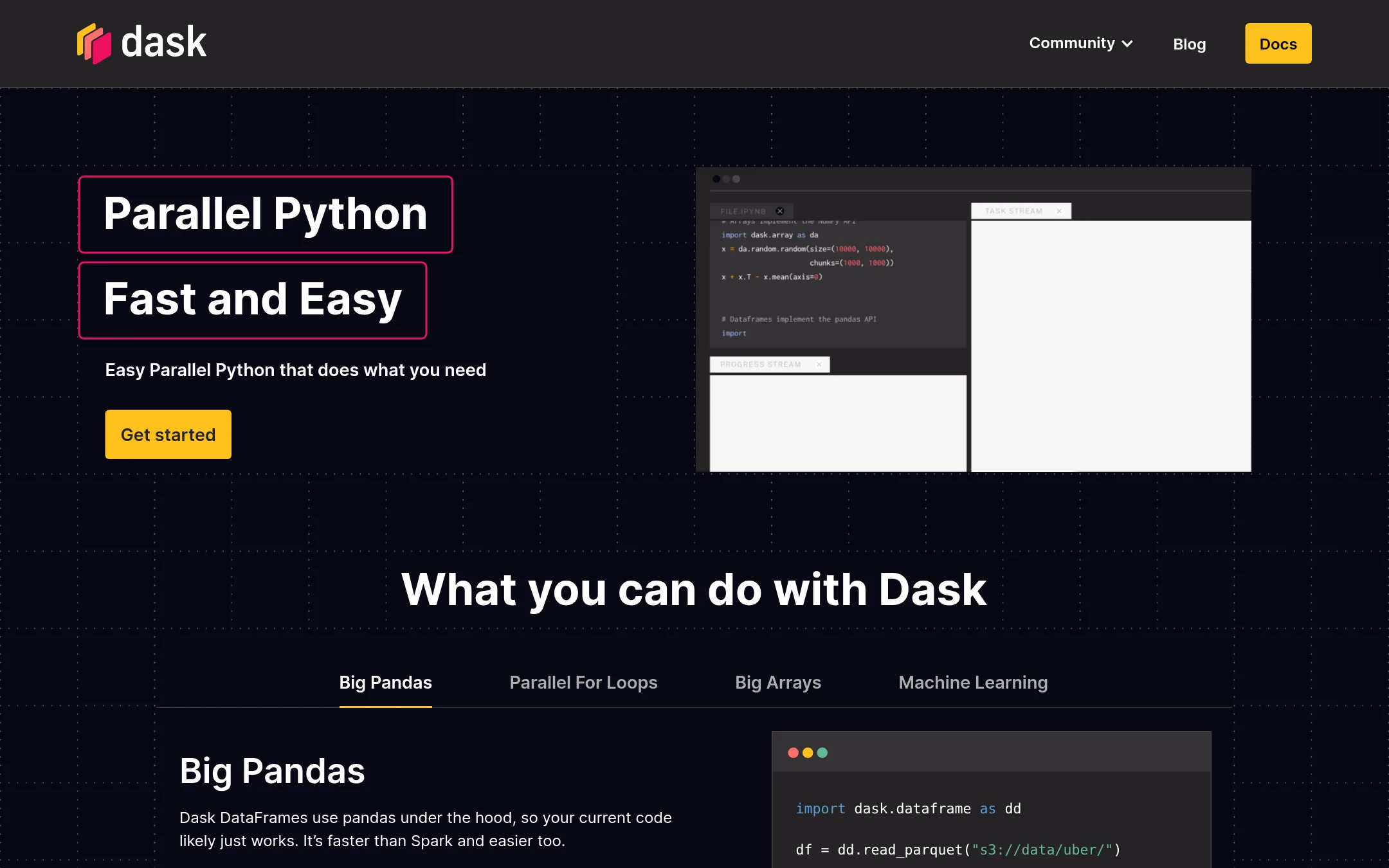
Dask is an open source Python library that scales pandas, NumPy and plain Python loops across cores or machines. Teams already writing pandas or NumPy can pick it up without learning a new framework. Someone would choose it over Eventual when their work is mostly tabular or array data and they want to stay close to pandas code, rather than multimodal media like video, images and audio processed alongside GPU model calls.
Where it is strong
- Dask DataFrames use pandas under the hood, so much existing code runs with little change.
- It runs on laptops, Kubernetes, HPC schedulers and legacy Hadoop or Spark clusters.
- The dashboard helps users find inefficiencies as they learn distributed computing.
Where it falls short
- The site focuses on tabular and array workloads and does not describe native handling of video, images or audio.
- Built-in model operators and LLM extraction are not mentioned, so AI pipelines need more custom code.
- Pricing:
- Dask is open source and free to run on your own infrastructure, and the site lists a managed option through Coiled that is free for individuals with modest use, but no paid plan figures are published on the page.
- PFree (MIT) / $200/mo T
5.Polars
Best for: Data and engineering teams processing large tabular datasets in Python or SQL who want a fast, free engine rather than a multimodal pipeline for images, video and audio.
- Pricing
- Free (MIT) / $200/mo T
- Category
- Other
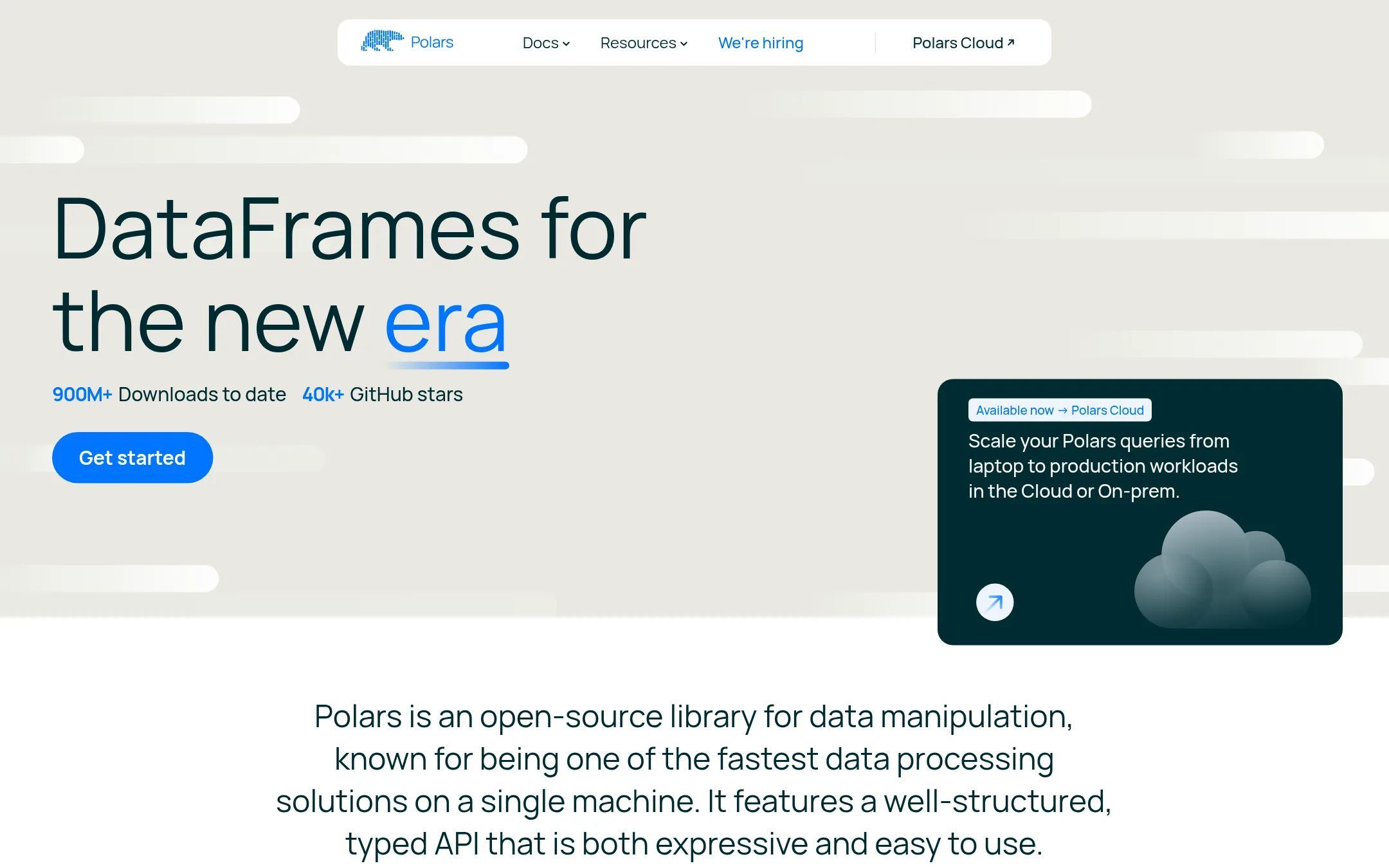
Polars is an open-source DataFrame engine for Python and SQL that runs queries fast on a single machine and can scale to a cluster with the same code. Teams choose it over Eventual when the work is tabular, the data fits a more conventional DataFrame workflow, and they want a free, MIT-licensed engine they can run on their own hardware.
Where it is strong
- The engine is free forever under the MIT license, with no usage limits on a single machine.
- It works with both Python DataFrames and SQL, so teams used to pandas or Spark can start quickly.
- The same query code runs on a laptop or scales out to a cluster on the managed Nanook platform.
Where it falls short
- Polars is built for tabular data and does not treat images, video and audio as native column types the way Eventual's Daft does.
- It has no built-in managed UDF runtime for model inference, so GPU model pipelines need more of your own code.
- Pricing:
- The Polars engine is free and open source under the MIT license, and the Polars Nanook managed platform has a Developer plan at no charge with 2,000 vCPU-hours a month, a Team plan at $200 a month with 5,000 vCPU-hours included, and custom Enterprise pricing.
- Switching from Eventual:
- Moving from Eventual would mean rewriting multimodal pipelines as tabular Polars queries and handling model calls and media decoding outside the engine.
See more comparisons in AI & Machine Learning alternatives.
FAQ
Questions about Eventual alternatives
What is the main difference between Daft and Ray Data?
Daft is an open source Python dataframe engine built for multimodal AI data such as video, images, audio and embeddings. Ray Data is a broader compute framework that also covers model serving and reinforcement learning. Teams that want a Pandas or Spark style API focused on curating multimodal data may prefer Daft, while teams wanting wider compute coverage may prefer Ray Data.
Is Polars a good replacement if I work mostly with tabular data?
Polars is a free, MIT-licensed DataFrame engine that works with Python and SQL and runs fast on a single machine. It can scale to a cluster with the same code on the managed Nanook platform. It does not treat images, video and audio as native column types, so it fits tabular work better than multimodal pipelines.
When should I choose Dask over Eventual?
Dask suits teams whose code is already built on pandas or NumPy and who need to scale past one machine without a rewrite. Its DataFrames use pandas under the hood and it runs on laptops, Kubernetes and HPC schedulers. Its site focuses on tabular and array workloads and does not describe native video, image or audio handling or built-in model operators.
Which alternatives handle GPU model inference inside a pipeline?
Eventual's site describes running GPU inference and CPU decode in one pipeline with native model operators. Among the entries, Ray Data is the closest fit for large multimodal workloads with a Pandas or Spark style API. Polars and Dask do not describe built-in managed UDF runtimes for model inference, so GPU model pipelines would need more of your own code with them.
Do any of these alternatives publish pricing I can compare directly?
Polars publishes the most concrete pricing: a free Developer plan, a Team plan at $200 a month, and custom Enterprise pricing for its managed platform. Dask is free to self-host and lists a managed option through Coiled without published paid plan figures. Apache Airflow, Pandas and Ray Data do not publish pricing on their sites, so comparing costs with those will need a direct conversation.
Last updated November 17, 2026.