
Extend alternatives
6 products compared · Updated November 9, 2026
The short answer
The three strongest alternatives to Extend are Reducto, LlamaIndex and Unstructured. Reducto suits AI teams processing table-heavy financial or legal PDFs who want published per-endpoint pricing. LlamaIndex suits engineering teams already building RAG or agent pipelines on its open-source framework. Unstructured suits enterprise teams in regulated industries that need to ingest documents from many sources into a vector database.
Your shortlist, at a glance
Read the comparisons ↓- DDocsumoCustom quoteLending, insurance and healthcare operations teams that need cross-document checks on multi-document files
 NanoNets$100/mo for 100 creditFinance, claims and operations teams that need document-driven agents wired into SAP, Salesforce or similar systems of record
 RossumNot publishedFinance and AP teams at mid-sized and large companies that need invoices and transactional documents posted into an ERP like SAP, Coupa or Workday
- UUnstructured$0.015 per pageEnterprise teams in regulated industries that need to ingest documents from many sources into a vector database
 Reducto$10 per 1k pagesAI teams processing table-heavy financial or legal PDFs who want per-endpoint pricing and a startup credit program
 LlamaIndex$1.5 per 1k creditsEngineering teams already building RAG or agent pipelines on LlamaIndex who need parsing for complex PDFs, tables, and charts
About Extend and its alternatives
Extend is a document processing platform for AI teams. Its site describes parsing, extraction, splitting and verification of complex documents through APIs, with a studio for schema iteration and evals, and it highlights accuracy on hard production documents, pay-as-you-go pricing and US, EU or VPC hosting.
When comparing alternatives in this category, weigh how each vendor charges (per page, per credit, per endpoint or per block run), which regions and deployment models it supports (cloud, EU hosting, VPC or on-prem), which file types and source systems it connects to, how it handles support and rate limits, and what the contract terms are for regulated data such as BAAs and data retention.
Explore the alternatives
- DCustom quote
1.Docsumo
Best for: Lending, insurance and healthcare operations teams that need cross-document checks on multi-document files
- Pricing
- Custom quote
- Category
- Other
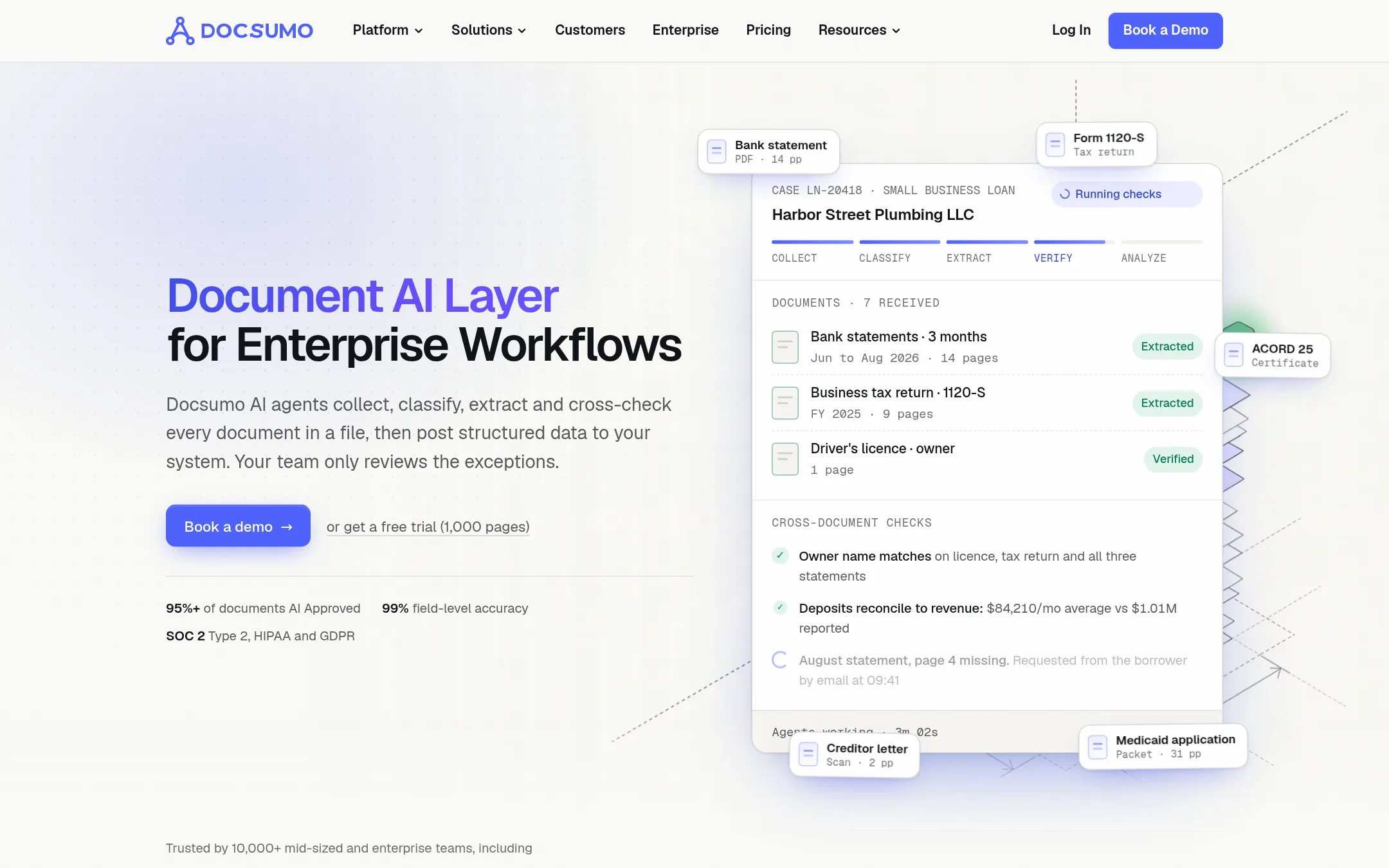
Docsumo reads and checks documents for teams that need data pulled from bank statements, ACORD forms, claims, or invoices and posted to their own systems. Pick it over Extend when the work is a whole file that has to be checked across documents, such as a loan or claim case with a missing page to chase, and when you want a case view and a human review queue built in.
Where it is strong
- Checks names, addresses and totals across documents in the same case, not just page by page.
- Routes failed checks to a reviewer and can request missing pages from the borrower.
- Includes a case view and an audit log of who approved what and when.
Where it falls short
- Pricing is not published, so budgeting requires a sales conversation.
- Its strength is in lending, insurance, healthcare and finance documents, which may be less relevant for other document types.
- Pricing:
- Pricing is not published on the site. A free plan covers 1,000 pages and Business and Enterprise are quoted on document volume.
- $100/mo for 100 credit
2.NanoNets
Best for: Finance, claims and operations teams that need document-driven agents wired into SAP, Salesforce or similar systems of record
- Pricing
- $100/mo for 100 credit
- Category
- AI & Machine Learning
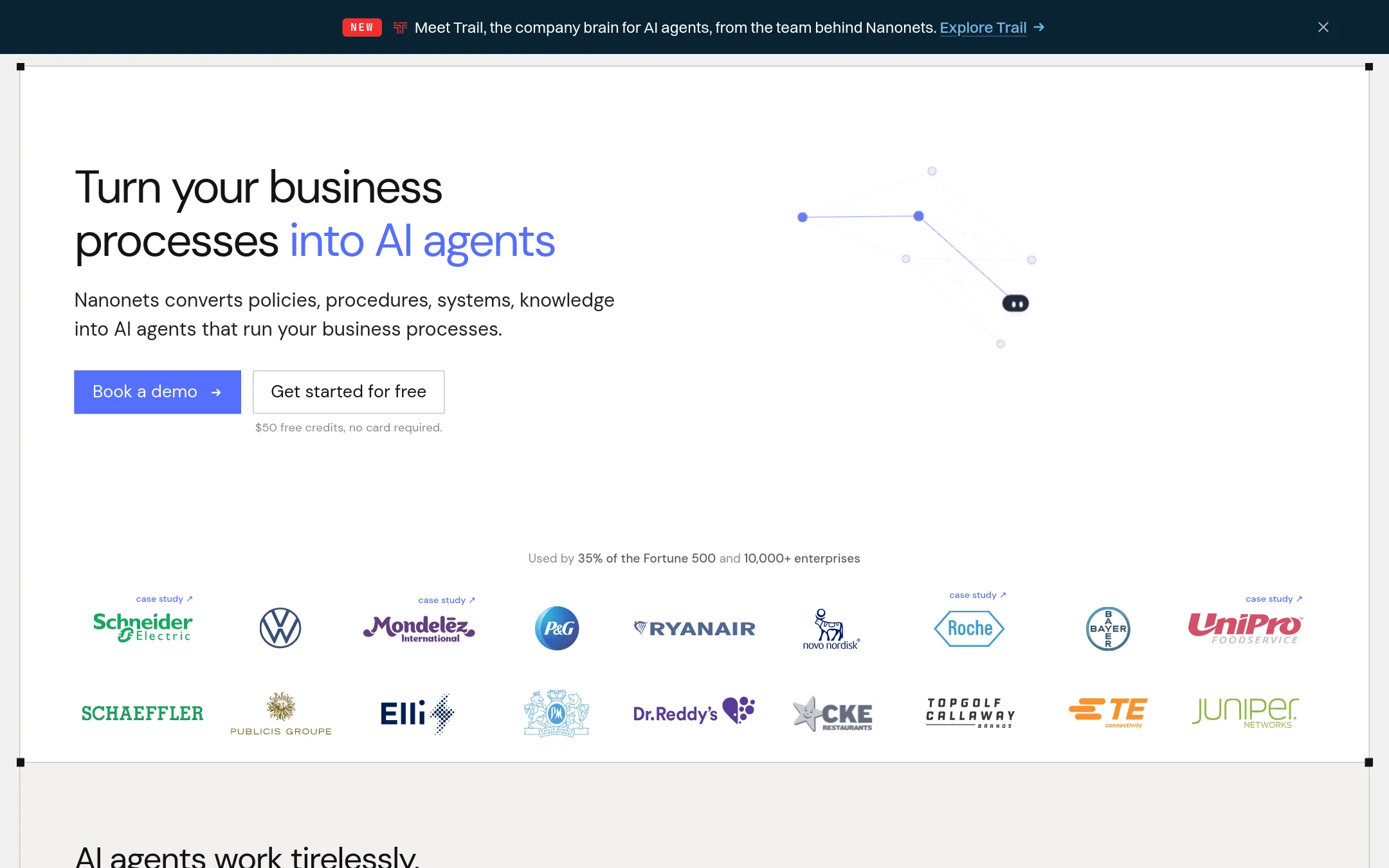
Nanonets turns business documents and rules into AI agents for finance, claims, order management and similar back-office work, and writes clean data into systems like SAP and Salesforce. A team would pick it over Extend when the job is less about parsing a single document accurately and more about running a whole process with business rules, exception handling and ERP connections.
Where it is strong
- Builds agents from SOPs and policy documents, with rules traced back to their source
- Learns from human corrections and approvals over time
- Offers private cloud, on-prem and data residency options (US, EU, APAC) on the Enterprise plan
Where it falls short
- Pricing is per block run, so costs depend on how many steps each workflow has
- Several features, including SAP and Oracle connectors and SAML SSO, sit only on the Enterprise tier
- Pricing:
- Nanonets bills per block run, with $50 in free credits to start, then $100/month for 100 credits on the Starter plan, and Growth and Enterprise plans are priced by volume or custom quote.
- Switching from Extend:
- Moving from Extend would mean rebuilding your parsing and extraction schemas as Nanonets workflows and agents, since the two products are structured differently.
- Not published
3.Rossum
Best for: Finance and AP teams at mid-sized and large companies that need invoices and transactional documents posted into an ERP like SAP, Coupa or Workday

- Pricing
- Not published
- Category
- AI & Machine Learning
Rossum automates transactional document workflows, mainly accounts payable invoices, from intake through validation to ERP posting and approvals. Teams choose it over Extend when the work is less about extracting clean data from arbitrary documents and more about running the full back-office process around invoices and order paperwork, including email handling, master data matching and downstream ERP integration.
Where it is strong
- Covers the whole transactional flow, from email and scanner intake through approval to ERP posting, not just extraction
- Built-in validation against master data and business rules before anything reaches the downstream system
- Ships with certified integrations for SAP, Coupa, Oracle, Workday and QuickBooks
Where it falls short
- Focused on transactional documents, so it is a weaker fit than Extend for general-purpose parsing of varied document types for AI agents
- Entry plans start at a sizable annual commitment based on the listed Starter tier, which may be steep for early-stage teams
- Pricing:
- Pricing is not published on the site.
- U$0.015 per page
4.Unstructured
Best for: Enterprise teams in regulated industries that need to ingest documents from many sources into a vector database
- Pricing
- $0.015 per page
- Category
- Other
Unstructured turns PDFs, scans, spreadsheets and more than 50 file types into structured data for RAG pipelines and AI agents. Teams pick it over Extend when they need to connect many sources and destinations, such as S3, SharePoint and vector databases, and run the whole pipeline without writing glue code. The site also stresses self-hosted and VPC deployment for regulated data.
Where it is strong
- Handles 50+ file types through one pipeline, not just PDFs
- Connects to 20+ sources and 20+ destinations, including major vector databases
- Lists SOC 2 Type 2, HIPAA, GDPR, ISO 27001 and FedRAMP High, with dedicated or in-VPC deployment
Where it falls short
- Its homepage does not publish accuracy benchmarks against document-level extraction, so comparing it with Extend's RealDoc results takes you
- Dedicated, VPC and multi-user Business plans are custom-priced and need a sales conversation
- Pricing:
- Unstructured offers 10,000 free pages to start, then charges $0.015 per page on pay-as-you-go, with Business pricing custom.
- $10 per 1k pages
5.Reducto
Best for: AI teams processing table-heavy financial or legal PDFs who want per-endpoint pricing and a startup credit program
- Pricing
- $10 per 1k pages
- Category
- AI & Machine Learning
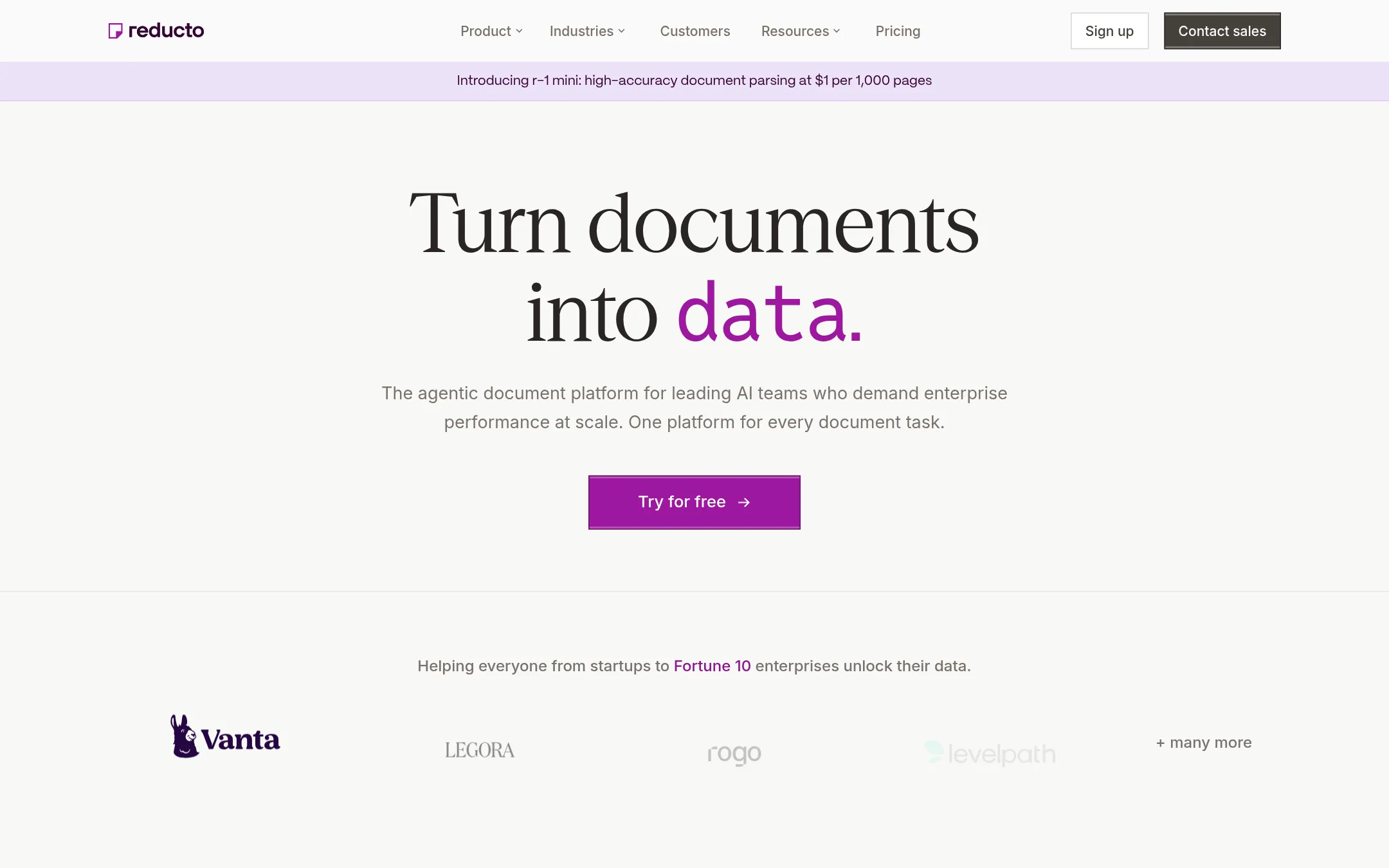
Reducto is an agentic document platform with parse, extract, split and edit endpoints, aimed at teams that need accurate output on hard layouts like complex tables. Someone would pick it over Extend when table-heavy or edge-case documents are the main problem and they want a per-endpoint rate card with a startup credit program.
Where it is strong
- Per-endpoint rates are published, so cost per page is easy to estimate
- Startup Program offers free credits and discounted Growth pricing for eligible early-stage teams
- Supports VPC and on-prem deployments on Enterprise plans
Where it falls short
- Only Enterprise adds VPC or on-prem deployment, while Extend offers BYOC and Hybrid options on its Enterprise tier
- Concurrent page limits are lower than Extend's published throughput on its standard tiers
- Pricing:
- Parse is $10 per 1,000 pages, r-1 mini Parse is $1 per 1,000 pages, Extract is $20 per 1,000 pages, Split is billed by Deep Split, Classify is $7.50 per 1,000 pages and Edit is $60 per 1,000 pages, with Standard including $150 of free usage before list rates a
- Switching from Extend:
- Reducto offers up to $5,000 in migration credits to customers moving a workload from another document processor.
- $1.5 per 1k credits
6.LlamaIndex
Best for: Engineering teams already building RAG or agent pipelines on LlamaIndex who need parsing for complex PDFs, tables, and charts
- Pricing
- $1.5 per 1k credits
- Category
- AI & Machine Learning
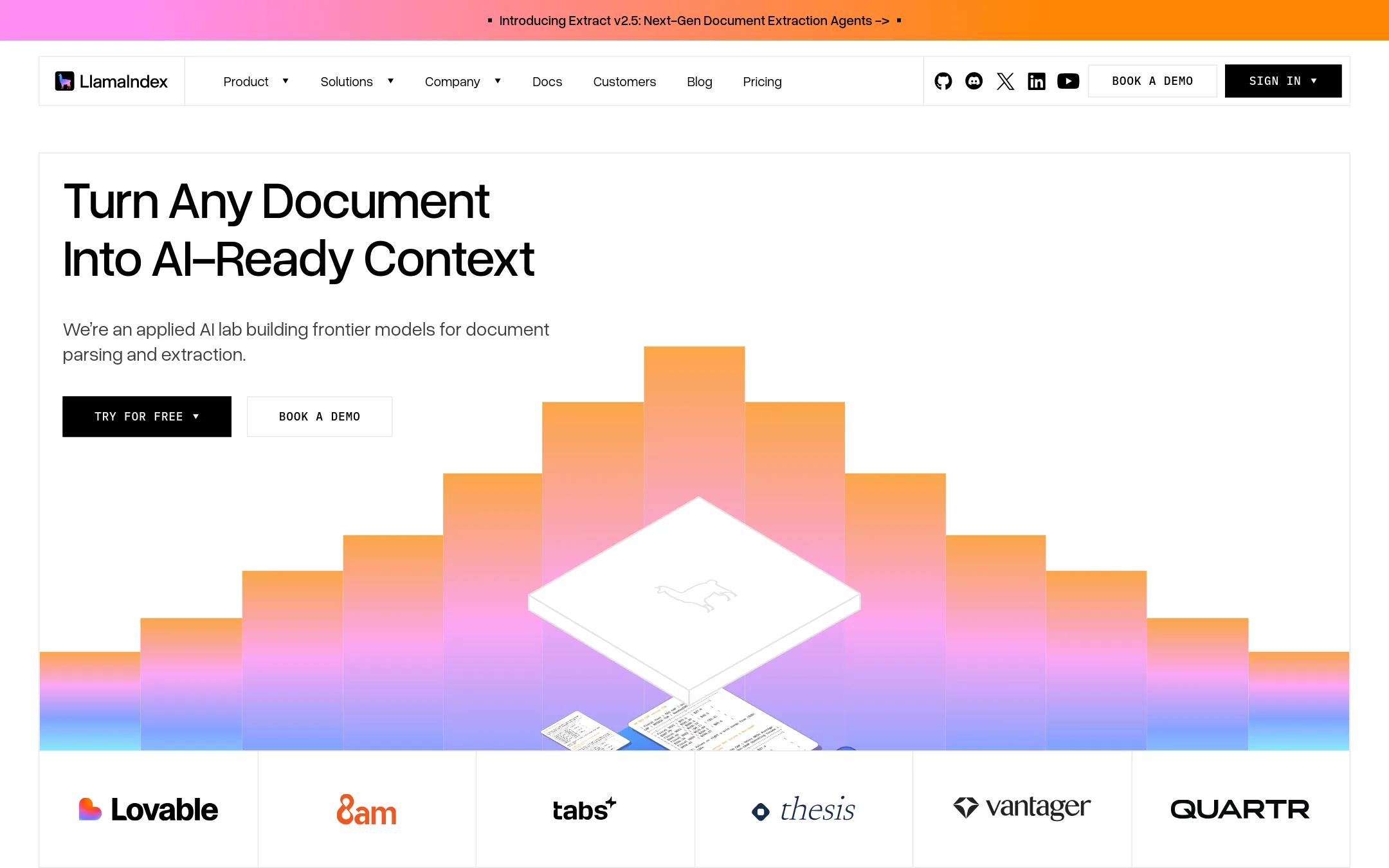
LlamaParse is a document parsing and extraction platform from LlamaIndex, offering agentic OCR, schema-based extraction, classification, splitting, and indexing for 130+ file types. Someone would choose it over Extend if they want a free-to-start tier with generous monthly credits, or if they already build on the LlamaIndex open-source framework and want parsing in the same ecosystem.
Where it is strong
- Free plan includes 10,000 credits per month, roughly 1,000 pages
- Offers 130+ file formats including Office documents, spreadsheets and images
- Open-source LiteParse option for local parsing without cloud costs
Where it falls short
- The core platform is commercial and not open source
- Enterprise deployment in a private VPC is listed, but pricing and terms require contacting sales
- Pricing:
- The site lists 10K free credits per month on the free plan, then $1.5 per 1k credits in Europe pricing, with a Pro tier at 400K included credits and custom Enterprise pricing.
See more comparisons in Productivity & Project Management alternatives.
FAQ
Questions about Extend alternatives
What is the cheapest way to start with an Extend alternative?
LlamaIndex offers a free plan with 10,000 credits per month, roughly 1,000 pages. Unstructured offers 10,000 free pages to start, then $0.015 per page on pay-as-you-go. Reducto publishes per-endpoint rates and a Startup Program with free credits for eligible early-stage teams.
Which alternative is best for table-heavy financial or legal documents?
Reducto is aimed at teams that need accurate output on hard layouts such as complex tables. Its entry lists per-endpoint pricing, so cost per page is easy to estimate before committing.
Which option fits a team that already uses LlamaIndex?
LlamaParse fits engineering teams already building RAG or agent pipelines on LlamaIndex. It covers 130+ file formats and offers an open-source LiteParse option for local parsing without cloud costs, though the core platform is commercial.
Which alternatives are better for end-to-end back-office workflows rather than parsing alone?
Nanonets builds document-driven agents for finance, claims and operations, wired into systems such as SAP and Salesforce. Rossum automates accounts payable invoice intake through ERP posting and approvals, though its pricing is not published and entry tiers carry a sizable annual commitment.
Which options support private deployment for regulated data?
Unstructured lists SOC 2 Type 2, HIPAA, GDPR, ISO 27001 and FedRAMP High, with dedicated or in-VPC deployment. Reducto supports VPC and on-prem deployments on its Enterprise plan, and Nanonets offers private cloud, on-prem and data residency options on its Enterprise plan.
Last updated November 9, 2026.