Firecrawl alternatives
11 products compared · Updated November 8, 2026
The short answer
The three strongest alternatives to Firecrawl are Exa, Tavily, and Browserbase. Exa suits coding agent builders who need fast, token-efficient search across docs, repos, and Stack Overflow. Tavily suits developer teams building research or question-answering agents that need fresh web facts through a simple search API. Browserbase suits engineering teams building agents that must log in to sites, fill forms, or click through multi-step workflows.
Your shortlist, at a glance
Read the comparisons ↓- AApifyFrom $19/mo + usageSales and growth teams that need lead lists from specific sites like Google Maps or Instagram without building scrapers themselves
- SScrapingBeeCustom quoteDevelopers and product teams that need scheduled scraping of e-commerce and search data without running their own proxy fleet.
- SScraperAPIFrom $49/moData teams running high-volume scraping of ecommerce, SERP, or real estate listings that already have in-house scrapers
- BBright DataNot publishedEngineering and data teams that need geo-targeted proxy access or bulk historical datasets across many sites.
- BBrowserbase$0.12/browser hrEngineering teams building agents that must log in to sites, fill forms, or click through multi-step web workflows
 Exa$12 per 1k requestsCoding agent builders who need fast, token-efficient search across docs, repos and Stack Overflow
- TTavilyFrom $0.008/creditDeveloper teams building research or question-answering agents that need fresh web facts with a simple search API
- JJina AINot publishedDevelopers building LLM tools who want a lightweight URL-to-Markdown reader with fine-grained request controls.
Hyperbrowser$30/mo usage includedEngineering teams building agents that log into sites, click through flows, and run code, and that need browsers and compute in one place
- RReworkdSee websiteThe simplest way to extract web data at scale
 SmoothSee websiteFast, simple, reliable AI browser agent
About Firecrawl and its alternatives
Firecrawl is a web data API for AI agents. Its site says it lets agents search and scrape the web, offers access to more sources through its Alexandria library, and is open source.
When comparing alternatives in this category, weigh the pricing structure first, since some tools bill by page, some by credit, and some by browser hour. Check regional coverage, integrations with the agent tools you already use, the level of support on each plan, and contract terms such as credit rollover and invoiced billing.
Explore the alternatives
- AFrom $19/mo + usage
1.Apify
Best for: Sales and growth teams that need lead lists from specific sites like Google Maps or Instagram without building scrapers themselves
- Pricing
- From $19/mo + usage
- Category
- Other
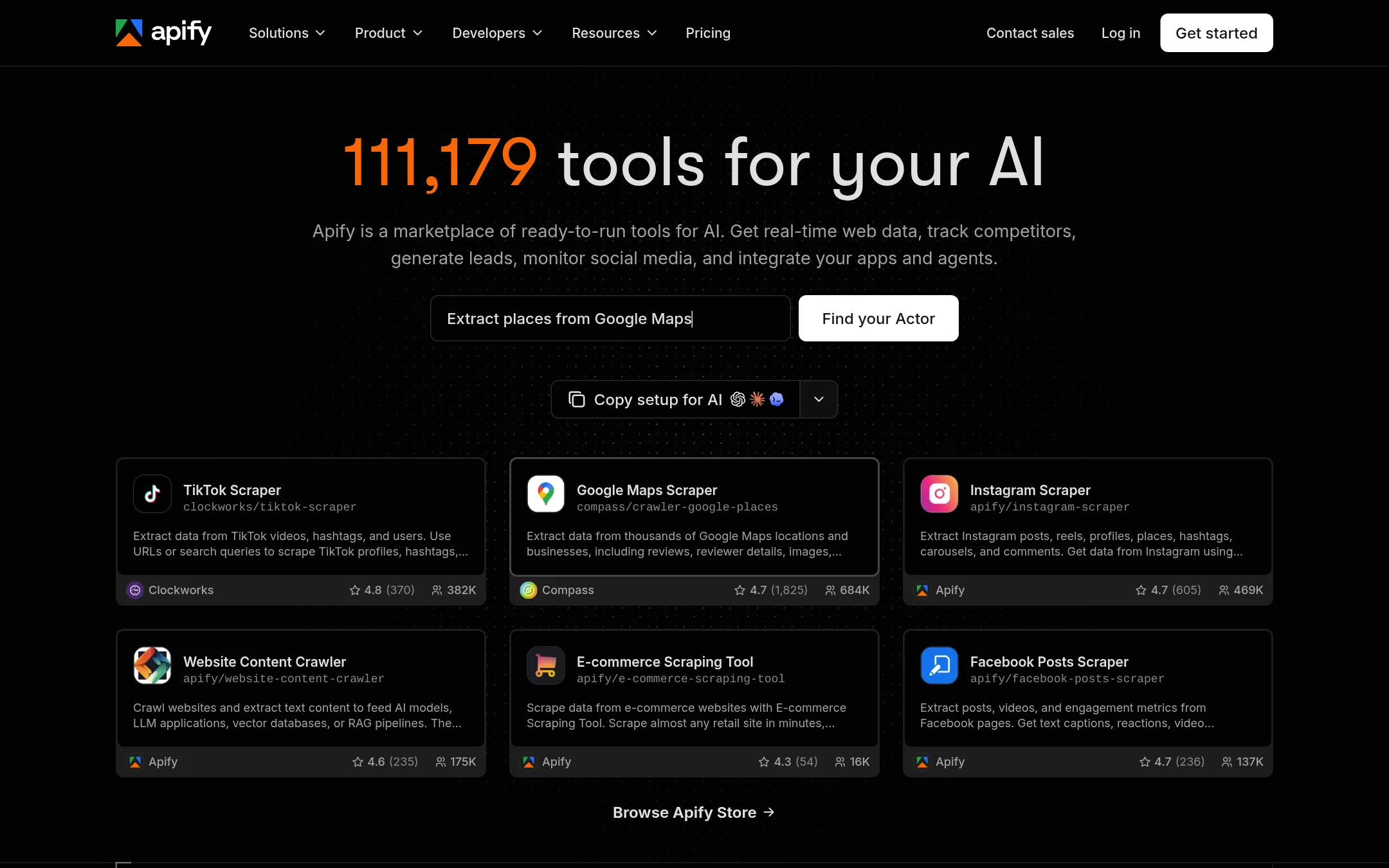
Apify is a marketplace of ready-made scrapers called Actors, plus a platform to build and run your own. Teams pick it over Firecrawl when they want a pre-built scraper for a specific site, such as TikTok, Google Maps or Instagram, rather than a general web data API. It also suits teams that want to sell a scraper to others and get paid per run.
Where it is strong
- Thousands of ready-to-run Actors for specific sites like TikTok, Google Maps and Instagram
- You can build and publish your own Actor and earn from it, with Apify handling payments and invoicing
- Runs can be triggered through an API, scheduled, and connected to tools like Zapier, n8n and Slack
Where it falls short
- Output depends on each Actor's author, so quality and upkeep vary across the store
- Costs can be harder to predict because pricing depends on the Actor and run type
- Pricing:
- Pricing is not published on the site in a single headline figure, but the Starter plan is $19 per month plus pay as you go, with a free plan that includes $5 of platform credit.
- Switching from Firecrawl:
- Moving from Firecrawl means finding an Actor that covers your target sites or writing your own, then rewiring your calls to Apify's API.
- SCustom quote
2.ScrapingBee
Best for: Developers and product teams that need scheduled scraping of e-commerce and search data without running their own proxy fleet.
- Pricing
- Custom quote
- Category
- Other
ScrapingBee is a web scraping API that handles proxies, headless Chrome rendering and anti-bot defenses for you. You send a URL and get back HTML, rendered content or structured JSON. Teams pick it over Firecrawl when they mainly need reliable page fetching at volume, with dedicated endpoints for sites like Amazon, Google and Walmart.
Where it is strong
- Automatic proxy rotation, with premium and stealth proxies for harder sites
- Dedicated scraper APIs for Amazon, Google, YouTube and Walmart
- Natural-language AI extraction and a CLI that works with common AI coding tools
Where it falls short
- Its public material does not mention an open-source option, which Firecrawl offers
- Its public material does not describe a knowledge library or specialised indexes of the kind Firecrawl's Alexandria offers
- Pricing:
- Plans run from a Hobby tier with 75,000 API credits to Enterprise tiers with up to 120,000,000 credits, and the pricing page does not give a per-plan monthly price in the text provided.
- SFrom $49/mo
3.ScraperAPI
Best for: Data teams running high-volume scraping of ecommerce, SERP, or real estate listings that already have in-house scrapers
- Pricing
- From $49/mo
- Category
- Other
ScraperAPI is a web scraping API that handles proxies, browsers, and CAPTCHAs so you can pull data from public sites. Teams pick it when they already have scrapers or want structured output from popular domains like Amazon and Google, and want to skip building proxy and anti-bot handling themselves. Firecrawl is built around search and scrape for AI agents, so ScraperAPI fits better when the job is high-volume extraction from known sites.
Where it is strong
- Structured JSON endpoints for Amazon, Google, and Walmart data
- Handles proxy rotation, CAPTCHA, and anti-bot bypass for you
- Geotargeting across 50+ countries on higher tiers
Where it falls short
- Credit cost varies by domain, so heavy sites like Google use far more credits per request
- Geotargeting is limited to US and EU on the entry plan
- Pricing:
- Plans run from $49/month for 100,000 API credits, $149/month for 1,000,000 credits, and $299/month for 3,000,000 credits, with a free trial of 5,000 credits and custom pricing above 22M credits.
- Switching from Firecrawl:
- Moving from Firecrawl means reworking calls from its search and scrape endpoints to ScraperAPI's request format, and checking per-domain credit costs before choosing a plan.
- BNot published
4.Bright Data
Best for: Engineering and data teams that need geo-targeted proxy access or bulk historical datasets across many sites.
- Pricing
- Not published
- Category
- Other
Bright Data is a web data platform with scraper APIs, a browser for automation, SERP data, prebuilt datasets, and the largest proxy network it lists, at over 400M residential IPs across 195 countries. Teams pick it over Firecrawl when they need proxy-level control, geo-targeting by country, city, carrier or ASN, or ready-made datasets instead of an API that returns clean markdown from pages.
Where it is strong
- Proxy network of 400M+ residential IPs in 195 countries
- Targeting by country, city, carrier and ASN
- Prebuilt datasets and SERP API for search data
Where it falls short
- Pricing is spread across many separate products with no single published plan
- Built for data collection at scale, so a simple page-to-markdown workflow is more work to set up than with Firecrawl
- Pricing:
- Pricing is not published on the site.
- B$0.12/browser hr
5.Browserbase
Best for: Engineering teams building agents that must log in to sites, fill forms, or click through multi-step web workflows
- Pricing
- $0.12/browser hr
- Category
- Other
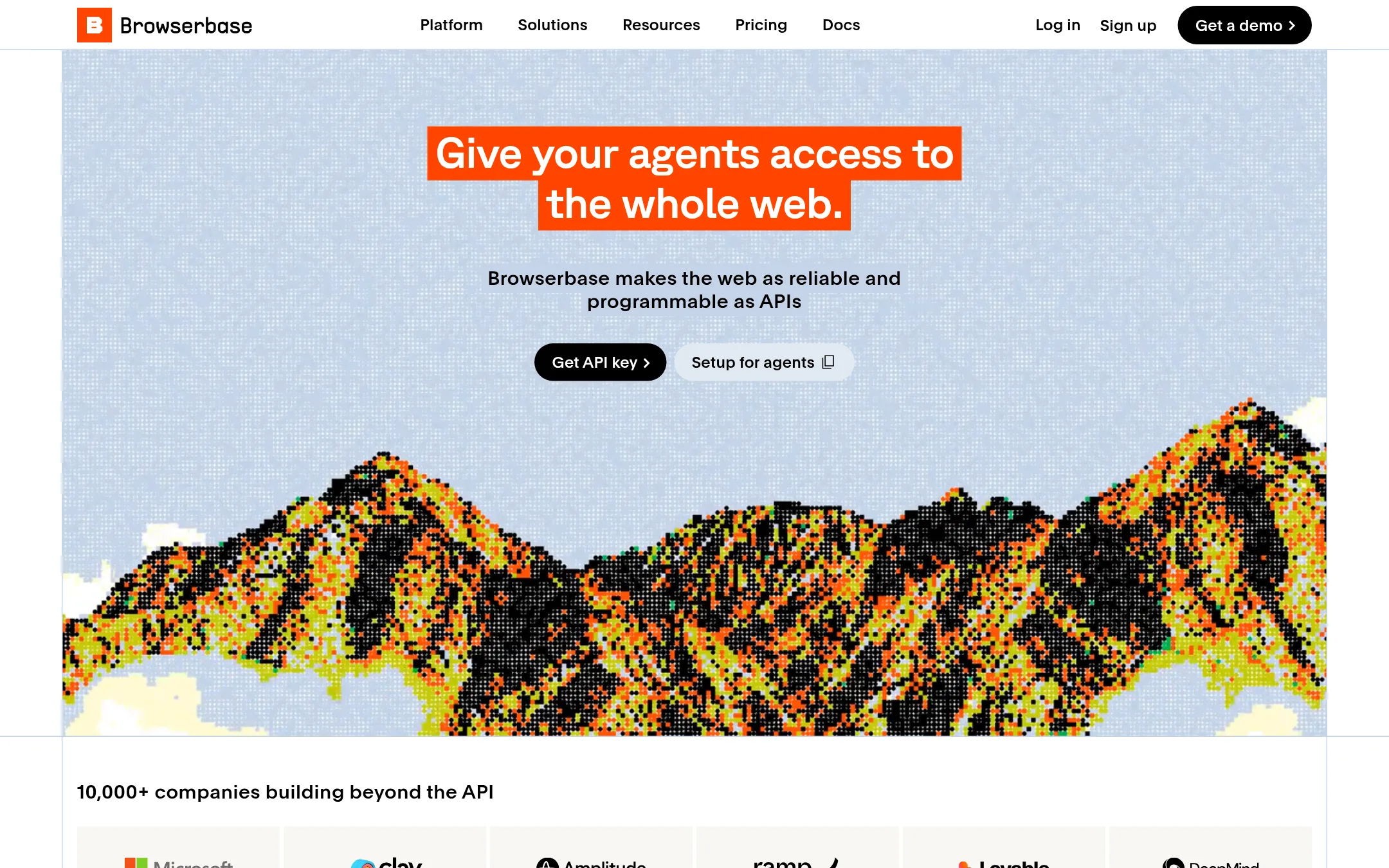
Browserbase gives agents a real, programmable browser that can log in, click through flows, and handle dynamic pages. It also offers a Search API and a Fetch API for quick web context. Choose it over Firecrawl when your agent has to act on websites, such as filling forms, passing login walls, or checking that a product flow still works, not just read pages.
Where it is strong
- Full browser sessions let agents handle logins, forms, and dynamic content
- Search and Fetch APIs cover lighter-weight web reads alongside browser work
- Scales to hundreds of concurrent browsers on higher tiers, with HIPAA and SSO listed for Enterprise
Where it falls short
- Browser-first design is heavier than a pure scrape API when you only need page content
- Pricing spans browser hours, search calls, fetch calls and proxies, so costs take some modelling
- Pricing:
- The Start for Free plan includes 3 concurrent browsers, 1 browser hour, 1,000 Search calls and 1,000 Fetch calls, and the Developer plan is $5 in tokens with 100 browser hours then $0.12/browser hr, with Startup and Enterprise tiers above that.
- $12 per 1k requests
6.Exa
Best for: Coding agent builders who need fast, token-efficient search across docs, repos and Stack Overflow
- Pricing
- $12 per 1k requests
- Category
- AI & Machine Learning
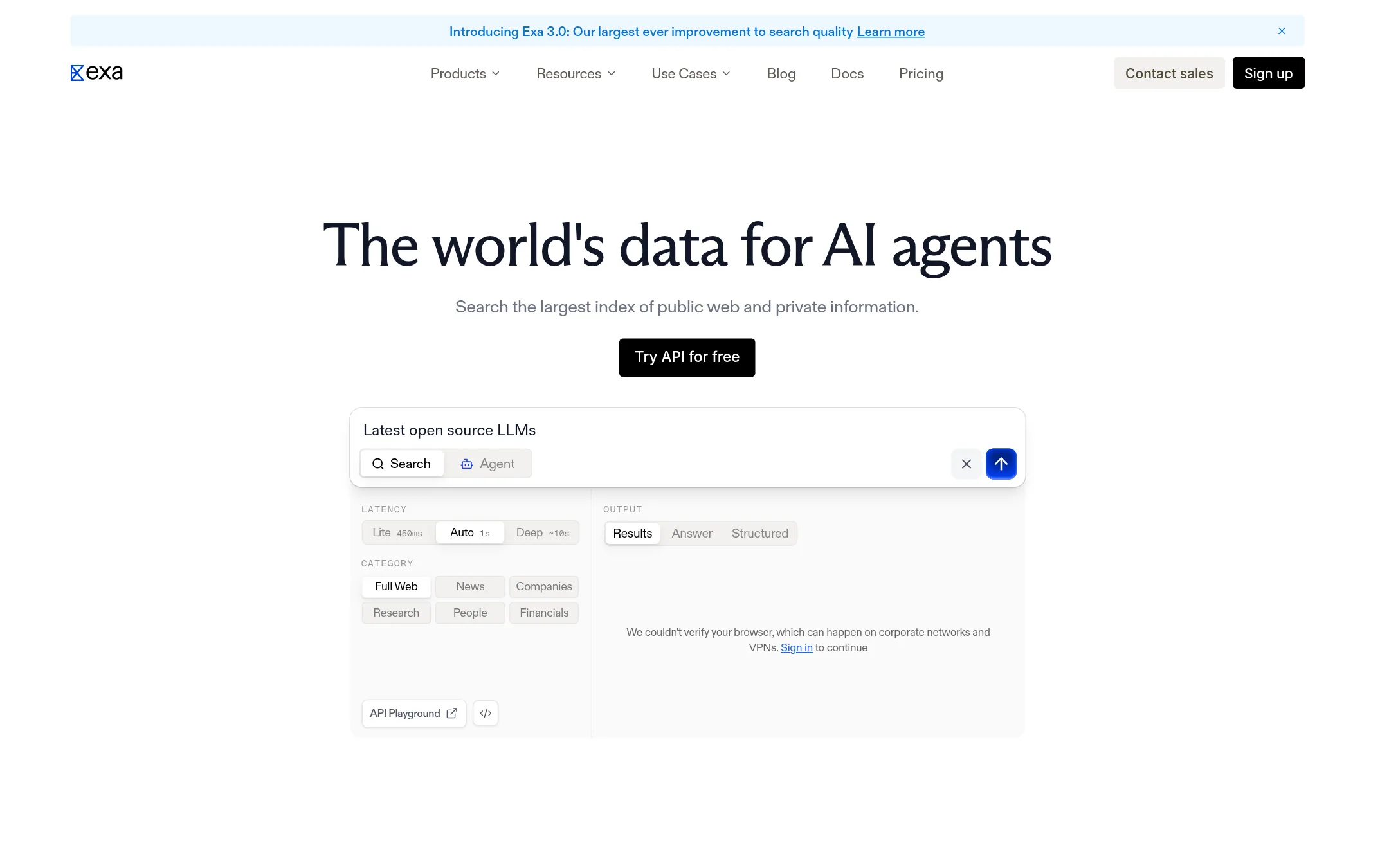
Exa is a search API built for AI agents. It returns web results with token-efficient highlights, so an agent gets relevant excerpts rather than full pages, and it offers deep research runs that return structured outputs with citations. Someone would pick Exa over Firecrawl when the main need is finding the right sources and passages across the web, not extracting clean content from a specific list of URLs.
Where it is strong
- Token-efficient highlights pass concise excerpts to models instead of whole pages.
- Lite, Auto and Deep search modes let you trade latency against depth.
- Deep research runs return structured outputs with grounded citations.
Where it falls short
- Exa is built around search and retrieval, so it does not match Firecrawl's focus on scraping and crawling whole sites.
- Self-serve plans cap search at 10 queries per second, and higher limits need an Enterprise plan.
- Pricing:
- Exa has a free plan with $10 in credits each month plus a $10 onboarding bonus, a pay-as-you-go plan with no commitment, and custom Enterprise pricing, and the Search API bills at $12 per 1k requests with up to 10 results.
- Switching from Firecrawl:
- Moving from Firecrawl would mean rewriting calls for search and scrape, since Exa's search endpoints return highlights and summaries rather than full page markdown.
- TFrom $0.008/credit
7.Tavily
Best for: Developer teams building research or question-answering agents that need fresh web facts with a simple search API
- Pricing
- From $0.008/credit
- Category
- Other
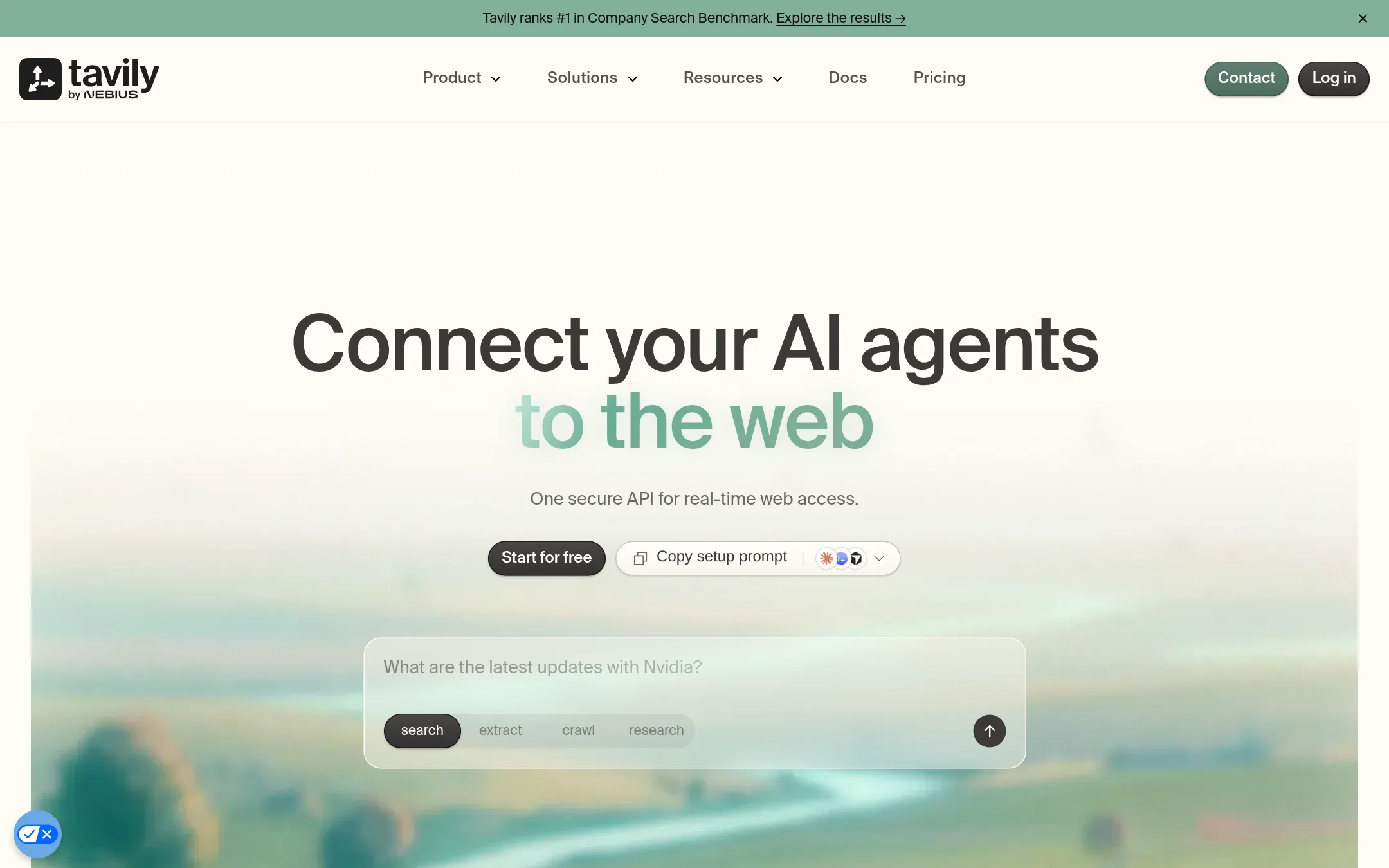
Tavily is a search and content extraction API built for AI agents. It returns live web results as structured, chunked text so models can answer from current facts. Teams choose it over Firecrawl when their main need is search-driven research grounding rather than full site crawling and scraping.
Where it is strong
- Free plan with 1,000 credits per month and no credit card required
- Returns search results structured and chunked for model consumption
- Pay As You Go option with no monthly commitment
Where it falls short
- Focused on search and extraction, so it lacks Firecrawl's full site crawling as a core feature
- Credits run out monthly and requests stop until reset or upgrade
- Pricing:
- Pricing is published as a free Researcher plan with 1,000 API credits per month, a Pay As You Go rate of $0.008 per credit, a Project plan at $30 per month with 4,000 credits, and custom Enterprise pricing.
- JNot published
8.Jina AI
Best for: Developers building LLM tools who want a lightweight URL-to-Markdown reader with fine-grained request controls.
- Pricing
- Not published
- Category
- Other
Jina AI offers a Reader API that fetches a URL and returns its content, plus a search endpoint that returns web results, and an MCP server so any LLM can call these tools. A team would pick it over Firecrawl if they want a simple URL-prefix call (r.jina.ai or s.jina.ai) with a long list of per-request options like CSS selectors, proxies, cookie forwarding and caching controls. Its site also lists an EU residency experiment, which may matter to teams with European data requirements.
Where it is strong
- Reader works with a simple URL prefix and no SDK setup
- Fine-grained controls for selectors, timeouts, proxies, cookies and caching
- Also offers an MCP server so any LLM client can call its APIs
Where it falls short
- The site does not publish pricing, so cost comparison needs a direct inquiry
- Its listed features centre on reading and searching pages, and the site does not show a crawl or structured extraction endpoint like Firecra
- Pricing:
- Pricing is not published on the site.
- $30/mo usage included
9.Hyperbrowser
Best for: Engineering teams building agents that log into sites, click through flows, and run code, and that need browsers and compute in one place
- Pricing
- $30/mo usage included
- Category
- Developer Tools
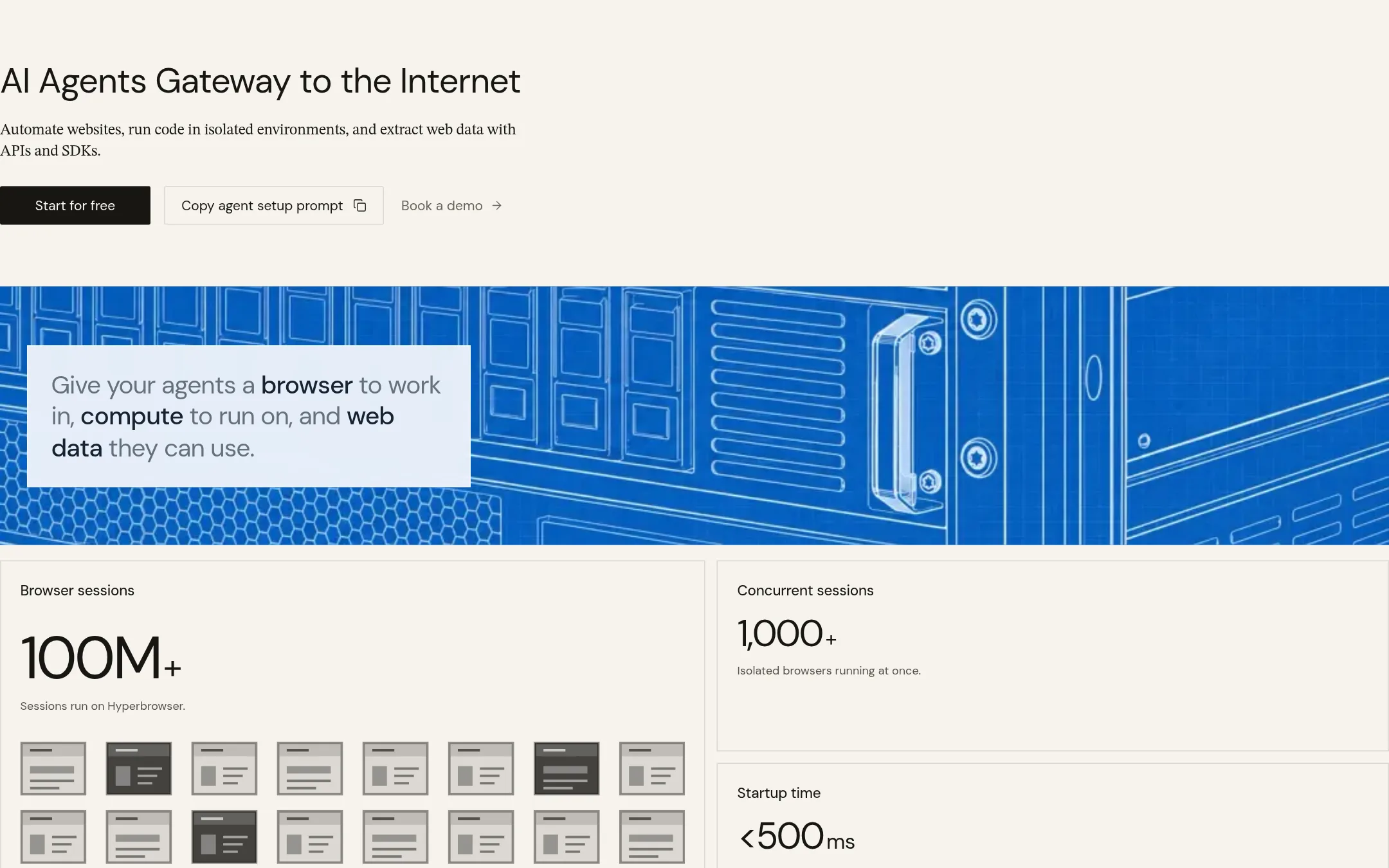
Hyperbrowser gives AI agents cloud Chrome sessions, isolated sandboxes, and a web data API in one product. Teams pick it over Firecrawl when they need a real browser that agents can drive with Playwright or Puppeteer, or when they need to run code in a VM next to the browsing.
Where it is strong
- Cloud browsers start in under 500 ms, and you can attach Playwright or Puppeteer to them directly
- Sandboxes let you install packages, run commands, and save environment snapshots for later runs
- Saved browser profiles keep cookies and logins between runs, and session recordings help with debugging
Where it falls short
- Credits span browsers, sandboxes, and web data, so costs are harder to predict than a flat page-based rate
- Full-page extraction is priced per page with add-ons for JSON output and stealth, which adds up at scale
- Pricing:
- Pricing is metered in credits, with a Free plan of 5,000 credits, a Startup plan at $30 of usage included each month, a Scale plan at $100 included each month, and custom Enterprise pricing.
- Switching from Firecrawl:
- Moving from Firecrawl means rewriting scrape and crawl calls against Hyperbrowser's Web API, and reworking any pipelines that depend on Firecrawl's output formats.
- RSee website
10.Reworkd
Analytics & Data
The simplest way to extract web data at scale
- See website
11.Smooth
Developer Tools
Fast, simple, reliable AI browser agent
See more comparisons in Analytics & Data alternatives.
FAQ
Questions about Firecrawl alternatives
What is Firecrawl best known for?
According to its site, Firecrawl is a web data API for AI agents that searches and scrapes the web and is open source. Its homepage also highlights the Alexandria library of indexed sources. Pricing is credit-based, with a free tier of 1,000 credits each month.
Which alternative is best if I mainly need search for an AI agent?
Exa and Tavily are both built around search for agents. Exa returns token-efficient highlights and offers deep research runs with citations. Tavily offers a free plan with 1,000 credits per month and returns structured, chunked text for models.
Which alternative is best if my agent has to log in or click through websites?
Browserbase gives agents a real programmable browser that can handle logins, forms, and dynamic pages. Hyperbrowser is another option, offering cloud Chrome sessions and sandboxes that agents can drive with Playwright or Puppeteer. Both bill on usage that spans browsers and compute.
Which alternatives suit teams that need data from specific sites at volume?
Apify offers ready-made scrapers for sites such as Google Maps, Instagram, and TikTok, and lets teams build their own. ScraperAPI provides structured JSON endpoints for Amazon, Google, and Walmart, starting at $49 per month. Bright Data suits teams that need geo-targeted proxy access across 195 countries.
How should I compare pricing across these tools?
Pricing models differ. Exa lists $12 per 1,000 requests for search, Tavily charges $0.008 per credit on pay as you go, and Browserbase bills browser hours. Some tools, such as Apify, Bright Data, and Jina AI, do not publish full pricing on their sites, so a direct inquiry is needed for an accurate comparison.
Last updated November 8, 2026.