Flightcontrol alternatives
6 products compared · Updated November 7, 2026
The short answer
The three strongest alternatives to Flightcontrol are Heroku, Railway, and Render, which all host apps on their own infrastructure rather than in your AWS account. Heroku suits small teams that want git-push deploys with managed Postgres and a large add-on catalog. Railway suits startups that want fast deploys with usage-based billing and no AWS setup. Render suits small teams that want managed hosting for web apps, APIs, databases, and background jobs without running their own AWS account.
Your shortlist, at a glance
Read the comparisons ↓ Vercel Image OptimizationFrom $0.05 per 1KFrontend teams already hosting on Vercel that need fast, cached image delivery at the edge
- RRenderFrom $7/mo per serviceStartups and small teams that want managed hosting for web apps, APIs, databases and background jobs without running their own AWS account.
 HerokuFrom $25/mo per dynoSmall teams that want git-push deploys with managed Postgres and no AWS account to run
 Railway$1/mo + usageStartups and developer teams that want to deploy apps and databases quickly with usage-based billing and no AWS setup
 Fly.ioFrom $2.19/moTeams building agent products or running untrusted code in parallel who want per-second billing and isolated VMs close to users
 Argo CDNot publishedKubernetes platform teams that want open source GitOps delivery with a visual UI on clusters they run themselves
About Flightcontrol and its alternatives
Flightcontrol is a deployment platform for running applications on AWS. According to its site, Ravion is now its successor, and the Flightcontrol product continues for existing customers. Ravion describes itself as CI and infrastructure as code that runs in your own cloud, with a focus on Terraform automation, deploys, and self-service modules.
When comparing alternatives in this category, weigh how each one bills, since some charge per module, some per resource, and some by usage or per seat. Check which regions and cloud accounts it supports, and whether workloads run in your own AWS account or on the vendor's infrastructure. Look at integrations with your existing CI, Terraform, and monitoring tools, the quality and speed of support, and the contract terms, including any annual discounts or enterprise agreements.
Explore the alternatives
- From $0.05 per 1K
1.Vercel Image Optimization
Best for: Frontend teams already hosting on Vercel that need fast, cached image delivery at the edge
- Pricing
- From $0.05 per 1K
- Category
- Media & Entertainment
Vercel Image Optimization is a media feature inside Vercel's hosting platform. It resizes and caches images through Vercel's global CDN, so it fits teams whose main problem is serving images fast, not deploying infrastructure. Pick it instead of Flightcontrol when your app is already on Vercel and you mainly need image delivery.
Where it is strong
- Image transformations are served from Vercel's global CDN with caching.
- Setup needs no separate image service, since it sits in the same platform as the app.
- Usage is metered per transformation, so small sites can start at no cost.
Where it falls short
- It only covers image delivery, so it does not replace Flightcontrol's deploy and infrastructure automation.
- Costs rise with transformation and cache volume, which is harder to forecast for image-heavy sites.
- Pricing:
- Image optimization includes 5K transformations and 300K cache reads per month, then transformations start at $0.05 per 1K, and paid plans are listed on the pricing page.
- RFrom $7/mo per service
2.Render
Best for: Startups and small teams that want managed hosting for web apps, APIs, databases and background jobs without running their own AWS account.
- Pricing
- From $7/mo per service
- Category
- Other
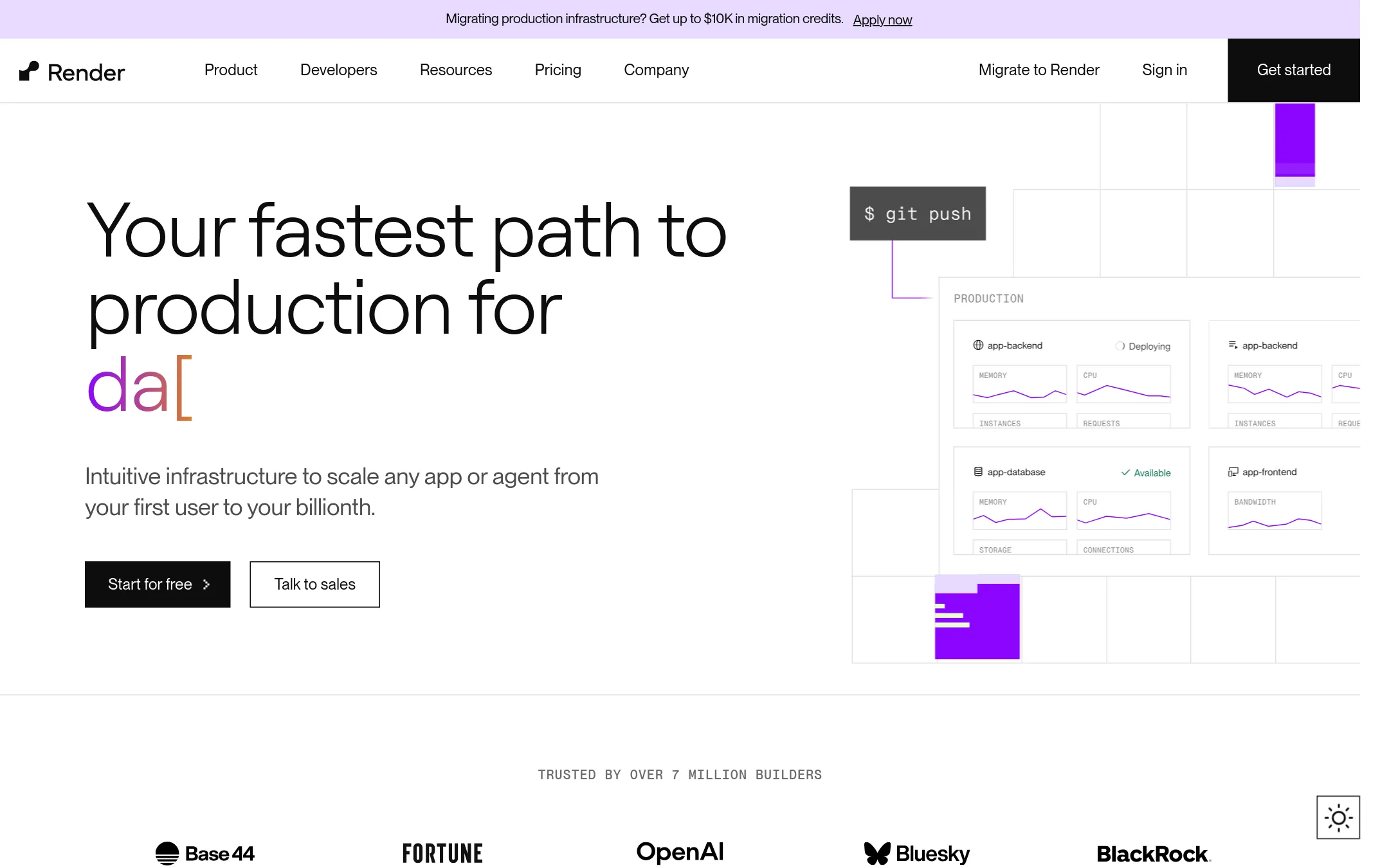
Render is a managed cloud platform that hosts web services, databases, cron jobs, workflows and static sites on Render's own infrastructure, with zero-ops deploys from a Git repo. Teams pick it over Flightcontrol when they want a hosted platform with managed Postgres, Redis-compatible storage and sandboxes for agents, rather than running everything in their own AWS account.
Where it is strong
- Pull-request previews of the full application stack, not just single services.
- Managed Postgres, Redis-compatible storage, cron jobs and workflows in one dashboard.
- Built-in DDoS protection, private networking and SOC 2 Type 2, HIPAA and ISO 27001 compliance.
Where it falls short
- Your workloads run on Render's infrastructure, not in your own AWS account, so you do not get direct AWS billing or account-level control.
- Terraform-based infrastructure automation and reusable platform modules are not part of the offering the way they are with Flightcontrol.
- Pricing:
- Pricing is published per resource: web services start at $7/month for 0.5 CPU and 512 MB RAM, Postgres starts at $6/month, and Redis-compatible storage starts at $10/month, with a custom-priced Organization tier for larger teams.
- From $25/mo per dyno
3.Heroku
Best for: Small teams that want git-push deploys with managed Postgres and no AWS account to run
- Pricing
- From $25/mo per dyno
- Category
- Developer Tools
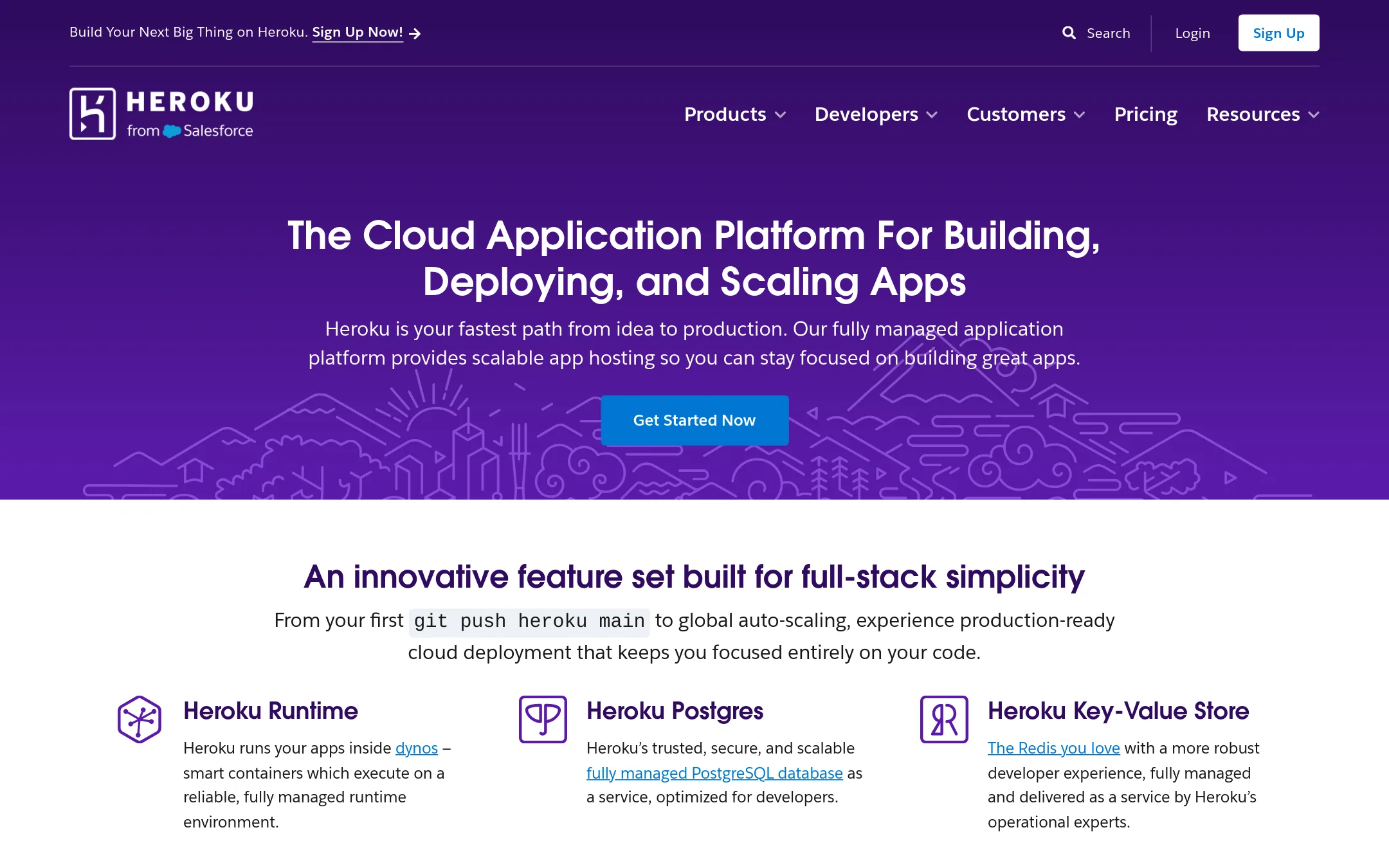
Heroku is a managed platform where you push code and it runs in dynos, with add-ons for Postgres, Redis-style key-value storage, and a large buildpack ecosystem. Teams pick it over Flightcontrol when they want a hosted PaaS with a long track record and a broad add-on catalog, and they are willing to accept less control over the underlying cloud account.
Where it is strong
- Git push deploys with review apps and fast rollback
- Managed Postgres and key-value store as add-on services
- Large ecosystem of add-ons and community buildpacks
Where it falls short
- Apps run on Heroku's infrastructure, not in your own AWS account
- Enterprise isolation features like Private Spaces are priced on top of standard dynos
- Pricing:
- Dyno prices start at $25 per month for Standard-1X, with Eco, Basic, Performance and Private tiers priced above that, and Heroku's own pricing page lists the full dyno table.
- Switching from Flightcontrol:
- Moving from Flightcontrol to Heroku means rebuilding your services as Heroku apps and moving your data into Heroku's managed databases, since Flightcontrol deploys into your own AWS account.
- $1/mo + usage
4.Railway
Best for: Startups and developer teams that want to deploy apps and databases quickly with usage-based billing and no AWS setup
- Pricing
- $1/mo + usage
- Category
- Developer Tools
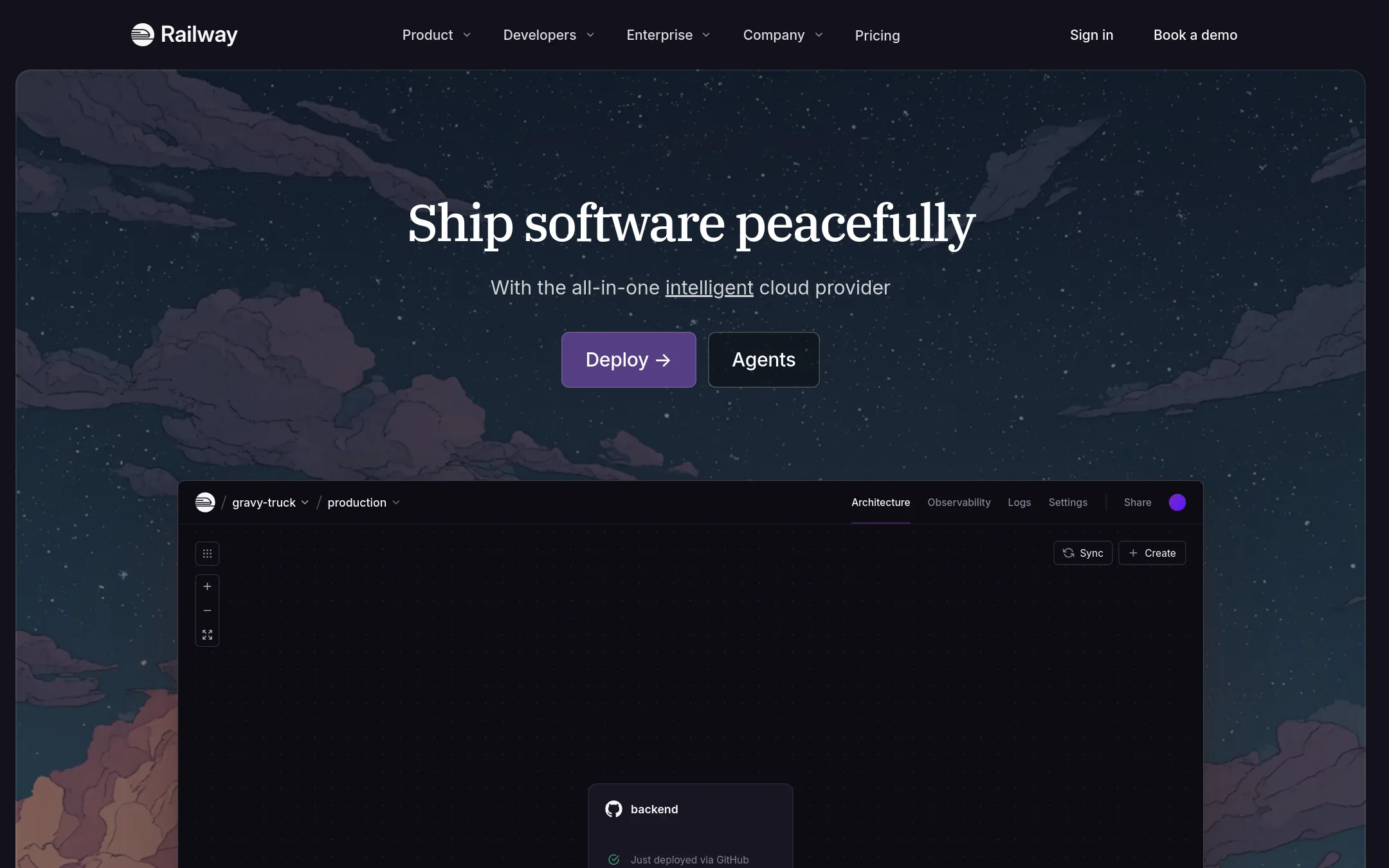
Railway is a full-stack cloud for deploying web apps, servers, and databases from a connected repo, with networking, scaling, and logs included. Teams pick it over Flightcontrol when they want a managed platform that runs on Railway's own infrastructure and bills by usage, rather than deploying into their own AWS account.
Where it is strong
- Deploys from a connected repo with automatic configuration and instant preview environments.
- Usage-based compute billing charges only for resources the app actually uses.
- Networking, SSL, logs, and metrics are available out of the box.
Where it falls short
- Runs on Railway's infrastructure, so it does not deploy into your own AWS account the way Flightcontrol does, unless you use the bring-your-
- Log history is limited to 7 days on Hobby and 30 days on Pro.
- Pricing:
- Pricing is usage-based: memory costs $0.00000386 per GB per second and CPU $0.00000772 per vCPU per second, with plans starting at $1 per month on Hobby.
- From $2.19/mo
5.Fly.io
Best for: Teams building agent products or running untrusted code in parallel who want per-second billing and isolated VMs close to users
- Pricing
- From $2.19/mo
- Category
- Developer Tools
Fly.io runs apps, agent sandboxes, and databases on Firecracker microVMs across many regions, billed by the second. Teams pick it over Flightcontrol when they want to host workloads on Fly's own infrastructure with fast, cheap-to-idle compute for agent fleets or per-customer computers, rather than deploying into their own AWS account.
Where it is strong
- Each computer is its own hardware-isolated Firecracker microVM
- Machines and Sprites sleep and bill only while active
- Runs in regions across North America, Europe, Asia, Oceania, South America, and Africa
Where it falls short
- Hosts your workloads on Fly's infrastructure, not in your own AWS account
- Compute and databases are Fly products, so AWS-native services are not part of the platform
- Pricing:
- Machines are billed by the second, with shared-cpu-1x at $2.19 per month and performance-1x at $33.00 per month, and Managed Postgres starts at $38 per month.
- Not published
6.Argo CD
Best for: Kubernetes platform teams that want open source GitOps delivery with a visual UI on clusters they run themselves
- Pricing
- Not published
- Category
- Developer Tools
Argo CD is an open source, Kubernetes-native GitOps tool that syncs cluster state to manifests stored in Git, with a full web UI. Teams already running Kubernetes choose it over Flightcontrol when they want deployments defined as Git-driven manifests on their own clusters rather than a managed platform on AWS.
Where it is strong
- Open source and free to use, part of the Argo project under the CNCF
- Declarative sync from Git keeps cluster state auditable
- Full web UI for viewing app state, history, and sync status
Where it falls short
- Only works with Kubernetes, so it does not cover ECS, Lambda, or static sites the way Flightcontrol does
- Requires you to operate the Kubernetes clusters and the Argo CD installation yourself
- Pricing:
- Pricing is not published on the site.
- Switching from Flightcontrol:
- Moving from Flightcontrol means containerising services for Kubernetes, writing manifests or Helm charts for each service, and setting up Argo CD to sync them from Git.
See more comparisons in Developer Tools alternatives.
FAQ
Questions about Flightcontrol alternatives
What is the best alternative to Flightcontrol if I want to stay in my own AWS account?
The entries in this list mostly host workloads on the vendor's own infrastructure rather than in your AWS account. Argo CD is the closest fit for teams that run their own Kubernetes clusters and want Git-driven deployments on infrastructure they control. It is open source, but it only covers Kubernetes and requires you to operate it yourself.
Which alternative is cheapest to start with?
Railway has the lowest starting point among the managed platforms, with its Hobby plan starting at $1 per month and usage-based compute billing. Render starts at $7 per month for a small web service and $6 per month for Postgres. Heroku's Standard-1X dyno starts at $25 per month.
Can I use these alternatives for Terraform and infrastructure automation?
The managed platforms in this list, Heroku, Railway, and Render, focus on deploying applications and databases rather than running Terraform pipelines. Render lists managed Postgres, Redis-compatible storage, cron jobs, and workflows, but its entry does not describe reusable Terraform modules. Teams that need Terraform automation should check that capability directly before choosing one of these.
How do the alternatives compare on pricing structure?
Each alternative bills differently. Railway charges by memory and CPU per second, Heroku prices dynos by tier, Render prices each resource separately with a custom-priced organization tier, and Fly.io bills machines by the second. Vercel Image Optimization meters transformations and cache reads, with a free allowance before per-thousand pricing starts.
Are these alternatives suited to AI agent workloads?
Fly.io is built for this case, running agent sandboxes and isolated VMs on Firecracker microVMs that sleep and bill only while active. Render also lists sandboxes for agents among its offerings. Heroku, Railway, and Argo CD are not described in their entries as agent platforms, so teams focused on agent workloads should compare Fly.io and Render first.
Last updated November 7, 2026.