
Formance alternatives
5 products compared · Updated November 14, 2026
The short answer
Stripe suits online businesses and SaaS teams that mainly need to accept payments and run recurring billing without building their own money movement core. Modern Treasury suits US lending and fintech teams that need to pay out and collect across many payment rails without building banking integrations. TigerBeetle suits engineering teams building high-volume transaction systems that need a database built specifically for financial transactions.
Your shortlist, at a glance
Read the comparisons ↓ Stripe2.9% + 30¢Online businesses and SaaS teams that need to accept payments and run recurring billing without building their own money movement core
 Modern TreasuryUsage-based, customLending and fintech teams in the US that need to pay out and collect across many payment rails without building banking integrations
- MMoovNot publishedMarketplaces, fundraising platforms and small businesses that need to accept and send payments without building a payments stack
- BBlnk FinanceSee websiteOther
- TTigerBeetleNot publishedEngineering teams building high-volume transaction systems that need a dedicated financial transactions database
About Formance and its alternatives
Formance is an open-source programmable ledger for fiat and digital assets. According to its site, teams use it to model any flow of funds in Numscript, connect PSPs and banks through one API, reconcile balances continuously, and keep an immutable record that auditors and regulators accept.
When comparing alternatives in this category, weigh how each product is priced, since usage-based and per-transaction fees can differ a lot from flat plans and some prices are not published. Check which regions and payment rails each product supports, and which integrations it offers with the PSPs and banks you already use. Also consider the level of support and the contract terms, especially if you need regulated payment accounts or want to keep direct bank relationships.
Explore the alternatives
- 2.9% + 30¢
1.Stripe
Best for: Online businesses and SaaS teams that need to accept payments and run recurring billing without building their own money movement core

- Pricing
- 2.9% + 30¢
- Category
- Finance & Accounting
Stripe is a payments and financial platform for accepting cards, subscriptions, local payment methods, payouts and disputes. Teams choose it over Formance when they mainly need to take payments and bill customers quickly, rather than design a custom double-entry ledger that models every money movement.
Where it is strong
- Accepts cards, wallets, bank debits and many local payment methods through one integration
- Handles recurring billing, invoicing and dispute responses within the same platform
- Offers SDKs, APIs and no-code options, so teams can start without a large engineering effort
Where it falls short
- Not a programmable double-entry ledger, so designing custom balances and chart-of-accounts logic is harder than with Formance
- Fees stack up with international cards, currency conversion and disputes, which adds cost beyond the headline rate
- Pricing:
- Standard domestic card pricing is 2.9% + 30¢ per successful transaction, with other fees such as international cards, currency conversion and disputes listed separately, and custom pricing is available for larger volumes.
- Switching from Formance:
- Moving from Formance to Stripe would mean replacing a custom ledger with Stripe's own balance and reporting model, so teams would need to plan how historical records map across.
- Usage-based, custom
2.Modern Treasury
Best for: Lending and fintech teams in the US that need to pay out and collect across many payment rails without building banking integrations
- Pricing
- Usage-based, custom
- Category
- Finance & Accounting
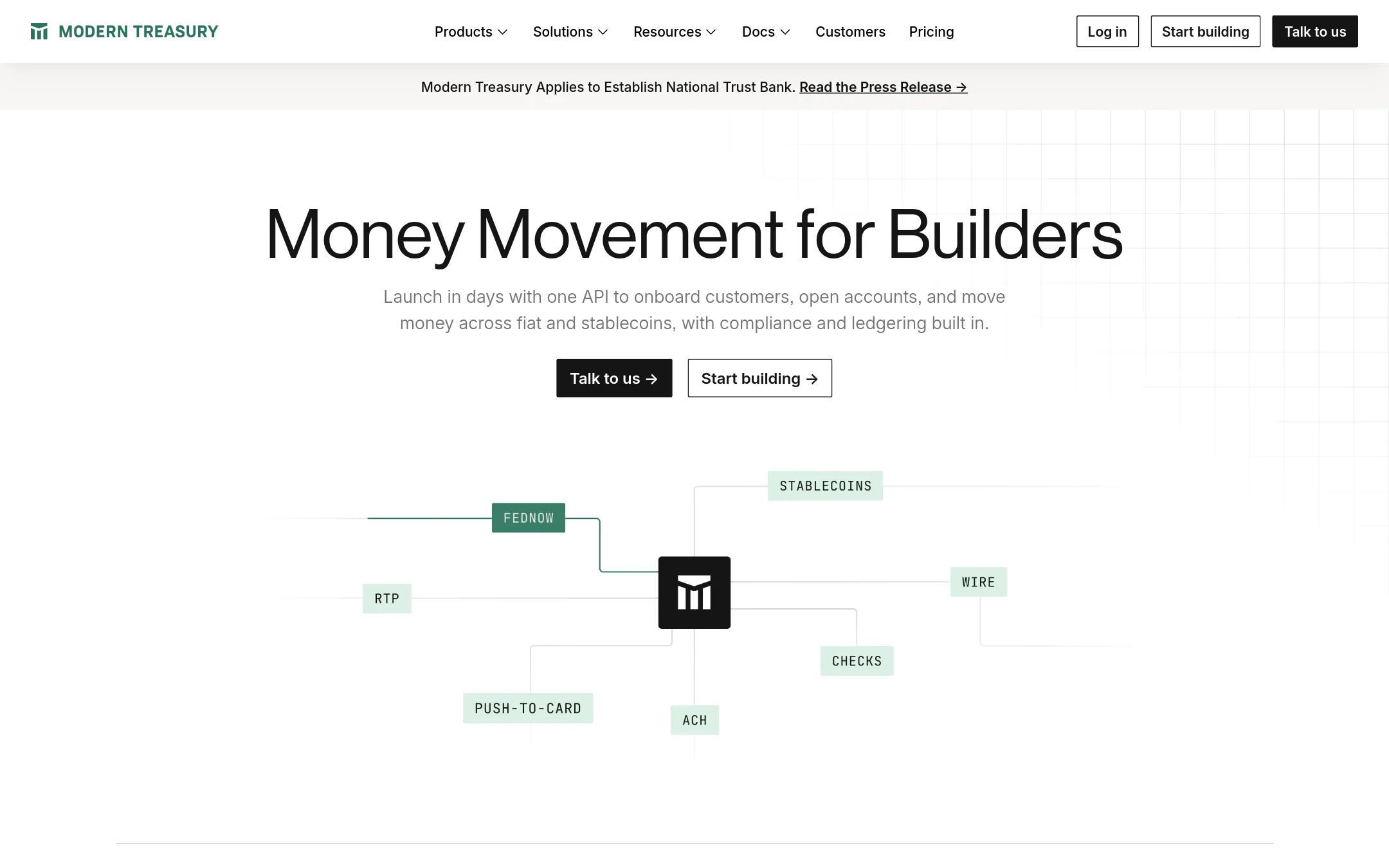
Modern Treasury is a payments operations platform that gives teams one API for moving money across ACH, wire, RTP, FedNow, checks and stablecoins, with built-in KYB/KYC and compliance. Teams pick it over Formance when they want a managed PSP with regulated payment accounts and do not need to model the ledger themselves.
Where it is strong
- One API covers ACH, wire, RTP, FedNow, checks and stablecoins
- Built-in KYB, KYC, transaction monitoring and sanctions screening
- Idle balances earn interest through banking partners
Where it falls short
- Usage-based fees make costs harder to forecast than a flat plan
- Payment accounts run through its regulated partners, so you give up direct bank relationships
- Pricing:
- Pricing is usage-based and depends on volume, payment rail and account structure, with per-unit costs falling as volume rises, and no fixed figures are published on the pricing page.
- MNot published
3.Moov
Best for: Marketplaces, fundraising platforms and small businesses that need to accept and send payments without building a payments stack
- Pricing
- Not published
- Category
- Other
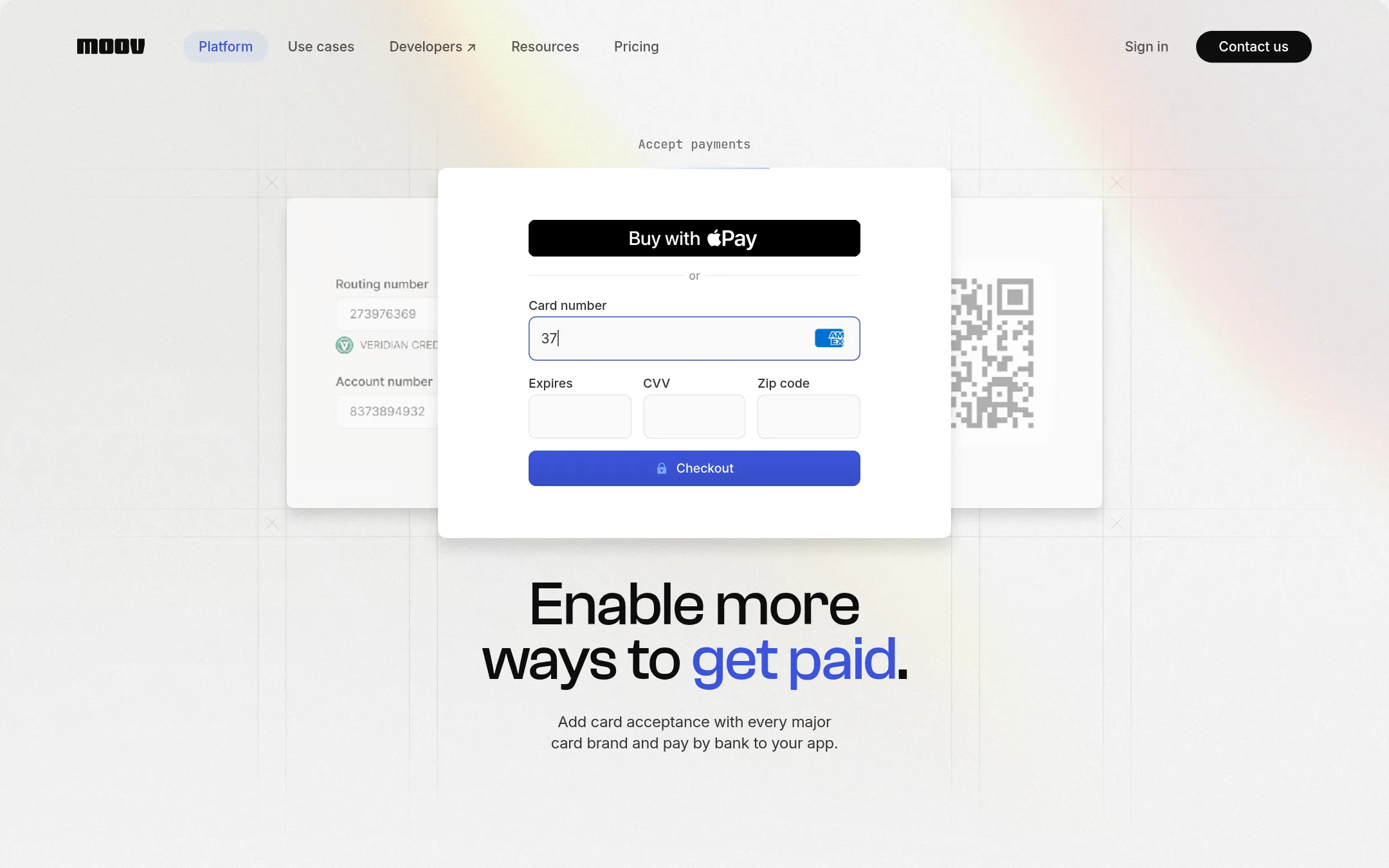
Moov is a payments platform that covers accepting cards and bank payments, storing funds in wallets, sending payouts, and issuing virtual cards, all behind one API and one legal agreement. Teams pick it over Formance when they want payment acceptance and money movement handled for them rather than a ledger they build and run themselves.
Where it is strong
- One integration covers card acceptance, bank transfers, instant payouts and virtual cards
- Standard pricing has no setup fees and a $500 monthly minimum
- Payments data can be synced to your own data warehouse
Where it falls short
- The site describes it as a payments platform rather than a programmable ledger for modeling your own flows
- Pricing for high-volume or custom models requires talking to sales
- Pricing:
- Pricing is not published on the site.
- BSee website
4.Blnk Finance
Other
Open-source ledger and transaction engine for fintech developers, comparable to Formance's self-hostable ledger approach.
- TNot published
5.TigerBeetle
Best for: Engineering teams building high-volume transaction systems that need a dedicated financial transactions database

- Pricing
- Not published
- Category
- Other
TigerBeetle is a database built specifically for financial transactions, aimed at high-throughput online transaction processing. Teams would choose it over Formance when the core need is raw transaction speed and consistency at the database layer, rather than a full programmable ledger with connectors, flows and reconciliation.
Where it is strong
- Built specifically for financial transactions rather than adapted from a general-purpose database.
- Positioned around performance, consistency, availability and durability as core properties.
- Offers a cloud option alongside self-hosted installation.
Where it falls short
- Covers the transaction database layer, not the broader set of PSP and bank connectors Formance provides.
- Does not appear on the site to include built-in reconciliation or workflow orchestration.
- Pricing:
- Pricing is not published on the site.
See more comparisons in Finance & Accounting alternatives.
FAQ
Questions about Formance alternatives
Which alternative is best if I only need to accept payments and bill customers?
Stripe is the strongest fit for that need. It accepts cards, wallets, bank debits and many local payment methods through one integration, and it handles recurring billing and invoicing. It is not a programmable double-entry ledger, so custom balance logic is harder to build on it than on Formance.
Which alternative helps a US lending or fintech team pay out across many rails?
Modern Treasury is built for that case. Its one API covers ACH, wire, RTP, FedNow, checks and stablecoins, and it includes KYB, KYC and sanctions screening. Its usage-based pricing can be harder to forecast than a flat plan.
Is TigerBeetle a full replacement for Formance?
Not on the evidence of its site. TigerBeetle is a database built for financial transactions and focuses on speed and consistency at the database layer. Formance also offers PSP and bank connectors, flows and reconciliation, which TigerBeetle's site does not describe.
How should I compare pricing across these options?
Stripe publishes a standard domestic card rate of 2.9% + 30¢ per successful transaction, with other fees listed separately. Modern Treasury's pricing depends on volume, rail and account structure. Moov and TigerBeetle do not publish figures on their sites, so you will need to ask their sales teams for a quote.
Which option gives me the most control over the ledger itself?
Formance is the option that lets you author your chart of accounts and transactions as code, with Numscript for flows and YAML for schemas. Stripe, Modern Treasury and Moov each handle money movement for you rather than letting you model the ledger yourself, which can be simpler to run but offers less customisation.
Last updated November 14, 2026.