Hatchet alternatives
8 products compared · Updated November 20, 2026
The short answer
Windmill suits internal tools teams that want scripts, workflows and apps on one self-hostable platform. Trigger.dev suits TypeScript teams building durable AI agents or long-running jobs that stream to a frontend. Temporal suits engineering teams running long multi-step business processes that need durable state across several languages.
Your shortlist, at a glance
Read the comparisons ↓- TTemporalUsage-based, no base fEngineering teams building long-running, multi-step business processes such as order fulfillment or payments that need durable state across several languages
- PPrefectCustom quotePython data and AI agent teams that need human approval steps and governed tool access in their workflows
 Apache AirflowNot publishedData engineering teams building batch pipelines that move data between cloud services and warehouses
- DDagster$10/mo + $0.040/creditData teams running dbt and Snowflake pipelines that need lineage, data quality checks and a shared view of asset health
- IInngestFrom $99/moBackend teams that want durable background jobs and AI agent workflows added to an existing codebase without provisioning new infrastructure
 Trigger.dev$10/mo + $0.25/10k runTypeScript teams building AI agents or long-running background jobs that need streaming to a frontend
- CCeleryNot publishedPython teams that already run a message broker and want to manage their own background task workers
- WWindmill$20/mo per builderInternal tools teams that want scripts, workflows and apps built on one self-hostable platform
About Hatchet and its alternatives
Hatchet is a background task orchestration platform. Its site describes it as a single, scalable platform for orchestrating AI agents, complex workflows, and distributed apps. It is known for background tasks defined as plain functions in its SDKs, durable execution for long-running workflows, retries, cron and scheduled tasks, rate limits, priorities, and a real-time web UI with OpenTelemetry tracing.
When comparing alternatives in this category, weigh the pricing structure first, since some tools charge per run, some per seat, some per compute second and some in credits, which makes cost harder or easier to predict. Check which languages the SDKs support, where the data plane runs and whether self-hosting is available. Look at integrations with the systems you already use, the support and SLA terms on the plans you would need, and the contract terms for production use.
Explore the alternatives
- TUsage-based, no base f
1.Temporal
Best for: Engineering teams building long-running, multi-step business processes such as order fulfillment or payments that need durable state across several languages
- Pricing
- Usage-based, no base f
- Category
- Other
Temporal is an open-source durable execution platform where your code survives crashes and deploys without checkpointing logic. Teams pick it over Hatchet when they want durable workflows across many languages, with a mature SDK ecosystem and a track record in production for long-running, human-in-the-loop, or saga-style processes.
Where it is strong
- Durable execution: workflow state survives crashes and deploys without custom recovery code
- Native SDKs across Go, Java, Python, TypeScript.NET, PHP, Ruby and Rust
- Fully open source under MIT, and you can self-host or use Temporal Cloud
Where it falls short
- Pricing is metered per action and per storage hour, so costs are harder to estimate than Hatchet's per-run and per-event rates
- Advanced support tiers such as 30-minute P0 response and dedicated architects sit behind Enterprise plans
- Pricing:
- Pay-as-you-go pricing starts with $150 in free credits for 90 days, then $0.042 per GB-hour of active storage and $0.00105 per GB-hour of retained storage, with no base monthly fee.
- Switching from Hatchet:
- Temporal publishes migration guides for Celery and Hatchet-style workloads are not covered, so moving from Hatchet would mean rewriting task definitions into Temporal Workflows and Activities.
- PCustom quote
2.Prefect
Best for: Python data and AI agent teams that need human approval steps and governed tool access in their workflows
- Pricing
- Custom quote
- Category
- Other
Prefect turns ordinary Python functions into durable, observable workflows with retries, scheduling and human approval steps built into the engine. It is aimed at data pipelines and AI agent workflows, and it can pair with Dagster for data and FastMCP for tool access. Choose it over Hatchet when your work is mainly Python data or agent pipelines and you want the approval and governance layer around them.
Where it is strong
- Plain Python functions become durable workflows with a single decorator, with no DAG to declare up front
- Human approval pauses and suspended runs are built in for steps that wait on a person
- Covers the wider stack with Dagster for data and FastMCP for tool connections
Where it falls short
- Prefect's open-source core does not include managed execution or push to serverless platforms
- Pricing tiers are not given as simple per-run figures, so comparing cost with Hatchet takes work
- Pricing:
- Prefect's plans are Hobby, Starter, Team and Enterprise, with the Team plan including 225 hours a month of serverless compute, but the site does not publish a per-run price for them in the material provided.
- Not published
3.Apache Airflow
Best for: Data engineering teams building batch pipelines that move data between cloud services and warehouses
- Pricing
- Not published
- Category
- Analytics & Data
Apache Airflow is an open source platform for writing, scheduling and monitoring workflows as Python code, with a web UI and many ready-made operators for Google Cloud, AWS, Azure and other services. Pick it over Hatchet when your pipelines are mostly data work built around cloud connectors and you want a mature, community-run project with a large ecosystem.
Where it is strong
- Pipelines are plain Python, with dynamic task generation via loops
- Plug-and-play operators for Google Cloud, AWS, Azure and many third-party services
- Open source with an active community and a web UI for status and logs
Where it falls short
- The site does not describe durable execution or per-task retries with backoff the way Hatchet does
- The site does not mention built-in rate limits, priorities or fair scheduling across tenants
- Pricing:
- Pricing is not published on the site.
- D$10/mo + $0.040/credit
4.Dagster
Best for: Data teams running dbt and Snowflake pipelines that need lineage, data quality checks and a shared view of asset health
- Pricing
- $10/mo + $0.040/credit
- Category
- Other
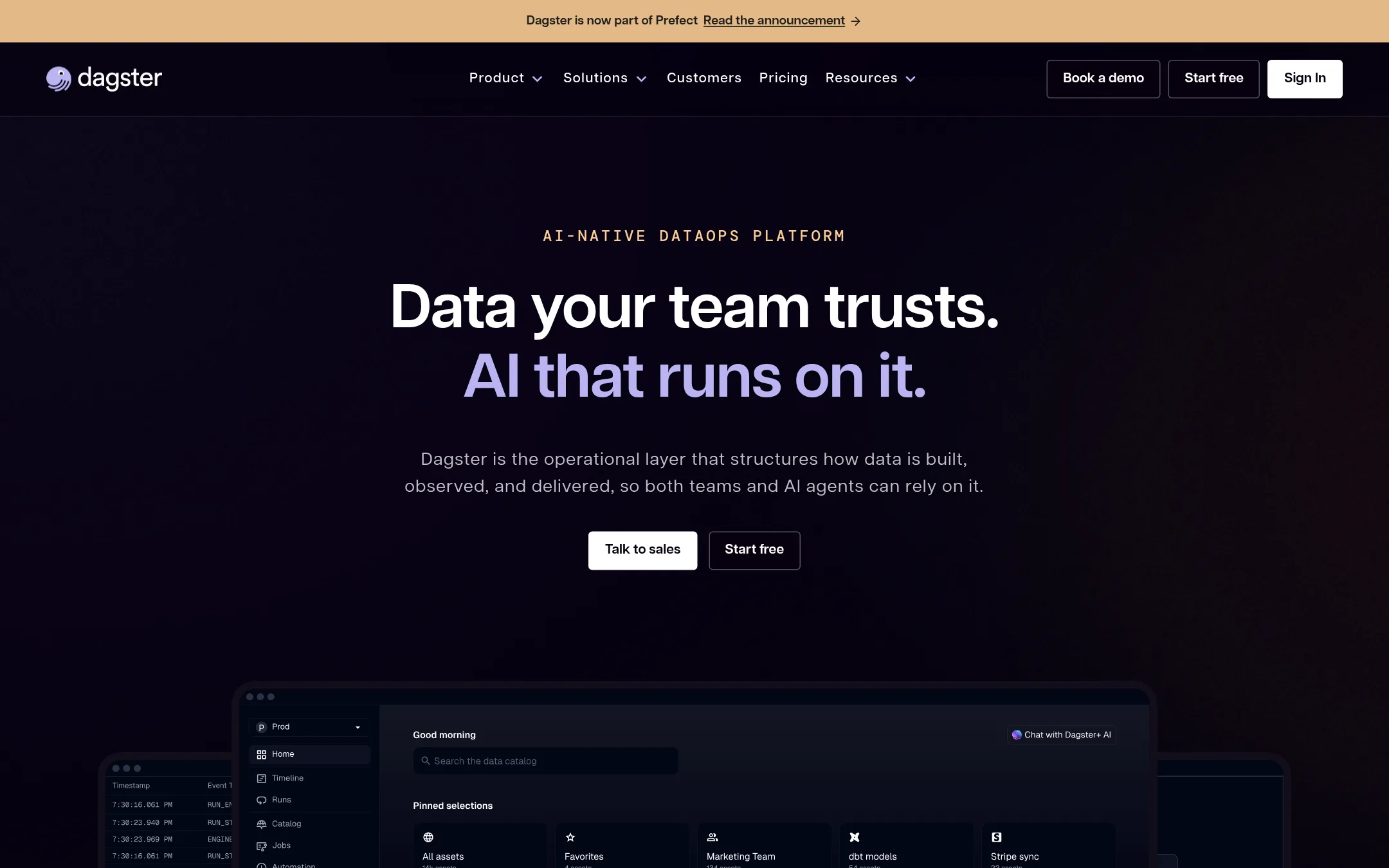
Dagster is an asset-centric data orchestrator. It tracks lineage, freshness and data quality per asset, so you can see what a failure affects downstream. Teams choose it over Hatchet when their main problem is data pipelines, dbt and Snowflake work, and knowing which data is stale or broken.
Where it is strong
- Tracks lineage, freshness and data quality for every asset
- Native integrations with dbt, Snowflake and Fivetran
- Hybrid deployment keeps compute in your own infrastructure
Where it falls short
- Built around data assets, so it is a weaker fit for general background job queues than Hatchet
- Credit-based billing is harder to predict than Hatchet's per-run and per-event rates
- Pricing:
- Solo is $10/month plus $0.040 per credit, Starter is $100/month plus $0.035 per credit, and Pro uses custom pricing with serverless compute at $0.010 per minute.
- IFrom $99/mo
5.Inngest
Best for: Backend teams that want durable background jobs and AI agent workflows added to an existing codebase without provisioning new infrastructure
- Pricing
- From $99/mo
- Category
- Other
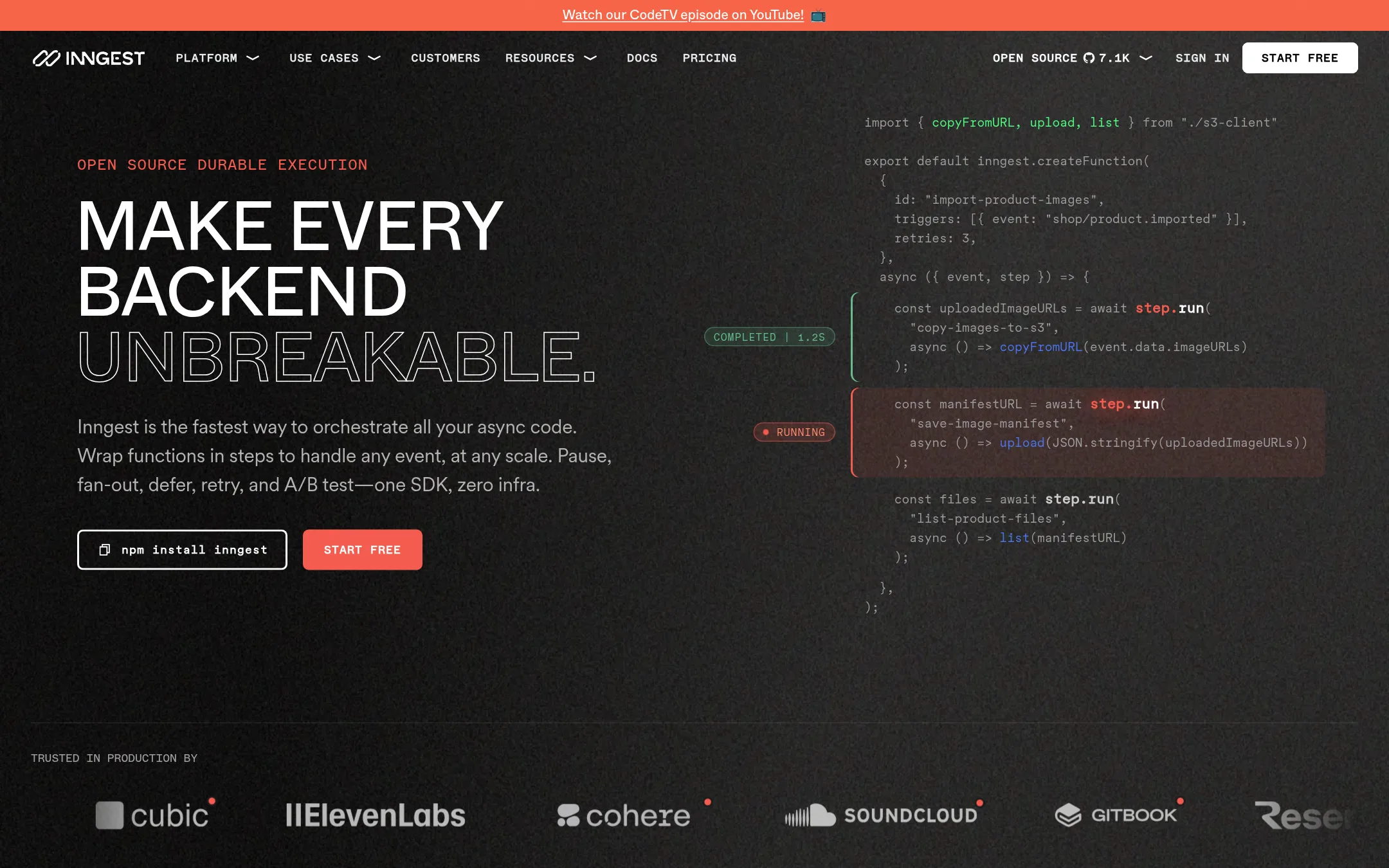
Inngest wraps ordinary functions in steps so they can retry, sleep, fan out and recover from failure, without you running a queue or broker. Teams pick it over Hatchet when they want durable execution inside code they already have, with flow control and step-level tracing included by default.
Where it is strong
- Functions gain retries, recovery and observability with a single SDK dropped into existing code
- Flow control handles per-user fairness and noisy neighbours without hand-rolled rate limits
- Sandboxes and scoring let you test a new prompt or code path on real triggers before shipping it
Where it falls short
- Pricing moves quickly from free to paid, with add-ons for workers and executions on Pro
- Advanced observability, HIPAA and SAML are gated to higher tiers or the Enterprise plan
- Pricing:
- The free tier includes 50k executions, 500k events and 5 seats, the Pro plan starts at $99 per month, Business at $499 per month, and Enterprise is custom.
- $10/mo + $0.25/10k run
6.Trigger.dev
Best for: TypeScript teams building AI agents or long-running background jobs that need streaming to a frontend
- Pricing
- $10/mo + $0.25/10k run
- Category
- AI & Machine Learning
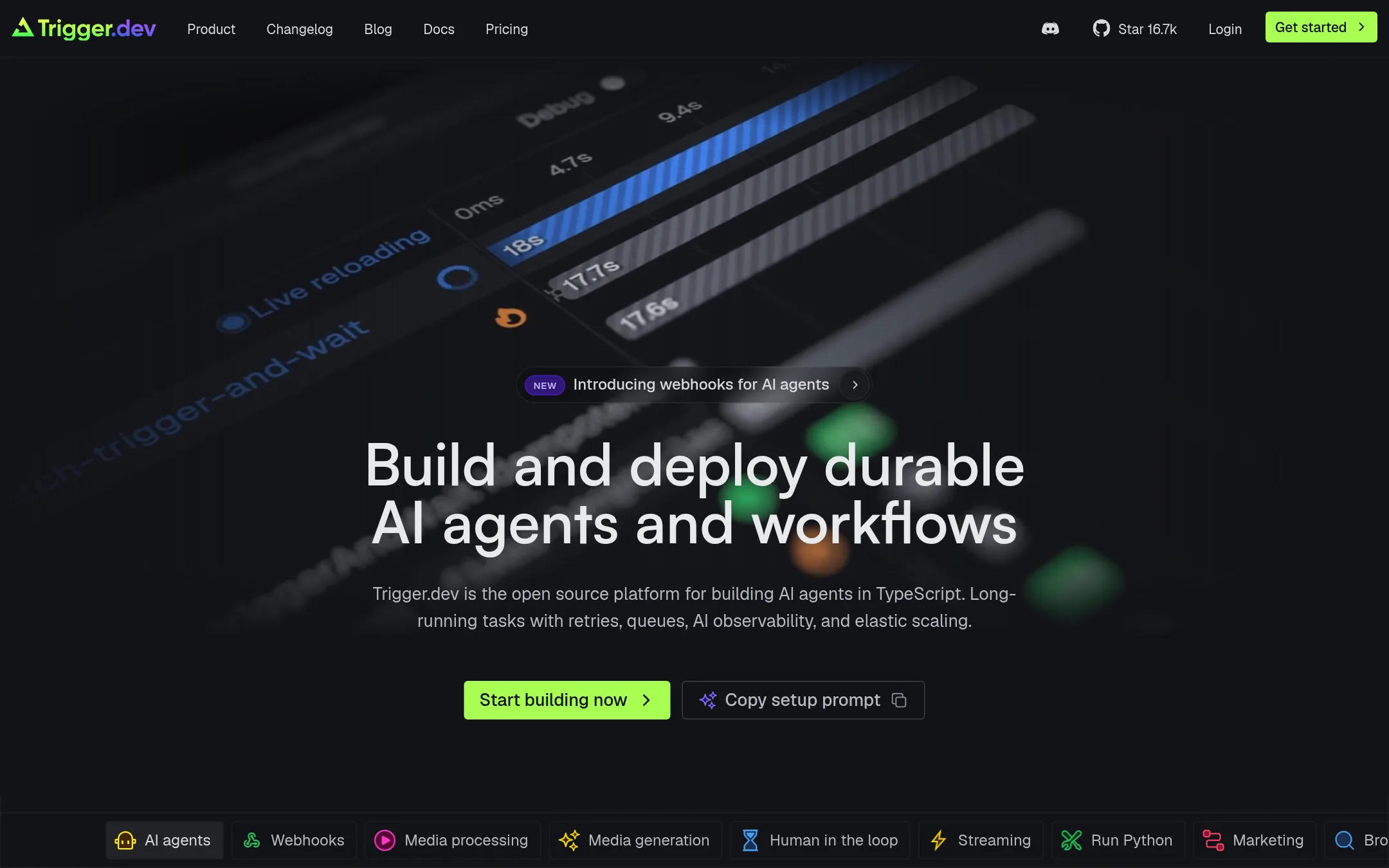
Trigger.dev is an open source platform for durable AI agents and background workflows written in TypeScript. It handles long-running tasks with retries, queues, LLM observability, and streaming responses to a frontend. Teams often pick it over Hatchet when they are building AI agents in TypeScript and want built-in streaming, human-in-the-loop steps, and a managed runtime that does not time out.
Where it is strong
- Durable AI agents that survive refreshes, redeploys, and crashes
- Streams LLM responses from runs straight to the frontend with React hooks
- Apache 2.0 licensed and self-hostable
Where it falls short
- Built around TypeScript, with Python support as a secondary option
- Pricing is split between per-run fees and per-second compute, so costs take some estimating
- Pricing:
- The Hobby plan is $10 per month with $10 of credits included, the Pro plan is $50 per month with $50 of credits included, and runs cost $0.25 per 10,000 plus compute billed per second by machine size, starting at $0.0000169 per second for the Micro machine.
- CNot published
7.Celery
Best for: Python teams that already run a message broker and want to manage their own background task workers

- Pricing
- Not published
- Category
- Other
Celery is a Python task queue that runs background jobs with worker processes and a message broker. A team would pick it over Hatchet when its stack is already Python and it wants a long-standing, self-run queue rather than a hosted orchestration engine. The site could not be reached, so nothing else about its feature set is confirmed here.
Where it is strong
- Established Python task queue that teams can self-host
- Runs on infrastructure the team already controls
- Works with a message broker the team may already operate
Where it falls short
- Celeryq.dev was unreachable when this entry was checked, so its current docs and features could not be confirmed
- Compared with Hatchet, durable execution and the built-in web UI are not confirmed for Celery in this entry
- Pricing:
- Pricing is not published on the site.
- W$20/mo per builder
8.Windmill
Best for: Internal tools teams that want scripts, workflows and apps built on one self-hostable platform
- Pricing
- $20/mo per builder
- Category
- Developer Tools
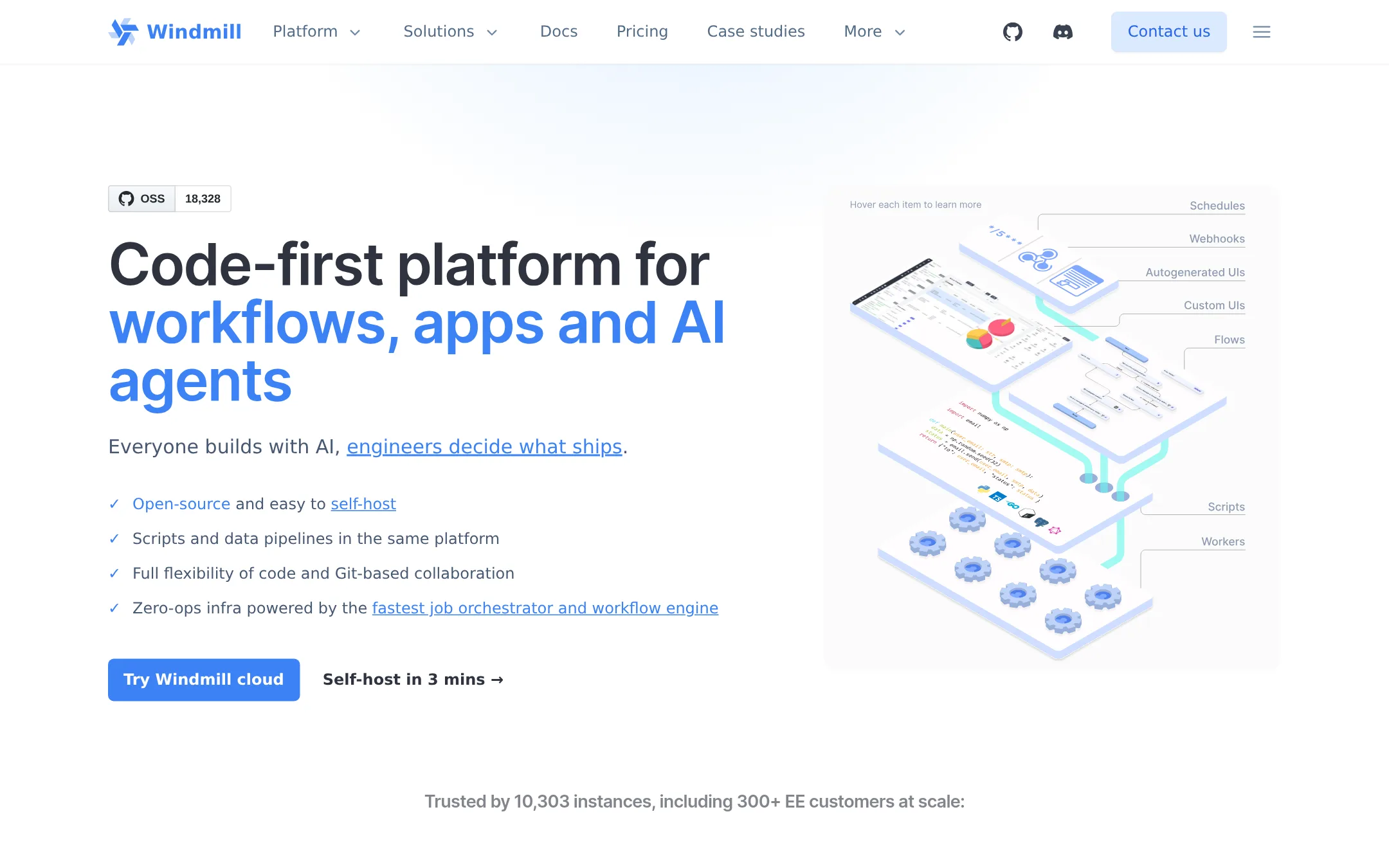
Windmill turns scripts in over 20 languages into APIs, workflows, internal apps, AI agents and data pipelines, and runs them on a self-hostable orchestration engine. Pick it over Hatchet when your team wants to ship internal tools and a UI on top of the same code, not just run background tasks.
Where it is strong
- Scripts in 20+ languages become API endpoints and forms automatically
- Apps with a React or Svelte frontend can call your existing scripts and workflows
- Open source and self-hostable in your cloud or on-prem, with Docker or Kubernetes deployment
Where it falls short
- Its orchestration features are presented as one part of a broader internal tools platform, so the focus is wider than Hatchet's
- Advanced observability, SSO groups sync and SLAs sit behind the Enterprise tier
- Pricing:
- Pricing is listed per seat, with a free open-source tier capped at 10 users with SSO, Enterprise from $120/mo, and builders at $20/mo each, non-builders at $10/mo, and standard workers at $50 per worker per month.
See more comparisons in Developer Tools alternatives.
FAQ
Questions about Hatchet alternatives
Which Hatchet alternative is best for AI agents?
Trigger.dev is built for durable AI agents and background workflows in TypeScript, with streaming LLM responses to a frontend. Inngest also offers durable execution for AI agent workflows, added to existing code with flow control and step-level tracing. Prefect suits Python agent pipelines that need human approval steps.
Is there a free or open-source option to compare with Hatchet?
Hatchet is MIT licensed and can be run locally with a single CLI command. Temporal is fully open source under MIT and can be self-hosted, and Trigger.dev is Apache 2.0 licensed and self-hostable. Windmill also offers a free open-source tier capped at 10 users with SSO.
How does Hatchet's pricing compare with Temporal's?
Hatchet charges $30 per million runs and $5 per million events after a free first million of each each month. Temporal meters per action and per storage hour, with $150 in free credits for 90 days, which makes its costs harder to estimate in advance. Hatchet's pricing page gives a cost estimator, while Temporal's cost depends on usage shape.
Which alternative is best for data pipelines?
Dagster is an asset-centric data orchestrator that tracks lineage, freshness and data quality, with native dbt, Snowflake and Fivetran integrations. Apache Airflow is a mature open source option for batch pipelines built from Python code and many cloud operators. Hatchet fits simpler pipelines through its DAG support.
Which tool should a team pick for long-running business processes?
Temporal is designed for long-running, multi-step processes such as order fulfillment or payments, with durable state across several languages. Hatchet also offers durable execution for fault-tolerant, long-running workflows that recover from failure. Choose between them by checking which SDK languages and pricing model fit your team.
Last updated November 20, 2026.