
hotglue alternatives
5 products compared · Updated November 6, 2026
The short answer
The three strongest hotglue alternatives are Paragon, Nango, and Merge. Paragon suits AI SaaS engineering teams that need agents to read and act in customer tools while enforcing file-level access control. Nango suits engineering teams building AI agents or product features that must act across many third-party APIs with managed auth. Merge suits product teams building AI features that need authenticated access to many third-party tools and customer data.
Your shortlist, at a glance
Read the comparisons ↓ AirbyteUsage-based / Custom qData teams that need to consolidate many sources into a warehouse and want the option to self-host or run in a private cloud.
 FivetranUsage-based, from freeData and analytics teams that need managed pipelines from many SaaS apps and databases into a warehouse or lake
- MMerge$650/mo, 10 accountsProduct teams building AI features that need authenticated access to many third-party tools and customer data
 ParagonCustom quoteAI SaaS engineering teams that need agents to read and act in customer tools while enforcing file-level access control
 Nango$0.29/conn + usageEngineering teams building AI agents or product features that must act across many third-party APIs with managed auth.
About hotglue and its alternatives
hotglue is an embedded integration platform for SaaS products. According to its site, it lets companies offer native, user-facing integrations to their own customers, with a white-label connection widget, a library of over 600 open-source connectors, and data delivered to the customer's warehouse. Its site says it is SOC 2 Type II and GDPR compliant and that it does not store customer data.
When comparing alternatives, weigh how each vendor charges, since some price by tenants, some by data volume, some by connections, and some by Linked Accounts. Check which regions and hosting options are available, how many integrations and connectors are included, what support and SLA terms apply, and whether the product is built to move data into a warehouse or to let agents and features act inside third-party tools.
Explore the alternatives
- Usage-based / Custom q
1.Airbyte
Best for: Data teams that need to consolidate many sources into a warehouse and want the option to self-host or run in a private cloud.
- Pricing
- Usage-based / Custom q
- Category
- Analytics & Data
Airbyte is an open-source data movement platform that moves data from 700+ sources into your warehouse, and it can run in your own VPC. Someone would pick it over hotglue when the job is feeding a central warehouse from many internal and third-party sources, not offering integrations to their own customers. Hotglue is built for embedding user-facing integrations inside a SaaS product.
Where it is strong
- Over 700 connectors for sources and destinations
- Open-source core you can self-host and modify
- Hybrid option keeps data inside your own cloud or VPC
Where it falls short
- Its focus is warehouse data movement, so it does not offer embedded customer-facing integrations like hotglue
- Exact plan costs depend on credits or capacity and are not spelled out on the page
- Pricing:
- Airbyte Core is free to self-host, Airbyte Cloud is usage-based with a 14-day trial of 400 credits, and Pro and Enterprise Flex use capacity-based pricing, but the page gives no exact per-credit or per-plan dollar figures.
- Switching from hotglue:
- Moving from hotglue would mean rebuilding your connections in Airbyte, since the two products handle authentication and mapping for different audiences.
- Usage-based, from free
2.Fivetran
Best for: Data and analytics teams that need managed pipelines from many SaaS apps and databases into a warehouse or lake
- Pricing
- Usage-based, from free
- Category
- Analytics & Data
Fivetran moves data from SaaS apps, databases, and ERPs into your warehouse or lake through 750+ fully managed connectors. It suits teams whose main problem is getting third-party data into their own analytics stack, not shipping integrations for their own customers. Choose it over hotglue when you want a managed ELT pipeline for internal analytics and AI rather than user-facing, white-label integrations.
Where it is strong
- 750+ fully managed connectors, so most common sources need no custom build
- Pipelines handle schema changes and sync at high volume
- Free plan includes core connections, transformations, and activations to test with
Where it falls short
- Costs rise with data volume, unlike hotglue's tenant-based pricing
- Built for internal data movement, so it does not offer a white-label widget for your own customers
- Pricing:
- Pricing is usage-based: a free plan covers 500,000 monthly active rows for connections, paid plans are priced per connection and per usage, and annual contracts save up to 22%.
- M$650/mo, 10 accounts
3.Merge
Best for: Product teams building AI features that need authenticated access to many third-party tools and customer data
- Pricing
- $650/mo, 10 accounts
- Category
- Other
Merge gives you one API that connects your product to customer data across hundreds of third-party systems. It also covers agent tool access and LLM routing, so it reaches past data sync. Choose it over hotglue when you need a unified API with prebuilt model and tool access for AI features, rather than a pipeline that reads data into your warehouse.
Where it is strong
- Connects to 5,000+ tools across hundreds of third-party services through one API.
- Routes requests to any major LLM with automatic failover when a provider goes down.
- Offers SOC 2 Type II, ISO 27001, HIPAA and GDPR certifications, and audit trails on the Enterprise plan.
Where it falls short
- Pricing per Linked Account can add up quickly as your customer count grows.
- Its focus extends to AI routing and workforce tooling, which you may not need if you only want data pipelines.
- Pricing:
- The Launch plan costs $650/month for up to 10 production Linked Accounts, with $65 per account after that, and the first 3 accounts are free. Professional and Enterprise pricing is custom.
- Custom quote
4.Paragon
Best for: AI SaaS engineering teams that need agents to read and act in customer tools while enforcing file-level access control
- Pricing
- Custom quote
- Category
- Developer Tools
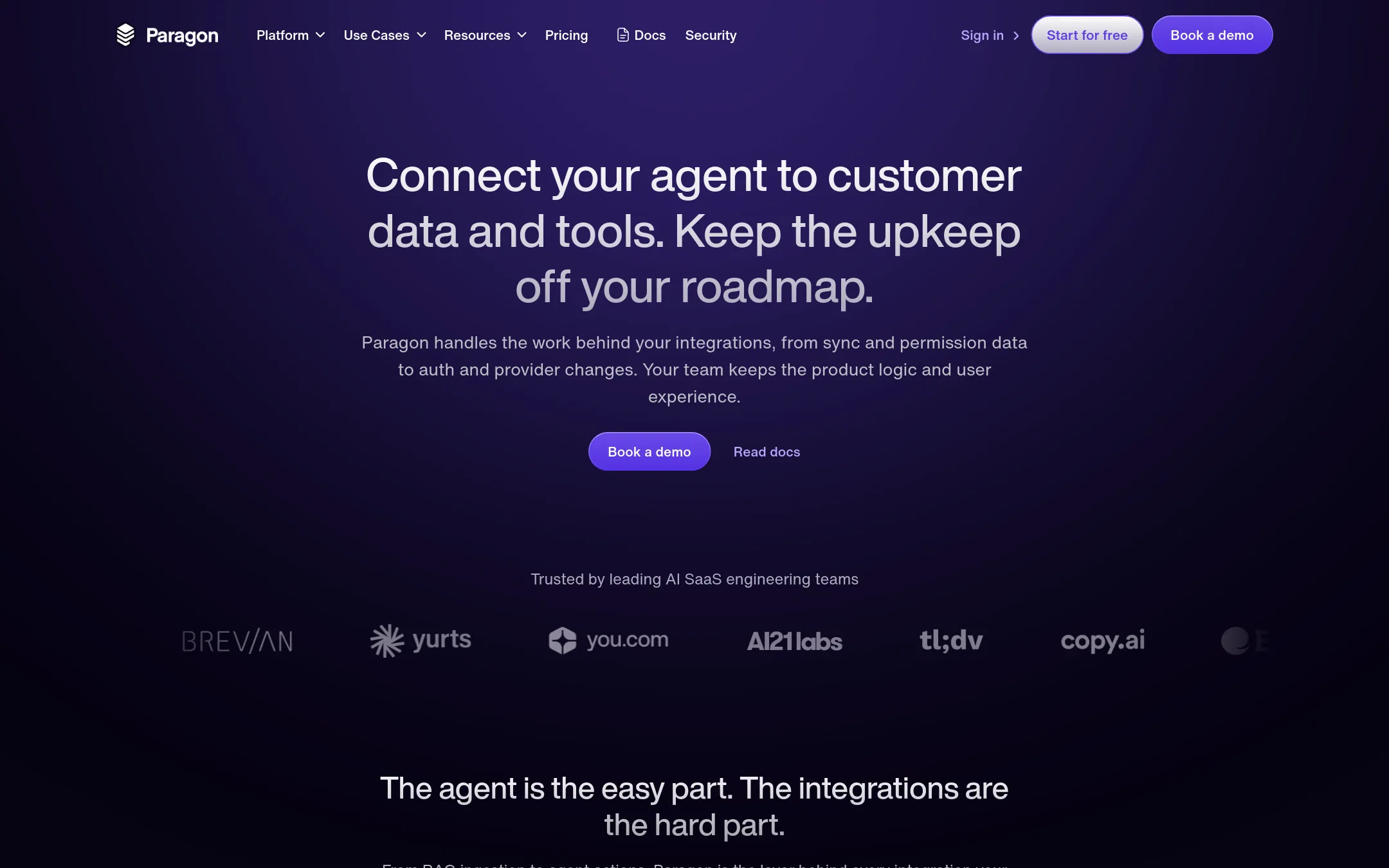
Paragon is an embedded integration platform that covers three areas: managed data sync with a permissions API for feeding customer files into retrieval pipelines, ActionKit for synchronous actions in third-party apps via one API and an MCP server, and Workflows for asynchronous integration logic. Teams building AI agents or RAG features that need customer data and tool actions, with permission checks kept in their own application, would pick it over hotglue, which centers on ETL into a warehouse and a white-label connection widget.
Where it is strong
- Managed Sync exposes a permissions API so your app can enforce access before returning content to an agent
- ActionKit gives one API and an MCP server across many integrations for synchronous agent actions
- Workflows let you write integration logic in TypeScript or a low-code editor and trigger it from webhooks
Where it falls short
- Pricing depends on connected users and a custom quote, so costs are hard to estimate upfront
- Self-hosting and on-premise options sit in the enterprise tier
- Pricing:
- Pricing is not published on the site.
- $0.29/conn + usage
5.Nango
Best for: Engineering teams building AI agents or product features that must act across many third-party APIs with managed auth.
- Pricing
- $0.29/conn + usage
- Category
- Developer Tools
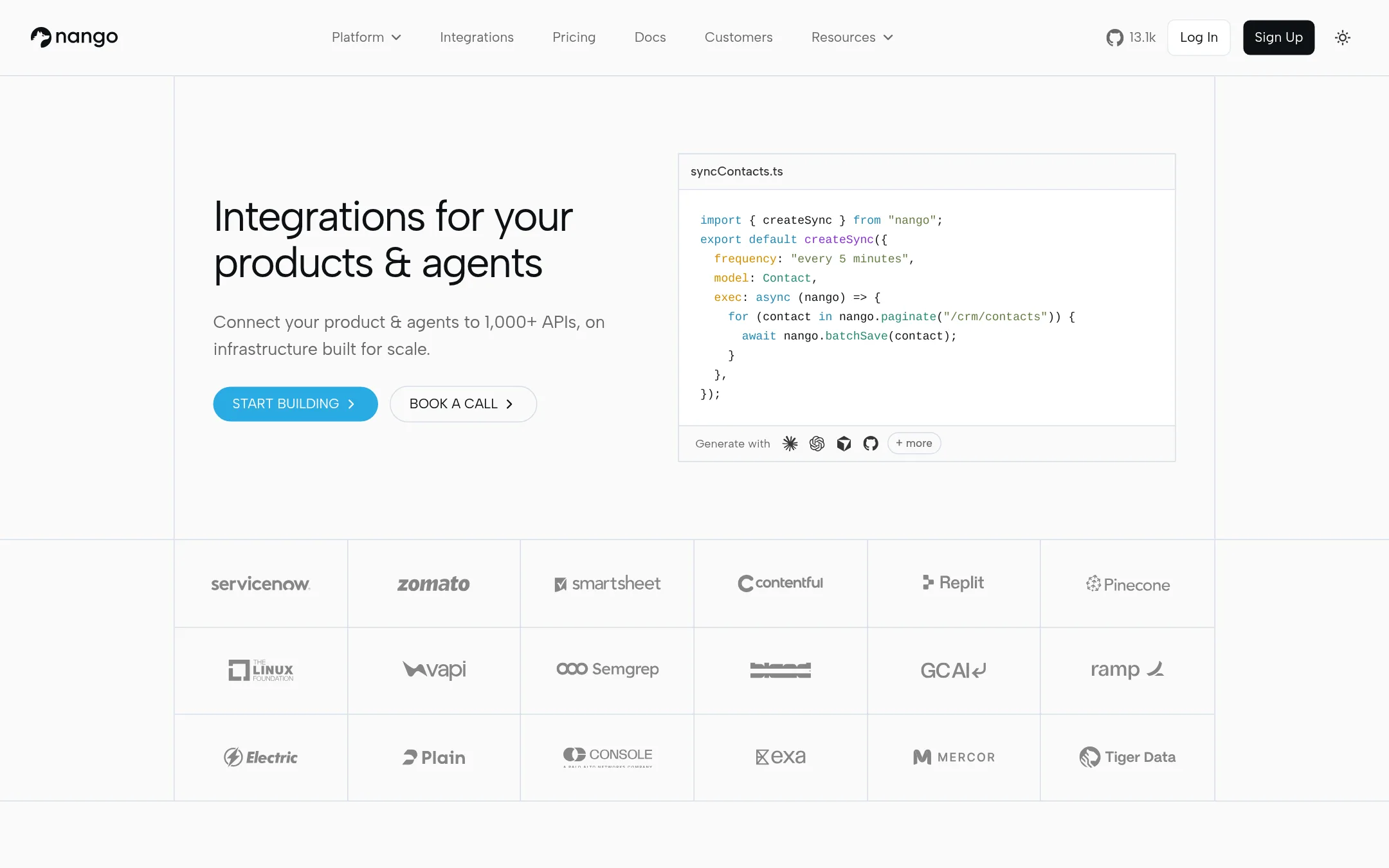
Nango is a developer platform for connecting products and AI agents to over 1,000 APIs, with auth, token refresh, and pre-built tools and syncs. Teams pick it over hotglue when their main need is agent tool access and API actions rather than moving data into a warehouse.
Where it is strong
- Connects to over 1,000 APIs and MCP servers, with 10,000+ pre-built tools, triggers and syncs.
- Handles managed authentication, credential storage and token refreshing for any auth type.
- Offers logs, audit trails, RBAC and SAML SSO for governing what agents do.
Where it falls short
- Costs scale with connections, compute time and data transfer, so usage needs tracking.
- Custom or new integrations on the free plan can take up to 20 days, versus 2 days for Enterprise.
- Pricing:
- Pricing is charged per connection, compute hour and GB of data transfer, with a free tier capped at 10 compute hours and 10GB per month, a $50/mo pay-as-you-go plan, and custom enterprise pricing.
See more comparisons in Developer Tools alternatives.
FAQ
Questions about hotglue alternatives
What is hotglue best known for?
According to its site, hotglue is known for letting SaaS companies ship native, user-facing integrations to their customers, with a white-label widget and magic link for connecting accounts. It also offers a library of over 600 open-source connectors and a tenant-based pricing model.
Which alternative should I choose if I am building AI agents?
Paragon and Nango both fit AI agent work. Paragon's ActionKit and MCP server support synchronous agent actions, and its permissions API lets your app enforce access, while Nango connects agents to over 1,000 APIs with managed auth and governance features.
Which option is best for moving data into a central warehouse?
Fivetran and Airbyte are built around moving data into a warehouse or lake. Fivetran offers 750+ managed connectors with usage-based pricing, and Airbyte offers over 700 connectors with an open-source core that you can self-host.
How do the pricing models differ from hotglue?
hotglue prices by tenants, meaning customers who have connected at least one integration, so bills do not spike with data volume. Fivetran and Nango charge by usage such as rows, connections, or compute and data transfer, and Merge charges $650 per month for up to 10 Linked Accounts, with $65 per account after that.
Which alternatives publish clear pricing?
Merge publishes its Launch plan price and Nango publishes pay-as-you-go and free tiers, while Fivetran describes its usage-based model and free plan. Paragon does not publish pricing on its site, and Airbyte gives no exact per-credit or per-plan dollar figures, so you will need to request a quote for those.
Last updated November 6, 2026.