Klavis AI alternatives
5 products compared · Updated November 23, 2026
The short answer
The three strongest alternatives to Klavis AI are Pipedream, Composio, and Merge. Pipedream suits product teams building agents that act inside their users' own SaaS accounts, since it manages auth for 3,000+ APIs. Composio suits product and operations teams that want an existing AI assistant to take actions in business tools without writing integration code. Merge suits B2B SaaS products and internal IT or AI teams that need one API across many third-party systems.
Your shortlist, at a glance
Read the comparisons ↓- CComposioFrom $18/seat/moProduct and operations teams that want their AI assistant to take actions in Gmail, Slack, Notion, GitHub and CRMs without writing integration code
 ZapierFree tier, then tieredOperations and support teams that need to automate multi-app workflows with AI steps and agents
- MMerge$650/mo + $65/accountB2B SaaS products and internal IT or AI teams that need to connect agents and products to many third-party systems through one API
 NangoFrom $0/mo, usage-baseSaaS product teams that need many customer accounts connected to third-party APIs with managed auth
Pipedream$99/mo annual, or custProduct teams building agents that act on behalf of users across their SaaS apps without building auth from scratch.
About Klavis AI and its alternatives
Klavis AI is an AI infrastructure company that, according to its site, builds RL environments and high-quality training data at scale for AI labs. Its site describes environments with persistent state, tasks that unfold over time, and rewards grounded in outcomes, across areas such as long-horizon coding, AI4Science, and agentic tool use. Its earlier positioning centred on open source MCP integrations for reliable tool use.
When comparing alternatives, weigh the pricing structure first, since some tools bill per connected account, per seat, or per task, while others publish only custom enterprise quotes. Check which regions and integrations a tool covers, how much support and security certification it offers, and what the contract terms require. Also confirm whether you need training data and evaluation for models or software that connects and automates your business.
Explore the alternatives
- CFrom $18/seat/mo
1.Composio
Best for: Product and operations teams that want their AI assistant to take actions in Gmail, Slack, Notion, GitHub and CRMs without writing integration code
- Pricing
- From $18/seat/mo
- Category
- Other
Composio gives AI assistants like Claude, ChatGPT and Cursor access to over 1,700 apps, with per-user accounts, per-action permissions and a log of every call. A team would pick it over Klavis AI when the goal is letting an existing assistant act inside business tools rather than building environments for training frontier models.
Where it is strong
- Connects to 1,700+ listed apps, and any app with an MCP server can be added.
- Works inside the AI assistant a team already uses, so no new chatbot is needed.
- Firewall policies written in plain English can block risky actions and catch secrets or personal data.
Where it falls short
- It is built to connect assistants to apps, not to supply RL environments or training data for AI labs.
- Zero data retention and single sign-on are only included on the Standard plan and above.
- Pricing:
- The Free plan includes 100,000 tool calls per month and up to 3 members, while Standard is $18 per seat per month with $18 in credits per seat and 10,000 tool calls per seat, and Enterprise is custom.
- Switching from Klavis AI:
- Moving from Klavis AI would mean reconnecting your apps through Composio's own connection flow and reconfiguring any MCP servers you run, since the two products serve different purposes.
- Free tier, then tiered
2.Zapier
Best for: Operations and support teams that need to automate multi-app workflows with AI steps and agents
- Pricing
- Free tier, then tiered
- Category
- Productivity & Project Management
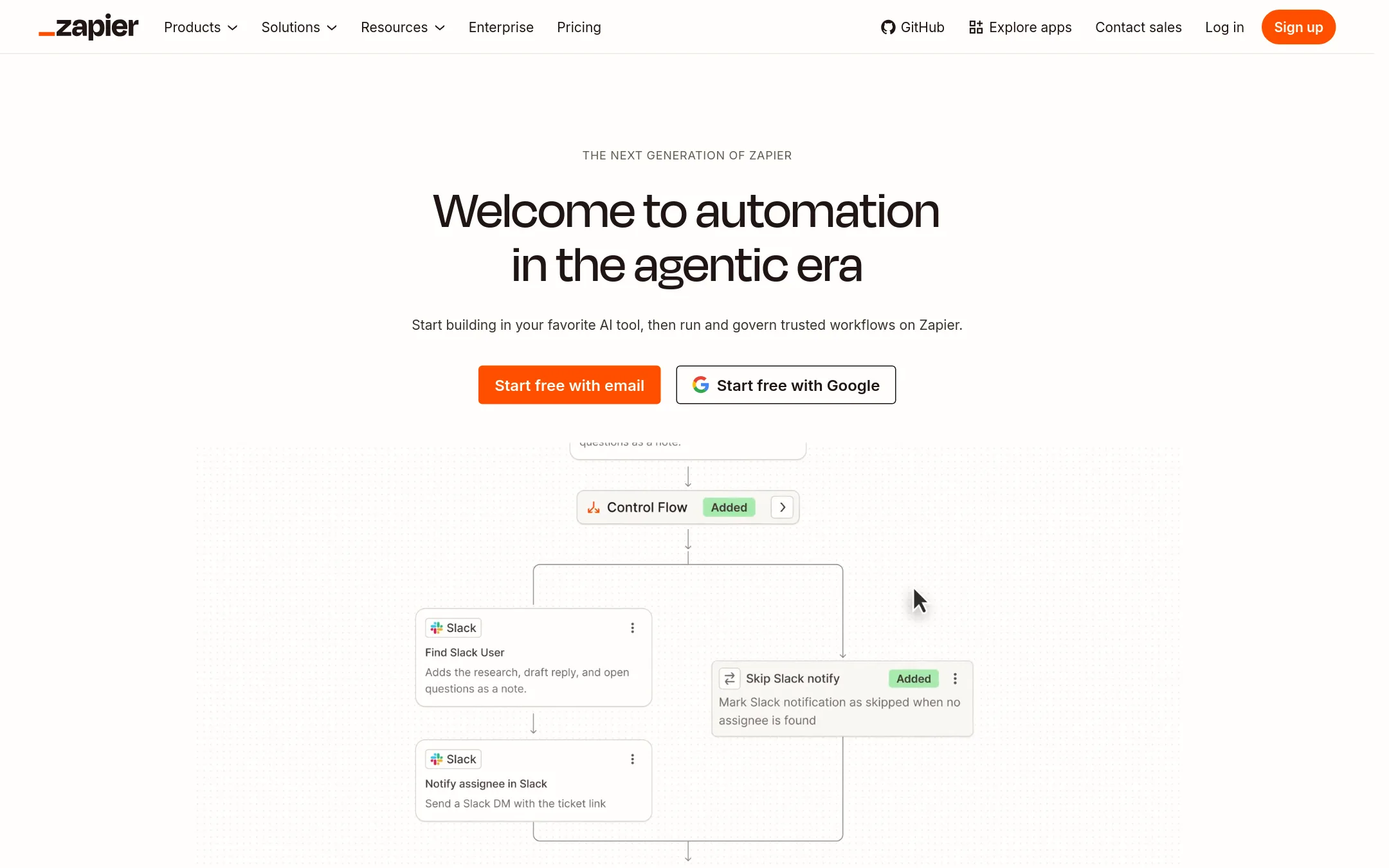
Zapier connects over 9,000 apps and lets you build workflows, Zaps, and agents without code. Pick it over Klavis AI when you want to automate business processes like ticket intake or CRM updates, not train or evaluate AI models. It is an orchestration tool for running work, while Klavis AI builds RL environments and training data for AI labs.
Where it is strong
- Connects to over 9,000 apps, so most common tools are covered
- Offers a range of control from fixed steps to fully agentic workflows
- Includes SOC 2 Type II, SAML SSO, and SCIM on higher tiers
Where it falls short
- Built for business automation, so it does not provide RL environments or training data for model development
- Some features like Copilot and AI custom actions are still marked as beta
- Pricing:
- Zapier has a Free plan with 100 tasks per month, a Professional plan, a Team plan for 25 users, and an Enterprise plan with custom annual task limits, but the page does not list the monthly price for the paid tiers.
- Switching from Klavis AI:
- Moving from Klavis AI to Zapier is not a straightforward migration because the two products do different jobs, so there is no direct switching path described on the site.
- M$650/mo + $65/account
3.Merge
Best for: B2B SaaS products and internal IT or AI teams that need to connect agents and products to many third-party systems through one API
- Pricing
- $650/mo + $65/account
- Category
- Other
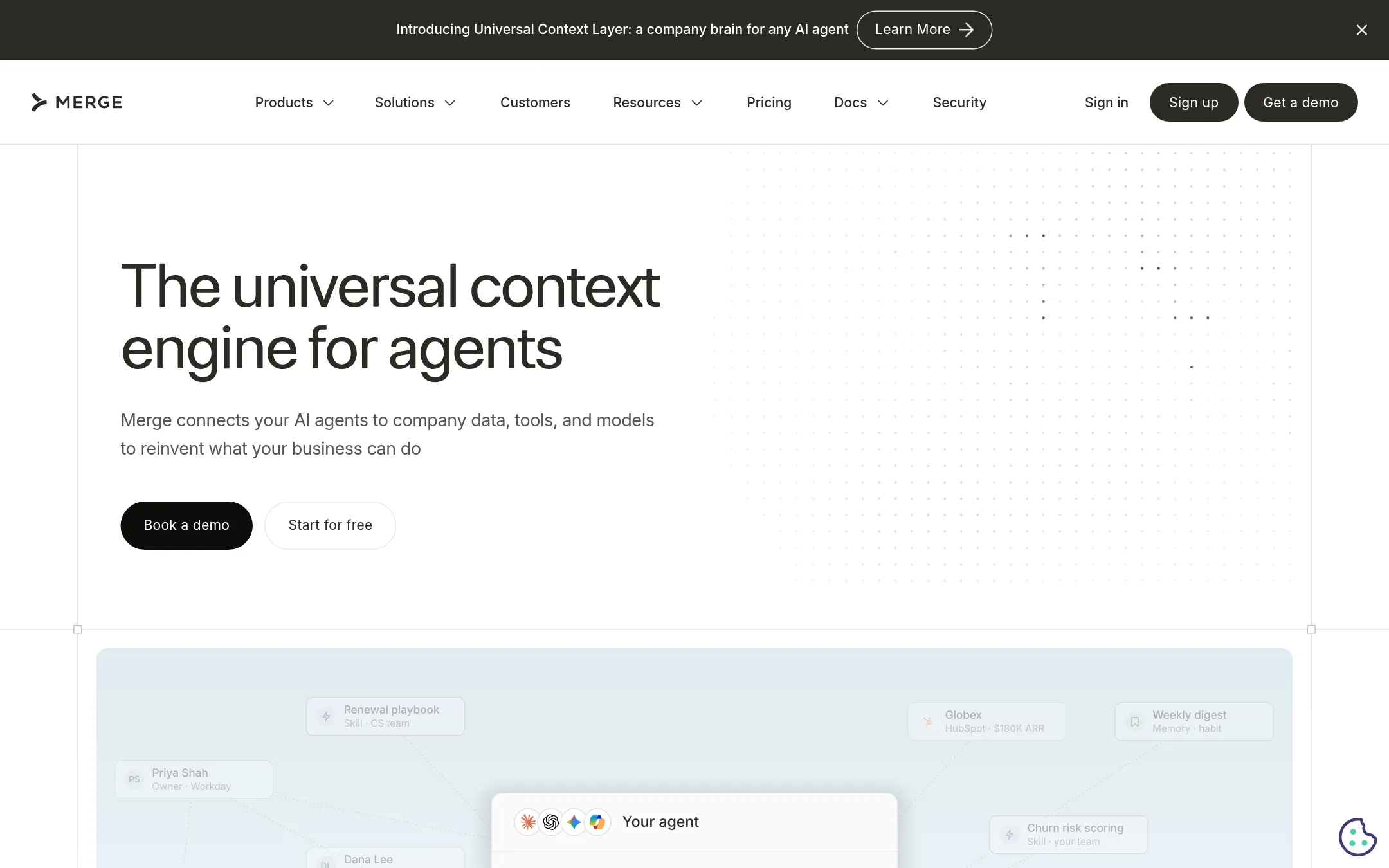
Merge is a unified integration layer that connects products and internal teams to third-party tools, data and LLMs through one API. Teams pick it over Klavis AI when the goal is shipping customer-facing integrations or giving employees governed access to apps and models, rather than building RL environments and training data for model labs.
Where it is strong
- Covers 5,000+ tools across hundreds of third-party services, per the site
- Includes scoped permissions, audit logs and built-in DLP for compliance reviews
- Routes requests to any major LLM with automatic failover
Where it falls short
- Built around product and workforce integration rather than RL environments or training data, which is Klavis AI's focus
- Per-account pricing adds up as the number of connected customer accounts grows
- Pricing:
- Pricing is not published as fixed figures, with a Launch plan at $650/month for up to 10 production Linked Accounts ($65 per account after) and Professional and Enterprise plans on request.
- From $0/mo, usage-base
4.Nango
Best for: SaaS product teams that need many customer accounts connected to third-party APIs with managed auth
- Pricing
- From $0/mo, usage-base
- Category
- Developer Tools
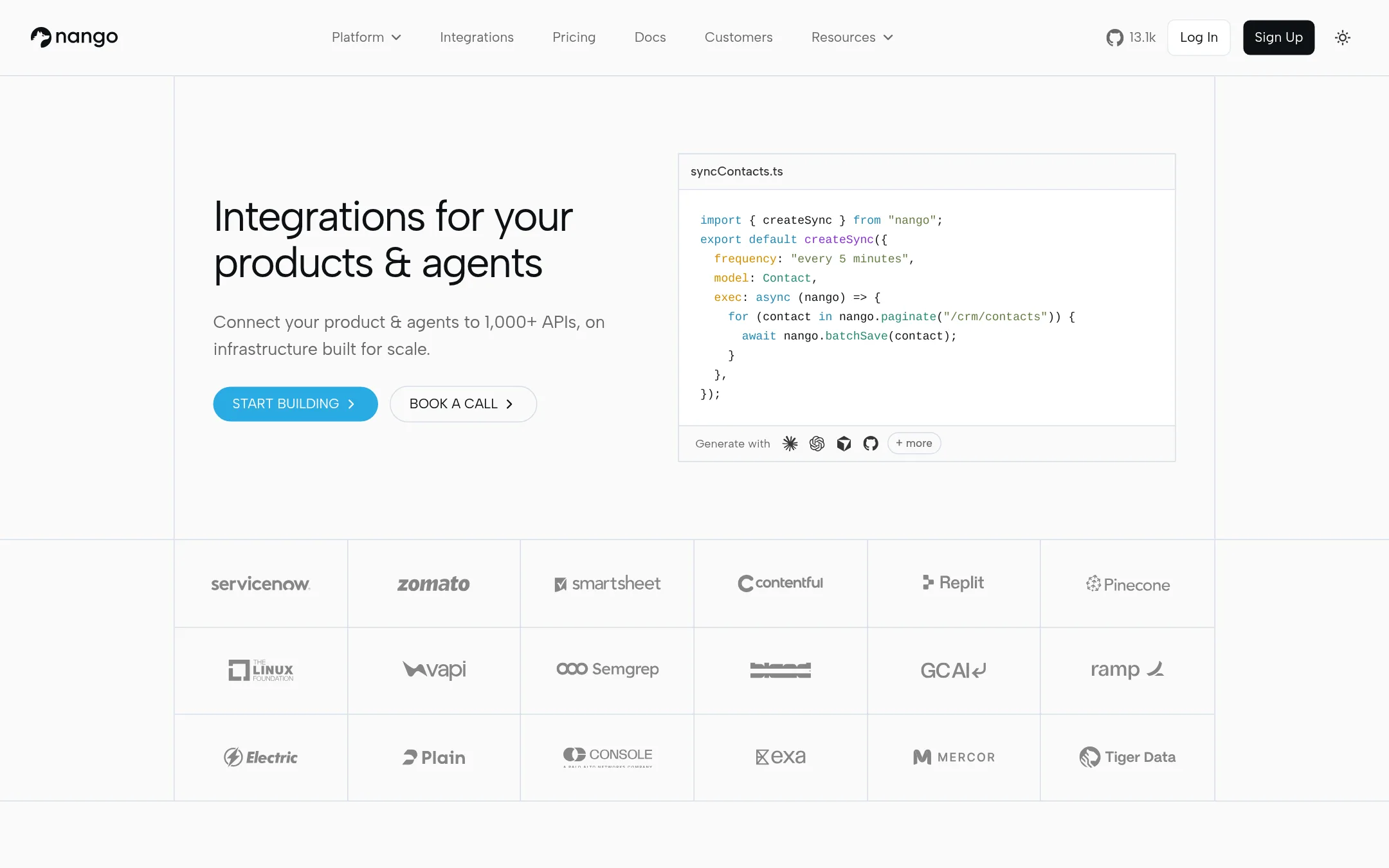
Nango gives your product and AI agents access to over 1,400 APIs, with authentication, token refreshing and a library of pre-built tools and syncs. Choose it over Klavis AI when your main need is connecting a product to many third-party SaaS accounts and you want managed auth and logs for those connections. Klavis AI focuses on RL environments and training data for AI labs, which is a different job.
Where it is strong
- Auth and token refreshing for 1,400+ APIs and MCP servers
- 10,000+ pre-built tools, triggers and syncs ready to use
- Startups can get up to $10,000 in credits and the Growth add-on free for six months
Where it falls short
- Costs scale with each connected user account, billed per connection per month
- Enterprise features like self-hosting, SAML SSO and HIPAA sit behind custom pricing
- Pricing:
- The Free plan costs $0 a month with hard-capped limits of 10 compute hours and 10GB of data, the Pay-as-you-go plan costs $50 a month with $50 in monthly credits, and Enterprise pricing is custom.
- $99/mo annual, or cust
5.Pipedream
Best for: Product teams building agents that act on behalf of users across their SaaS apps without building auth from scratch.
- Pricing
- $99/mo annual, or cust
- Category
- Developer Tools
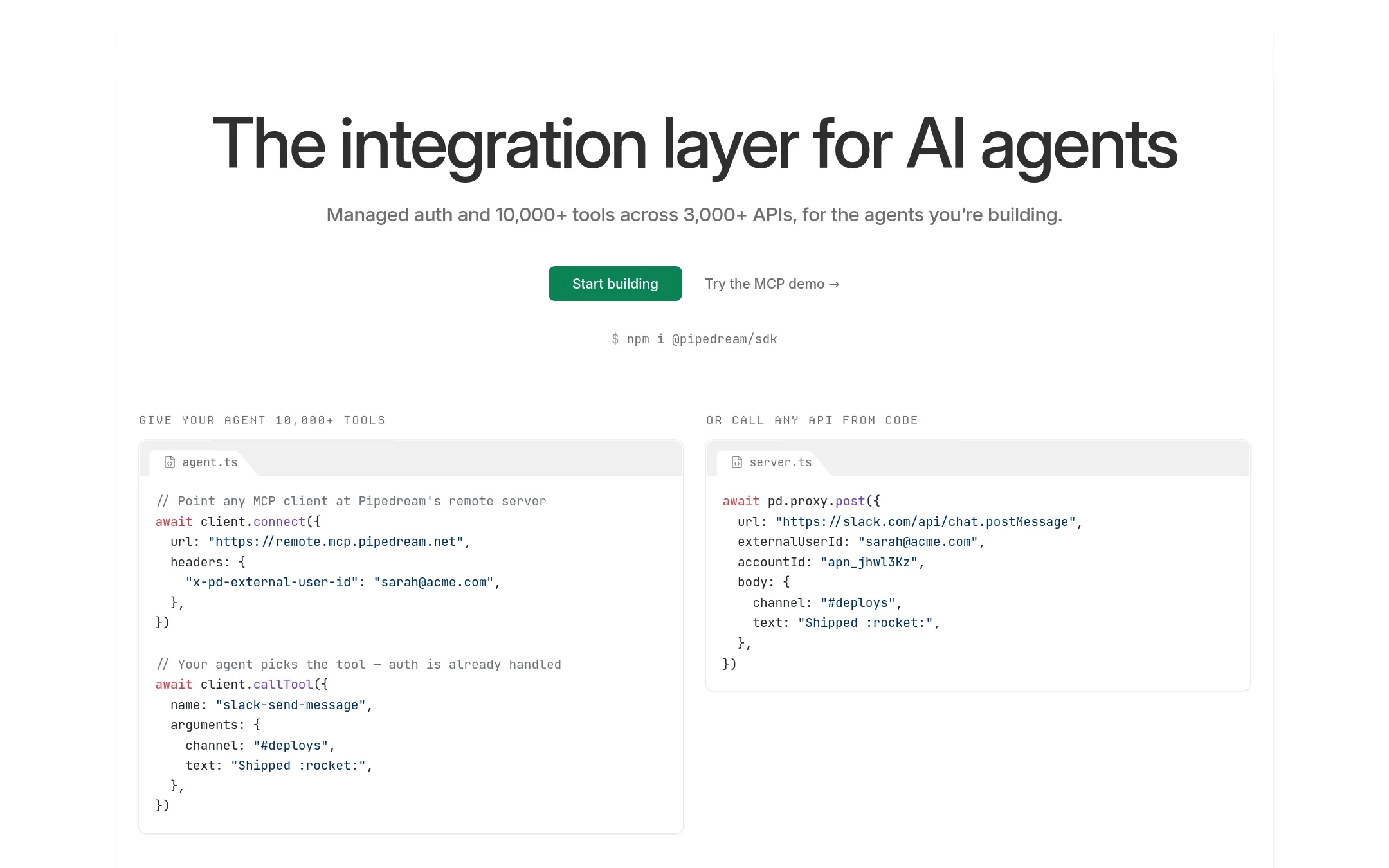
Pipedream is an integration layer for AI agents. It handles managed auth for 3,000+ APIs, 10,000+ prebuilt tools and triggers, and a proxy for any other endpoint, with per-user credentials. Teams choose it when their agents need to act inside users' own SaaS accounts and they would rather not build OAuth flows and token refresh themselves. Klavis AI is focused on RL environments and training data for AI labs, so Pipedream fits a product team wiring agents to customer tools rather than a lab training models.
Where it is strong
- Managed OAuth and token refresh for 3,000+ APIs, so users connect accounts without you handling credentials
- 10,000+ prebuilt tools and triggers, plus an MCP endpoint that works with any MCP client
- Raw API proxy lets you call any endpoint that has no prebuilt tool
Where it falls short
- Built for connecting agents to third-party apps, so it does not offer RL environments or training data the way Klavis AI does
- Production use requires the Startup plan, and per-user and per-credit charges add up at scale
- Pricing:
- Pricing is published: the Free tier is $0 for development, Startup is $99 per month billed annually ($150 monthly) with 100 production users included and $2 per extra user, and Business is custom.
See more comparisons in AI & Machine Learning alternatives.
FAQ
Questions about Klavis AI alternatives
What is Klavis AI mainly used for?
According to its site, Klavis AI builds RL environments and training data for AI labs building models that can do real work. Its work covers stateful environments, expert-curated tasks, and verifiers for frontier model post-training. It is not an automation tool for business workflows.
Which alternative should I pick if I want to connect my product to customers' SaaS accounts?
Pipedream and Nango are built for this. Pipedream offers managed OAuth and token refresh for 3,000+ APIs, with per-user credentials and a raw API proxy. Nango offers auth and token refreshing for 1,400+ APIs, with a Free plan and a Pay-as-you-go plan at $50 a month.
Which option is best for letting an AI assistant take actions in business apps?
Composio is the closest fit. It connects assistants such as Claude, ChatGPT and Cursor to 1,700+ apps, with per-action permissions and a log of every call. Its Free plan includes 100,000 tool calls per month and up to 3 members.
How do the pricing models differ across these alternatives?
Nango and Merge charge per connected account, which adds up as your customer base grows. Composio charges per seat on its Standard plan, while Pipedream's Startup plan includes 100 production users and charges $2 per extra user. Zapier's paid tiers do not list monthly prices on its page.
Is any alternative a good fit for AI labs that need training data?
None of the listed alternatives provides RL environments or training data for model development. Zapier, Nango, Pipedream, Merge and Composio all focus on connecting apps, automating work, or governing access to tools. Klavis AI is the entry in this category built for training frontier models.
Last updated November 23, 2026.