
LanceDB alternatives
8 products compared · Updated November 3, 2026
The short answer
For teams that want a fully managed vector database with enterprise compliance, Pinecone is the strongest choice. Weaviate suits teams that want built-in embeddings and natural-language querying in a managed cloud. Qdrant is best for teams that need a high-performance, self-hosted vector search engine with advanced filtering.
Your shortlist, at a glance
Read the comparisons ↓- CChromaFrom $0 + usageTeams that need a managed or self-hosted vector search database with simple usage-based pricing and strong open-source licensing.
 PineconeFrom $20/mo flatTeams that want a fully managed vector database with enterprise compliance and don't want to run their own infrastructure.
- WWeaviateFree. From $45/moTeams building AI applications that want a managed vector database with built-in embeddings and natural-language querying, especially those needing enterprise security and multi-cloud deployment.
- QQdrantNot publishedTeams building AI search and retrieval systems that need high-performance vector search with complex metadata filters and hybrid dense-sparse search.
- MMilvusNot publishedTeams that want a dedicated vector database with flexible deployment tiers, from local prototyping to distributed clusters handling billions of vectors.
 GitHub ProjectsFrom $4/user/moSoftware teams already on GitHub that want issue tracking and project planning without adding another tool
 ActiveloopSee websiteDatabase for AI
 LangfuseSee websiteOpen source LLM engineering platform
About LanceDB and its alternatives
LanceDB is an open-source, serverless vector database for production-scale generative AI. It is known for its multimodal lakehouse approach, which lets you manage training data, feature engineering, and retrieval in one table. The site emphasizes petabyte-scale performance and a single platform for the AI data lifecycle.
When comparing alternatives, weigh pricing structure, deployment options, and compliance certifications. Some products are fully managed, others are self-hosted or hybrid. Check whether pricing is usage-based or has minimum commitments. Look for built-in features like embeddings or hybrid search that reduce pipeline work. Consider support and contract terms, especially for enterprise plans.
Explore the alternatives
- CFrom $0 + usage
1.Chroma
Best for: Teams that need a managed or self-hosted vector search database with simple usage-based pricing and strong open-source licensing.
- Pricing
- From $0 + usage
- Category
- Other
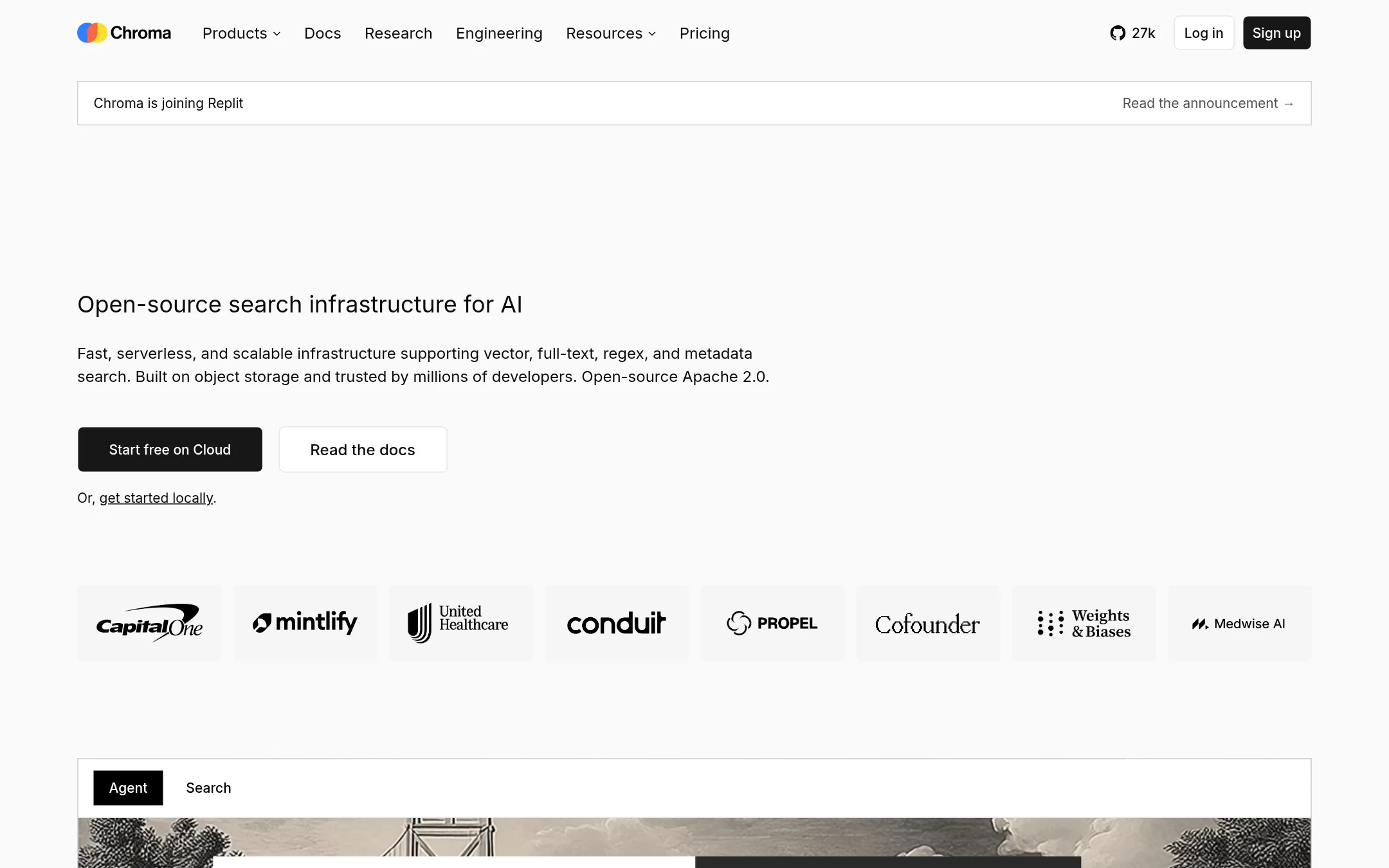
Chroma is an open-source search database for AI that handles vector, full-text, regex, and metadata search on object storage. It is a good choice if you want a serverless search layer with usage-based pricing and the option to run it yourself under Apache 2.0.
Where it is strong
- Supports vector, full-text, regex, and metadata search in one system.
- Open-source Apache 2.0, so you can self-host or use the managed cloud.
- Usage-based pricing with free credits on Starter and $100 credits on Team.
Where it falls short
- Team plan requires a monthly fee before usage-based charges.
- Enterprise features like BYOC and single-tenant clusters are not available on lower tiers.
- Pricing:
- Starter is $0 plus usage, Team is $250 per month plus usage, Enterprise is custom pricing.
- From $20/mo flat
2.Pinecone
Best for: Teams that want a fully managed vector database with enterprise compliance and don't want to run their own infrastructure.
- Pricing
- From $20/mo flat
- Category
- AI & Machine Learning
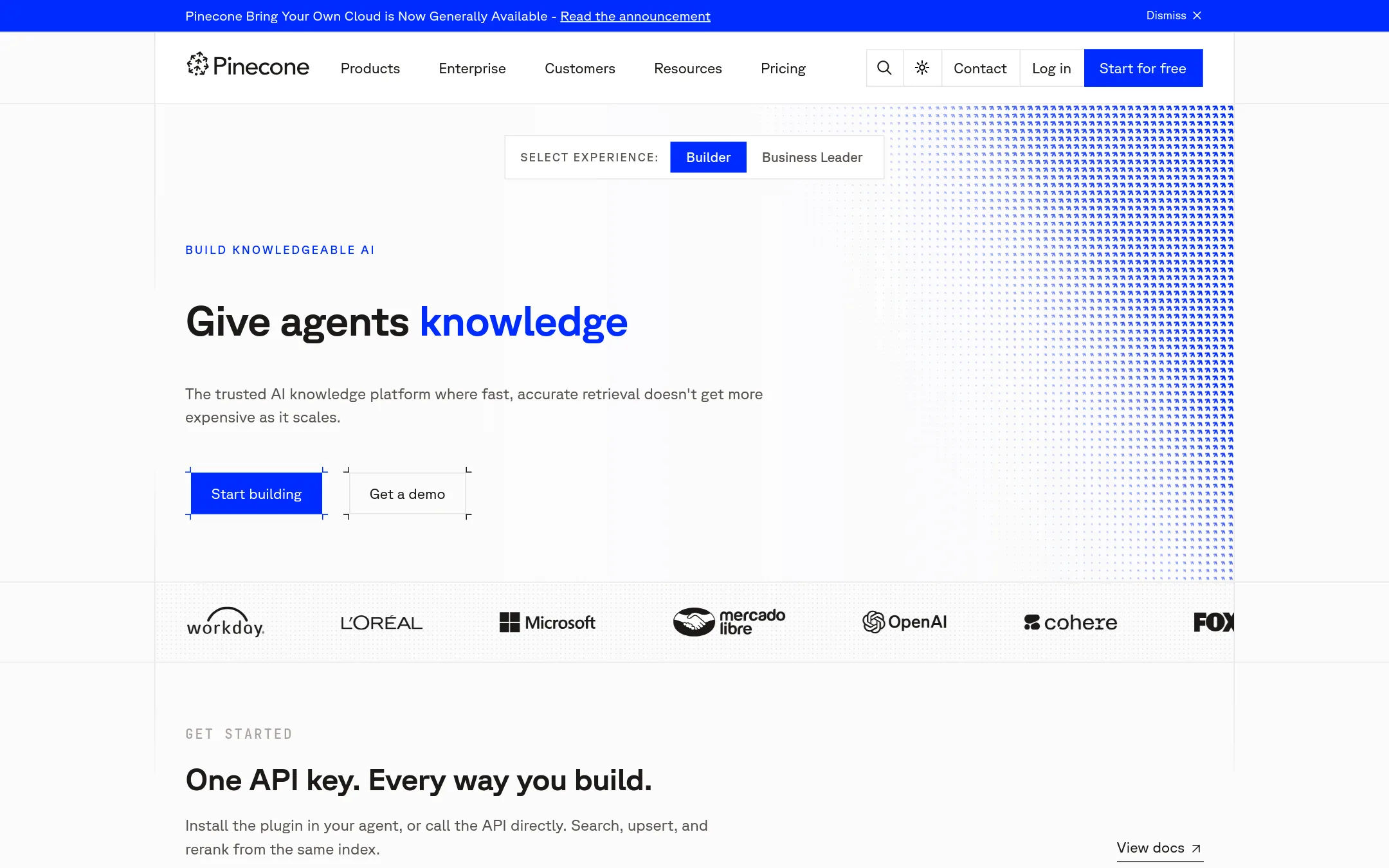
Pinecone is a fully managed vector database with automatic indexing and scaling, so teams avoid operating infrastructure. Choose it over LanceDB when you want a hosted service with built-in compliance (SOC 2, HIPAA) and don't need LanceDB's open-source, self-managed lakehouse approach.
Where it is strong
- Fully managed: no infrastructure to operate
- Automatic indexing and scaling with consistent p99 latency
- SOC 2, HIPAA, GDPR, ISO 27001 compliance built in
Where it falls short
- Closed source, no self-hosting option
- Minimum usage charges on paid plans ($50/mo Standard, $500/mo Enterprise)
- Pricing:
- Starter is free. Builder is $20/month flat. Standard starts at $50/month minimum usage. Enterprise starts at $500/month minimum usage. Storage is $0.33/GB/month, write units $4–$6.75 per million, read units $16–$18 per million.
- Switching from LanceDB:
- Moving from LanceDB to Pinecone means re-creating indexes and re-ingesting data, since Pinecone is a managed service with different APIs and no direct import from Lance format.
- WFree. From $45/mo
3.Weaviate
Best for: Teams building AI applications that want a managed vector database with built-in embeddings and natural-language querying, especially those needing enterprise security and multi-cloud deployment.

- Pricing
- Free. From $45/mo
- Category
- Other
Weaviate is an open-source AI-native database that combines vector search, RAG, and agent memory in one platform. Choose it over LanceDB when you want built-in embeddings and natural-language querying without assembling separate pipelines, or when you need a managed cloud with enterprise compliance like SOC 2 and HIPAA.
Where it is strong
- Built-in embeddings and Query Agent reduce external pipeline work
- Multi-tenancy supports 50K+ tenants in a single cluster
- SOC 2 Type II and HIPAA compliance available
Where it falls short
- Free tier limited to 100,000 objects and 1 collection
- Premium plan requires prepaid commitment and contact for pricing
- Pricing:
- Free tier includes 100,000 objects, 1 GB memory, and 10 GB disk. Flex starts at $45/month, Premium from $400/month, with vector dimension pricing from $0.00465 per 1M on Flex.
- QNot published
4.Qdrant
Best for: Teams building AI search and retrieval systems that need high-performance vector search with complex metadata filters and hybrid dense-sparse search.
- Pricing
- Not published
- Category
- Other
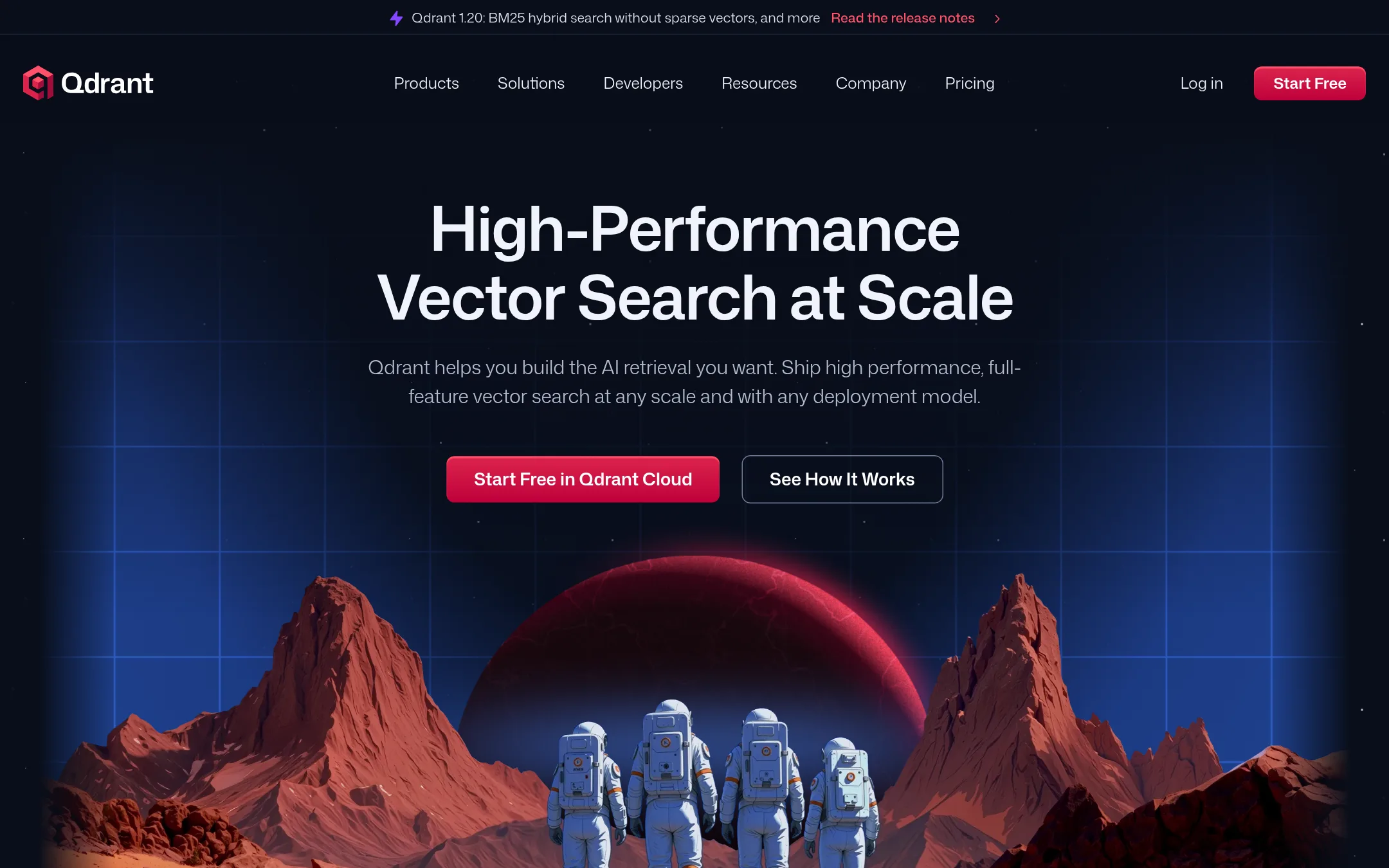
Qdrant is a Rust-based vector search engine focused on production-grade retrieval with advanced filtering, hybrid search, and reranking. Choose it over LanceDB when you need a dedicated vector database with strong metadata filtering and flexible deployment options like on-prem, hybrid, or edge. It suits teams that want a mature, standalone search engine rather than a multimodal lakehouse for training data.
Where it is strong
- Built entirely in Rust with SIMD for high performance
- Native hybrid search with dense and sparse vectors
- Deploy on-prem, hybrid, edge, or fully managed cloud
Where it falls short
- No built-in multimodal lakehouse for training data pipelines
- Pricing details are not transparent on the site
- Pricing:
- Pricing is not published on the site. Qdrant offers a free tier with a single node cluster, and paid tiers with dedicated resources, but specific prices are not listed.
- MNot published
5.Milvus
Best for: Teams that want a dedicated vector database with flexible deployment tiers, from local prototyping to distributed clusters handling billions of vectors.
- Pricing
- Not published
- Category
- Other
Milvus is an open-source vector database built for GenAI applications, with deployment options from a lightweight Lite version for prototyping to a distributed enterprise setup for billions of vectors. Choose Milvus over LanceDB when you need a standalone vector database with a clear path from local notebooks to large-scale production, especially if you prefer a more traditional database architecture.
Where it is strong
- Multiple deployment options: Lite, Standalone, Distributed, and managed Zilliz Cloud.
- Scales to tens of billions of vectors with minimal performance loss.
- Feature-rich: metadata filtering, hybrid search, multi-vector support.
Where it falls short
- No built-in multimodal lakehouse features like LanceDB's table-based data management.
- Managed cloud option (Zilliz) is separate and may have different pricing.
- Pricing:
- Pricing is not published on the site.
- Switching from LanceDB:
- Moving from LanceDB to Milvus means reworking your data pipeline, as Milvus uses a collection-based model rather than LanceDB's table and dataset approach.
- From $4/user/mo
6.GitHub Projects
Best for: Software teams already on GitHub that want issue tracking and project planning without adding another tool
- Pricing
- From $4/user/mo
- Category
- Productivity & Project Management
GitHub Projects is a project management layer built into GitHub, letting teams track issues, plan sprints, and automate workflows next to their code. Choose it over LanceDB when your team already lives in GitHub and needs lightweight planning tools, not a vector database for AI workloads.
Where it is strong
- Tight integration with pull requests and code review
- Free tier includes unlimited public and private repositories
- Automation with GitHub Actions for workflow triggers
Where it falls short
- Not a vector database, so no similarity search or AI data management
- Limited to GitHub's ecosystem, no standalone use
- Pricing:
- Free plan at $0, Team at $4 per user per month, Enterprise at $21 per user per month. Codespaces starts at $0.18 per hour of compute and $0.07 per GB of storage.
- See website
7.Activeloop
AI & Machine Learning
Database for AI
- See website
8.Langfuse
AI & Machine Learning
Open source LLM engineering platform
See more comparisons in AI & Machine Learning alternatives.
FAQ
Questions about LanceDB alternatives
What is the cheapest way to start with a vector database?
Pinecone's Starter plan is free, and Weaviate has a free tier with 100,000 objects. Chroma's Starter is $0 plus usage. Qdrant and Milvus do not publish prices, so you need to contact them for quotes.
Which options can I self-host?
Weaviate, Qdrant, Milvus, and Chroma are open-source and can be self-hosted. Pinecone is closed-source and only available as a managed service. LanceDB is also open-source and self-hostable.
Which products have enterprise compliance like SOC 2 or HIPAA?
Pinecone lists SOC 2, HIPAA, GDPR, and ISO 27001. Weaviate offers SOC 2 Type II and HIPAA. Qdrant and Milvus do not list compliance details on their pricing pages.
Which is best for teams already using GitHub?
GitHub Projects is a project management tool, not a vector database. It is listed as an alternative only for teams that need lightweight planning, not AI data management. For vector search, choose Pinecone, Weaviate, or Qdrant instead.
Do any of these offer built-in embeddings or natural-language querying?
Weaviate has built-in embeddings and a Query Agent for natural-language queries. Qdrant supports hybrid search with dense and sparse vectors. Pinecone focuses on vector search and requires you to generate embeddings separately.
Last updated November 3, 2026.