
Luciq (formerly Instabug) alternatives
7 products compared · Updated November 14, 2026
The short answer
The three strongest alternatives to Luciq (formerly Instabug) are Sentry, Bugsnag and Embrace. Sentry suits engineering teams across web, backend and mobile that want to trace errors from production back to code. Bugsnag suits mobile and web teams that want error monitoring and distributed tracing in one tool, and Embrace suits mobile and web teams that want OpenTelemetry-based monitoring and the option to send data to other vendors.
Your shortlist, at a glance
Read the comparisons ↓ SentryFrom $26/mo (annual)Engineering teams across web, backend and mobile that want one tool to trace errors from production back to code
- RRecordBookNot publishedSmall and medium businesses that need to organise records and workflows in a simple mobile app
 DatadogNot publishedEngineering and operations teams running cloud infrastructure and backend services that want one monitoring platform for servers, apps, logs, and security
 Embrace$0.80 per 1,000 sessioMobile and web engineering teams that want OpenTelemetry-based monitoring and plan to send their data to multiple tools.
- BBugsnagFrom $0/mo, customMobile and web development teams that want error monitoring and distributed tracing in one tool
- RRaygunPer error volume tiersEngineering teams running web and mobile apps who want crash reporting and back-end performance monitoring in one tool.
 New Relic$0.40/GB + user feesEngineering teams that run backend services, cloud infrastructure and mobile apps and want one platform for all of them
About Luciq (formerly Instabug) and its alternatives
Luciq (formerly Instabug) is a mobile-first observability platform. According to its site, it turns app signals into context that engineers, product managers and agents can act on, and it is known for capturing every session, prioritising issues, and suggesting fixes for mobile apps.
When comparing alternatives in this category, weigh the pricing structure first, since some tools charge by daily active users, some by events or data volume, and some by seats. Check regional data hosting, integrations with your release and issue tools, the level of support included in each plan, and the contract terms for enterprise security features such as SSO and audit logs.
Explore the alternatives
- From $26/mo (annual)
1.Sentry
Best for: Engineering teams across web, backend and mobile that want one tool to trace errors from production back to code
- Pricing
- From $26/mo (annual)
- Category
- Other
Sentry is application monitoring for developers. It captures errors, traces, logs and session replays, and links them so a developer can move from an issue to its context and fix. Teams choose it over Luciq (formerly Instabug) when their main need is error and performance debugging across web and backend code, not mobile-specific feedback and in-app reporting.
Where it is strong
- Five-line SDK setup with no agent to install
- Errors, logs, replays, traces and profiles are linked by the same trace
- Free tier covers one user with error monitoring and tracing
Where it falls short
- Mobile-specific features such as in-app bug reporting are not part of the core offer
- Advanced controls like SAML and SCIM sit on the Business tier and above
- Pricing:
- Sentry lists a free Developer plan for one user, a Team plan at $26/mo billed annually, a Business plan at $80/mo, and custom Enterprise pricing.
- RNot published
2.RecordBook
Best for: Small and medium businesses that need to organise records and workflows in a simple mobile app
- Pricing
- Not published
- Category
- Productivity & Project Management
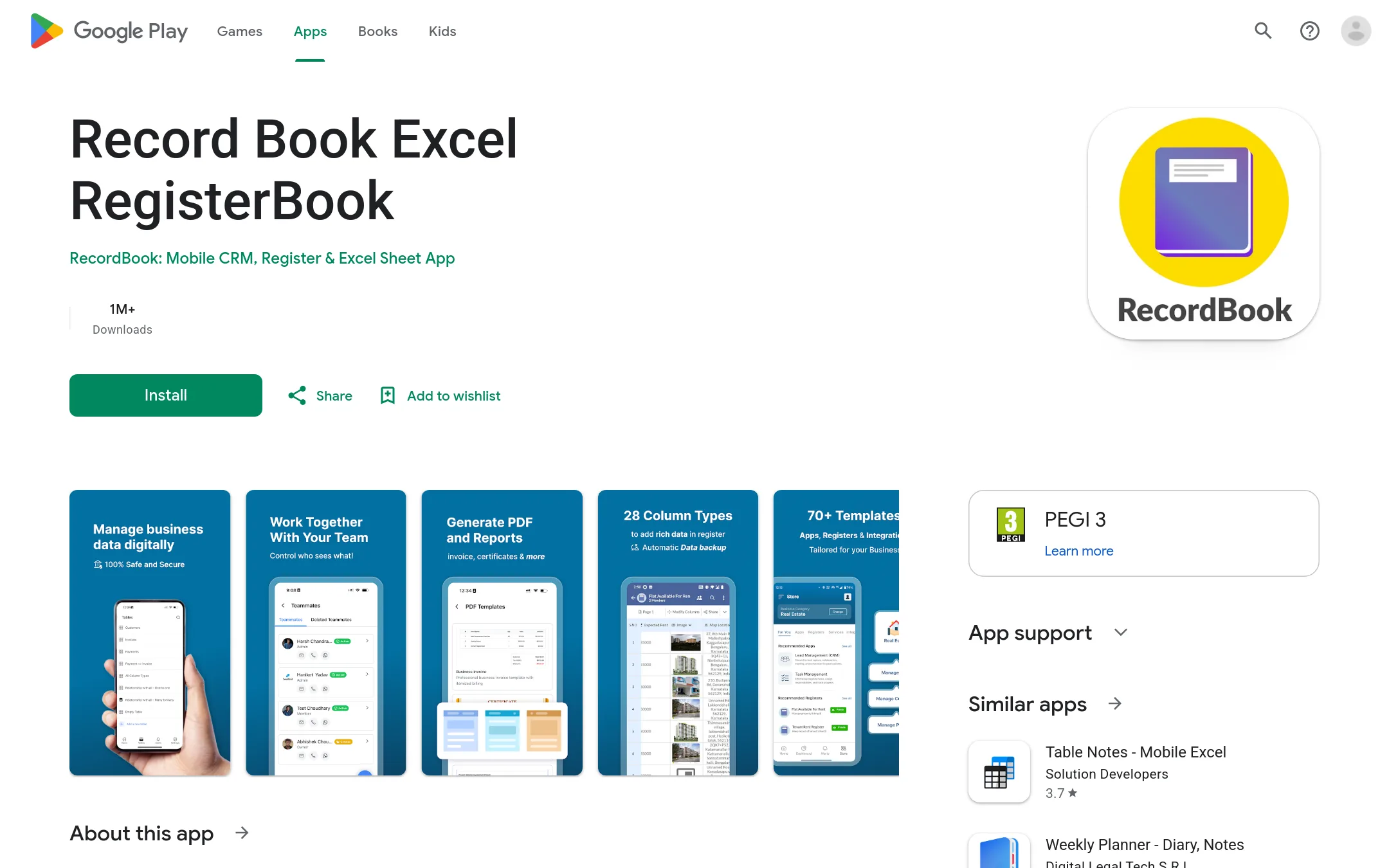
RecordBook is a Google Play app built around the Airtable idea of structured records, aimed at small and medium businesses that need to track customers, stock, or jobs without learning a database. It suits a small team that wants a simple record-keeping tool on a phone rather than mobile crash and session monitoring. Choose it over Luciq (formerly Instabug) when the problem is business data, not app quality.
Where it is strong
- Built as a simple record-keeping app for non-technical owners
- Listed on Google Play, so it installs in minutes on Android
- Aimed at everyday business tracking rather than engineering workflows
Where it falls short
- It does not provide crash reporting, session replay or app performance monitoring
- The public listing gives no published pricing or plan details to compare
- Pricing:
- Pricing is not published on the site.
- Not published
3.Datadog
Best for: Engineering and operations teams running cloud infrastructure and backend services that want one monitoring platform for servers, apps, logs, and security
- Pricing
- Not published
- Category
- Analytics & Data
Datadog is a broad cloud monitoring and observability platform covering infrastructure, applications, logs, security, and digital experience. A team would pick it over Luciq when the main need is server, cloud, and backend visibility across the whole stack, not mobile crash and session context alone.
Where it is strong
- Covers infrastructure, APM, logs, security, and digital experience in one platform
- Strong cloud monitoring for AWS, Azure, and Google Cloud
- Large catalog of integrations and a public API
Where it falls short
- Its mobile-specific tooling, such as the mobile app testing and session replay, is one part of a much larger product set rather than the cor
- Breadth of modules can make the platform harder to scope and budget for a small team
- Pricing:
- Pricing is not published on the site.
- $0.80 per 1,000 sessio
4.Embrace
Best for: Mobile and web engineering teams that want OpenTelemetry-based monitoring and plan to send their data to multiple tools.
- Pricing
- $0.80 per 1,000 sessio
- Category
- Developer Tools
Embrace is a mobile and web real user monitoring tool built on OpenTelemetry. It captures sessions for crashes, ANRs, network issues and performance, and it can forward data into tools like Grafana. Teams pick it over Luciq (formerly Instabug) when they want open standards and the freedom to send their telemetry to other vendors.
Where it is strong
- Built on OpenTelemetry, so telemetry can be forwarded to other tools
- Captures mobile and web sessions in one platform, with crash, ANR and network monitoring
- Free tier for small apps and staging environments
Where it falls short
- Mobile-only features like crash reporting, ANRs and view capture do not apply to web
- Lower tiers cap users and limit event data retention to 3 or 14 days
- Pricing:
- Embrace's Pro plan is $0.80 per 1,000 sessions with an $80 monthly minimum, a free tier covers up to 1 million sessions per year for up to 5 users, and Enterprise is custom.
- BFrom $0/mo, custom
5.Bugsnag
Best for: Mobile and web development teams that want error monitoring and distributed tracing in one tool
- Pricing
- From $0/mo, custom
- Category
- Other
Bugsnag monitors crashes, errors, and performance across mobile and web apps, with stability scores and an inbox that ranks bugs by severity and user impact. Teams pick it over Luciq (formerly Instabug) when they need full-stack visibility, including distributed tracing and OpenTelemetry support, rather than a mobile-only focus.
Where it is strong
- Stability scores show when a release is ready to ship.
- OpenTelemetry compatibility means you keep ownership of your data.
- Connects crashes to traces so you can see which service caused a failure.
Where it falls short
- Its pricing is based on events and spans, not on daily active users like Luciq (formerly Instabug).
- The free plan includes only one user and 7 days of data retention.
- Pricing:
- Pricing is published with a free tier at $0 per month, a Select tier starting at $0 per month, and custom Enterprise plans, with limits such as 7.5K events and 1M spans per month on the free plan.
- RPer error volume tiers
6.Raygun
Best for: Engineering teams running web and mobile apps who want crash reporting and back-end performance monitoring in one tool.
- Pricing
- Per error volume tiers
- Category
- Other
Raygun is an application monitoring tool that catches crashes and errors in web and mobile apps, and it also covers back-end performance and real user monitoring for web pages. A team would pick it over Luciq (formerly Instabug) when the main need is crash and error reporting plus back-end tracing, and mobile observability is only part of the job.
Where it is strong
- Covers crash reporting, real user monitoring and application performance monitoring in one product
- Lightweight SDKs and agents for major languages and frameworks
- Native integrations with Slack, GitHub, Jira and Bitbucket
Where it falls short
- Its mobile focus is narrower than Luciq's, which is built mobile-first
- Enterprise terms like custom SLAs and data retention require talking to sales
- Pricing:
- Raygun publishes tiered plans priced by error volume, with Basic, Team, Business and Enterprise levels, and extra usage charged at $0.001 per error on the crash plans and $0.002 per error on the real user monitoring plans.
- $0.40/GB + user fees
7.New Relic
Best for: Engineering teams that run backend services, cloud infrastructure and mobile apps and want one platform for all of them

- Pricing
- $0.40/GB + user fees
- Category
- Analytics & Data
New Relic is an observability platform that correlates telemetry across an entire stack, including cloud, Kubernetes, APM, logs and browser or mobile monitoring, to find root causes faster. A team would pick it over Luciq (formerly Instabug) when they need observability across backend, infrastructure and AI workloads rather than a mobile-first view of app issues.
Where it is strong
- Covers mobile, web, backend, Kubernetes and cloud infrastructure in one correlated view
- Free tier with 100 GB of data ingest and unlimited basic users
- Offers AI-driven investigation and automated remediation features
Where it falls short
- Mobile crash and session tooling is one part of a much broader platform, so mobile-first teams may find it less focused
- Costs are split across data ingest, user licenses and compute units, which can be harder to forecast than a DAU-based plan
- Pricing:
- The free tier includes 100 GB of data ingest per month and one full platform user, with paid Standard and Pro editions at $0.40 per GB beyond the free allowance, and Enterprise is quoted by sales.
See more comparisons in AI & Machine Learning alternatives.
FAQ
Questions about Luciq (formerly Instabug) alternatives
Which alternative is best if I want to trace errors from my mobile app back to backend code?
Sentry is the strongest fit for that need. It links errors, traces, logs and session replays so a developer can move from an issue to its context and fix, across web, backend and mobile. Its free Developer plan covers one user, which makes it easy to test before committing.
Which tool gives me stability scores and a bug inbox ranked by user impact?
Bugsnag provides stability scores and an inbox that ranks bugs by severity and user impact, covering mobile and web apps. It also offers distributed tracing and OpenTelemetry compatibility, so you keep ownership of your data. Its pricing is based on events and spans rather than daily active users.
I want to avoid being locked into one vendor. Which option helps with that?
Embrace is built on OpenTelemetry, so telemetry can be forwarded to tools such as Grafana. It captures mobile and web sessions in one platform, and it has a free tier for small apps and staging environments. Note that lower tiers cap users and limit event data retention to 3 or 14 days.
Which alternatives have published pricing I can compare directly?
Sentry lists a free Developer plan, a Team plan at $26 per month billed annually and a Business plan at $80 per month. Embrace's Pro plan is $0.80 per 1,000 sessions with an $80 monthly minimum. Datadog, RecordBook and Luciq's own pricing details are not fully published in the entries, so you will need to request quotes for those.
Which option is for a small business tracking customers or stock rather than app quality?
RecordBook is aimed at small and medium businesses that need to organise records and workflows in a simple mobile app. It does not provide crash reporting, session replay or app performance monitoring, so it is a different category from Luciq. Its public listing gives no published pricing to compare.
Last updated November 14, 2026.