
Modern Treasury alternatives
12 products compared · Updated November 3, 2026
The short answer
For founders and operators comparing Modern Treasury alternatives, the three strongest options are Stripe for global card payments and subscriptions, Treasury Prime for embedded banking with bank flexibility, and Increase for direct bank access with full control over US rails. Stripe suits online businesses scaling globally, Treasury Prime fits fintechs needing a sponsor bank, and Increase is best for teams wanting a direct bank partnership.
Your shortlist, at a glance
Read the comparisons ↓- MMoov$500/mo min + card feeTechnical teams that want a single platform for both accepting card payments and moving money via bank rails, with wallet and virtual card capabilities.
 Stripe2.9% + 30¢Online businesses and platforms that need to accept card payments globally, manage subscriptions, and scale from first transaction to large volume.
 PlaidCustom quoteFintech startups and apps that need to link user bank accounts, verify balances, and pull transaction history for underwriting or personal finance features.
- DDwollaCustom quotePlatforms and enterprises in real estate, lending, B2B fintech, insurance, and healthcare that need high-volume ACH and real-time bank payments with standardized status and exception handling.
- FFinixCustom quoteSoftware platforms and marketplaces in the US and Canada that want to embed payments with flexible pricing and in-person device support.
- UUnitNot publishedFintechs and vertical software companies that want to embed banking, card issuing, and lending alongside payments.
 FormanceSee websiteOpen Source Infrastructure for the Financial Internet
 IncreaseNot publishedFintechs and platforms that need a direct bank partner with bare-metal payments, card issuing, and flexible bank accounts.
 SimetrikSee websiteNo code enterprise SaaS for financial control automation.
 BlackLineSee websiteAgentic AI platform automating financial close, intercompany, and invoice-to-cash operations.
 ColumnNot publishedFintechs and financial institutions that want to build card programs, lending products, or multicurrency banking on a bank's own infrastructure.
 GalileoNot publishedFintechs and banks that need card issuing and core banking infrastructure alongside payment processing.
About Modern Treasury and its alternatives
Modern Treasury is a payment service provider for fiat and stablecoin. It offers one API for payments, accounts, and ledgering, with built-in compliance across ACH, RTP, FedNow, and wire. The platform is known for automating manual processes and supporting multi-rail pay-ins and payouts.
When comparing alternatives, weigh pricing structure (published vs. custom quotes), geographic reach, available payment rails, and integration complexity. Consider whether you need a sponsor bank, card issuing, or stablecoin support. Check contract terms like monthly minimums and volume discounts.
Explore the alternatives
- M$500/mo min + card fee
1.Moov
Best for: Technical teams that want a single platform for both accepting card payments and moving money via bank rails, with wallet and virtual card capabilities.
- Pricing
- $500/mo min + card fee
- Category
- Other
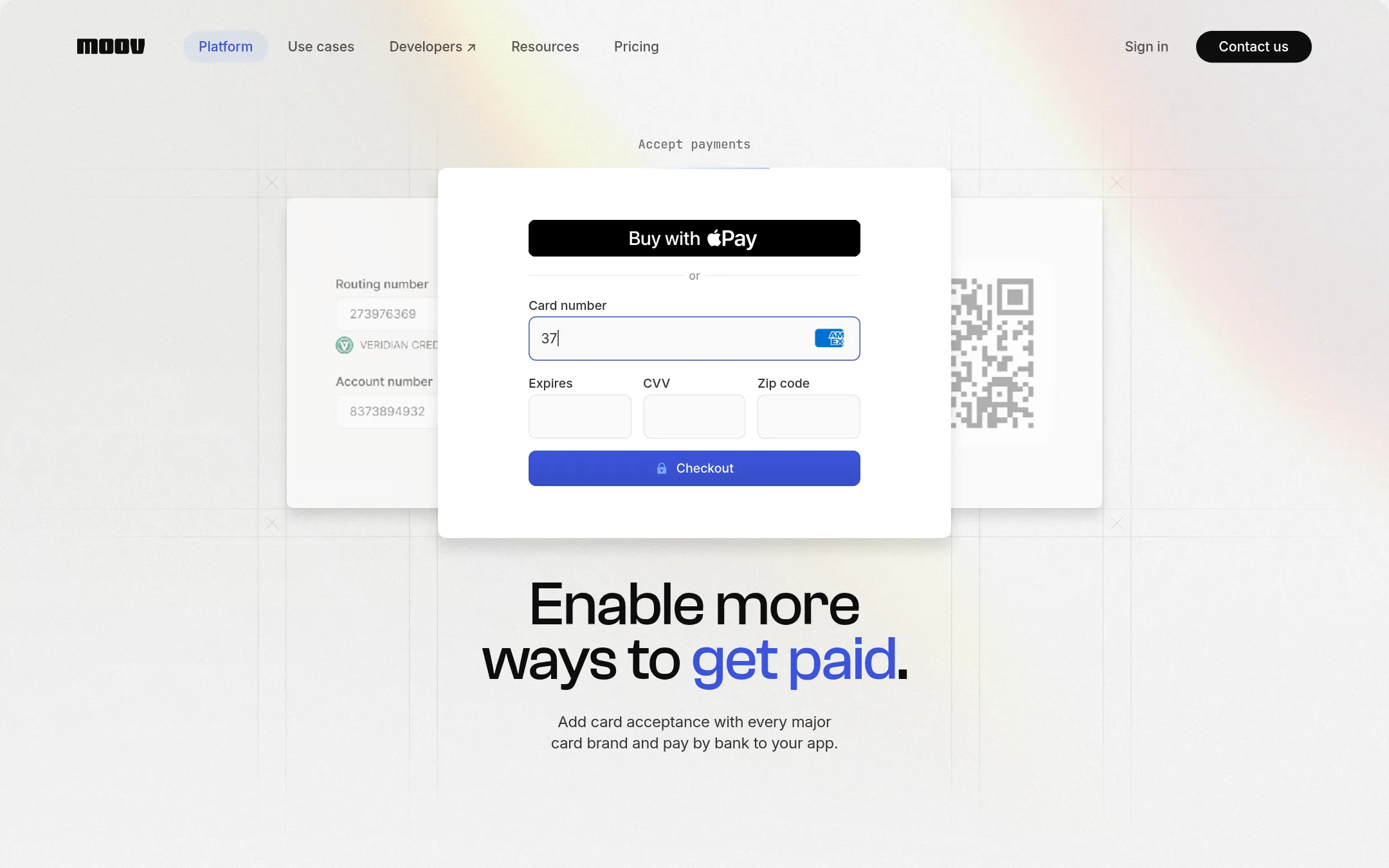
Moov is a payments platform that lets you accept, store, and send money through one API, with support for cards, ACH, RTP, FedNow, and virtual cards. Choose it over Modern Treasury if you want a broader set of payment methods (including card acceptance and digital wallets) and don't need Modern Treasury's dedicated treasury management features like stablecoin orchestration.
Where it is strong
- One API for card acceptance, ACH, RTP, FedNow, and virtual cards.
- Drop-in web components (Moov Drops) for quick customization.
- Data syncs to your warehouse for analytics.
Where it falls short
- No stablecoin support mentioned, unlike Modern Treasury.
- Pricing details are not fully transparent. Requires contacting sales for custom plans.
- Pricing:
- Pricing is not published on the site. Standard pricing starts with a $500 monthly minimum, and card acceptance fees are listed per successful charge for U.S. domestic cards, with $0.15 per transaction or refund, plus 1.5% for international cards.
- Switching from Modern Treasury:
- Moving from Modern Treasury to Moov means re-integrating your payment flows with Moov's API and adjusting to its pricing model, which includes a monthly minimum and per-transaction fees.
- 2.9% + 30¢
2.Stripe
Best for: Online businesses and platforms that need to accept card payments globally, manage subscriptions, and scale from first transaction to large volume.
- Pricing
- 2.9% + 30¢
- Category
- Finance & Accounting
Stripe is a broad payments platform for accepting online and in-person payments, billing, and money movement. Choose it over Modern Treasury if you need a global payment processor with checkout, subscriptions, and card issuing, rather than a treasury-focused payment operations tool.
Where it is strong
- Global reach with 135+ currencies and payment methods.
- Handles billing, subscriptions, and card issuing in one platform.
- High reliability with 99.999% historical uptime.
Where it falls short
- Less focused on treasury operations like ledgering and reconciliation compared to Modern Treasury.
- Stablecoin support is limited to pay-ins, not full orchestration.
- Pricing:
- Standard pricing is 2.9% + 30¢ per successful domestic card transaction, with custom pricing for higher volume and additional features.
- Custom quote
3.Plaid
Best for: Fintech startups and apps that need to link user bank accounts, verify balances, and pull transaction history for underwriting or personal finance features.

- Pricing
- Custom quote
- Category
- Finance & Accounting
Plaid is a financial data network that lets you connect to thousands of banks for account verification, transactions, and identity. You'd choose it over Modern Treasury if your core need is reading financial data or initiating bank payments via Plaid's Transfer product, not running a full treasury operation with ledgers and compliance.
Where it is strong
- Access to 12,000 financial institutions across 20 countries
- Free sandbox and Limited Production with 200 live API calls per product
- Flexible plans from month-to-month to custom enterprise contracts
Where it falls short
- Pricing is not transparent. You must contact sales for most products
- No built-in ledger, compliance, or stablecoin support like Modern Treasury
- Pricing:
- Pricing is not published on the site. Plans are Pay as You Go, Growth, and Custom, with product-specific fees quoted by sales.
- DCustom quote
4.Dwolla
Best for: Platforms and enterprises in real estate, lending, B2B fintech, insurance, and healthcare that need high-volume ACH and real-time bank payments with standardized status and exception handling.
- Pricing
- Custom quote
- Category
- Other
Dwolla is a bank payment infrastructure platform focused on ACH and real-time rails for high-volume platforms and enterprises. You would choose it over Modern Treasury if you need a straightforward, single integration for ACH and real-time payments without the broader treasury features like stablecoin orchestration or programmatic accounts.
Where it is strong
- Single API for ACH, Same Day ACH, RTP, and FedNow.
- Tokenization protects sensitive financial data.
- Guided implementation and responsive customer support.
Where it falls short
- No stablecoin support or programmatic accounts like Modern Treasury.
- Pricing is custom only. No published rates for comparison.
- Pricing:
- Pricing is not published on the site. It is custom and tailored to your transaction volume, rails, and integration needs.
- Switching from Modern Treasury:
- Moving from Modern Treasury involves re-integrating your payment flows with Dwolla's API and migrating any existing ledger or account structures, as Dwolla does not offer the same treasury management features.
- FCustom quote
5.Finix
Best for: Software platforms and marketplaces in the US and Canada that want to embed payments with flexible pricing and in-person device support.
- Pricing
- Custom quote
- Category
- Other
Finix is a payments platform for accepting and sending payments online or in person, with tools for billing, payouts, and merchant management. Choose it over Modern Treasury if you need a full payment processor with terminal support and vertical-specific features like iGaming or CBD, rather than a treasury-focused API for money movement.
Where it is strong
- Accepts payments online, in person, by phone, or via payment link
- Supports US and Canada locations with multi-store management
- Offers flat rate, dynamic, or custom pricing for platforms
Where it falls short
- Pricing requires contacting sales, no transparent rates
- No mention of stablecoin or multi-rail support like ACH, RTP, FedNow
- Pricing:
- Pricing is not published on the site. Contact sales for custom quotes.
- UNot published
6.Unit
Best for: Fintechs and vertical software companies that want to embed banking, card issuing, and lending alongside payments.
- Pricing
- Not published
- Category
- Other
Unit is a full-stack financial infrastructure platform that lets you store, move, spend, and lend money inside your product. You would choose it over Modern Treasury when you need to issue cards, extend credit, or offer bank accounts, not just orchestrate payments.
Where it is strong
- Includes card issuing and lending, not just payment rails.
- Direct access to Federal Reserve, card networks, and bank partners.
- Offers managed compliance, fraud, and dispute handling.
Where it falls short
- Pricing is not public, so you must contact sales for a quote.
- Primarily U.S.-focused. No mention of stablecoin support.
- Pricing:
- Pricing is not published on the site.
- See website
7.Formance
Finance & Accounting
Open Source Infrastructure for the Financial Internet
- Not published
8.Increase
Best for: Fintechs and platforms that need a direct bank partner with bare-metal payments, card issuing, and flexible bank accounts.
- Pricing
- Not published
- Category
- Finance & Accounting
Increase is an API-first bank that gives you direct access to every US payment rail and card issuing, with a modern banking core built from scratch. Choose it over Modern Treasury when you want a direct bank partnership and full control over the underlying banking infrastructure, rather than a payment operations layer on top of existing banks.
Where it is strong
- Direct bank partnership with FDIC-insured deposits through partner banks
- Bare-metal access to every US payment rail and full-stack card issuing
- Transparent APIs expose all network data behind every transaction
Where it falls short
- No published pricing, so you must contact sales for a quote
- US-focused rails only, with no stablecoin orchestration mentioned
- Pricing:
- Pricing is not published on the site.
- See website
9.Simetrik
Finance & Accounting
No code enterprise SaaS for financial control automation.
- See website
10.BlackLine
Finance & Accounting
Agentic AI platform automating financial close, intercompany, and invoice-to-cash operations.
- Not published
11.Column
Best for: Fintechs and financial institutions that want to build card programs, lending products, or multicurrency banking on a bank's own infrastructure.
- Pricing
- Not published
- Category
- Finance & Accounting
Column is a nationally chartered bank built for developers, so you get direct connections to the Federal Reserve, The Clearing House, and Swift without middleware or sponsor banks. Choose it when you need to build banking products like card programs, lending, or multicurrency accounts and want the regulatory and balance-sheet backing of a real bank. It suits teams that need more than payment orchestration and want to control the full banking stack.
Where it is strong
- Direct connections to Federal Reserve, TCH, and Swift without middleware
- Programmatic accounts with FDIC insurance and disposable account numbers
- Built-in card issuing and loan origination capabilities
Where it falls short
- No published pricing. Likely requires a sales conversation
- As a chartered bank, onboarding and compliance may be heavier than a payment service provider
- Pricing:
- Pricing is not published on the site.
- Not published
12.Galileo
Best for: Fintechs and banks that need card issuing and core banking infrastructure alongside payment processing.
- Pricing
- Not published
- Category
- Finance & Accounting
Galileo is a cloud-native platform for core banking, card issuing, and payment processing, so it fits companies that need to build banking-like products or issue cards, not just move money. Choose it over Modern Treasury when your primary need is card issuing or a full core banking stack rather than treasury-focused payment operations.
Where it is strong
- Covers core banking, card issuing, and payments in one platform
- Cloud-native architecture for scalability
- Backed by SoFi's technology and resources
Where it falls short
- Pricing not transparent, likely requires sales engagement
- More complex than Modern Treasury if you only need payment operations
- Pricing:
- Pricing is not published on the site.
See more comparisons in Finance & Accounting alternatives.
FAQ
Questions about Modern Treasury alternatives
What are the main differences between Modern Treasury and Stripe?
Modern Treasury focuses on treasury operations like ledgering and reconciliation, while Stripe is a broad payments platform for accepting cards and managing subscriptions. Stripe offers global reach and card issuing, but lacks stablecoin orchestration and dedicated treasury features.
Which alternative is best for a fintech that needs a bank partner?
Treasury Prime connects you to 20+ banks through one API, letting you launch with one bank and switch later. Increase and Column are direct banks, but Treasury Prime offers more flexibility in changing banks without rebuilding your integration.
Are there alternatives with transparent pricing?
Stripe publishes standard rates (2.9% + 30¢ per card transaction), and Moov lists a $500 monthly minimum with per-transaction fees. Most others, like Treasury Prime, Increase, and Dwolla, require contacting sales for custom quotes.
Which alternatives support stablecoins?
Modern Treasury supports stablecoin orchestration, but among the listed alternatives, none explicitly mention stablecoin support. Stripe has limited stablecoin pay-ins, but not full orchestration. If stablecoins are critical, you may need to stick with Modern Treasury or check with vendors directly.
What should I consider for US-only vs. global payment needs?
Stripe operates in 135+ currencies and is best for global reach. Increase, Column, and Dwolla focus on US rails like ACH, RTP, and FedNow. Finix supports US and Canada, while Plaid connects to 12,000 institutions across 20 countries for data, not payments.
Last updated November 3, 2026.