
Nango alternatives
7 products compared · Updated November 9, 2026
The short answer
The three strongest Nango alternatives are Pipedream, Paragon and Unified.to. Pipedream suits startups building AI agents that need a large prebuilt tool catalog through one MCP endpoint. Paragon suits AI and SaaS teams that need customer file and permission data synced into a retrieval pipeline. Unified.to suits B2B SaaS teams that need normalized HR, CRM, accounting or ticketing data from many customer systems through one data model.
Your shortlist, at a glance
Read the comparisons ↓- MMergeCustom quoteB2B SaaS teams that need one API to sync customer data from hundreds of HRIS, CRM and other systems, or companies rolling out governed AI tools to employees
 ParagonNot publishedAI and SaaS teams that need customer file and permission data synced into their retrieval pipeline without maintaining every provider API
- UUnified.toFrom $0 / monthB2B SaaS teams that need normalized HR, CRM, accounting or ticketing data from many customer systems through one data model.
- CComposioFree, $29/mo ProOperations and sales teams that want their existing AI assistant to act across 1,500+ business apps with per-action permissions
- AArcadeNot publishedMarketing teams that need on-brand, editable AI videos without hiring an agency for each one
PipedreamNot publishedStartups building AI agents that need many prebuilt actions and triggers across common SaaS apps without writing custom integrations
hotglueCustom quoteSaaS product teams that need to read customer data from many third-party tools into their own warehouse
About Nango and its alternatives
Nango is a developer platform for building and running integrations. According to its site, it is known for managed authentication across more than 1,200 APIs, a catalog of over 10,000 tools, triggers and syncs, and infrastructure for giving AI agents access to third-party tools with permissions and audit logs.
When comparing alternatives in this category, weigh the pricing structure first, since some tools bill per connection, per user, per tenant or per API call, and those models scale very differently. Check which regions the platform hosts data in, how many integrations are prebuilt versus custom, what support and uptime commitments come with each tier, and what the contract terms are for self-hosting or enterprise security features.
Explore the alternatives
- MCustom quote
1.Merge
Best for: B2B SaaS teams that need one API to sync customer data from hundreds of HRIS, CRM and other systems, or companies rolling out governed AI tools to employees
- Pricing
- Custom quote
- Category
- Other
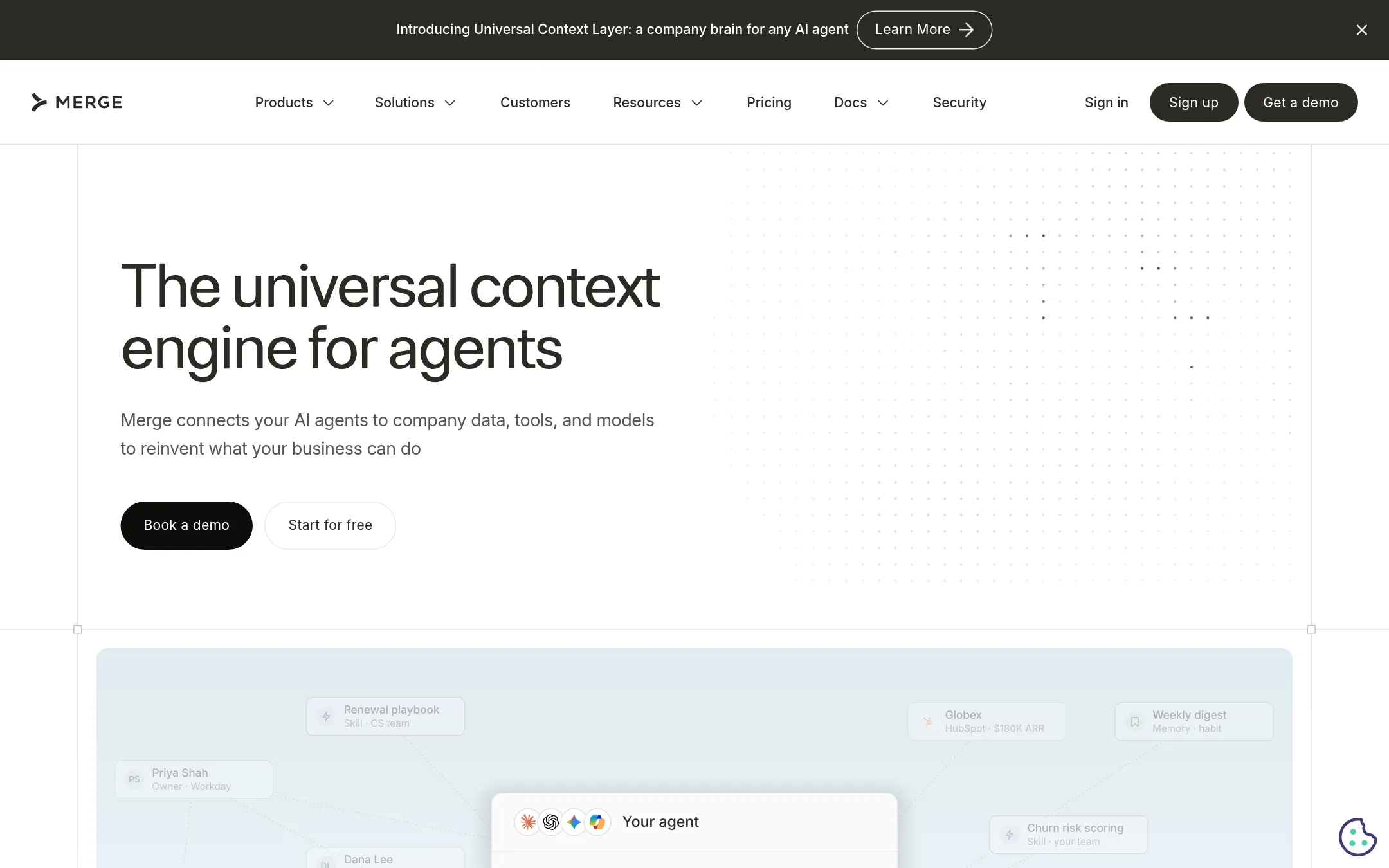
Merge connects products and AI agents to company data and tools through one API, with 5,000+ tools across hundreds of third-party services. Teams choose it over Nango when they want to add a unified integration layer for customer data, or distribute approved tools and models to employees with access controls, DLP, and budget limits. Its pitch leans toward workforce AI governance and customer-facing sync more than raw developer infrastructure.
Where it is strong
- Covers 5,000+ tools across hundreds of services, including identity and access controls for employee AI
- Offers a unified sync API with a React component and managed integration maintenance
- Holds SOC 2 Type II, ISO 27001, HIPAA and GDPR certifications
Where it falls short
- Costs rise per Linked Account beyond the included production accounts, $65 each after 10 on the Launch plan
- Its focus on workforce AI and HRIS-style data sync may not suit developers who want low-level, code-first control like Nango offers
- Pricing:
- Pricing is not published on the site, with plans starting from a free Launch tier of 3 production Linked Accounts, a $650/month plan for up to 10, and custom Enterprise pricing.
- Not published
2.Paragon
Best for: AI and SaaS teams that need customer file and permission data synced into their retrieval pipeline without maintaining every provider API
- Pricing
- Not published
- Category
- Developer Tools
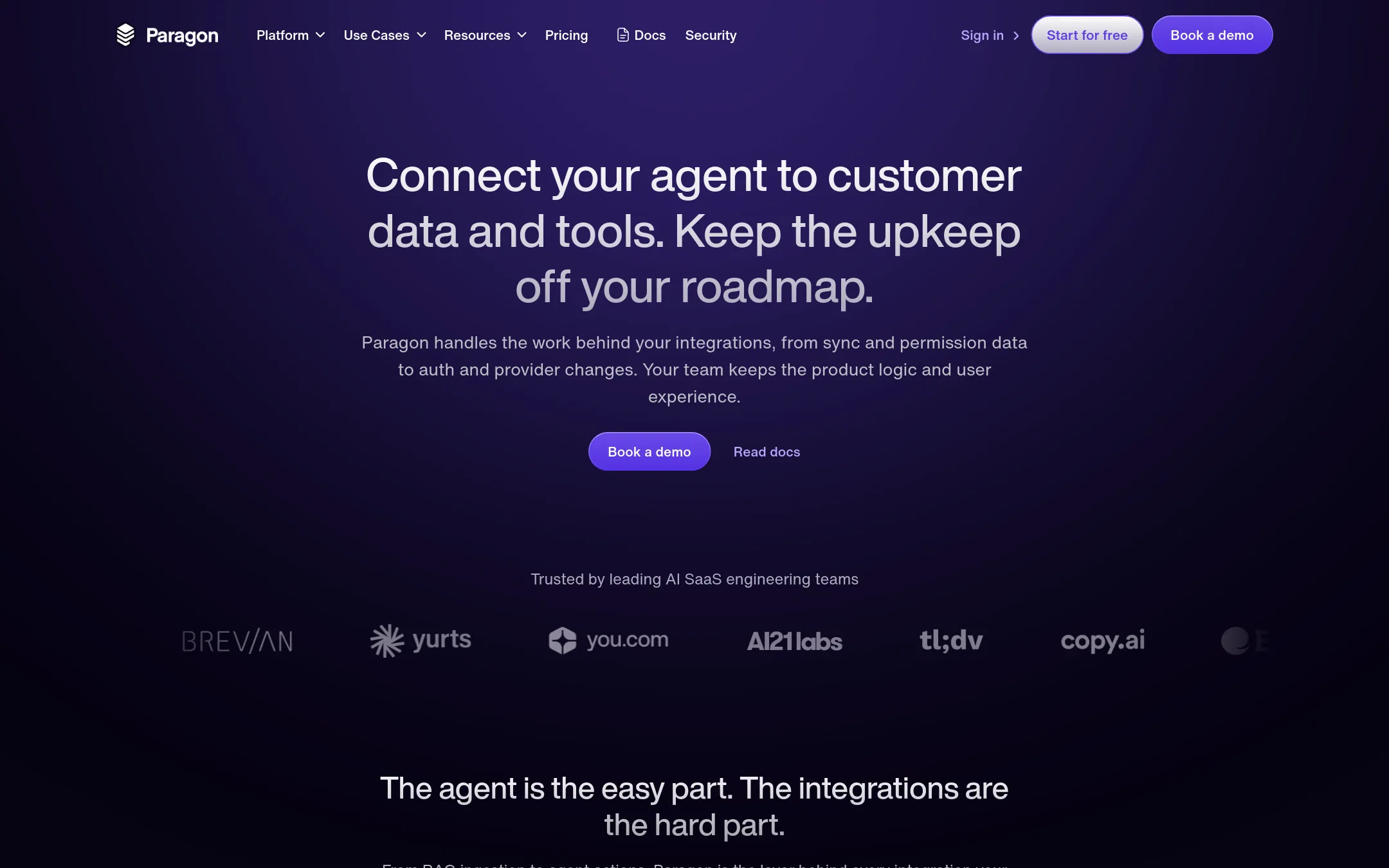
Paragon is an embedded integration platform for SaaS and AI products. It covers managed auth, managed sync for RAG ingestion with permissions, a synchronous action API and MCP server, and workflows for async logic. Teams choose it over Nango when they want a managed sync and permissions layer for customer data, or ready-made action schemas for agents, rather than building each integration in code.
Where it is strong
- Managed Sync pulls customer files and permission data into a RAG pipeline with access checks.
- ActionKit offers one API and MCP server for many synchronous integration actions.
- Workflows let teams write integration logic in TypeScript or a low-code editor.
Where it falls short
- Pricing depends on connected users and a custom quote, so costs are hard to estimate upfront.
- The site lists fewer published numbers and pre-built tools than Nango's 1,200+ APIs and 10,000+ tools.
- Pricing:
- Pricing is not published on the site.
- UFrom $0 / month
3.Unified.to
Best for: B2B SaaS teams that need normalized HR, CRM, accounting or ticketing data from many customer systems through one data model.
- Pricing
- From $0 / month
- Category
- Other
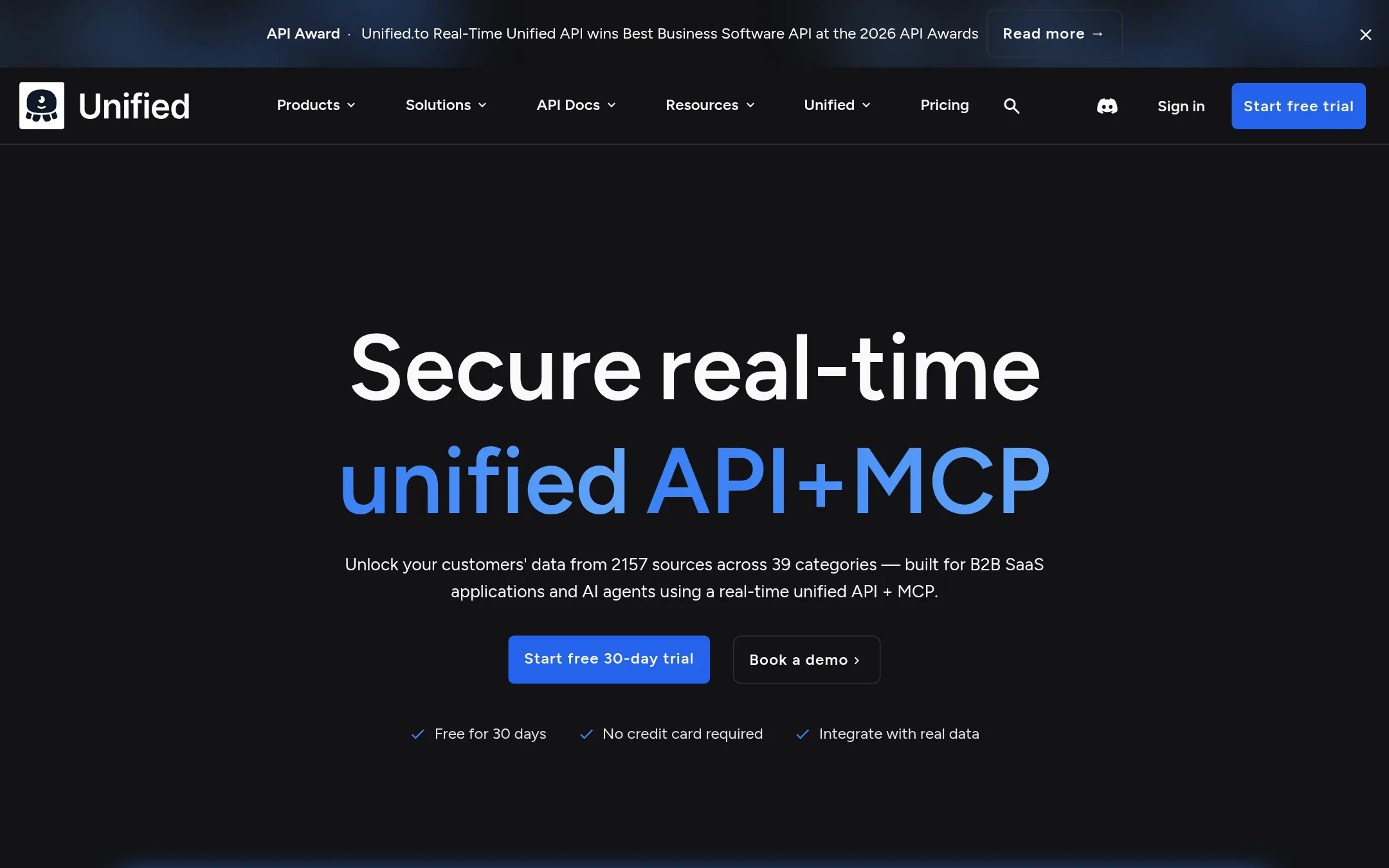
Unified.to is a unified API and MCP platform that gives developers one API and one data model across 2,150+ integrations in 39 categories, including CRM, HR, accounting and ticketing. Every request goes live to the source system and the platform stores no end-customer data. Pick it over Nango when your product needs deeply normalized business data objects across many categories, not just authenticated access to raw APIs.
Where it is strong
- Normalized data models across 39 categories, so one integration works across many CRMs or ATS platforms
- Zero-storage design with US, EU and AU regional hosting
- Free 30-day trial with unlimited connections and no credit card required
Where it falls short
- Usage tiers are based on API call volume, so costs rise steeply as traffic grows
- Enterprise plan pricing is custom and not published, and single-tenant or on-prem options are offered only there
- Pricing:
- Pricing is not published on the site for Enterprise, while the Test plan is $0 per month with 10,000 monthly API calls, Grow starts at $750 per month for 750,000 calls, and Pro starts at $1,500 per month for 2,000,000 calls.
- CFree, $29/mo Pro
4.Composio
Best for: Operations and sales teams that want their existing AI assistant to act across 1,500+ business apps with per-action permissions
- Pricing
- Free, $29/mo Pro
- Category
- Other
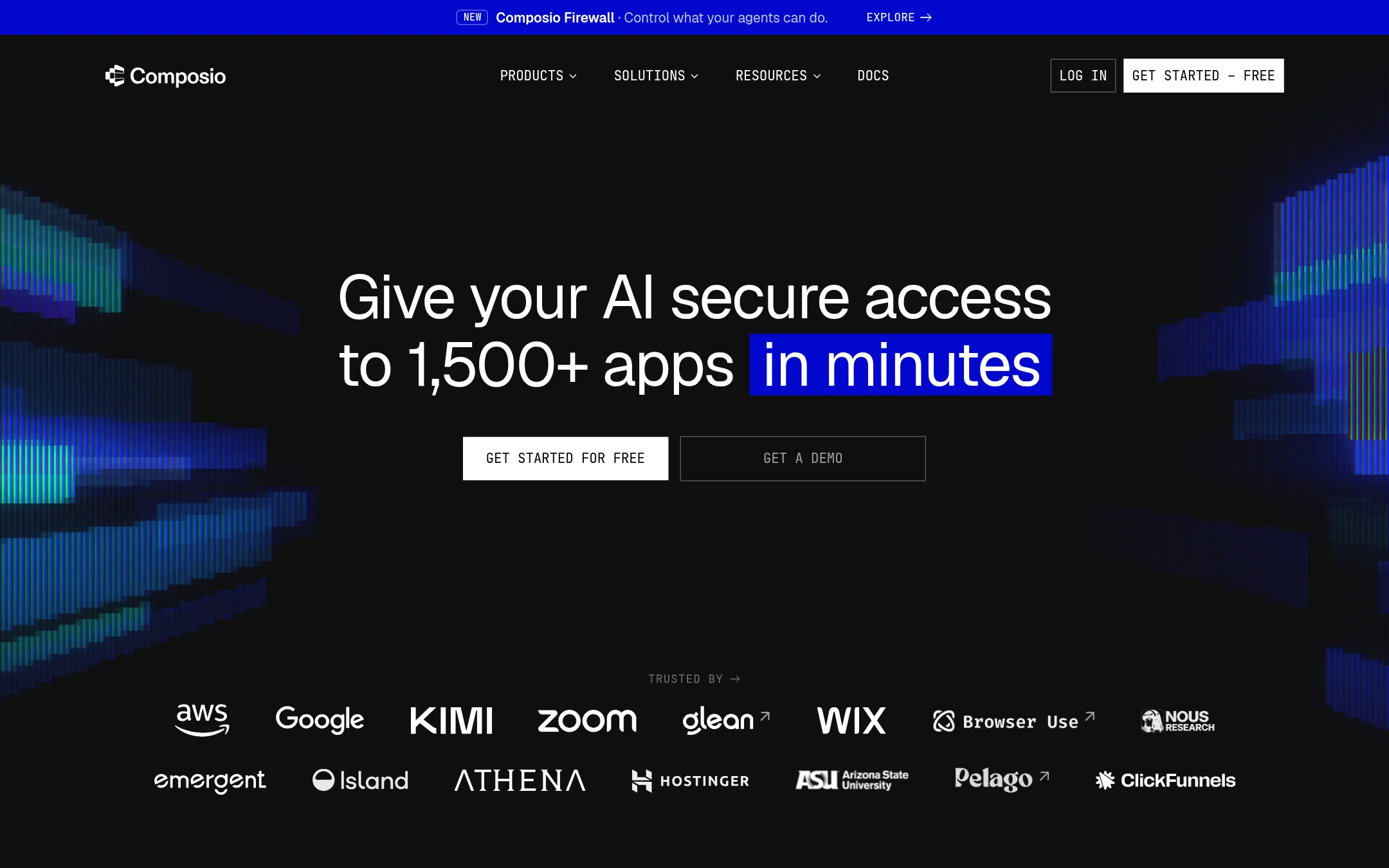
Composio gives an AI assistant secure access to 1,500+ apps, from Claude, ChatGPT, Cursor and similar tools, without the assistant holding passwords. It handles per-user accounts, per-action permissions, prompt injection blocking and an action log. Choose it over Nango when the goal is letting an existing AI assistant act inside business apps, rather than building integrations into your own product.
Where it is strong
- Works inside Claude, ChatGPT, Cursor and other MCP-capable assistants without writing code
- Per-action permissions, approval steps and an action log show exactly what the AI did
- Covers 1,500+ apps, with custom MCP servers added for apps not on the list
Where it falls short
- Aimed at AI assistants rather than embedded product integrations, so it fits less well if you are building integrations into your own app
- Some tools run on paid third-party services billed per call, separate from the plan
- Pricing:
- The Hobby plan is free with 100,000 tool calls, 50,000 triggers and 3 team members each month, the Pro plan is $29 in monthly credits, and Enterprise is custom.
- ANot published
5.Arcade
Best for: Marketing teams that need on-brand, editable AI videos without hiring an agency for each one
- Pricing
- Not published
- Category
- Other
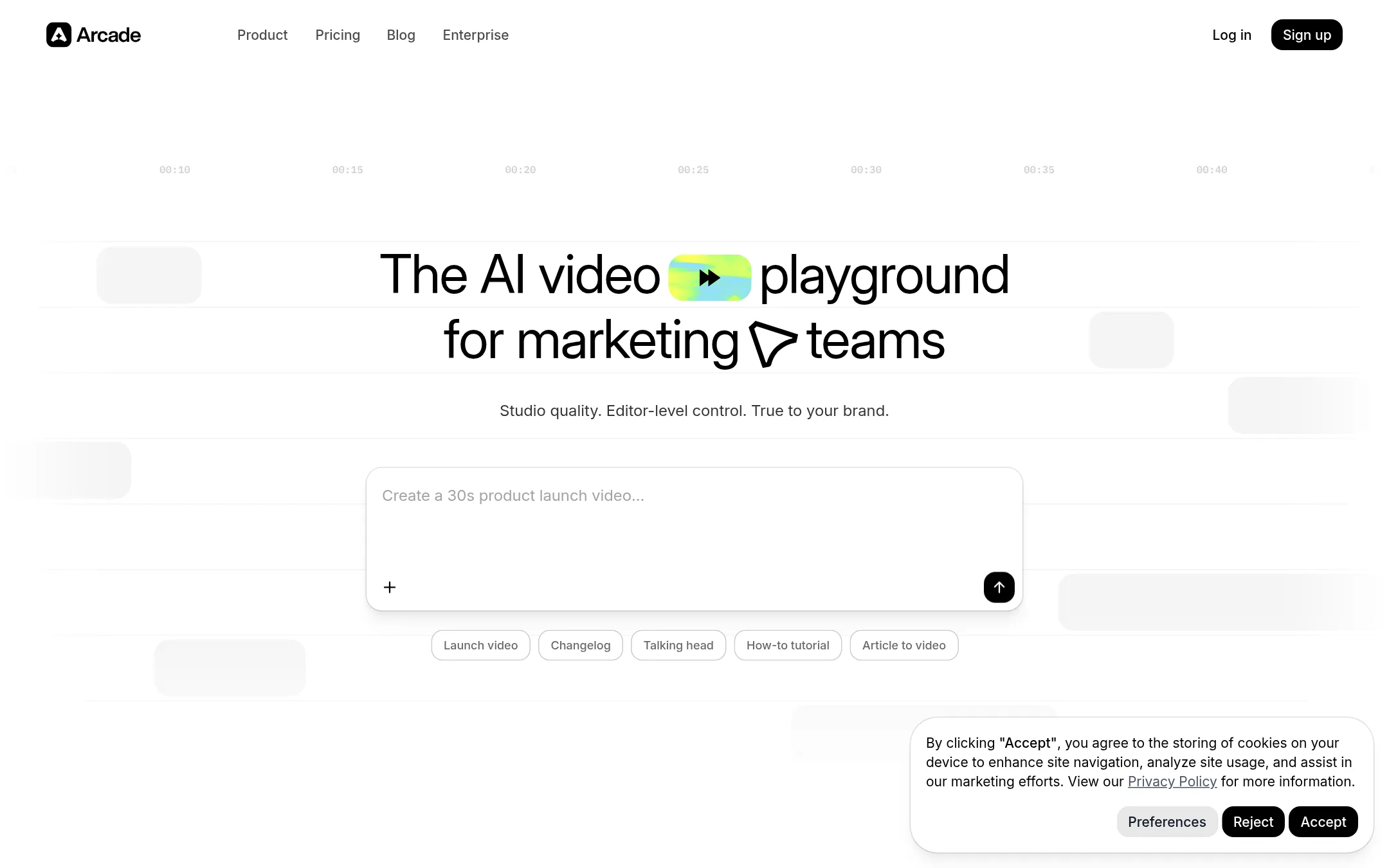
Arcade is an AI video generator for marketing teams. It makes short videos from a text description or a reference video, and the output stays editable and on-brand, unlike many generative video tools. Pick Arcade over Nango when the job is producing marketing video rather than connecting your product to third-party APIs.
Where it is strong
- Output stays editable, so teams can change it by hand after generation.
- Lets you pick between three AI models, trading off quality against credit cost.
- Changes you make yourself, like trimming or swapping an image, cost no credits.
Where it falls short
- Credits are shared across the whole workspace, so one heavy user can use up the balance for everyone.
- Credits do not roll over on monthly plans, and you cannot buy extra credit packs.
- Pricing:
- Pricing is not published on the site.
- Not published
6.Pipedream
Best for: Startups building AI agents that need many prebuilt actions and triggers across common SaaS apps without writing custom integrations
- Pricing
- Not published
- Category
- Developer Tools
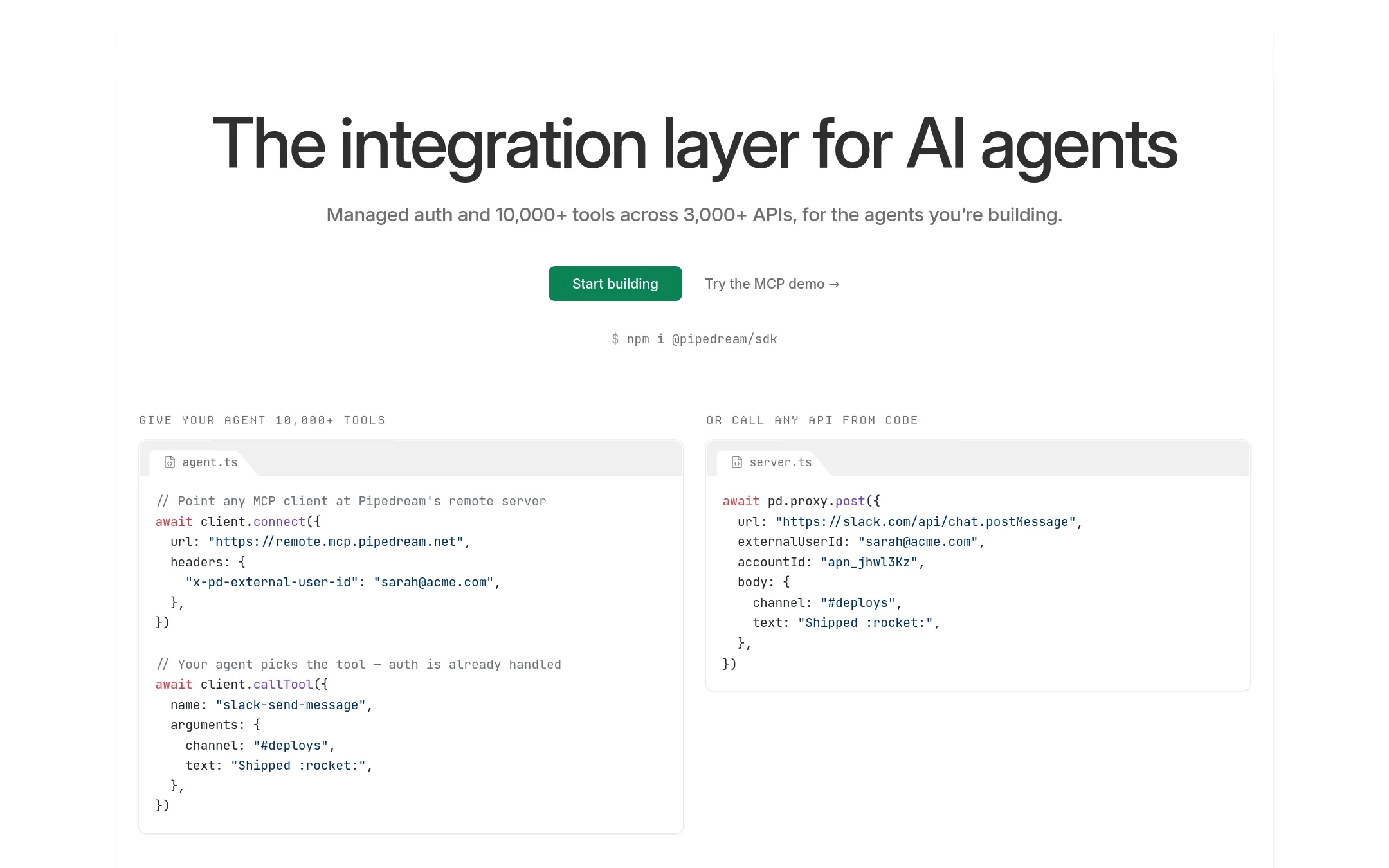
Pipedream is an integration layer for AI agents, offering managed auth for over 3,000 APIs and more than 10,000 prebuilt tools and triggers, plus an MCP server and a raw API proxy. Teams would pick it over Nango when they want a large prebuilt tool catalog exposed to agents through one MCP endpoint, or when they need a free development tier with no credit card required before moving to production.
Where it is strong
- Managed auth for 3,000+ APIs with token refresh handled for each user
- 10,000+ prebuilt tools and triggers, reachable through a single MCP endpoint
- Free development access to the full API, SDK and MCP before paying for production
Where it falls short
- Production use for external users requires the Startup plan, which is priced per user and per usage credit
- Advanced security features such as SSO, SCIM and HIPAA sit behind the custom Business plan
- Pricing:
- Pricing is not published on the site.
- Custom quote
7.hotglue
Best for: SaaS product teams that need to read customer data from many third-party tools into their own warehouse
- Pricing
- Custom quote
- Category
- Developer Tools
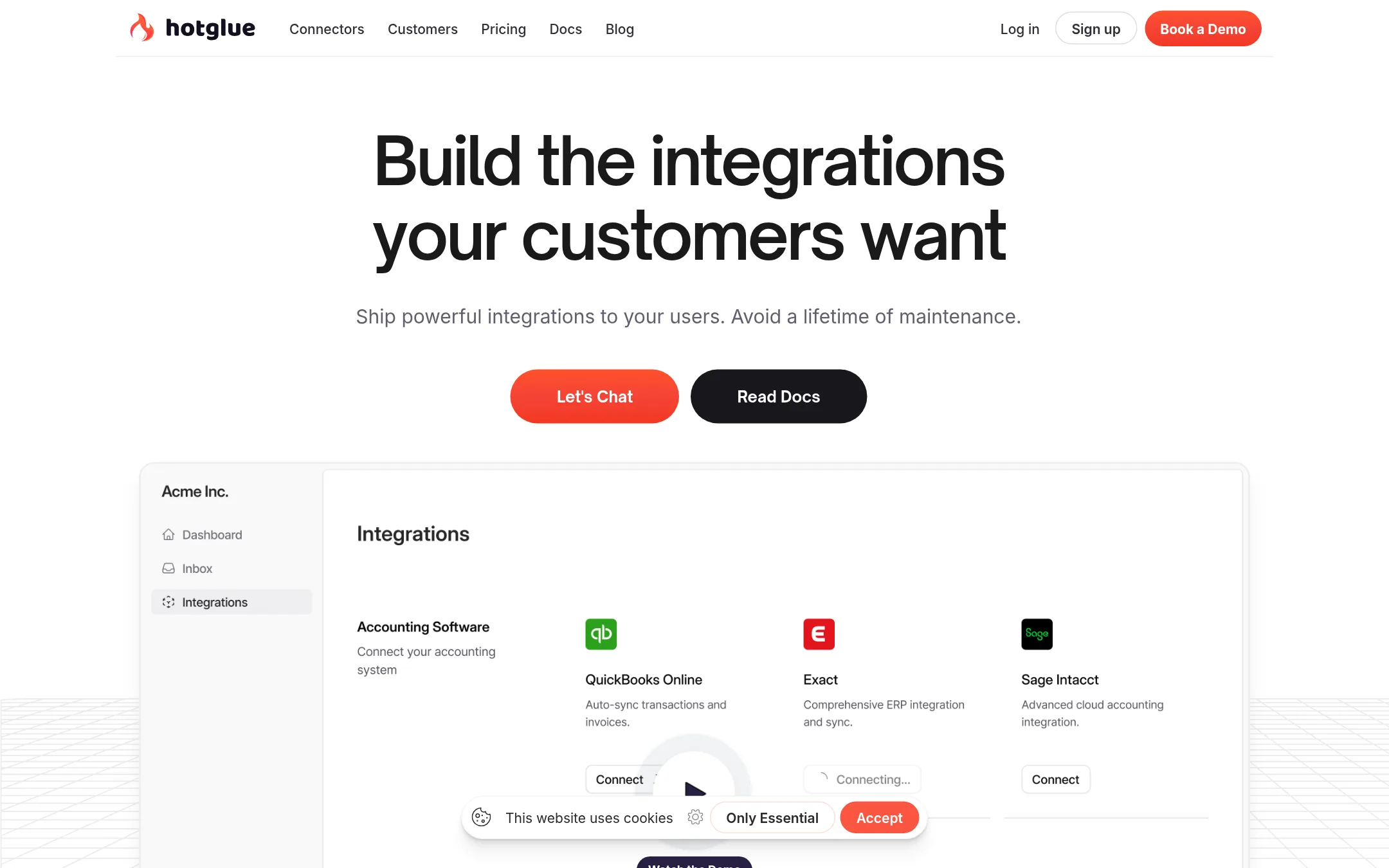
hotglue is an embedded integration platform that lets a SaaS product ship native, user-facing connectors to its customers' tools and move that data into the customer's warehouse. Teams choose it over Nango when the main job is bulk data pipelines into a warehouse, with over 600 open-source Singer and Airbyte connectors and a no-code connector builder. Its white-label widget and magic link handle the customer connection flow.
Where it is strong
- Over 600 open-source connectors, including Singer and Airbyte specs, available out of the box
- Pricing is based on tenants rather than data volume, so bills do not spike with data growth
- Open-source connectors can be forked or extended, and there is a Python SDK and no-code builder for custom ones
Where it falls short
- The site describes its focus as data movement into a warehouse, so it is less oriented toward AI agent tool use than Nango
- Some features such as the static IP, observability integrations and extended data retention sit in higher tiers
- Pricing:
- Pricing is based on active tenants, meaning customers with at least one sync in the last month, with Basic, Pro and Enterprise tiers and custom quotes for active tenants.
See more comparisons in Developer Tools alternatives.
FAQ
Questions about Nango alternatives
Which Nango alternative has the largest prebuilt tool catalog?
Pipedream lists more than 10,000 prebuilt tools and triggers and managed auth for over 3,000 APIs, reachable through a single MCP endpoint. Nango lists over 1,200 APIs and more than 10,000 tools, so the two are close in catalog size. Pipedream is the stronger fit when agents need many ready-made actions exposed through one endpoint.
Is there a free way to try a Nango alternative before paying?
Pipedream offers free development access to its full API, SDK and MCP before you pay for production. Unified.to has a free 30-day trial with unlimited connections and no credit card required. Nango itself has a free tier with hard-capped monthly limits and a $50 monthly pay-as-you-go plan.
Which alternative is best for syncing customer files and permissions into an AI retrieval pipeline?
Paragon is the strongest fit for this job. Its Managed Sync pulls customer files and permission data into a RAG pipeline with access checks, and its ActionKit offers one API and MCP server for synchronous actions. Its pricing depends on connected users and a custom quote, so costs are harder to estimate upfront.
Which alternative should I choose if I need normalized business data across many systems?
Unified.to is built for this. It offers one API and one data model across 2,150+ integrations in 39 categories, including CRM, HR, accounting and ticketing, and it stores no end-customer data. Its usage tiers are based on API call volume, so costs rise as traffic grows.
Which alternative is aimed at AI assistants rather than product integrations?
Composio is aimed at letting existing AI assistants such as Claude, ChatGPT and Cursor act across more than 1,500 apps without holding passwords. It provides per-action permissions, approval steps and an action log. It fits less well if you are building integrations into your own product, which is Nango's core use.
Last updated November 9, 2026.