
Okteto alternatives
8 products compared · Updated November 3, 2026
The short answer
For teams choosing between Okteto and alternatives, Gitpod (now Ona) suits those wanting a managed platform for AI agents that write and test code. Coder fits enterprises needing self-hosted, governed environments for agents and developers. DevPod is best for teams wanting a lightweight, open-source, client-only tool without a central platform. Each addresses different priorities: managed agents, security and compliance, or simplicity and no lock-in.
Your shortlist, at a glance
Read the comparisons ↓- GGitpodNot publishedTeams that want to delegate software tasks to cloud-based AI agents and occasionally jump in to review or pair program.
- CCoderNot publishedEnterprises that need self-hosted, governed environments for AI agents and developers, especially in regulated industries.
- DDevPodNot publishedTeams that want a lightweight, self-hosted dev environment tool without a central platform or per-user pricing.
 GitHub ProjectsFrom $4/user/moTeams already on GitHub that want simple issue tracking and project boards without leaving their code repository
- EE2BFrom $150/mo + usageTeams building AI agents that need secure, isolated runtime environments for coding, computer use, or reinforcement learning, especially with BYOC requirements.
- DDaytonaFrom $0.0504/vCPU/hTeams that need to run AI-generated code in isolated, pay-as-you-go sandboxes with GPU support
 SignadotSee websiteShift Left Testing for Microservices
 ReleaseSee websiteEnvironments as a service
About Okteto and its alternatives
Okteto is a cloud development environment platform that gives coding agents production-like, isolated environments on your own infrastructure. It is known for letting agents build, test, and verify changes against real services, with features like preview environments and flexible isolation, and is priced per user with unlimited environments.
When comparing alternatives, weigh pricing structure (per user vs. usage-based), deployment model (self-hosted vs. managed), and whether the tool supports full development environments or just agent sandboxes. Also consider integrations with your existing stack, governance and security features, and contract terms like free tiers or custom quotes.
Explore the alternatives
- GNot published
1.Gitpod
Best for: Teams that want to delegate software tasks to cloud-based AI agents and occasionally jump in to review or pair program.
- Pricing
- Not published
- Category
- Other
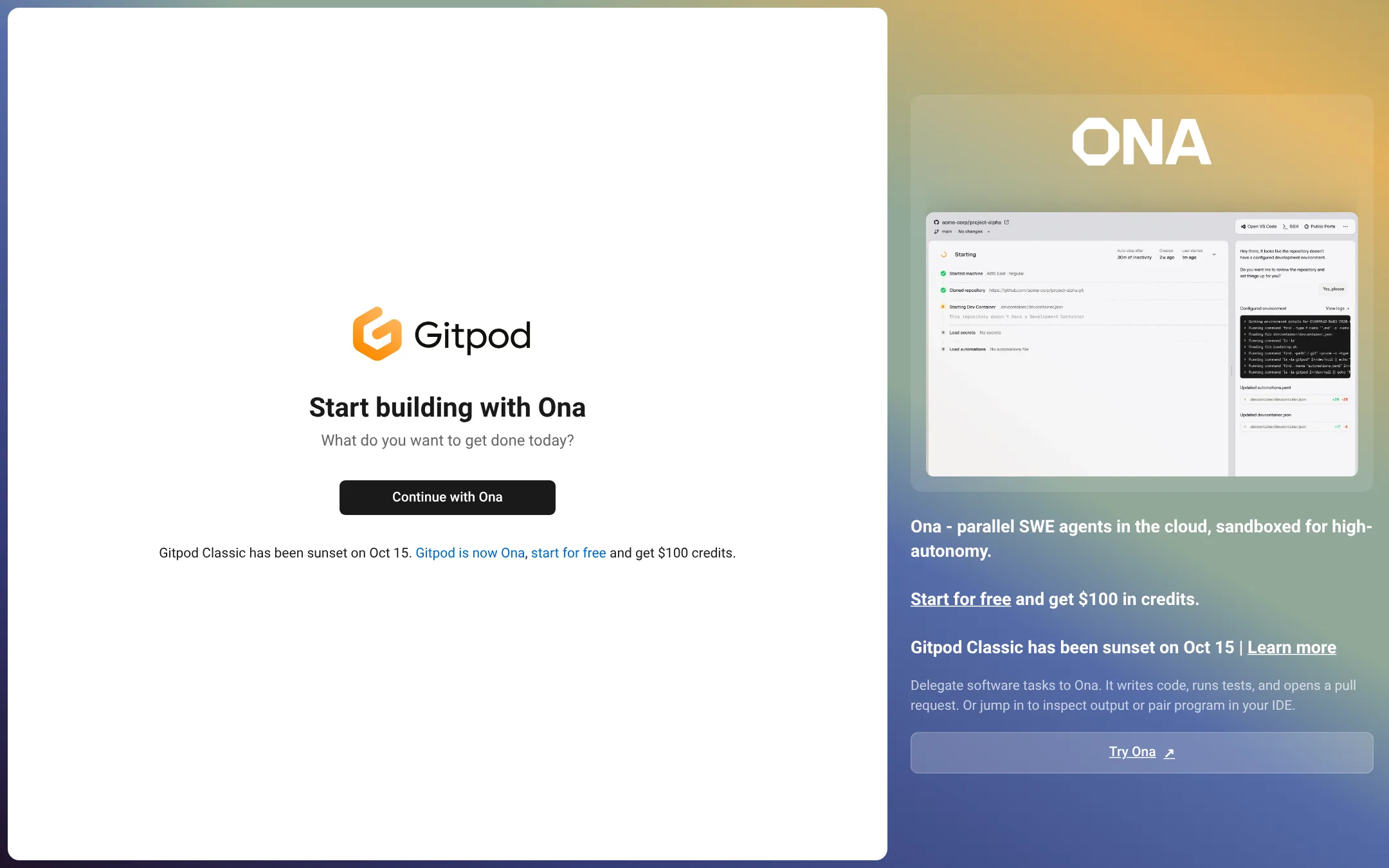
Gitpod has been rebranded as Ona, a cloud platform for parallel software engineering agents. It writes code, runs tests, and opens pull requests, with optional human inspection or pair programming. Choose Gitpod/Ona if you want a managed agent platform rather than running environments on your own infrastructure like Okteto.
Where it is strong
- Parallel SWE agents in the cloud, sandboxed for high autonomy
- Agents open pull requests directly, reducing manual handoff
- You can inspect output or pair program in your IDE when needed
Where it falls short
- Gitpod Classic has been sunset. Only the new Ona product is available
- No published pricing or self-hosting details on the site
- Pricing:
- Pricing is not published on the site.
- CNot published
2.Coder
Best for: Enterprises that need self-hosted, governed environments for AI agents and developers, especially in regulated industries.
- Pricing
- Not published
- Category
- Other
Coder is a self-hosted platform for running AI coding agents and development workspaces on your own infrastructure, with governance and audit controls. Choose it over Okteto if you need strict security and compliance for agent usage, or if you want to run agents with any model while keeping all data on-prem.
Where it is strong
- Self-hosted on your own infrastructure, with no vendor SaaS for AI workflows
- Supports any AI model (Anthropic, OpenAI, Azure, AWS Bedrock) and third-party agents like Claude Code and Codex
- Includes audit logging, RBAC, quotas, and network-isolated agent workspaces for governance
Where it falls short
- Paid tiers require contacting sales. No transparent pricing
- Community plan limits active agents to 5 and only one platform integration
- Pricing:
- Pricing is not published on the site. Plans are Community (free, open source), Premium, and AI Premium, with custom quotes for paid tiers.
- Switching from Okteto:
- Moving from Okteto means redefining your environments as Coder templates and reconfiguring agent access, but your Kubernetes infrastructure can be reused.
- DNot published
3.DevPod
Best for: Teams that want a lightweight, self-hosted dev environment tool without a central platform or per-user pricing.
- Pricing
- Not published
- Category
- Other
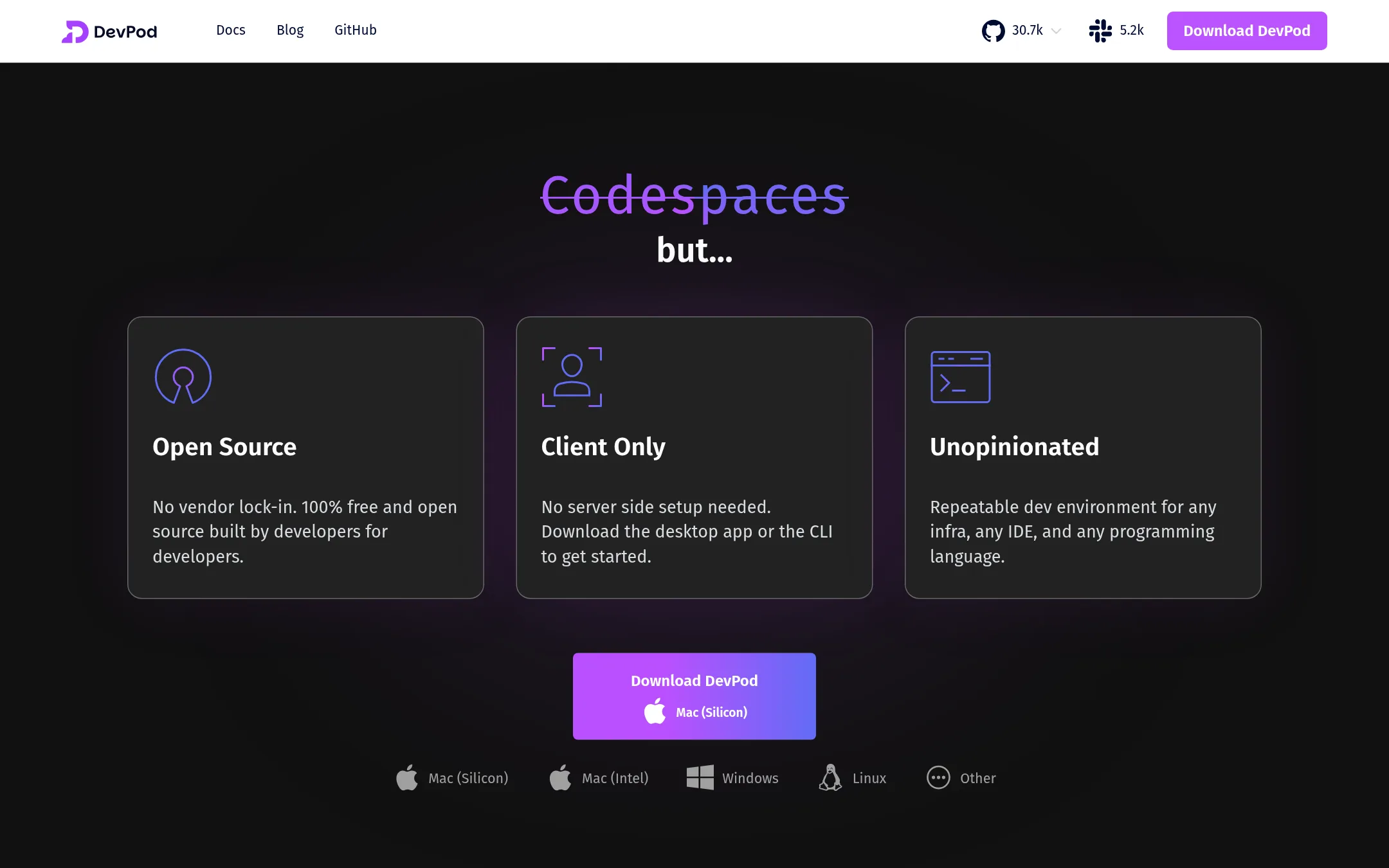
DevPod is an open-source, client-only tool that creates dev environments from devcontainer.json files. Choose it over Okteto if you want no server-side setup, no vendor lock-in, and the freedom to run environments on any infrastructure, from your laptop to a Kubernetes cluster.
Where it is strong
- Open source and free, no vendor lock-in
- Client-only, no server setup needed
- Works with any infrastructure and IDE
Where it falls short
- No built-in preview environments or agent orchestration
- Lacks centralized governance and access control for teams
- Pricing:
- Pricing is not published on the site.
- Switching from Okteto:
- Moving from Okteto means giving up the managed, production-like environments and per-user pricing. You'd manage your own infrastructure and rely on devcontainer.json for environment definitions.
- From $4/user/mo
4.GitHub Projects
Best for: Teams already on GitHub that want simple issue tracking and project boards without leaving their code repository
- Pricing
- From $4/user/mo
- Category
- Productivity & Project Management
GitHub Projects is a lightweight project management tool built into GitHub, letting teams plan and track work next to their code. Choose it over Okteto when your main need is issue tracking and task organization, not cloud development environments.
Where it is strong
- Native integration with GitHub repos and pull requests
- Free tier for individuals and small teams
- AI-powered features like Copilot included in Enterprise
Where it falls short
- No cloud development environments or production-like testing
- Limited to GitHub ecosystem. Not for non-GitHub workflows
- Pricing:
- Free for individuals, Team at $4 per user per month, Enterprise at $21 per user per month.
- EFrom $150/mo + usage
5.E2B
Best for: Teams building AI agents that need secure, isolated runtime environments for coding, computer use, or reinforcement learning, especially with BYOC requirements.

- Pricing
- From $150/mo + usage
- Category
- Other
E2B gives each AI agent its own isolated microVM for running code, browsing, and using tools, with pause and fork capabilities. Choose it over Okteto when your priority is sandboxing agent workloads rather than providing full production-like development environments for human developers.
Where it is strong
- MicroVM isolation per agent session, safe for untrusted workloads
- Runs in your AWS, GCP, or Azure account via BYOC
- Pause, resume, snapshot, and fork sandboxes for flexible lifecycle
Where it falls short
- Usage-based pricing can be unpredictable for heavy workloads
- Focuses on agent sandboxes, not full development environments with previews
- Pricing:
- Free Hobby tier with $100 credits. Pro at $150/month plus usage costs billed by the second. Enterprise starts at $2,000/month commit with 500 concurrent sandboxes.
- Switching from Okteto:
- Moving from Okteto means reworking your environment setup from Kubernetes-based dev environments to E2B's microVM sandboxes, which are agent-centric rather than developer-centric.
- DFrom $0.0504/vCPU/h
6.Daytona
Best for: Teams that need to run AI-generated code in isolated, pay-as-you-go sandboxes with GPU support
- Pricing
- From $0.0504/vCPU/h
- Category
- Other
Daytona provides secure, elastic infrastructure for running AI-generated code in isolated sandboxes. You would choose it over Okteto when your focus is on executing untrusted AI code safely with per-second billing, rather than managing full development environments for agents.
Where it is strong
- Millisecond sandbox spin-up and shutdown
- Per-second billing with $200 free compute
- GPU options from RTX 4090 to B300
Where it falls short
- No built-in preview environments or full-stack dev environment orchestration
- Pricing is usage-based, which may be unpredictable for steady-state workloads
- Pricing:
- Compute is $0.0504 per vCPU per hour, memory is $0.0162 per GiB per hour, and storage is $0.000108 per GiB per hour after the first 5 free. GPU instances range from $0.57/hour for an RTX 4090 to $6.25/hour for a B300 on-demand.
- See website
7.Signadot
Developer Tools
Shift Left Testing for Microservices
- See website
8.Release
Developer Tools
Environments as a service
See more comparisons in Developer Tools alternatives.
FAQ
Questions about Okteto alternatives
What is the main difference between Okteto and Gitpod (Ona)?
Okteto runs environments on your own infrastructure, giving you control and governance. Gitpod, rebranded as Ona, is a managed cloud platform for AI agents that write code and open pull requests, with optional human review. Choose Okteto for self-hosted control, or Ona for a managed agent platform.
Which alternative is best for enterprises with strict security requirements?
Coder is the strongest fit for enterprises needing self-hosted, governed environments. It runs on your infrastructure, supports any AI model, and includes audit logging, RBAC, and network-isolated workspaces. Paid tiers require contacting sales, but the Community plan is free with limits.
Are there free or open-source alternatives to Okteto?
Yes, DevPod is open source and free, with no vendor lock-in and no server setup. It creates dev environments from devcontainer.json files and works on any infrastructure. However, it lacks preview environments and centralized governance, so it suits smaller teams or individual developers.
How do pricing models compare among these alternatives?
Okteto is priced per user with unlimited environments. E2B and Daytona use usage-based pricing, billing by the second or per hour, which can be unpredictable. GitHub Projects has a free tier and per-user pricing, while Gitpod and Coder do not publish pricing and require contacting sales.
Can these alternatives handle AI coding agents like Okteto does?
Yes, several are built for AI agents. Gitpod (Ona) runs parallel agents that open pull requests. Coder supports agents like Claude Code and Codex with governance. E2B and Daytona provide isolated sandboxes for running AI-generated code, but they focus on execution, not full development environments with previews.
Last updated November 3, 2026.