
OptaPlanner alternatives
10 products compared · Updated November 3, 2026
The short answer
For production scheduling and routing, Timefold is the strongest alternative because it offers a managed API built on OptaPlanner's technology. For guaranteed optimal solutions in complex optimization, Gurobi Optimizer is the best choice for enterprises. For a free, code-first solver, Google OR-Tools suits engineering teams that want to embed optimization directly.
Your shortlist, at a glance
Read the comparisons ↓- RRecordBookNot publishedSmall and medium businesses that want a lightweight, mobile-friendly tool to manage records and basic workflows without a dedicated planning system.
- TTimefoldNot publishedTeams that need scheduling and routing APIs without solver expertise, especially in field service, workforce management, and logistics.
- CChoco SolverNot publishedJava developers who want a minimal constraint programming library and are comfortable building custom solution logic.
- MMiniZincNot publishedResearch teams and developers who want a solver-agnostic constraint modeling language for discrete optimization problems.
- GGecodeNot publishedC++ teams building custom constraint-solving applications that need a high-performance, MIT-licensed solver they can embed directly.
 NextmvFrom $0.0027/creditOperations research teams that need to deploy and monitor multiple optimization models in production with CI/CD and shadow testing.
 AIMMSNot publishedEnterprise supply chain teams in process industries, retail, and manufacturing that need network design, capacity planning, and scenario modeling with vendor support.
 Google OR-ToolsNot publishedEngineering teams that want a pure Java or Python optimization library for vehicle routing, job scheduling, or bin packing without the full KIE business automation stack.
 Gurobi OptimizerCustom quoteEnterprises with complex optimization problems like supply chain, scheduling, or network design that need guaranteed optimal solutions and high-performance computing.
 IBM watsonxNot publishedLarge enterprises that need governed AI agents and assistants across hybrid cloud environments, not for solving planning or scheduling optimization problems.
About OptaPlanner and its alternatives
OptaPlanner is an open-source constraint-solving engine for planning and scheduling problems, such as employee shifts, vehicle routes, and task assignments. It is part of the Apache KIE suite, which also includes Drools, jBPM, and Kogito, and is known for its Java-based domain-specific language and heuristic algorithms.
When comparing alternatives, weigh the pricing structure, whether it is open-source or commercial, and how it fits your tech stack. Consider the regions and integrations supported, the level of vendor support, and the contract terms, such as free tiers or custom quotes. Also evaluate whether you need a managed service or are comfortable hosting and maintaining the solver yourself.
Explore the alternatives
- RNot published
1.RecordBook
Best for: Small and medium businesses that want a lightweight, mobile-friendly tool to manage records and basic workflows without a dedicated planning system.
- Pricing
- Not published
- Category
- Productivity & Project Management
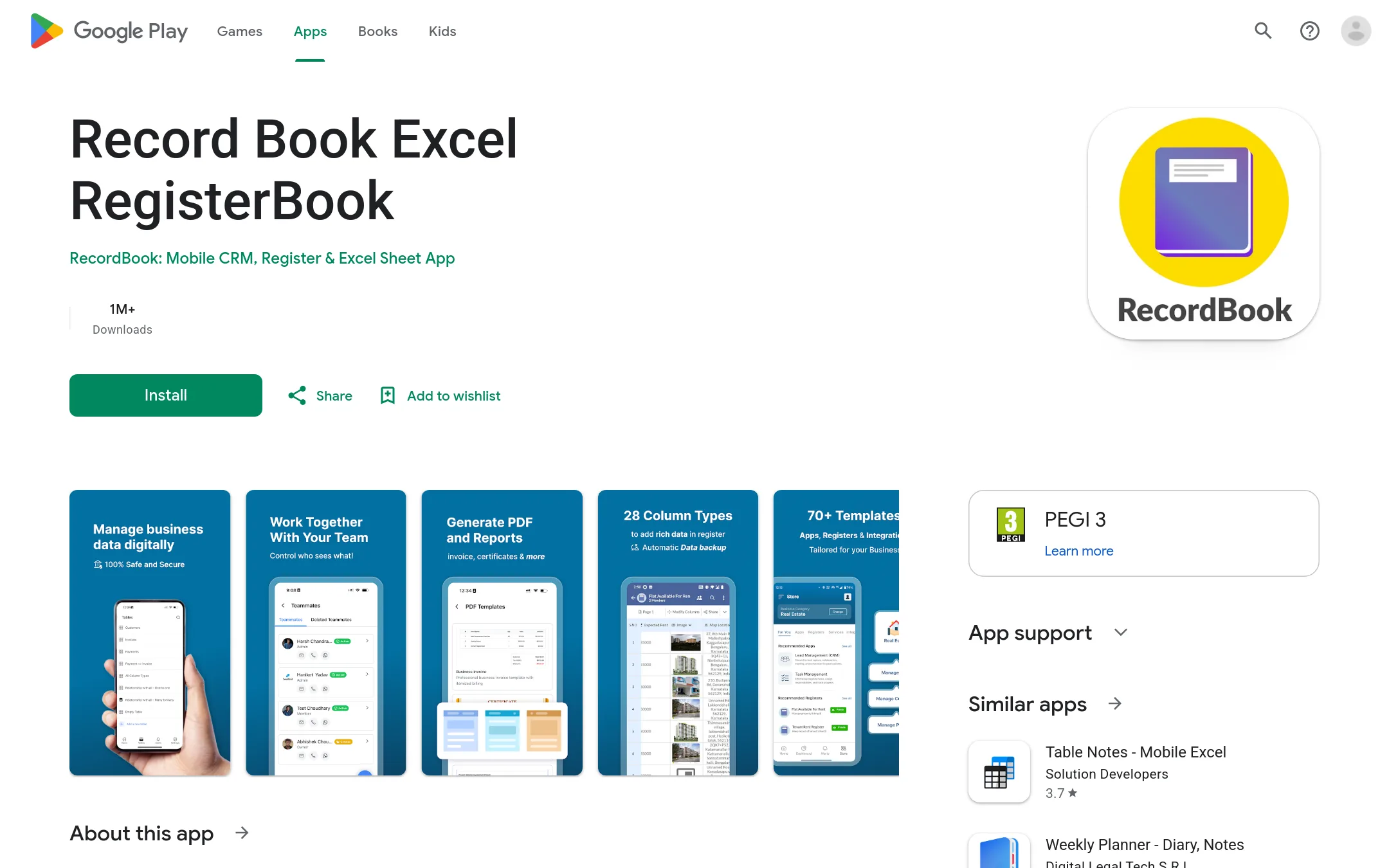
RecordBook is a mobile-first database app for small businesses, positioned as an Airtable alternative. You would choose it over OptaPlanner if you need a simple way to organize records and workflows on a phone, not a constraint-solving engine for complex planning.
Where it is strong
- Mobile-first design, accessible on Android devices.
- Simple database functionality, easy for non-technical users.
- Free to download from the Google Play Store.
Where it falls short
- No desktop or web version mentioned, limiting use to mobile.
- Lacks the advanced optimization and constraint-solving features of OptaPlanner.
- Pricing:
- Pricing is not published on the site.
- TNot published
2.Timefold
Best for: Teams that need scheduling and routing APIs without solver expertise, especially in field service, workforce management, and logistics.

- Pricing
- Not published
- Category
- Other
Timefold is a managed scheduling and routing API built on the same constraint-solving technology as OptaPlanner. You would choose it over OptaPlanner if you want to avoid building and maintaining a solver yourself and prefer a REST API that fits into your existing stack. It handles field service routing, employee shift scheduling, pickup and delivery, and task scheduling at production scale.
Where it is strong
- Stateless REST API over JSON, works with any stack
- Handles 100,000s of shifts and 10,000s of jobs in a single run
- SOC 2, ISO 27001:2022, and GDPR compliant
Where it falls short
- Managed cloud only, no self-hosting option mentioned
- Pricing not transparent, requires contacting sales
- Pricing:
- Pricing is not published on the site. The page mentions an open-source Apache 2.0 engine that is free forever, but no specific numbers are given.
- Switching from OptaPlanner:
- Moving from OptaPlanner to Timefold is straightforward because Timefold is built on the same open-source engine, so your existing constraint models can be adapted to the API.
- CNot published
3.Choco Solver
Best for: Java developers who want a minimal constraint programming library and are comfortable building custom solution logic.
- Pricing
- Not published
- Category
- Other
Choco Solver is an open-source Java library for constraint programming. You model a problem by declaring constraints, and it solves it with filtering and search. Choose it over OptaPlanner when you need a lightweight, BSD-licensed solver and prefer to write your own search logic rather than use OptaPlanner's optimization heuristics.
Where it is strong
- BSD license, free to use and modify
- Declarative modeling with constraints
- Active GitHub community with pull request workflow
Where it falls short
- No built-in optimization heuristics like OptaPlanner's
- Documentation is tutorial-based, not a full reference
- Pricing:
- Pricing is not published on the site.
- Switching from OptaPlanner:
- Moving from OptaPlanner means rewriting your model as a constraint satisfaction problem and implementing your own search strategy, since Choco Solver does not provide OptaPlanner's score-based optimization out of the box.
- MNot published
4.MiniZinc
Best for: Research teams and developers who want a solver-agnostic constraint modeling language for discrete optimization problems.
- Pricing
- Not published
- Category
- Other
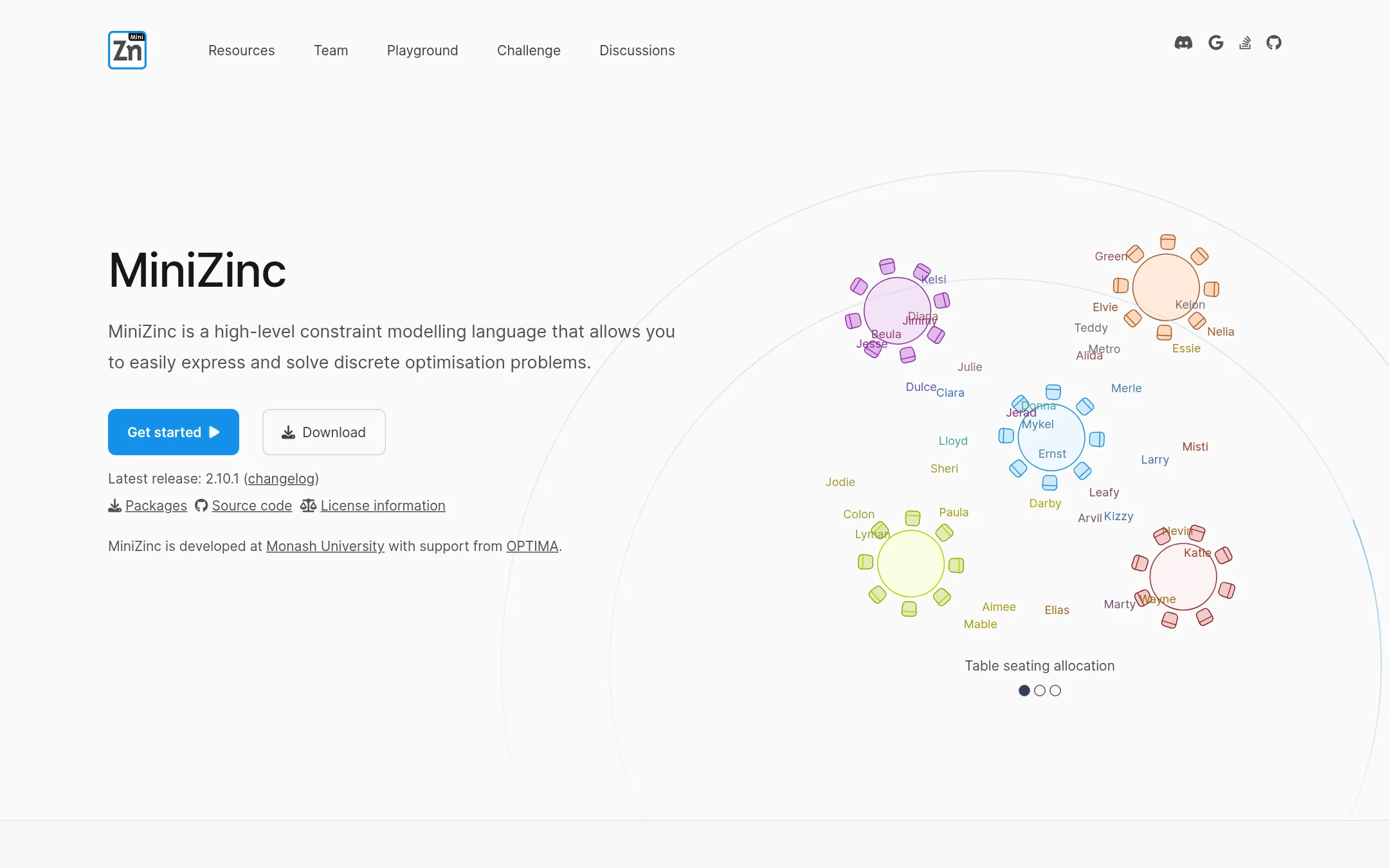
MiniZinc is a free, open-source constraint modeling language for expressing and solving discrete optimization problems. You would choose it over OptaPlanner if you prefer writing high-level logical models and want to run the same model across different solver backends without being locked in. It suits teams that value a solver-independent approach and are comfortable with a modeling language rather than a Java-based planning engine.
Where it is strong
- Free and open-source with a permissive license
- Solver-independent, so you can switch backends without rewriting models
- Includes a full IDE with visualization and profiling tools
Where it falls short
- No built-in planning algorithms like OptaPlanner's. You model constraints yourself
- Requires learning a dedicated modeling language rather than using a familiar programming language
- Pricing:
- Pricing is not published on the site.
- GNot published
5.Gecode
Best for: C++ teams building custom constraint-solving applications that need a high-performance, MIT-licensed solver they can embed directly.
- Pricing
- Not published
- Category
- Other
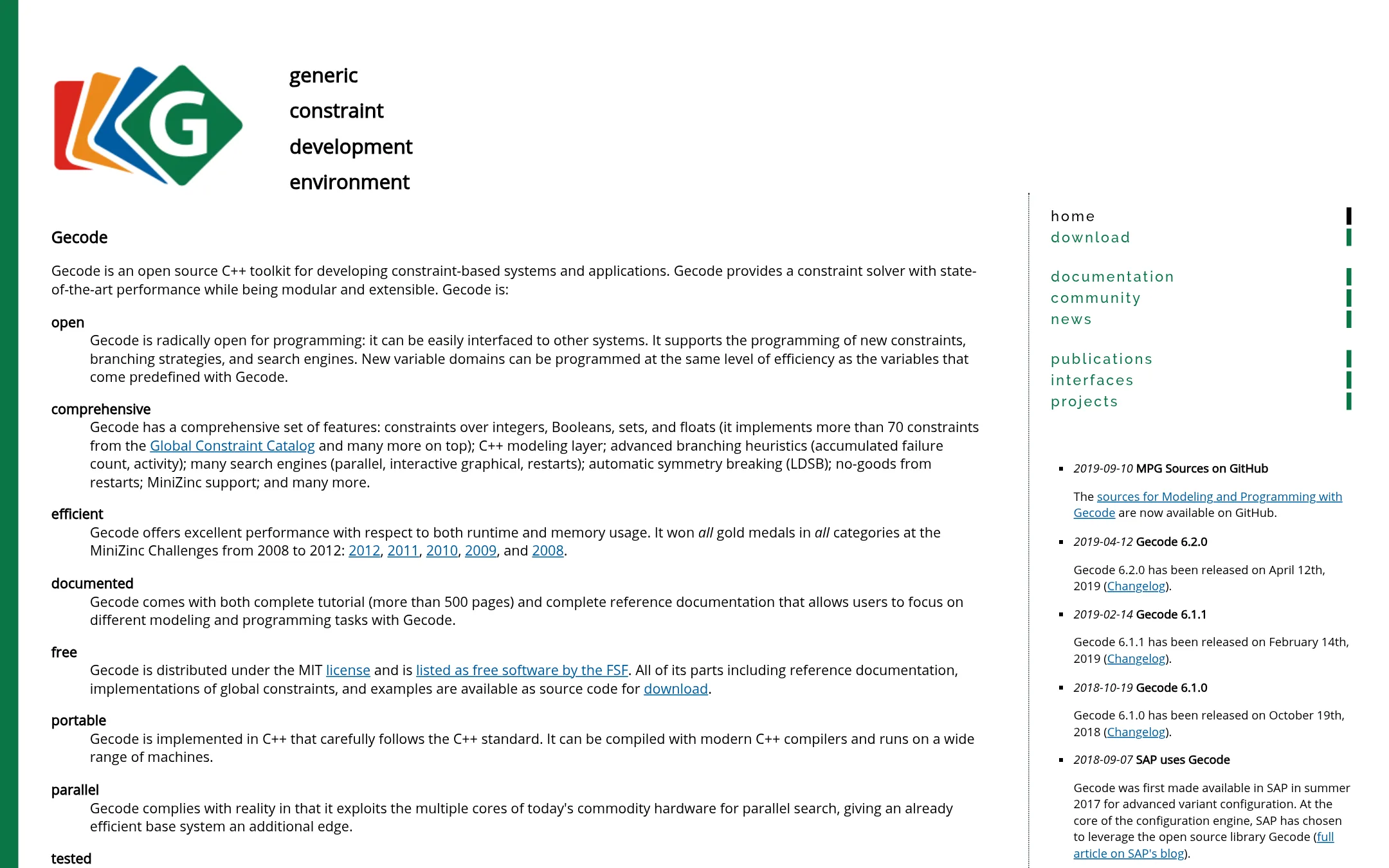
Gecode is an open source C++ toolkit for building constraint-based systems. It gives you a fast, modular constraint solver with support for integers, Booleans, sets, and floats, plus parallel search and symmetry breaking. Choose it over OptaPlanner if you need a lightweight, embeddable solver in a C++ codebase and want to control the modeling layer yourself, rather than working inside a Java-based planning engine with its own domain model and score system.
Where it is strong
- MIT license, free for commercial use
- Won all gold medals at MiniZinc Challenges 2008-2012
- Supports parallel search and automatic symmetry breaking
Where it falls short
- C++ only, no Java or cloud integration
- No built-in planning domain model or score system like OptaPlanner
- Pricing:
- Pricing is not published on the site.
- Switching from OptaPlanner:
- Moving from OptaPlanner means rewriting your planning model in C++ and reimplementing any domain-specific scoring or constraints yourself, since Gecode provides only the generic constraint solver.
- From $0.0027/credit
6.Nextmv
Best for: Operations research teams that need to deploy and monitor multiple optimization models in production with CI/CD and shadow testing.
- Pricing
- From $0.0027/credit
- Category
- AI & Machine Learning
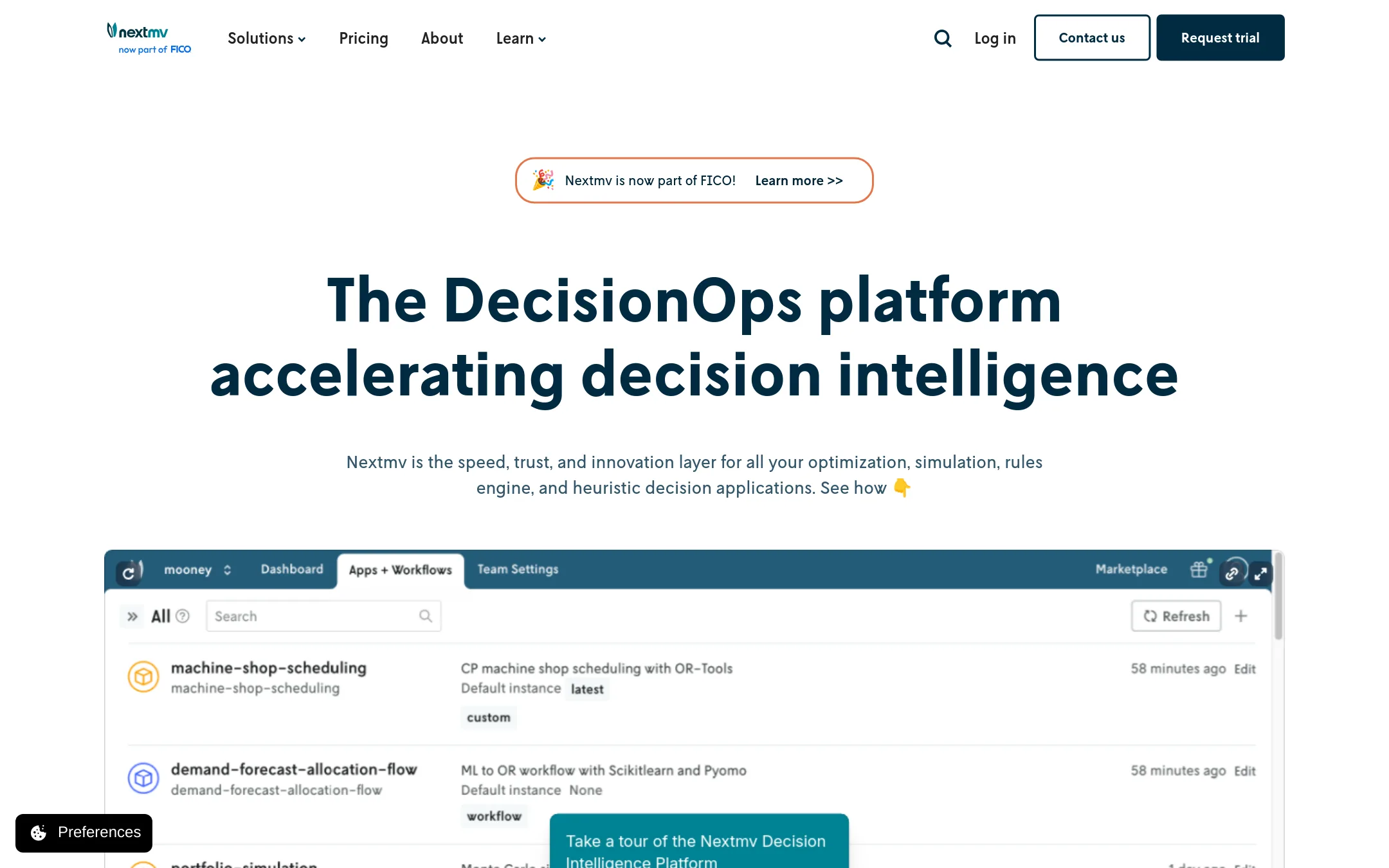
Nextmv is a DecisionOps platform for teams that build and run optimization models, including routing, scheduling, and simulation. It gives you a workflow to validate, test, and monitor models in production, plus a marketplace of pre-built decision apps. Choose it over OptaPlanner if you want managed infrastructure, experiment tooling, and a system of record for multiple decision models, rather than an open-source engine you host yourself.
Where it is strong
- Managed infrastructure with autoscaling and CI/CD support
- Built-in experimentation tools like shadow and switchback testing
- Pre-built decision apps and integrations with OR-Tools, Pyomo, Gurobi, and more
Where it falls short
- Pricing is credit-based, which can be hard to estimate for large workloads
- No open-source option. You depend on Nextmv's cloud platform
- Pricing:
- Innovator plan includes 600 credits, $0.0027 per pay-as-you-go credit, and $0.0013 per pre-paid credit. Scale-up includes 6,000 credits, $0.0019 per pay-as-you-go credit, and $0.0009 per pre-paid credit. Enterprise pricing is custom.
- Switching from OptaPlanner:
- Moving from OptaPlanner means rewriting your models to run inside Nextmv's SDK and connecting them to its test bench and deployment pipeline, which is a significant migration if you have existing OptaPlanner code.
- Not published
7.AIMMS
Best for: Enterprise supply chain teams in process industries, retail, and manufacturing that need network design, capacity planning, and scenario modeling with vendor support.

- Pricing
- Not published
- Category
- AI & Machine Learning
AIMMS is a commercial decision intelligence platform for supply chain optimization and scenario modeling. Choose it over OptaPlanner when you need pre-built supply chain applications, industry-specific modules, and vendor support for enterprise planning, rather than building and maintaining your own optimization models on an open-source engine.
Where it is strong
- Pre-built supply chain apps for network design, capacity planning, and transportation
- SENSAI adds natural language AI to optimization workflows
- Vendor support and partner ecosystem for enterprise deployment
Where it falls short
- Pricing is not public, likely enterprise-only
- Focused on supply chain, less general-purpose than OptaPlanner for other planning domains
- Pricing:
- Pricing is not published on the site.
- Not published
8.Google OR-Tools
Best for: Engineering teams that want a pure Java or Python optimization library for vehicle routing, job scheduling, or bin packing without the full KIE business automation stack.
- Pricing
- Not published
- Category
- AI & Machine Learning
Google OR-Tools is an open-source optimization library for routing, scheduling, and planning problems. Choose it over OptaPlanner when you need a lightweight, code-first solver that you can embed directly into your own application without a separate rule engine or business process layer.
Where it is strong
- Free and open source under the Apache 2.0 license
- Strong support for vehicle routing and constraint programming
- Simple API that integrates directly into existing code
Where it falls short
- No built-in UI, web console, or business rule management
- Requires more manual modeling for complex business constraints compared to OptaPlanner's domain-specific language
- Pricing:
- Pricing is not published on the site.
- Custom quote
9.Gurobi Optimizer
Best for: Enterprises with complex optimization problems like supply chain, scheduling, or network design that need guaranteed optimal solutions and high-performance computing.

- Pricing
- Custom quote
- Category
- AI & Machine Learning
Gurobi Optimizer is a commercial mathematical optimization solver that finds the best possible solution to complex decision problems. You would choose it over OptaPlanner when you need proven optimality and high performance on large-scale linear, quadratic, or mixed-integer programming, and you are willing to pay for a commercial license.
Where it is strong
- Proven optimality: guarantees the best solution, unlike heuristic approaches.
- High performance on large-scale problems with up to 2,000 variables in the free tier.
- Flexible licensing: named user, floating, cloud, and academic options.
Where it falls short
- Commercial licenses require a quote. No published pricing.
- Free tier is limited to 2,000 variables and non-commercial use.
- Pricing:
- Pricing is not published on the site. Commercial licenses are available through annual subscription plans, with free size-limited and academic licenses available.
- Not published
10.IBM watsonx
Best for: Large enterprises that need governed AI agents and assistants across hybrid cloud environments, not for solving planning or scheduling optimization problems.
- Pricing
- Not published
- Category
- AI & Machine Learning
IBM watsonx is an enterprise AI platform for building, deploying, and governing AI agents and assistants across business workflows. Choose it over OptaPlanner when your priority is AI orchestration, governance, and hybrid cloud integration rather than constraint-based planning and optimization. OptaPlanner is for solving scheduling and resource allocation problems. Watsonx is for managing AI models and automation at scale.
Where it is strong
- Strong governance and security controls for AI agents
- Runs on-premises or in sovereign clouds for data residency
- Integrates with IBM consulting and automation services
Where it falls short
- No constraint-solving or planning engine like OptaPlanner
- Enterprise-focused, so not suitable for lightweight or open-source use cases
- Pricing:
- Pricing is not published on the site.
See more comparisons in AI & Machine Learning alternatives.
FAQ
Questions about OptaPlanner alternatives
What is the best alternative to OptaPlanner for production scheduling?
Timefold is the strongest choice because it is built on the same constraint-solving technology as OptaPlanner but offers a managed REST API. It handles large-scale scheduling and routing without requiring you to build or maintain a solver. It is SOC 2 and GDPR compliant, making it suitable for production use.
Which alternative guarantees optimal solutions?
Gurobi Optimizer guarantees optimal solutions for linear, quadratic, and mixed-integer programming problems. It is a commercial solver with high performance on large-scale problems. The free tier is limited to 2,000 variables and non-commercial use, so enterprises typically need a paid license.
Is there a free and open-source alternative to OptaPlanner?
Google OR-Tools is a free, open-source optimization library under the Apache 2.0 license. It supports vehicle routing, scheduling, and constraint programming. It is code-first, so you need to integrate it into your own application without a built-in UI or rule engine.
Which alternative is best for small businesses without technical expertise?
RecordBook is a mobile-first database app for small businesses, but it is not an optimization solver. For scheduling and routing without solver expertise, Timefold is a better fit because it provides a simple REST API. RecordBook is only suitable for basic record management, not complex planning.
How do pricing models differ among these alternatives?
Nextmv uses a credit-based pricing model with pay-as-you-go and pre-paid credits. Gurobi and AIMMS require custom quotes, with Gurobi offering free academic and size-limited licenses. Timefold and IBM watsonx do not publish pricing, so you must contact sales. Google OR-Tools and Choco Solver are free and open-source.
Last updated November 3, 2026.