ParadeDB alternatives
7 products compared · Updated November 10, 2026
The short answer
The three strongest alternatives to ParadeDB are Algolia, Meilisearch and Typesense. Algolia suits e-commerce and content teams that want hosted search with merchandising controls and no search infrastructure to run. Meilisearch suits product teams adding fast site or app search with faceting and hybrid AI retrieval. Typesense suits product and content teams that want typo-tolerant search and faceting from a dedicated engine with its own API.
Your shortlist, at a glance
Read the comparisons ↓ ElasticsearchNot publishedEngineering and security teams at larger companies that need search, observability and SIEM work on one platform.
- OOpenSearchNot publishedEngineering teams running log analytics, observability or enterprise search that want an open source engine with its own dashboards and no Postgres dependency
 MeilisearchStarting price not shoProduct teams adding fast site or app search with faceting, filters, and hybrid AI retrieval, without running a Postgres extension
 TypesenseCustom quoteProduct and content teams that want fast typo-tolerant site or app search with an API built for search and faceting
 AlgoliaFrom $0.50 / 1K requesE-commerce and content teams that need hosted search with merchandising controls and analytics, without running their own search infrastructure.
 Apache AirflowNot publishedData and ML teams that need to schedule and monitor multi-step pipelines across cloud and third-party services
 NeonFrom $0 · $0.106/CU-hrEarly-stage app teams that want a managed Postgres backend with branching for previews and agent work
About ParadeDB and its alternatives
ParadeDB is a Postgres extension that makes text and vector search, filters, facets and joins fast inside Postgres. According to its site, it is known for avoiding a separate search cluster such as Elasticsearch, so developers can keep search in the same database as their application data with no ETL step.
When comparing alternatives in this category, weigh the pricing structure first, since some tools bill by search volume or record count while others are open source and self-hosted. Check which regions and deployment options are supported, what integrations the tool offers with your existing stack, how much support and SLA coverage the plan includes, and what the contract terms require. The right choice depends on whether search should stay inside Postgres or move to a dedicated engine.
Explore the alternatives
- Not published
1.Elasticsearch
Best for: Engineering and security teams at larger companies that need search, observability and SIEM work on one platform.
- Pricing
- Not published
- Category
- Analytics & Data
Elasticsearch is a general-purpose search engine built for search, observability, security and AI retrieval across large data sets. Teams pick it over ParadeDB when search is one part of a wider platform, or when they need the Elastic stack for logs, threat detection and vector retrieval in one place.
Where it is strong
- Covers search, observability, security and vector retrieval in one platform
- Runs hosted, serverless, on-premises or self-managed
- Available on AWS, Azure and Google Cloud marketplaces
Where it falls short
- Requires a separate search cluster, so data is copied out of your main Postgres database
- Heavier to run than an extension inside Postgres
- Pricing:
- Pricing is not published in the supplied text. The pricing page lists Elasticsearch, Vector Database, Observability and Security as hosted, serverless or self-managed options, with figures only on the linked page.
- Switching from ParadeDB:
- Moving from ParadeDB means copying search data into an Elasticsearch index and keeping it in sync with your Postgres tables.
- ONot published
2.OpenSearch
Best for: Engineering teams running log analytics, observability or enterprise search that want an open source engine with its own dashboards and no Postgres dependency
- Pricing
- Not published
- Category
- Other
OpenSearch is an Apache 2.0 licensed search and analytics engine built on Apache Lucene, with vector search, observability tooling and security analytics included. Someone would pick it over ParadeDB when they want a standalone search cluster with dashboards and observability features, or when they need a separate search engine that sits alongside their existing data store rather than inside Postgres.
Where it is strong
- Apache 2.0 licensed and governed by the OpenSearch Software Foundation under the Linux Foundation
- Covers search, vector search, observability and security analytics in one suite
- Includes OpenSearch Dashboards for visualizing and exploring data
Where it falls short
- It runs as a separate cluster, so you keep the data sync work that ParadeDB is built to avoid
- The site does not describe a managed offering, so you should plan for running it yourself
- Pricing:
- Pricing is not published on the site.
- Switching from ParadeDB:
- Moving from ParadeDB means exporting your Postgres search indexes and data into OpenSearch and rebuilding queries in its own query language, which the sources supplied here do not detail.
- Starting price not sho
3.Meilisearch
Best for: Product teams adding fast site or app search with faceting, filters, and hybrid AI retrieval, without running a Postgres extension

- Pricing
- Starting price not sho
- Category
- AI & Machine Learning
Meilisearch is an open-source search engine that adds full-text, semantic, and hybrid search to a website or app with little setup. Teams pick it over ParadeDB when search is the main job and they want a dedicated engine with typo-tolerant, search-as-you-type results and a managed cloud option.
Where it is strong
- Search-as-you-type returns results in under 50 milliseconds, per its site.
- Works out of the box with smart presets and little configuration.
- Combines full-text, semantic, and hybrid search with filtering, faceting, and sorting.
Where it falls short
- It is a separate engine, so you run a second system beside Postgres, which ParadeDB avoids.
- Full enterprise features such as SSO SAML, SOC 2, and the 99.999% SLA sit behind the Enterprise plan.
- Pricing:
- Meilisearch Cloud starts at a usage-based price with a 14-day free trial and no credit card required, and Enterprise pricing is custom, but the exact starting figure is not shown in the pricing text.
- Switching from ParadeDB:
- Moving from ParadeDB means sending your Postgres data into Meilisearch's index and keeping the two in sync, which is the synchronization work ParadeDB is designed to remove.
- Custom quote
4.Typesense
Best for: Product and content teams that want fast typo-tolerant site or app search with an API built for search and faceting
- Pricing
- Custom quote
- Category
- AI & Machine Learning
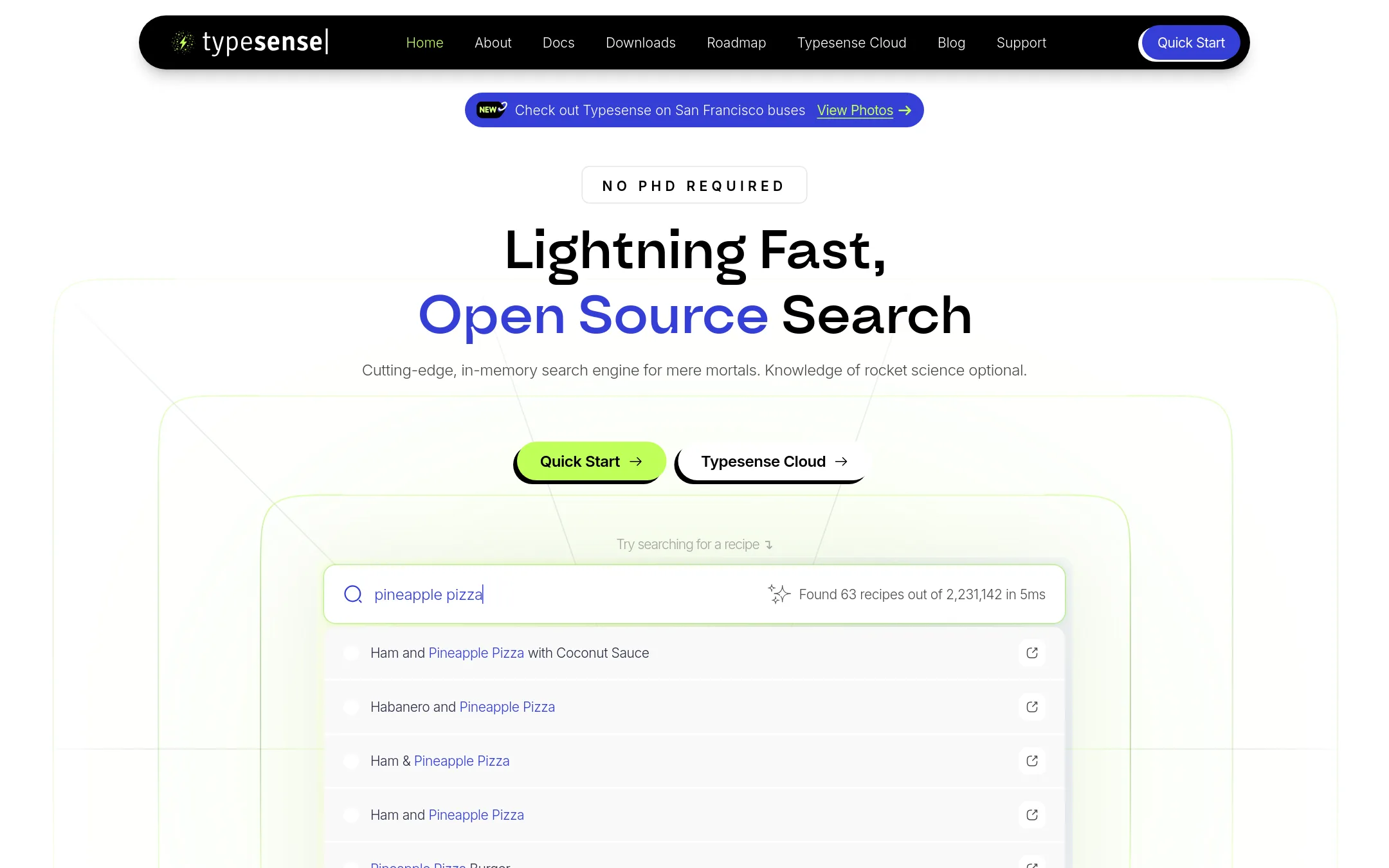
Typesense is an open-source, in-memory search engine built for typo-tolerant site and app search, with faceting, geo search, and vector and semantic search. You would pick it over ParadeDB when search is the main job and you want a dedicated search engine with its own API, rather than keeping search inside your Postgres database.
Where it is strong
- Typo tolerance, autocomplete, faceted navigation, and geo search are built in
- Open source, with a self-hosted option alongside Typesense Cloud
- Vector and semantic search, plus built-in RAG, sit in the same engine
Where it falls short
- Search lives in a separate system, so your data must be indexed into it
- Its strengths are search and discovery, not the joins and transactional workloads ParadeDB keeps in Postgres
- Pricing:
- Pricing is not published on the site.
- Switching from ParadeDB:
- Moving from ParadeDB means exporting the searchable data from Postgres into Typesense collections and keeping them in sync with your application writes.
- From $0.50 / 1K reques
5.Algolia
Best for: E-commerce and content teams that need hosted search with merchandising controls and analytics, without running their own search infrastructure.

- Pricing
- From $0.50 / 1K reques
- Category
- AI & Machine Learning
Algolia is a hosted search and retrieval API built for product discovery, with keyword search, AI ranking, merchandising tools and generative AI grounding. A team would choose it over ParadeDB when they want search delivered as a managed service, with merchandising and storefront tooling, rather than building search inside their own Postgres database.
Where it is strong
- Hosted API, so no search cluster to run
- Merchandising Studio lets business teams adjust rankings without engineering help
- Free tier includes 10K search requests a month and 50K records
Where it falls short
- Usage-based pricing grows with search volume and record count
- Keeping search data in sync with your own database is a separate job compared with ParadeDB's single-database approach
- Pricing:
- Pricing is tiered, with a free plan that includes 10K search requests a month and 50K records, and paid plans that charge $0.50 or $1.75 per additional 1K search requests and $0.40 per additional 1K records, while enterprise pricing is custom.
- Switching from ParadeDB:
- Moving from ParadeDB to Algolia means exporting indexed data into Algolia's index and rebuilding search queries against its API, rather than keeping search inside existing Postgres tables.
- Not published
6.Apache Airflow
Best for: Data and ML teams that need to schedule and monitor multi-step pipelines across cloud and third-party services
- Pricing
- Not published
- Category
- Analytics & Data
Apache Airflow is a Python-based platform for authoring, scheduling and monitoring workflows as code. Teams pick it when their problem is orchestrating data pipelines, ML jobs or infrastructure tasks across many systems, not running search queries inside a database. It is an alternative to ParadeDB only for a different job, since ParadeDB handles search in Postgres while Airflow coordinates the steps around it.
Where it is strong
- Workflows are defined in standard Python, including dynamic task generation
- Web UI shows status and logs for completed and running tasks
- Plug-and-play operators for Google Cloud, AWS, Azure and many third-party services
Where it falls short
- It orchestrates workflows and does not provide text or vector search, so it cannot replace ParadeDB
- Running it well means operating a scheduler, workers and a message queue
- Pricing:
- Pricing is not published on the site.
- From $0 · $0.106/CU-hr
7.Neon
Best for: Early-stage app teams that want a managed Postgres backend with branching for previews and agent work
- Pricing
- From $0 · $0.106/CU-hr
- Category
- Developer Tools
Neon is a managed Postgres platform with branching, autoscaling, and scale-to-zero, plus auth, storage, functions, and an AI gateway around the database. Someone would pick it over ParadeDB when they want a hosted backend for apps and agents rather than a search extension inside Postgres. It fits teams whose main need is a serverless database with instant copy-on-write branches for previews and tests.
Where it is strong
- Copy-on-write branches let teams spin up isolated copies of the database for previews and tests.
- Compute autoscales with load and scales to zero when idle, including on the Free plan.
- Auth, object storage, functions, and an AI gateway sit alongside the database in one platform.
Where it falls short
- Neon is a general-purpose Postgres platform, so it does not offer ParadeDB's search, vector, and facet indexing inside Postgres.
- Private networking, SLAs, and HIPAA are limited to the higher-priced Scale plan.
- Pricing:
- Pricing is published with a Free plan at $0, a Launch plan billed by usage at $0.106 per CU-hour, and a Scale plan at $0.222 per CU-hour. Usage-based plans list storage at $0.35 per GB-month on Launch.
See more comparisons in Analytics & Data alternatives.
FAQ
Questions about ParadeDB alternatives
What is ParadeDB?
ParadeDB is a Postgres extension, not a fork, that adds fast text and vector search, filters, facets and joins to Postgres. Its site describes it as the home of the pg_search extension and a way to avoid running Elasticsearch alongside your database. It is open source and can be self-hosted or run as a managed service.
Which alternative is best if I want a hosted search API with merchandising tools?
Algolia suits e-commerce and content teams that want hosted search with merchandising controls and analytics. Its Merchandising Studio lets business teams adjust rankings without engineering help. Pricing is usage-based, so costs grow with search volume and record count.
Which alternative suits a product team that wants fast search with little setup?
Meilisearch suits product teams adding fast site or app search with faceting, filters and hybrid AI retrieval. Its site says search-as-you-type returns results in under 50 milliseconds and that it works with little configuration. It runs as a separate engine beside Postgres, so you manage a second system.
Is there a good alternative if I want an open source search engine I can self-host?
Typesense is an open-source, in-memory search engine with typo tolerance, autocomplete, faceted navigation, geo search and vector search, and it offers a self-hosted option alongside Typesense Cloud. Search lives in a separate system, so your data must be indexed into it. OpenSearch is another Apache 2.0 option, though it is aimed more at log analytics and observability.
When should I not choose ParadeDB and look at a different category of tool?
If your need is orchestrating data pipelines rather than running search, Apache Airflow is a different kind of tool that coordinates steps around a database. If you want a managed Postgres backend with branching for previews and agent work, Neon fits better, although it does not offer ParadeDB's search indexing inside Postgres. Choose based on whether your core job is search, orchestration or hosted database infrastructure.
Last updated November 10, 2026.