Paragon alternatives
10 products compared · Updated October 16, 2026
The short answer
The three strongest alternatives to Paragon are Pipedream, Airbyte, and Workato. Pipedream suits AI agent teams that need broad API access and a code-first approach. Airbyte fits data engineering teams focused on bulk data replication into their own storage. Workato is best for large enterprises orchestrating complex multi-agent workflows with governance.
Your shortlist, at a glance
Read the comparisons ↓ ZapierFree tier, paid customInternal operations teams and small businesses that want to automate repetitive tasks across many apps without building custom integrations.
 n8nFrom $2.5K/moTechnical teams that want a flexible, self-hosted workflow automation tool with AI capabilities and full source code access.
WorkatoCustom quoteLarge enterprises that need to govern and orchestrate AI agents, MCP servers, and workflows across thousands of apps.
Pipedream$99/mo + $2/userAI agent teams that need quick access to thousands of APIs and prefer a developer-first, code-centric integration platform.
 Tray.ioCustom quoteEnterprise IT teams that need governed integration, automation, and MCP management across many internal systems.
 MakeNot publishedTeams that want to automate internal processes and AI workflows visually without writing code, and need broad app connectivity.
 AirbyteFrom $189/moData engineering teams that need to move large volumes of data from many sources into their own storage for analytics or AI training.
- MMuleSoftSee websiteEnterprise integration and API platform
 SegmentFrom $120/moTeams that need to unify customer data from many sources and send it to analytics, marketing, and data warehouse tools.
 BoomiNot publishedLarge enterprises that need a single platform for API management, data integration, and AI agent governance across many internal and external systems.
About Paragon and its alternatives
Paragon is an embedded integration platform for SaaS apps and AI agents. It handles the work behind integrations, from sync and permission data to auth and provider changes. Paragon is known for its managed sync, ActionKit, and Workflows products, and for letting your team keep the product logic and user experience.
When comparing alternatives, weigh pricing structure, regions, integrations, support, and contract terms. Some alternatives publish transparent pricing, while others require a sales conversation. Consider whether you need embedded customer-facing integrations or internal automation. Check the connector catalog size and whether managed auth and sync are included. Support options and contract flexibility vary widely.
Explore the alternatives
- Free tier, paid custom
1.Zapier
Best for: Internal operations teams and small businesses that want to automate repetitive tasks across many apps without building custom integrations.
- Pricing
- Free tier, paid custom
- Category
- Productivity & Project Management
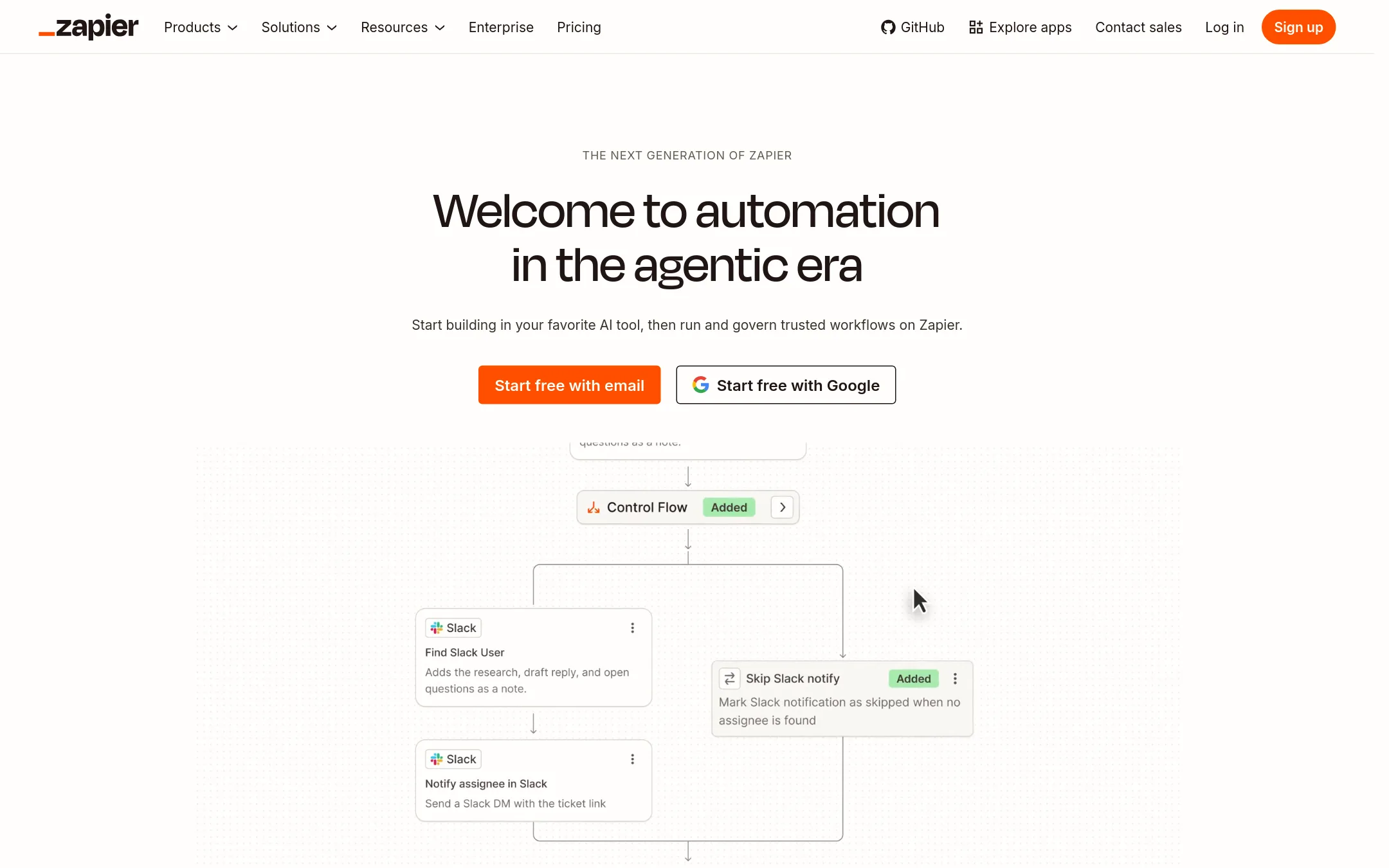
Zapier is a general-purpose automation platform for connecting thousands of apps with deterministic workflows, AI steps, and agents. You would choose it over Paragon when you need broad, non-embedded automation across your own internal tools rather than customer-facing integrations with managed auth and sync.
Where it is strong
- Connects to 9,000+ apps with pre-built integrations
- Free plan includes 100 tasks per month
- Supports deterministic workflows, AI steps, and agents
Where it falls short
- Not built for embedding customer-facing integrations in your product
- Pricing for paid plans is not published
- Pricing:
- Pricing is not published on the site. Plans start with a free tier at 100 tasks per month, with paid plans requiring a quote.
- From $2.5K/mo
2.n8n
Best for: Technical teams that want a flexible, self-hosted workflow automation tool with AI capabilities and full source code access.
- Pricing
- From $2.5K/mo
- Category
- AI & Machine Learning
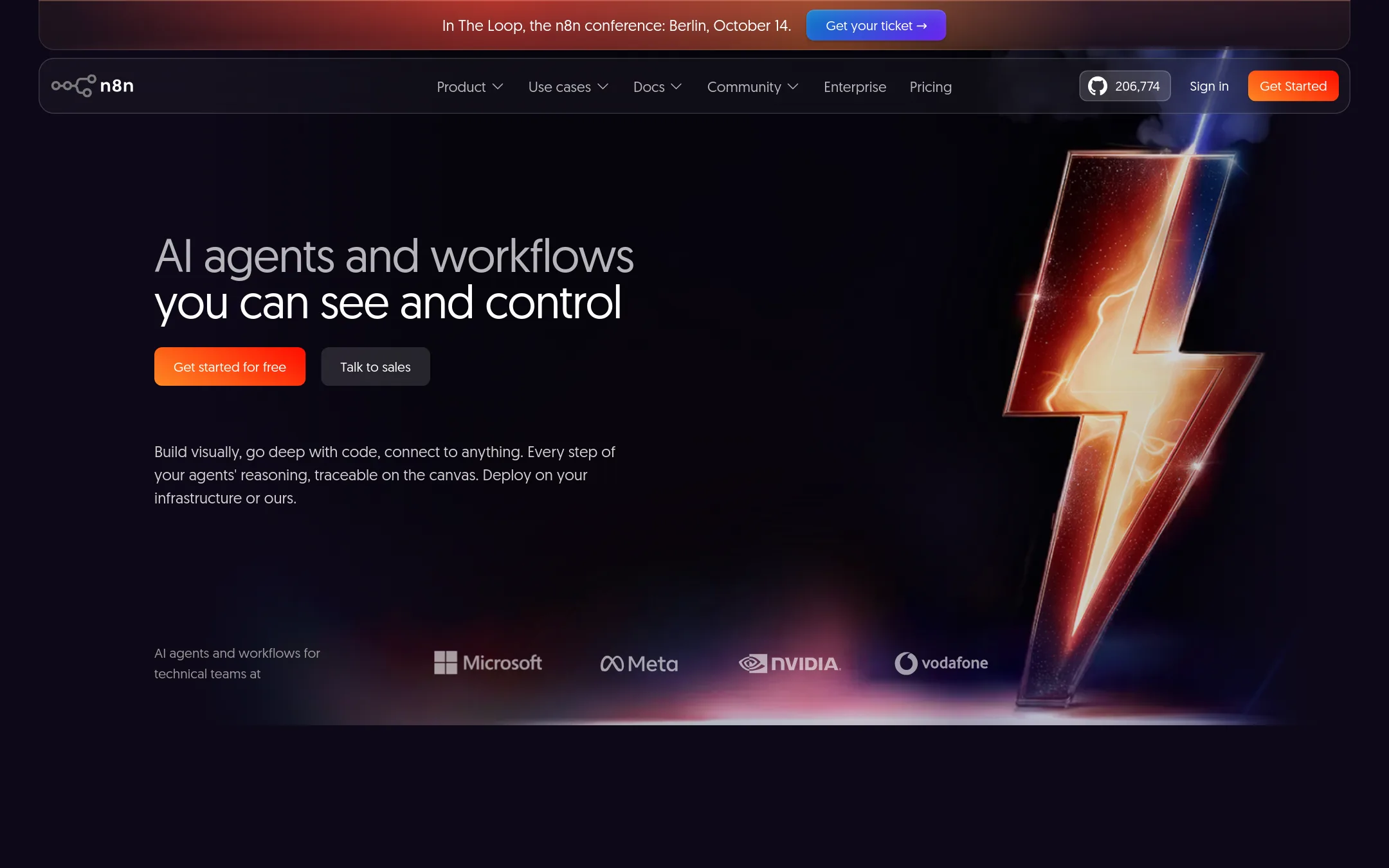
n8n is a self-hostable workflow automation platform where you build with code or a visual editor. Choose it over Paragon when you want full control of your automation logic and infrastructure, and when your team prefers an open-source tool over a managed integration platform.
Where it is strong
- Self-hostable with full source code on GitHub
- Pay per full workflow execution, not per step
- Write JavaScript or Python anywhere in workflows
Where it falls short
- No managed connectors or sync for customer data like Paragon
- Requires your own infrastructure and maintenance for self-hosting
- Pricing:
- Pricing starts at $2.5K/month for Starter, $10K/month for Pro, and $40K/month for Business, billed monthly. Annual billing saves 17%. A free Community Edition is available on GitHub.
- Switching from Paragon:
- Moving from Paragon means rebuilding your integrations as n8n workflows and managing your own authentication and data sync, since n8n doesn't provide managed connectors or a permissions API.
- Custom quote
3.Workato
Best for: Large enterprises that need to govern and orchestrate AI agents, MCP servers, and workflows across thousands of apps.
- Pricing
- Custom quote
- Category
- AI & Machine Learning
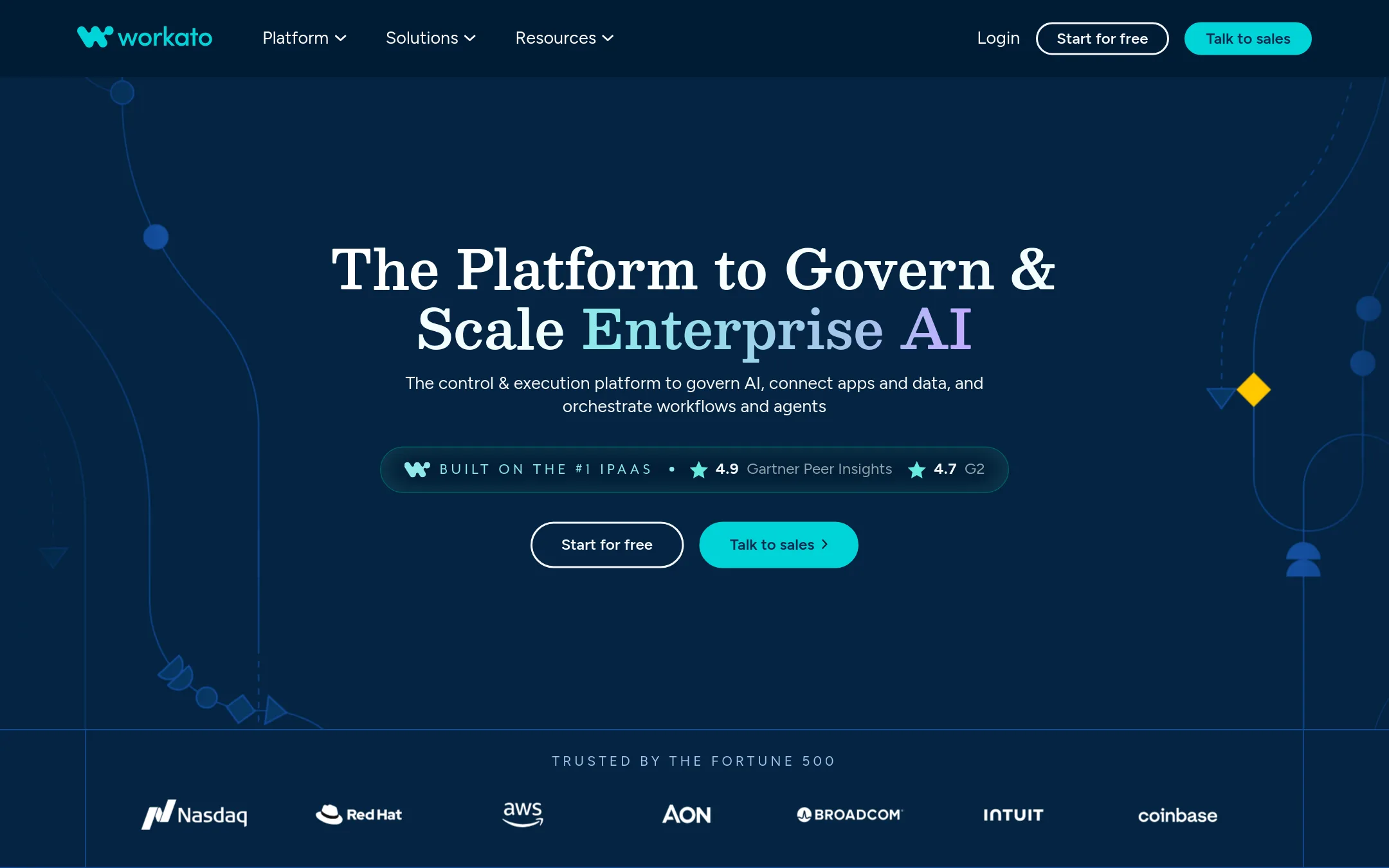
Workato is an enterprise iPaaS with a strong focus on AI agent orchestration, governance, and MCP support. Choose it over Paragon when you need to orchestrate complex multi-agent workflows across many enterprise systems, not just embed customer-facing integrations.
Where it is strong
- Connects to 17,000+ apps and APIs out of the box.
- Built-in governance for AI agents, MCP, and API interactions.
- Includes data integration (ETL, ELT, reverse ETL) and API platform.
Where it falls short
- Pricing is not transparent. Requires a sales conversation.
- Heavier and more complex than Paragon for simple embedded integrations.
- Pricing:
- Pricing is not published on the site. Plans are available by contacting sales.
- Switching from Paragon:
- Moving from Paragon means re-building your integration logic in Workato's recipe and agent framework, and re-mapping your authentication and data sync flows.
- $99/mo + $2/user
4.Pipedream
Best for: AI agent teams that need quick access to thousands of APIs and prefer a developer-first, code-centric integration platform.
- Pricing
- $99/mo + $2/user
- Category
- Developer Tools
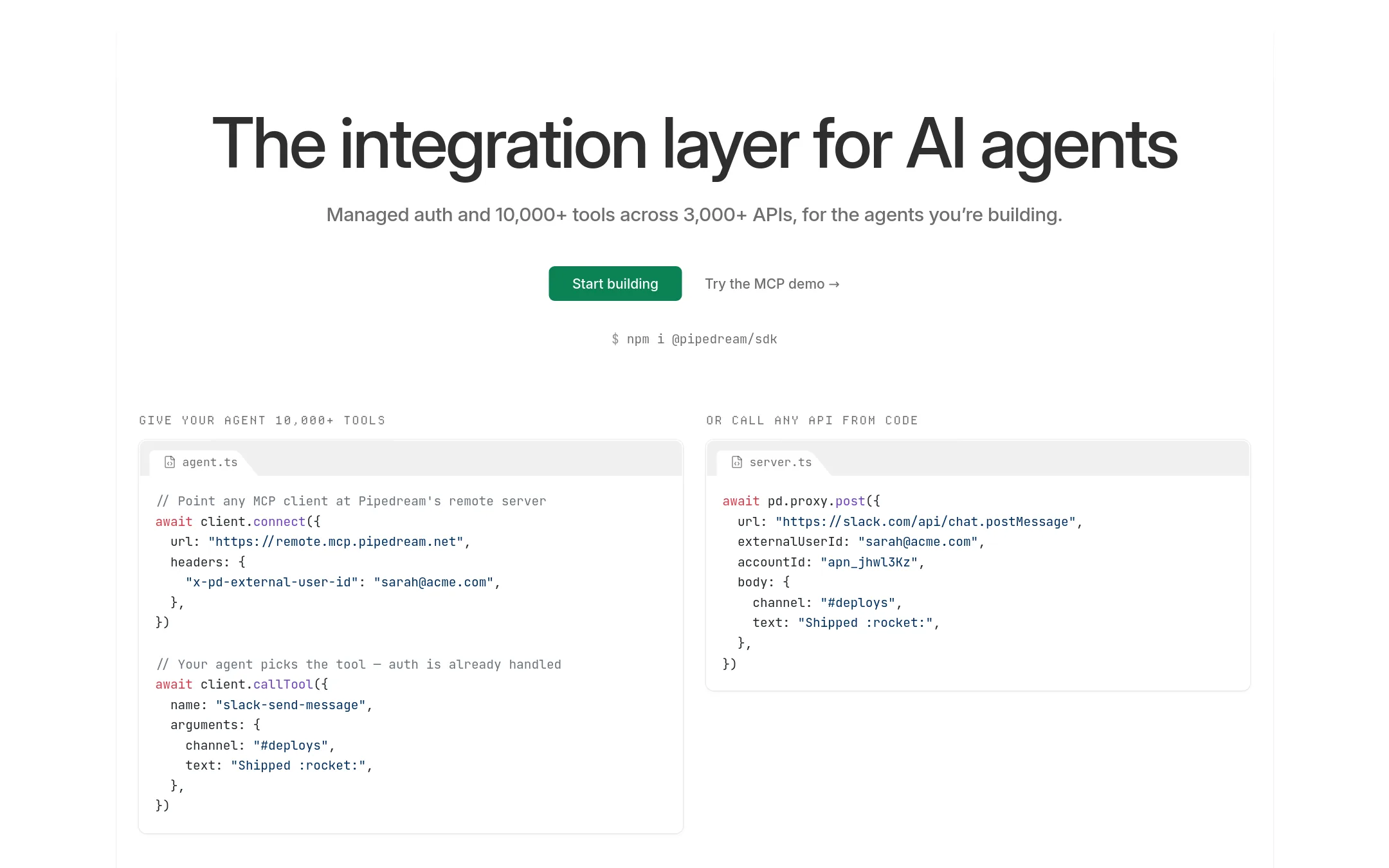
Pipedream is an integration layer for AI agents with managed auth, 10,000+ prebuilt tools, and a proxy for 3,000+ APIs. Choose it over Paragon if you want a broader connector catalog and a simpler, code-first approach without Paragon's managed sync and workflow products.
Where it is strong
- 10,000+ prebuilt tools and triggers across 3,000+ APIs
- Managed auth with hosted OAuth, token storage, and refresh
- Free full access in development, no credit card required
Where it falls short
- Startup plan caps at 100 users before per-user fees
- No managed sync or workflow orchestration like Paragon's products
- Pricing:
- Free for development. Startup plan is $99/month billed annually or $150/month billed monthly, includes 100 users and 10,000 usage credits, then $2 per user and $0.012 per credit.
- Switching from Paragon:
- Moving from Paragon involves re-implementing integrations with Pipedream's SDK and proxy, and migrating any custom connectors you built.
- Custom quote
5.Tray.io
Best for: Enterprise IT teams that need governed integration, automation, and MCP management across many internal systems.
- Pricing
- Custom quote
- Category
- Developer Tools
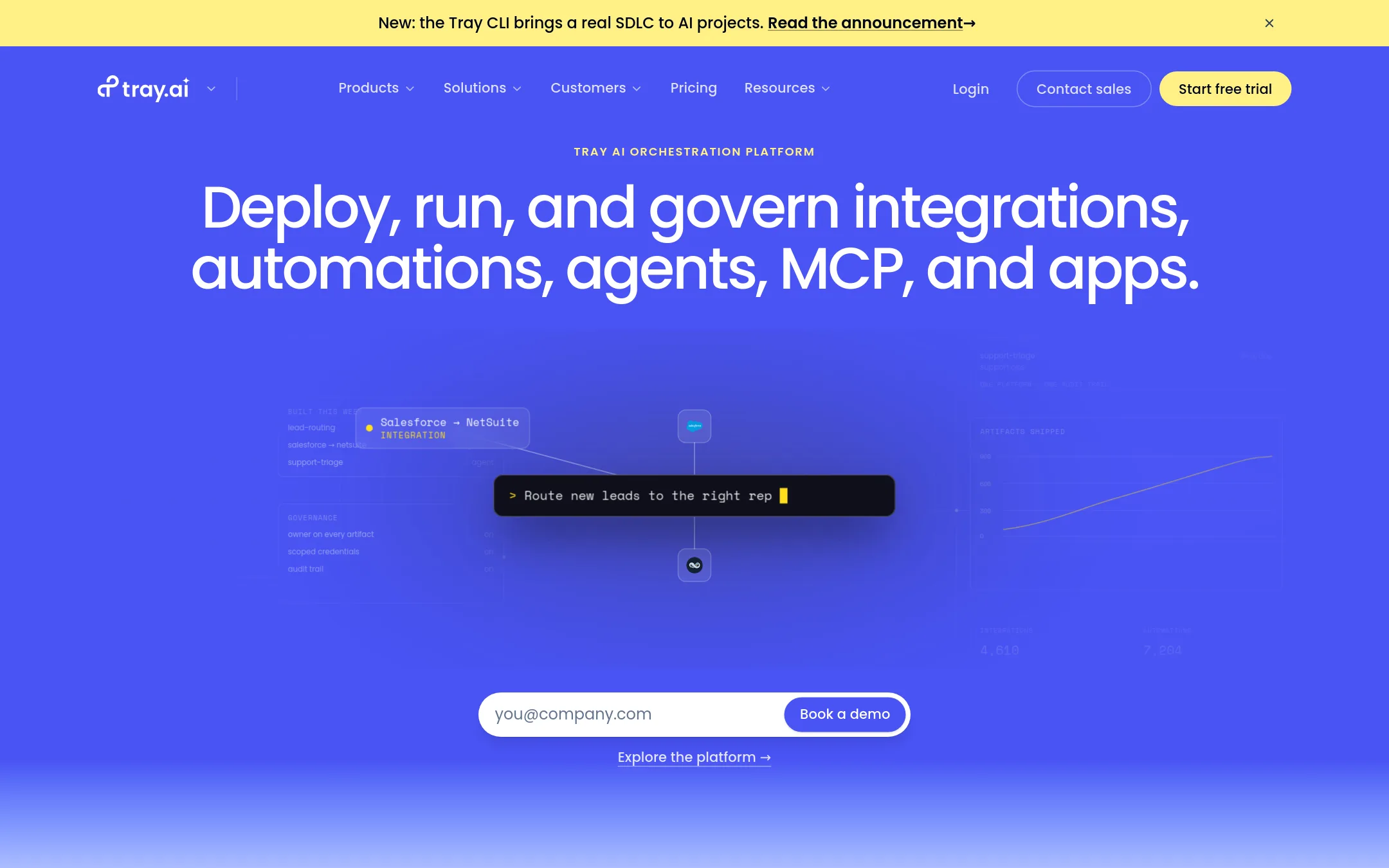
Tray.ai is an enterprise iPaaS for integrating 700+ apps, building AI agents, and governing MCP. Choose it over Paragon when you need broad internal automation across departments, not just embedded customer-facing integrations.
Where it is strong
- 700+ pre-built connectors for enterprise systems
- Built-in MCP governance and agent builder
- SOC 1, SOC 2, HIPAA, and GDPR compliance
Where it falls short
- Pricing is custom, no self-serve tiers
- Heavier focus on internal IT than embedded customer integrations
- Pricing:
- Pricing is not published on the site. Plans are Pro, Team, and Enterprise with custom quotes based on usage and features.
- Not published
6.Make
Best for: Teams that want to automate internal processes and AI workflows visually without writing code, and need broad app connectivity.
- Pricing
- Not published
- Category
- Productivity & Project Management
Make is a visual automation platform for building AI agents and workflows across 3,500+ apps. Choose it over Paragon when you want a general-purpose tool for internal automation and team workflows, not embedded customer-facing integrations.
Where it is strong
- Visual drag-and-drop builder with prompt-based creation
- 3,500+ pre-built app integrations and custom API connectors
- Free plan with no credit card and no time limit
Where it falls short
- No embedded integration platform for SaaS products
- Credit-based pricing can be unpredictable for high-volume use
- Pricing:
- Pricing is not published on the site. Plans are credit-based and scale with usage.
- From $189/mo
7.Airbyte
Best for: Data engineering teams that need to move large volumes of data from many sources into their own storage for analytics or AI training.
- Pricing
- From $189/mo
- Category
- Analytics & Data
Airbyte is an open-source data movement platform for ELT pipelines, syncing data from 700+ connectors into warehouses, lakes, vector databases, or AI agents. Choose it over Paragon when your focus is bulk data replication and analytics, not embedding customer-facing integrations with managed auth and permission sync.
Where it is strong
- 700+ pre-built connectors for diverse sources
- Open-source with hybrid deployment options
- Capacity-based pricing on Pro/Enterprise for predictable costs
Where it falls short
- Not built for embedding customer-facing integrations in your product
- No managed auth or permission-aware sync for end-user data
- Pricing:
- Standard starts at $195/mo for volume-based usage. Plus starts at $189/mo with 40 credits included. Pro and Enterprise Flex use capacity-based pricing on Data Workers.
- MSee website
8.MuleSoft
Developer Tools
MuleSoft delivers API-led connectivity for large enterprises with extensive governance tools. It is more heavyweight than Paragon for quick SaaS connector shipping and lacks the same focus on AI workflows or 70% engineering reduction via pre-built embedded components. Pricing and complexity suit only the largest deployments.
- From $120/mo
9.Segment
Best for: Teams that need to unify customer data from many sources and send it to analytics, marketing, and data warehouse tools.
- Pricing
- From $120/mo
- Category
- Analytics & Data
Segment is a customer data platform that collects, unifies, and activates first-party data across apps and devices. Choose it over Paragon when your main need is centralizing customer data for analytics, marketing, and warehouse syncs, rather than embedding product integrations for your SaaS users.
Where it is strong
- Collects data from any source and routes to 550+ destinations.
- Unified customer profiles and audience segmentation built in.
- Real-time data streaming with warehouse sync options.
Where it falls short
- Pricing for CDP plans is custom, not transparent.
- Not designed for embedding third-party app integrations into your product.
- Pricing:
- In the United States, Connections starts at $120/month for up to 10k visitors/month. CDP plans are custom quoted.
- Not published
10.Boomi
Best for: Large enterprises that need a single platform for API management, data integration, and AI agent governance across many internal and external systems.
- Pricing
- Not published
- Category
- E-commerce
Boomi is a broad enterprise integration platform covering APIs, data, B2B/EDI, and AI agent governance. Choose it over Paragon when you need to connect and orchestrate systems across a large organization, not just embed customer-facing integrations into a SaaS product.
Where it is strong
- Covers API management, data integration, B2B/EDI, and AI agent governance in one platform.
- Includes low-code and no-code tools for building workflows and automations.
- Offers on-premise and behind-the-firewall deployment options for security-sensitive organizations.
Where it falls short
- Pricing is not transparent and likely requires a sales conversation.
- Broader and heavier than Paragon, which may be overkill for a SaaS team that just needs embedded integrations.
- Pricing:
- Pricing is not published on the site.
See more comparisons in Developer Tools alternatives.
FAQ
Questions about Paragon alternatives
What is the best alternative to Paragon for AI agent teams?
Pipedream is a strong choice for AI agent teams. It offers 10,000+ prebuilt tools and managed auth, with a developer-first, code-centric approach. It also has a free development tier and a startup plan at $99/month.
Which alternative is best for data engineering and analytics?
Airbyte is best for data engineering teams that need to move large volumes of data from many sources into their own storage. It has 700+ connectors and open-source options. Standard starts at $195/month.
Are there alternatives with transparent pricing?
Yes, Airbyte and Pipedream publish their pricing. Airbyte starts at $195/month, and Pipedream has a free development tier and a startup plan at $99/month. Other alternatives like Zapier, Make, Workato, and Tray.io do not publish paid plan pricing.
Which alternative is best for large enterprises?
Workato is best for large enterprises that need to orchestrate AI agents and workflows across many systems. It connects to 17,000+ apps and includes built-in governance. However, pricing is not transparent and requires a sales conversation.
Can I self-host any of these alternatives?
Yes, n8n is self-hostable with full source code on GitHub. Airbyte also offers hybrid deployment options. Other alternatives are cloud-based or require custom arrangements.
Last updated October 16, 2026.