Playwright alternatives
12 products compared · Updated November 1, 2026
The short answer
For teams that want a free, open-source test runner with an optional cloud for scaling, Cypress is the strongest alternative. If you need to automate mobile apps or multiple device types, Appium is the best fit. For a single tool that covers web, mobile, and desktop with no paid tier, WebdriverIO is a solid choice.
Your shortlist, at a glance
Read the comparisons ↓ CypressFree. Team from $67/moTeams that want a free open-source test runner with an optional cloud service for CI scaling, flake detection, and AI-driven test creation.
 SeleniumNot publishedTeams that need browser automation in Java, Python, C#, Ruby, or Kotlin and want to run tests across many browsers and operating systems in parallel.
- PPuppeteerNot publishedNode.js developers who want to script browser interactions directly, such as scraping, screenshotting, or automating tasks without a full testing framework.
- WWebdriverIONot publishedTeams that need one test runner for web, mobile, and desktop apps, and want a community-driven tool with no paid tier.
- TTestCafeFrom $20/moTeams that want a lightweight, open-source testing framework with quick setup and no WebDriver dependency, plus optional paid dashboard features for reporting.
- NNightwatch.jsNot publishedTeams that need one framework for web, mobile web, and native mobile testing, especially those already using BrowserStack or other cloud grids.
- MMochaNot publishedNon-technical founders who need to launch a basic web app fast without touching code.
- JJestNot publishedJavaScript projects that need a zero-config unit testing framework with mocking and snapshot support
- VVitestNot publishedVite-based frontend teams that want a fast, integrated unit and component test runner with TypeScript and JSX support out of the box.
 Katalon StudioNot publishedQA teams that want a single platform for authoring, managing, and running tests across web, mobile, API, and desktop, with AI help and without writing all code from scratch.
- AAppiumNot publishedTeams testing mobile apps or multiple device types (iOS, Android, TV, desktop) who need a single automation tool.
Axiom.aiSee websiteNo-code Browser RPA
About Playwright and its alternatives
Playwright is a fast and reliable end-to-end testing framework for modern web apps. It offers a full-featured test runner with auto-waiting, assertions, tracing, and parallelism across Chromium, Firefox, and WebKit. It also provides a CLI and MCP server for AI agents, making it a versatile tool for both manual and automated testing.
When comparing alternatives, consider the pricing structure, as some tools are free and open-source while others require paid plans for cloud features. Check which regions and integrations matter to you, such as CI/CD pipelines or test management tools. Also evaluate the level of support and contract terms, especially if you need enterprise-level assistance or custom pricing.
Explore the alternatives
- Free. Team from $67/mo
1.Cypress
Best for: Teams that want a free open-source test runner with an optional cloud service for CI scaling, flake detection, and AI-driven test creation.
- Pricing
- Free. Team from $67/mo
- Category
- Developer Tools
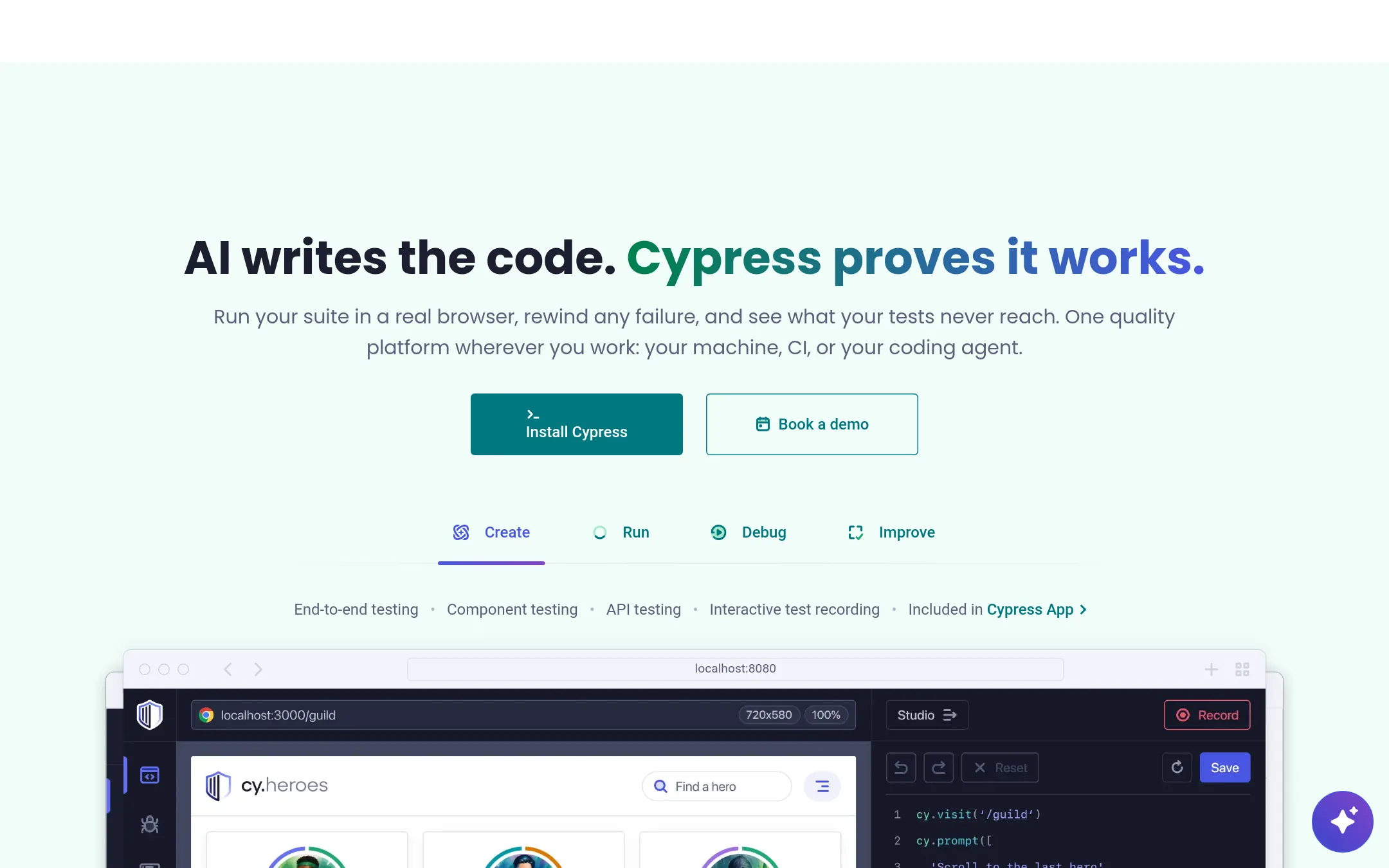
Cypress is a browser testing platform that runs end-to-end, component, and API tests in a real browser with real-time debugging. Choose it over Playwright if you want a free open-source app plus a paid cloud for CI recording, parallelization, and AI-assisted test generation and debugging.
Where it is strong
- Free open-source Cypress App with no credit card required
- AI features like cy.prompt and Studio AI generate self-healing tests
- Time Travel and Test Replay let you rewind failures in local and CI runs
Where it falls short
- Cloud features like parallelization and flake detection require paid plans
- UI Coverage and Accessibility are premium add-ons, not in standard plans
- Pricing:
- Starter is free for 10 users with 500 test results/month. Team starts at $67/month billed annually at $799. Business is $267/month billed annually at $3,199. Enterprise is custom.
- Switching from Playwright:
- Moving from Playwright means rewriting tests in Cypress's API and adopting its browser-driven execution model, though the open-source app is free to try.
- Not published
2.Selenium
Best for: Teams that need browser automation in Java, Python, C#, Ruby, or Kotlin and want to run tests across many browsers and operating systems in parallel.
- Pricing
- Not published
- Category
- Developer Tools
Selenium is a browser automation tool that follows the W3C WebDriver standard, letting you write scripts in Java, Python, C#, Ruby, JavaScript, or Kotlin. Choose it over Playwright when your team is already invested in a non-JavaScript language or needs to drive real browsers across a wide matrix of environments via Selenium Grid.
Where it is strong
- Works with six programming languages, not just JavaScript.
- Official W3C standard, so it's widely supported and familiar.
- Selenium Grid lets you distribute tests across many machines and browser/OS combinations.
Where it falls short
- No built-in test runner or assertions. You need to bring your own framework.
- Setup can be more manual compared to Playwright's auto-downloading of browsers.
- Pricing:
- Pricing is not published on the site.
- Switching from Playwright:
- Moving from Playwright means rewriting your tests in a supported language and adopting a separate test runner, since Selenium only handles browser control.
- PNot published
3.Puppeteer
Best for: Node.js developers who want to script browser interactions directly, such as scraping, screenshotting, or automating tasks without a full testing framework.
- Pricing
- Not published
- Category
- Other
Puppeteer is a JavaScript library that gives you direct control over Chrome or Firefox via the DevTools Protocol or WebDriver BiDi. Choose it over Playwright when you need a lightweight, programmatic browser automation library rather than a full test runner with built-in assertions and tracing.
Where it is strong
- Direct control over Chrome or Firefox via DevTools Protocol or WebDriver BiDi
- Runs headless by default, with no visible UI
- Works with modern package managers like npm, pnpm, Yarn, Bun, and Deno
Where it falls short
- No built-in test runner, assertions, or tracing like Playwright Test
- Browser download can be blocked by package manager install scripts, requiring manual setup
- Pricing:
- Pricing is not published on the site.
- Switching from Playwright:
- Moving from Playwright to Puppeteer means replacing the test runner with your own scripts and assertions, since Puppeteer is a library, not a testing framework.
- WNot published
4.WebdriverIO
Best for: Teams that need one test runner for web, mobile, and desktop apps, and want a community-driven tool with no paid tier.
- Pricing
- Not published
- Category
- Other
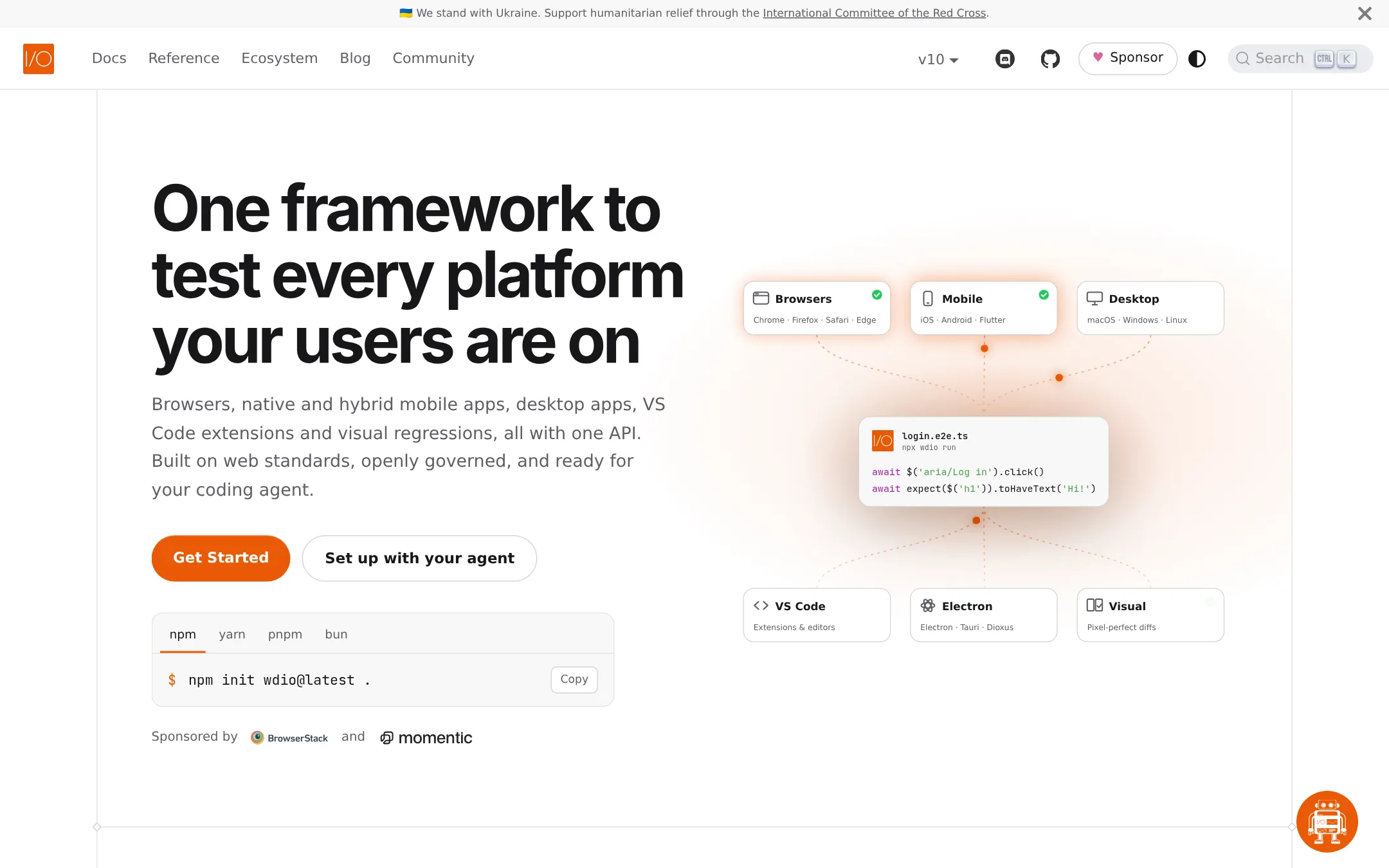
WebdriverIO is an open-source test runner that covers web, mobile, and desktop apps through the WebDriver protocol. Choose it over Playwright when you need to test across browsers, phones, and desktop apps like Electron with a single tool, or when you want a community-governed project without vendor lock-in.
Where it is strong
- Runs the same tests on web, mobile, and desktop via WebDriver and WebDriver BiDi
- AI service records steps with your own model, then replays them with zero tokens
- Every feature is free, no feature gates, and governed by the OpenJS Foundation
Where it falls short
- No built-in cross-browser project like Playwright's. Relies on WebDriver setup
- AI features require bringing your own model (Anthropic, OpenAI, etc.)
- Pricing:
- Pricing is not published on the site.
- Switching from Playwright:
- Moving from Playwright means rewriting test specs to WebdriverIO's API and configuring WebDriver servers for each platform.
- TFrom $20/mo
5.TestCafe
Best for: Teams that want a lightweight, open-source testing framework with quick setup and no WebDriver dependency, plus optional paid dashboard features for reporting.
- Pricing
- From $20/mo
- Category
- Other
TestCafe is a free, open-source end-to-end testing framework that runs in any modern browser without needing WebDriver. Choose it over Playwright if you want a simpler setup with one npm package, built-in auto-waiting, and the option to record tests in the browser.
Where it is strong
- No WebDriver required. Works with common browsers out of the box
- Auto-waiting eliminates manual timeouts and waitForElement calls
- Free open-source core. Paid plans add dashboard and Studio licenses
Where it falls short
- Paid plans limit test runs and users, which may cap scaling
- Advanced analytics and collaboration features are still coming soon
- Pricing:
- Personal plan is $20/month (first 60 days free) for 3 users and 7,500 test runs. Team plan is $50/month for 20 users and 50,000 test runs. Enterprise is custom quote.
- Switching from Playwright:
- Moving from Playwright means rewriting tests in TestCafe's API, but the auto-waiting and browser support are similar, so the learning curve is moderate.
- NNot published
6.Nightwatch.js
Best for: Teams that need one framework for web, mobile web, and native mobile testing, especially those already using BrowserStack or other cloud grids.
- Pricing
- Not published
- Category
- Other
Nightwatch.js is a Node.js end-to-end testing framework that runs against W3C WebDriver, so it works on real desktop and mobile browsers rather than browser engines. Choose it over Playwright if you need to test native iOS and Android apps with the same framework, or if you prefer WebDriver standards and a no-paywall open-source model.
Where it is strong
- Supports native iOS and Android testing alongside web, all in one framework.
- Built-in HTML reporter with HTTP logs and DOM history for debugging.
- Open source with no paywalls, backed by BrowserStack.
Where it falls short
- No pricing information is listed, so cost for enterprise features is unclear.
- Relies on WebDriver, which may be slower or less convenient than Playwright's browser-native automation.
- Pricing:
- Pricing is not published on the site.
- MNot published
7.Mocha
Best for: Non-technical founders who need to launch a basic web app fast without touching code.

- Pricing
- Not published
- Category
- Developer Tools
Mocha is a no-code platform for building and publishing web apps, aimed at people who want to ship quickly without writing tests or automation scripts. Choose it over Playwright if your goal is to create a simple web app visually, not to test an existing one.
Where it is strong
- No coding required to build and publish apps
- Fast time-to-launch for simple projects
- Targets non-developers directly
Where it falls short
- No test runner or browser automation features
- Site was unreachable during review, so details are unverified
- Pricing:
- Pricing is not published on the site.
- JNot published
8.Jest
Best for: JavaScript projects that need a zero-config unit testing framework with mocking and snapshot support
- Pricing
- Not published
- Category
- Other
Jest is a JavaScript testing framework focused on unit and integration tests for logic, components, and APIs. Choose it over Playwright when you need fast, isolated, in-process tests with built-in mocking and snapshots, not browser-level end-to-end testing.
Where it is strong
- Zero config for most JavaScript projects
- Built-in mocking and snapshot testing
- Runs tests in parallel with isolated processes
Where it falls short
- No browser automation or cross-browser testing
- Not designed for end-to-end UI workflows
- Pricing:
- Pricing is not published on the site.
- VNot published
9.Vitest
Best for: Vite-based frontend teams that want a fast, integrated unit and component test runner with TypeScript and JSX support out of the box.
- Pricing
- Not published
- Category
- Other
Vitest is a Vite-native test runner that reuses your Vite config and plugins, making it fast and consistent for apps already built on Vite. Choose it over Playwright when you need unit and component testing with Jest-compatible APIs, not end-to-end browser automation.
Where it is strong
- Reuses Vite config and plugins for consistency
- Jest-compatible, so migration is straightforward
- Only reruns related tests, like HMR for tests
Where it falls short
- No built-in browser automation for end-to-end testing
- Requires Vite or a compatible setup for best results
- Pricing:
- Pricing is not published on the site.
- Not published
10.Katalon Studio
Best for: QA teams that want a single platform for authoring, managing, and running tests across web, mobile, API, and desktop, with AI help and without writing all code from scratch.
- Pricing
- Not published
- Category
- Developer Tools
Katalon Studio is a full test automation platform that covers web, mobile, API, and desktop, with AI-assisted authoring, self-healing, and a system of record for test management. You would choose it over Playwright if your team wants a managed environment with built-in test management, execution, and reporting, rather than assembling those pieces yourself.
Where it is strong
- Supports Playwright scripts directly, so you can keep existing tests and run them on Katalon TestCloud.
- AI features generate test cases from requirements or Jira tickets, self-heal locators, and explain failures in plain language.
- Built-in test management, execution, and reporting in one platform, with integrations to JIRA and CI/CD pipelines.
Where it falls short
- Pricing is not transparent on the site. You need to contact sales for Enterprise details.
- Heavier than Playwright if you only need a lightweight test runner for a small project.
- Pricing:
- Pricing is not published on the site. Plans differ by product and execution needs, with a free tier and a Professional plan for individuals or small teams.
- Switching from Playwright:
- Moving from Playwright is straightforward because Katalon supports Playwright scripts directly, and TestOps can ingest your existing Playwright test results for reporting and AI analysis.
- ANot published
11.Appium
Best for: Teams testing mobile apps or multiple device types (iOS, Android, TV, desktop) who need a single automation tool.
- Pricing
- Not published
- Category
- Other
Appium is an open-source automation framework for native, hybrid, and web apps across mobile, desktop, TV, and more. Choose it over Playwright when you need to automate iOS, Android, or non-browser platforms that Playwright doesn't support.
Where it is strong
- Supports iOS, Android, Tizen, macOS, Windows, Roku, tvOS, and more
- Open-source with a large ecosystem of drivers and plugins
- Works with native, hybrid, and web apps
Where it falls short
- Setup and configuration are more complex than Playwright
- No built-in test runner. You must integrate with external frameworks
- Pricing:
- Pricing is not published on the site.
- See website
12.Axiom.ai
AI & Machine Learning
No-code Browser RPA
See more comparisons in Developer Tools alternatives.
FAQ
Questions about Playwright alternatives
What is the best free alternative to Playwright?
Cypress offers a free open-source app with no credit card required. WebdriverIO is also completely free with no feature gates. Both are strong choices if you want to avoid paid plans.
Which alternative supports mobile app testing?
Appium supports iOS, Android, TV, and desktop platforms. Nightwatch.js also supports native iOS and Android testing alongside web. These are better than Playwright if you need to automate mobile apps.
Can I use these alternatives with my existing CI/CD pipeline?
Yes, most alternatives integrate with CI/CD pipelines. Rainforest and Katalon Studio explicitly mention CI/CD integration. Cypress and WebdriverIO also work well in CI environments.
Are there alternatives with AI-powered test generation?
Cypress offers AI features like cy.prompt and Studio AI. Katalon Studio generates test cases from requirements or Jira tickets. WebdriverIO has an AI service that records steps with your own model.
Which alternative is best for non-technical team members?
Rainforest is a no-code platform that lets non-engineers build tests. Mocha is also no-code but focuses on building apps, not testing. These are suitable if you want to avoid writing code.
Last updated November 1, 2026.