Polytomic alternatives
10 products compared · Updated October 16, 2026
The short answer
For lightweight app-to-app automation without a data warehouse, choose Zapier. For enterprise-grade, high-volume ETL and reverse ETL with strict compliance, choose Fivetran. For marketing teams needing a composable CDP with AI-assisted campaigns, choose Hightouch.
Your shortlist, at a glance
Read the comparisons ↓ FivetranUsage-based, free tierData teams at large enterprises that need automated, high-volume pipelines with strict compliance and security requirements.
 AirbyteFrom $195/moTeams that need sovereign data movement with on-prem or hybrid deployment and a broad connector ecosystem.
 CensusFree plan. Usage-basedTeams that want to start with a free plan and need to sync warehouse data into SaaS apps with usage-based pricing.
 HightouchUsage-based, free tierMarketing teams at companies with a data warehouse that want to activate customer data and run AI-assisted campaigns across channels.
 SegmentFrom $120/moTeams that need a customer data platform to unify profiles and activate data across 550+ destinations.
 StitchFrom 100M rows/moTeams that want a simple, row-based ETL tool to get data into a warehouse without building custom pipelines.
WorkatoCustom quoteLarge enterprises that need to automate business processes across many apps and govern AI agents at scale.
 ZapierFree, paid tiersSmall teams and non-technical users who want to automate everyday app-to-app tasks without touching a data warehouse.
 TalendNot publishedLarge enterprises that need heavy data transformation, quality, and governance alongside integration.
 InformaticaNot publishedLarge enterprises that need governed, AI-ready data across multiple clouds and systems, not just warehouse syncing.
About Polytomic and its alternatives
Polytomic is a no-code data syncing platform that combines ETL and reverse ETL in one tool. It is known for enterprise scale, handling billions of rows, and fine-grained access controls, with pricing starting at $500 per month.
When comparing alternatives, weigh pricing structure (flat vs. usage-based), deployment options (cloud, on-prem, hybrid), integration breadth, and support levels. Check whether the product fits your specific use case, such as marketing activation or simple app automation, and whether contract terms require annual commitments or custom quotes.
Explore the alternatives
- Usage-based, free tier
1.Fivetran
Best for: Data teams at large enterprises that need automated, high-volume pipelines with strict compliance and security requirements.
- Pricing
- Usage-based, free tier
- Category
- Analytics & Data
Fivetran is a fully managed data movement platform that automates ETL and reverse ETL at scale, with 700+ connectors and support for hybrid deployment. Choose it over Polytomic if you need enterprise-grade security certifications, real-time syncs, and a platform that handles massive data volumes with minimal engineering effort.
Where it is strong
- 700+ fully managed connectors and 200+ activation destinations
- Enterprise features like 1-minute syncs, custom roles, and hybrid deployment
- Free plan for low-volume data movement
Where it falls short
- Pricing is usage-based and can become expensive at high volumes
- No on-prem deployment on lower tiers. Requires Enterprise or Business Critical plans
- Pricing:
- Pricing is usage-based, starting with a free plan up to 500,000 monthly active rows for connections. Paid plans have no published base price, with a $5 base charge per standard connection and discounts up to 22% for annual contracts.
- Switching from Polytomic:
- Moving from Polytomic to Fivetran means reconfiguring your pipelines and connectors, and adapting to Fivetran's usage-based pricing model, which may require a cost analysis.
- From $195/mo
2.Airbyte
Best for: Teams that need sovereign data movement with on-prem or hybrid deployment and a broad connector ecosystem.
- Pricing
- From $195/mo
- Category
- Analytics & Data
Airbyte is an open-source data movement platform that runs ELT pipelines across 700+ connectors to warehouses, lakes, vector databases, and AI agents. Choose it over Polytomic if you need a self-managed or hybrid deployment for sovereignty, or if you want a large connector library and capacity-based pricing for predictable costs.
Where it is strong
- Open-source platform with 700+ connectors
- Hybrid deployment keeps data in your environment
- Capacity-based pricing avoids volume spikes
Where it falls short
- Standard plan lacks SSO and field renaming
- Enterprise features like RBAC require Pro or higher
- Pricing:
- Standard starts at $195/mo, Plus at $189/mo (with 40 credits), and Pro and Enterprise Flex use capacity-based pricing on Data Workers.
- Switching from Polytomic:
- Moving from Polytomic involves rebuilding syncs in Airbyte's connector-based model and adjusting to credit-based pricing.
- Free plan. Usage-based
3.Census
Best for: Teams that want to start with a free plan and need to sync warehouse data into SaaS apps with usage-based pricing.
- Pricing
- Free plan. Usage-based
- Category
- Analytics & Data
Census is a reverse ETL platform that syncs warehouse data into business tools, similar to Polytomic. Choose it if you need a free plan to start, or if you want a platform with a strong focus on AI-ready data movement and activation.
Where it is strong
- Free plan for low volumes
- 700+ connectors and 200+ activation destinations
- Usage-based pricing with automatic discounts
Where it falls short
- Standard plan pricing not published
- Enterprise features like 1-minute syncs require higher tiers
- Pricing:
- Pricing is usage-based, with a free plan up to 500,000 monthly active rows for connections and 3,500 for activations. Standard plan pricing is not published. Annual contracts save up to 22%.
- Switching from Polytomic:
- Moving from Polytomic to Census involves setting up new connections and reconfiguring syncs, but both are no-code reverse ETL tools, so the transition is straightforward.
- Usage-based, free tier
4.Hightouch
Best for: Marketing teams at companies with a data warehouse that want to activate customer data and run AI-assisted campaigns across channels.
- Pricing
- Usage-based, free tier
- Category
- AI & Machine Learning
Hightouch is a composable CDP and AI decisioning platform that syncs customer data from your warehouse to marketing and business tools, and adds AI agents for campaign creation and personalization. Choose it over Polytomic when you need a customer data platform with marketing-focused features like audience building, journey orchestration, and AI-generated ads, not just general-purpose ETL/reverse ETL.
Where it is strong
- Composable CDP with no-code audience builder and journey orchestration
- AI agents for campaign planning, creative generation, and execution
- Enterprise security: ISO 27001, SOC 2, HIPAA, GDPR, EU deployment
Where it falls short
- Pricing is not transparent. Requires contacting sales for quotes
- Heavier focus on marketing use cases, less suited for general data engineering tasks
- Pricing:
- Pricing is usage-based with a free tier for Basic Reverse ETL (up to 2 active syncs), and paid plans for the Agentic Marketing Platform and Composable CDP. Specific prices are not published.
- Switching from Polytomic:
- Moving from Polytomic to Hightouch involves setting up new syncs and potentially reconfiguring data models, but Hightouch offers a free tier to test basic reverse ETL before committing.
- From $120/mo
5.Segment
Best for: Teams that need a customer data platform to unify profiles and activate data across 550+ destinations.
- Pricing
- From $120/mo
- Category
- Analytics & Data
Segment is a customer data platform that collects, unifies, and activates customer data across apps and devices. Choose it over Polytomic when you need a full CDP with audience building and journey orchestration, not just data syncing.
Where it is strong
- Collects first-party data from every touchpoint in real time
- Unified profiles and advanced audience building
- 550+ integrations and 750+ total integrations
Where it falls short
- CDP plans require custom quote, not self-serve
- Pricing is usage-based and can scale with volume
- Pricing:
- In the United States, Connections starts at $120/month for up to 10k visitors/month. CDP plans are custom-priced.
- Switching from Polytomic:
- Moving from Polytomic to Segment means replacing sync pipelines with event-based data collection and CDP features, which requires re-architecting how data flows into your warehouse.
- From 100M rows/mo
6.Stitch
Best for: Teams that want a simple, row-based ETL tool to get data into a warehouse without building custom pipelines.
- Pricing
- From 100M rows/mo
- Category
- Analytics & Data
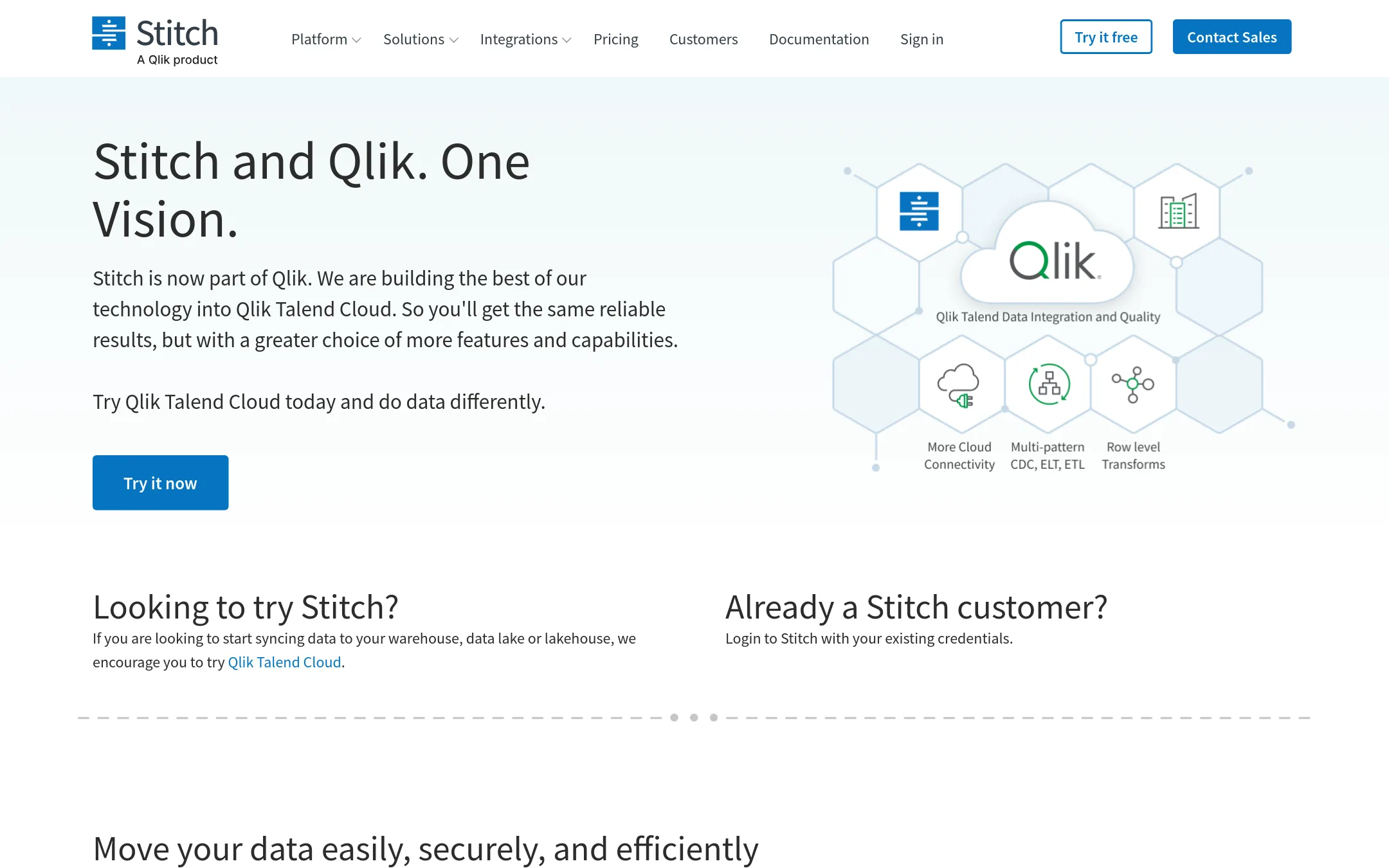
Stitch is a data integration tool that syncs data from 130+ sources into your warehouse, data lake, or lakehouse. It's a good fit if you need a straightforward ETL pipeline and are already comfortable with Qlik's ecosystem, since Stitch is being folded into Qlik Talend Cloud.
Where it is strong
- Connects to 130+ sources, including on-premises options.
- Transparent pricing based on rows ingested, with a 14-day free trial.
- SOC 2 Type II and ISO 27001 compliance on Standard and above.
Where it falls short
- Standard plan limits you to 1 destination and 5 users.
- Stitch is being phased into Qlik Talend Cloud, so new users are directed elsewhere.
- Pricing:
- Standard starts at 100 million rows/month with 1 destination. Advanced offers 100 million rows/month with 3 destinations. Premium offers 1 billion rows/month with 5 destinations. US pricing only. Contact for international.
- Switching from Polytomic:
- Moving from Polytomic to Stitch means rebuilding your syncs as ETL pipelines, since Stitch focuses on loading data into warehouses rather than reverse ETL or two-way syncing.
- Custom quote
7.Workato
Best for: Large enterprises that need to automate business processes across many apps and govern AI agents at scale.
- Pricing
- Custom quote
- Category
- AI & Machine Learning
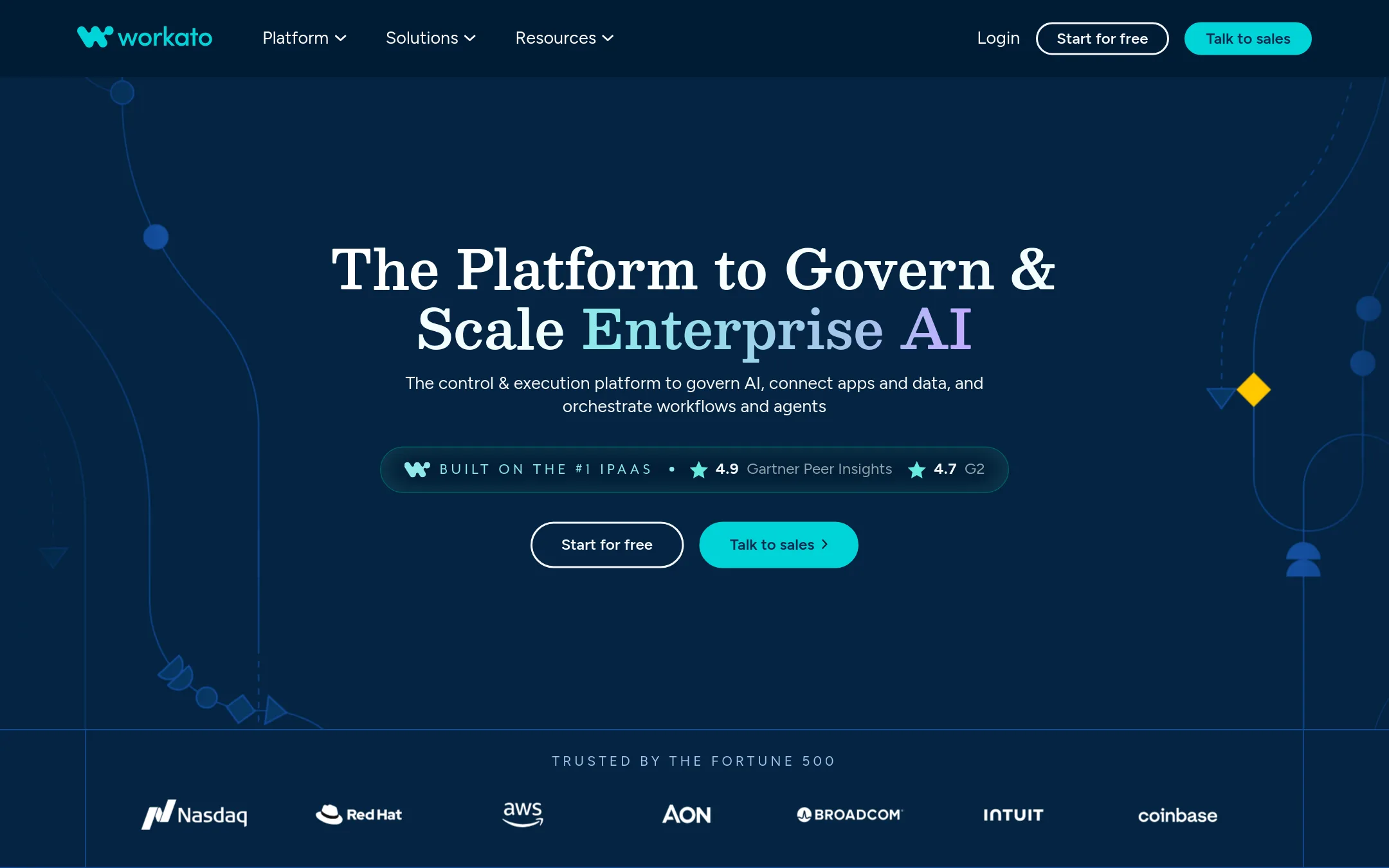
Workato is an enterprise iPaaS that connects 17,000+ apps and includes data integration, API management, and AI agent orchestration. Choose it over Polytomic when you need broad workflow automation and AI governance alongside data syncing, not just ETL/reverse ETL.
Where it is strong
- 17,000+ pre-built connectors for apps, APIs, and databases
- Built-in AI agent orchestration and governance features
- Includes ETL, reverse ETL, and API platform in higher tiers
Where it falls short
- Pricing is not transparent and likely enterprise-level
- May be overkill if you only need simple data syncing
- Pricing:
- Pricing is not published on the site. Plans are Standard, Business MCP, Enterprise MCP, and Workato ONE, with custom quotes.
- Free, paid tiers
8.Zapier
Best for: Small teams and non-technical users who want to automate everyday app-to-app tasks without touching a data warehouse.
- Pricing
- Free, paid tiers
- Category
- Productivity & Project Management
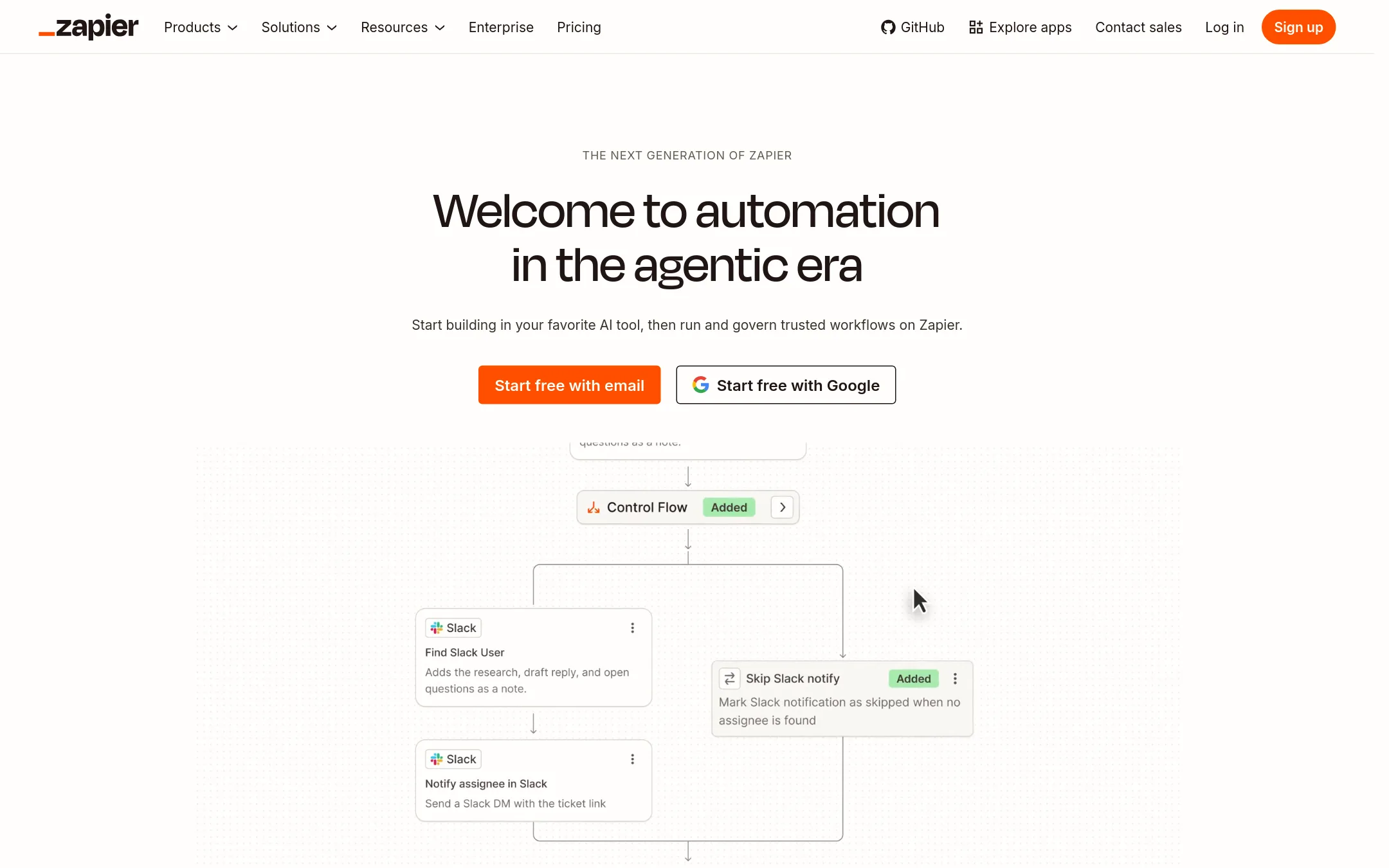
Zapier is a general-purpose automation platform that connects thousands of apps with simple triggers and actions. Choose it when you need lightweight, event-driven workflows across many SaaS tools, not heavy data warehouse syncing or reverse ETL.
Where it is strong
- Connects to 9,000+ apps with pre-built integrations
- No-code visual editor for building workflows
- Generous free tier for testing
Where it falls short
- Not designed for bulk data warehouse syncs or reverse ETL
- Task-based pricing can get expensive at scale
- Pricing:
- Free plan includes 100 tasks per month. Paid plans start at the Professional tier, but specific prices are not listed on the page.
- Switching from Polytomic:
- Moving from Polytomic to Zapier means rebuilding your data syncs as event-driven automations, which works for small volumes but lacks warehouse-native features like CDC and complex transformations.
- Not published
9.Talend
Best for: Large enterprises that need heavy data transformation, quality, and governance alongside integration.
- Pricing
- Not published
- Category
- Analytics & Data
Talend, now part of Qlik, is a full data integration and quality platform for complex, enterprise-wide data pipelines. Choose it over Polytomic when you need deep data governance, transformation, and quality features across many systems, not just simple syncs.
Where it is strong
- Broad integration and transformation capabilities
- Strong data quality and governance features
- Part of Qlik's larger analytics ecosystem
Where it falls short
- Pricing not transparent, likely enterprise-focused
- Heavier and more complex than Polytomic for simple syncs
- Pricing:
- Pricing is not published on the site.
- Not published
10.Informatica
Best for: Large enterprises that need governed, AI-ready data across multiple clouds and systems, not just warehouse syncing.
- Pricing
- Not published
- Category
- Analytics & Data
Informatica is a full enterprise data management platform covering integration, quality, governance, and master data management. Choose it over Polytomic when you need a broad suite beyond syncing, like MDM or data governance, and you're already in a Salesforce-centric enterprise stack.
Where it is strong
- 300+ connectors for broad integration coverage
- Includes data quality, governance, and MDM in one platform
- Recognized as a leader in multiple Gartner Magic Quadrants
Where it falls short
- Pricing is not transparent. Requires contacting sales
- Overkill for simple ETL/reverse ETL needs that Polytomic handles
- Pricing:
- Pricing is not published on the site. The pricing page returns a 404 error.
- Switching from Polytomic:
- Moving from Polytomic to Informatica means adopting a much larger platform with a steeper learning curve and likely a longer implementation, since it covers more than just data syncing.
See more comparisons in Analytics & Data alternatives.
FAQ
Questions about Polytomic alternatives
What is the difference between ETL and reverse ETL?
ETL moves data from sources into a data warehouse. Reverse ETL moves data from the warehouse back into business tools like CRM or marketing platforms. Polytomic does both in one platform.
Which alternative is best for a small team without a data warehouse?
Zapier is best for small teams that need to automate app-to-app tasks without touching a data warehouse. It connects to 9,000+ apps and has a free plan, but it is not designed for bulk data syncs.
Are there free plans available among these alternatives?
Yes. Zapier offers a free plan with 100 tasks per month. Fivetran and Census both offer free plans up to 500,000 monthly active rows. Airbyte's Standard plan starts at $195 per month, but it is open-source.
Which option provides on-prem or hybrid deployment?
Airbyte offers hybrid deployment, keeping data in your environment. Fivetran supports hybrid deployment on Enterprise or Business Critical plans. Polytomic offers on-prem deployment on its Enterprise tier.
How do pricing models compare?
Pricing varies. Polytomic starts at $500 per month. Airbyte has flat monthly plans starting at $195. Fivetran and Census use usage-based pricing with free tiers. Zapier uses task-based pricing. Others like Workato and Informatica do not publish prices.
Last updated October 16, 2026.