
Relace alternatives
6 products compared · Updated November 9, 2026
The short answer
The three strongest alternatives to Relace are OpenRouter, Together AI and Fireworks AI. OpenRouter suits teams that want one API key and one bill across hundreds of models from many providers. Together AI suits teams that need serverless inference plus GPU clusters, fine-tuning and dedicated endpoints under one provider. Fireworks AI suits multi-model teams that need open-model inference together with fine-tuning or data residency in their own cloud.
Your shortlist, at a glance
Read the comparisons ↓- OOpenRouterNot publishedTeams that want one API key and one bill across hundreds of models from many providers, with routing and fallback between them
- TTogether AIFrom $0.15 / 1M tokensTeams that want serverless inference plus GPU clusters, fine-tuning and dedicated endpoints under one provider
- FFireworks AIFrom $0.05 / 1M inputMulti-model teams that need open-model inference plus fine-tuning or data residency in their own cloud
- GGroqNot publishedTeams that need low-latency inference at scale and want a dedicated inference cloud on its own hardware
- DDeepInfraFrom $0.06 / $0.18 perStartups and enterprises that need a broad model catalogue, SOC 2 and ISO 27001 compliance, or dedicated GPU clusters for inference
- NNovita AIFrom $0.03/Mt inDevelopers who want one API for many open models plus dedicated GPUs under the same account
About Relace and its alternatives
Relace is an open-weight inference provider. According to its site, it served 30 trillion tokens in the last 30 days, is one of the top providers on OpenRouter, and is usually the cheapest option for the models it serves. It bills per token with no subscription or minimum, and its site lists eight models, including DeepSeek, Kimi and GLM variants.
When comparing alternatives in this category, weigh the pricing structure first: per-token rates, cached and batch pricing, and whether a provider bills by execution time instead. Then check the model catalogue, regions and data residency, integrations, support and uptime terms, and the contract terms that come with dedicated capacity or volume discounts.
Explore the alternatives
- ONot published
1.OpenRouter
Best for: Teams that want one API key and one bill across hundreds of models from many providers, with routing and fallback between them
- Pricing
- Not published
- Category
- Other
OpenRouter is a single API that gives access to 600+ models from 80+ providers, so you can switch between models and vendors without changing your code. Relace is a narrower option: it serves a fixed set of open-weight models (DeepSeek, Kimi and GLM variants) on its own inference stack. Choose OpenRouter when you want to compare or route across many models and providers, or want one bill and one key for all of them.
Where it is strong
- Access to 600+ models from 80+ providers through one OpenAI-compatible API
- Pay-as-you-go credits with no subscription on the Standard plan
- Free tier with 25+ free models and 50 requests per day
Where it falls short
- Standard plan adds a 5.5% fee on credit purchases, and Business adds 8%
- Fallback and provider routing adds a layer you have to understand to control cost and latency
- Pricing:
- Pricing is not published on the site.
- TFrom $0.15 / 1M tokens
2.Together AI
Best for: Teams that want serverless inference plus GPU clusters, fine-tuning and dedicated endpoints under one provider
- Pricing
- From $0.15 / 1M tokens
- Category
- Other
Together AI is a full-stack AI cloud. Besides serverless model inference, it sells GPU clusters, dedicated endpoints, fine-tuning, storage and sandboxes. Choose it over Relace when you need more than token inference, such as your own GPU capacity, custom or fine-tuned models, or committed throughput with an uptime SLA.
Where it is strong
- Covers inference, GPU clusters, fine-tuning and storage in one platform
- Offers provisioned throughput with a 99% uptime SLA for production workloads
- Lists a batch API price for asynchronous, high-volume jobs
Where it falls short
- Relace's listed token prices for the same open models look lower in several cases, such as Kimi K3 output
- Wider product range means more to learn than a pure inference API
- Pricing:
- Serverless prices are per million tokens and vary by model, for example Kimi K3 at $3.00 input and $15.00 output, and GLM-5.3-Flash at $0.15 input and $0.50 output, with a separate Batch API price list.
- Switching from Relace:
- Both expose open models through per-token APIs, so the main change is pointing your client at Together's endpoint and matching model names. Relace's site does not describe a migration process.
- FFrom $0.05 / 1M input
3.Fireworks AI
Best for: Multi-model teams that need open-model inference plus fine-tuning or data residency in their own cloud
- Pricing
- From $0.05 / 1M input
- Category
- Other
Fireworks AI runs open models for inference, and it also offers ensembling (routing each request to the right model) and training on your own data. Teams pick it over Relace when they need more than a token API: dedicated capacity, data residency across 30+ regions, fine-tuning on their own data, or running inference inside their own cloud.
Where it is strong
- Covers inference, ensembling and training on one platform
- Offers Reserved Throughput with an SLA and 99.9% uptime terms
- Supports data residency across 30+ regions and in your own cloud
Where it falls short
- Sovereign deployment is a private preview for Enterprise customers only
- Ultra-fast mode is in preview and available by request only
- Pricing:
- Serverless pricing is pay-per-token from $0.05 per million input tokens, with Standard and Priority rates per model, Batch at half the Standard rate, and Reserved Throughput and Sovereign plans available by contract.
- Switching from Relace:
- Moving from Relace means changing the API endpoint and key, since both providers serve open models over a token API. The pricing pages do not describe a migration process.
- GNot published
4.Groq
Best for: Teams that need low-latency inference at scale and want a dedicated inference cloud on its own hardware
- Pricing
- Not published
- Category
- Other
Groq runs inference on its own LPU hardware, now alongside NVIDIA GPUs through its LPX line, and sells capacity as a cloud service. Someone would choose Groq over Relace when they want a provider built around hardware for fast inference at large scale, or when they want to own a dedicated inference platform rather than buy tokens from an open-weight host.
Where it is strong
- Built on its own LPU hardware for inference
- Positioned as a dedicated inference cloud with capacity still being added
- Serves millions of developers according to its site
Where it falls short
- No public per-token pricing to compare against Relace's posted rates
- The site does not list the specific models it serves
- Pricing:
- Pricing is not published on the site.
- DFrom $0.06 / $0.18 per
5.DeepInfra
Best for: Startups and enterprises that need a broad model catalogue, SOC 2 and ISO 27001 compliance, or dedicated GPU clusters for inference
- Pricing
- From $0.06 / $0.18 per
- Category
- Other
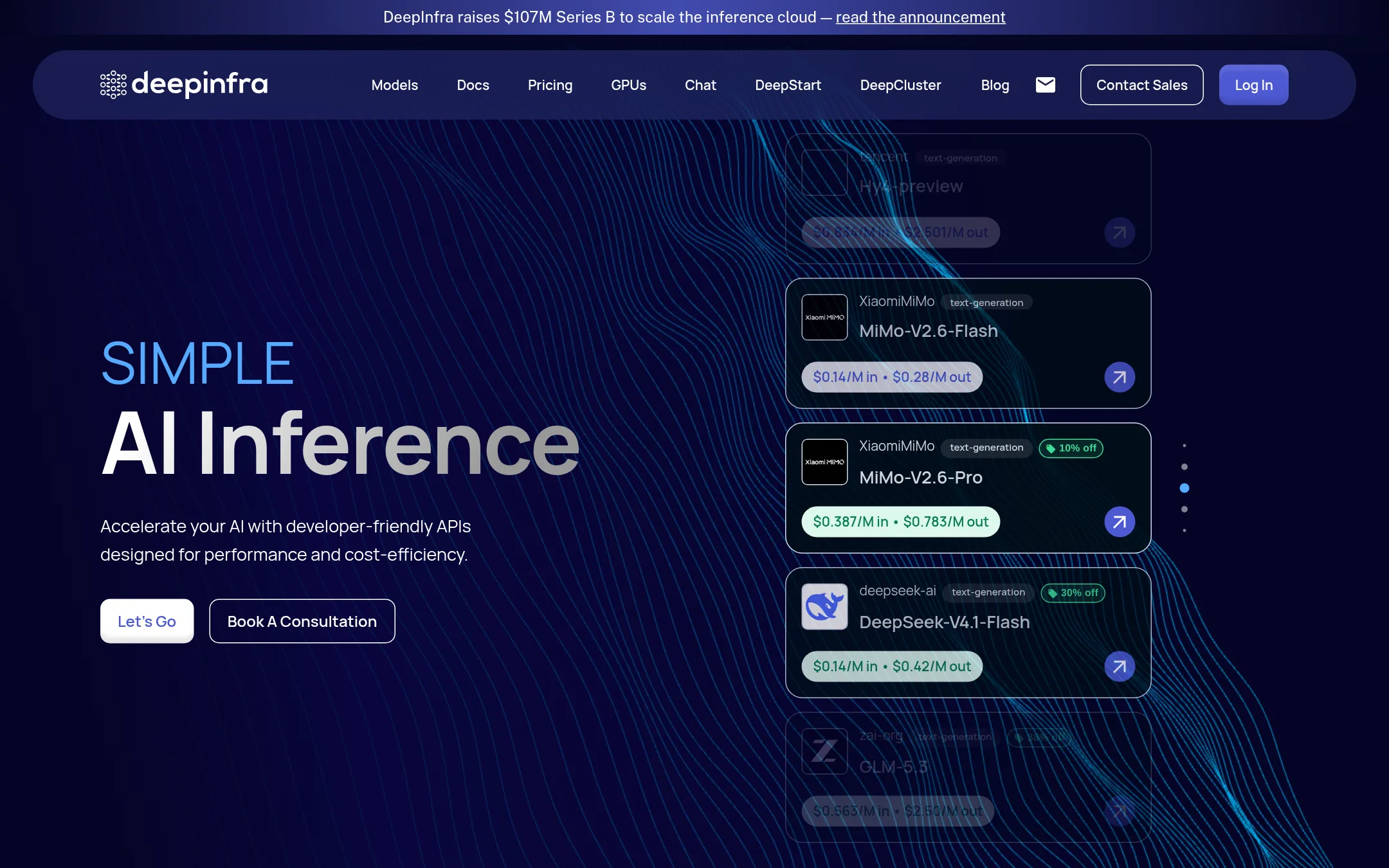
DeepInfra is a pay-as-you-go inference cloud that serves 100+ open models through a simple API, with zero data retention and SOC 2 and ISO 27001 certification. Teams pick it over Relace when they need a wider model catalogue, dedicated NVIDIA B300 clusters with a 99.982% uptime SLA, or compliance paperwork for a security review.
Where it is strong
- Serves 100+ models across DeepSeek, Kimi, GLM, Qwen, Llama, Gemini, Gemma and Nemotron families
- Zero retention policy with SOC 2 and ISO 27001 certification
- Offers dedicated NVIDIA B300 GPU clusters with a 99.982% uptime SLA
Where it falls short
- Its infrastructure is US-based, with no regional data centres mentioned on the site
- Many models are billed by execution time rather than per token, so costs are harder to predict
- Pricing:
- Pricing is billed per million tokens with no contracts or minimums, for example DeepSeek-V4-Flash-0731 at $0.06 input and $0.18 output, and GLM-5.3 at $0.90 input and $4.00 output before its listed discount.
- Switching from Relace:
- Both platforms use per-token API access, so moving usually means swapping the base URL and API key and then checking that the model IDs you use exist on DeepInfra.
- NFrom $0.03/Mt in
6.Novita AI
Best for: Developers who want one API for many open models plus dedicated GPUs under the same account
Novita AI is a developer cloud that offers a single API for over 200 hosted models, plus GPU instances and agent sandboxes. Teams pick it over Relace when they want one vendor for model APIs and dedicated GPU capacity, or when they need a wider model catalogue than Relace's eight models. Its listed prices for DeepSeek V4 Pro and GLM 5.3 are in the same range as Relace's.
Where it is strong
- Over 200 models through one API, against Relace's eight
- Offers dedicated GPU instances and agent sandboxes as well as model APIs
- Private endpoints with isolated resources for steadier latency
Where it falls short
- Its own model rates are not always lower than Relace's, so compare the exact model you need
- Relace's own listing on OpenRouter is a reference point for price, but Novita's pricing is quoted separately per model
- Pricing:
- Pricing is pay per token with a published rate table, for example DeepSeek V4 Pro at $1.6 per million input tokens and $3.2 per million output tokens, and batch inference at an introductory 50% discount on supported models.
- Switching from Relace:
- Moving from Relace to Novita means changing the base URL and API key in your client and checking that each model you use has the same name and output behaviour on Novita.
See more comparisons in AI & Machine Learning alternatives.
FAQ
Questions about Relace alternatives
What is Relace best known for?
According to its site, Relace is one of the fastest-growing open-weight inference providers, with 30 trillion tokens served in the last 30 days. It is known for being one of the top providers on OpenRouter and usually the cheapest option for the models it serves. Its pricing is pay-as-you-go per token with no subscription or minimum.
Which alternative has the widest model catalogue?
Novita AI lists over 200 hosted models through one API, and DeepInfra serves 100+ open models across several families. OpenRouter gives access to 600+ models from 80+ providers. Relace's site lists eight models, so these alternatives offer far more choice.
Which alternative is better if I need more than token inference?
Together AI covers inference, GPU clusters, fine-tuning, storage and sandboxes in one platform, and it offers provisioned throughput with a 99% uptime SLA. Fireworks AI adds training on your own data and data residency across 30+ regions. Novita AI also offers dedicated GPU instances alongside its model APIs.
Which alternatives publish compliance certifications?
DeepInfra states that it holds SOC 2 and ISO 27001 certification and has a zero data retention policy, which can help with a security review. Relace's site does not list certifications, so buyers with formal compliance needs should ask Relace directly before deciding.
How do I compare prices across these providers?
Compare the exact model you plan to use, since rates differ by model and provider. Relace lists per-million-token prices for input, cached input and output, and Novita AI and DeepInfra publish their own per-model rate tables. Groq does not publish per-token pricing on its site, so you will need to request it directly.
Last updated November 9, 2026.