
RevenueCat alternatives
6 products compared · Updated November 5, 2026
The short answer
The three strongest RevenueCat alternatives are Superwall, Adapty, and Qonversion. Superwall suits mobile teams that run frequent paywall experiments and want to change pricing without waiting on app store review. Adapty suits subscription app teams that want paywall testing, revenue analytics, and ad attribution in one platform. Qonversion suits mobile subscription apps that want paywall testing, revenue analytics, and refund handling in one tool.
Your shortlist, at a glance
Read the comparisons ↓- AAdaptyFree to $5K/mo, then 1Subscription app teams that want paywall testing, revenue analytics and ad attribution in one platform rather than a purchase backend alone
 SuperwallUp to $10k, then 1%Mobile app teams that run frequent paywall experiments and want to change pricing and offers without waiting on app store review
- QQonversion0.8% of tracked rev.Mobile subscription apps that want paywall testing, revenue analytics, and refund handling in one tool without a separate experimentation vendor
- AApphud0.99% of MTR, $49/mo mIndie and mid-size subscription apps that want paywall design, pricing tests and refund defense in one tool
- PPurchaselyNot publishedGrowth and product teams at mobile apps that want to test paywalls, onboarding and win-back flows without waiting on engineering releases.
 Stripe2.9% + 30¢Web and SaaS businesses that bill customers directly and want to avoid app store fees on subscriptions
About RevenueCat and its alternatives
RevenueCat is a subscription backend for in-app purchases. According to its site, it handles purchase setup and receipt validation across StoreKit, Google Play, smart TV, and web, and it offers paywall, A/B testing, and analytics tools alongside that core.
When comparing alternatives in this category, weigh the pricing structure first, including whether the tool charges a percentage of tracked revenue, a flat fee, or a free tier with limits. Then check regional coverage, the integrations you already depend on, the level of support you get at your revenue stage, and the contract terms.
Explore the alternatives
- AFree to $5K/mo, then 1
1.Adapty
Best for: Subscription app teams that want paywall testing, revenue analytics and ad attribution in one platform rather than a purchase backend alone
- Pricing
- Free to $5K/mo, then 1
- Category
- Other
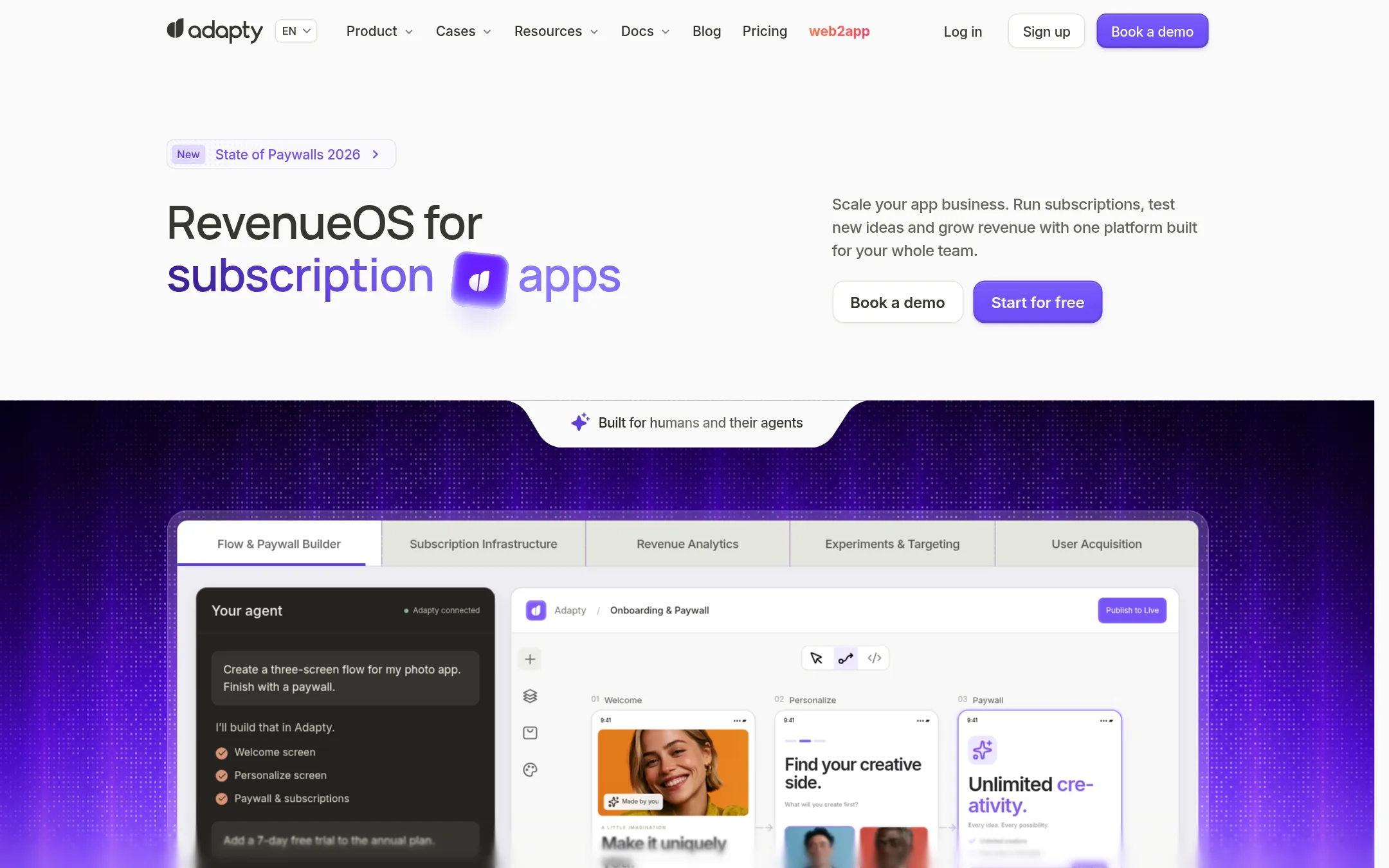
Adapty runs in-app subscription infrastructure for mobile apps. It validates purchases, keeps access levels in sync across iOS, Android and the web, and includes a paywall and onboarding builder with A/B testing and revenue analytics. A team would pick it over RevenueCat when they want paywall changes and experiments without app releases, or when they want built-in attribution and campaign-level revenue reporting alongside the purchase layer.
Where it is strong
- Paywalls and onboarding flows can be changed from the dashboard without shipping an app update.
- A/B tests can be judged on revenue per user and predicted LTV, not only conversion rate.
- Apple Ads attribution is built in, and an existing MMP can be connected.
Where it falls short
- Its own pricing page describes the free tier as covering apps under $5K per month, so the cost picture changes as revenue grows.
- The comparison data does not show whether it matches RevenueCat's regional coverage or integration count, so check those for your markets an
- Pricing:
- Adapty is free while a app earns under $5K per month, then charges 1% of monthly tracked revenue beyond $5K, and Enterprise pricing is custom.
- Switching from RevenueCat:
- Adapty says migration usually takes a few days to a week, that it will help plan the move and import data, and that complex setups can run alongside the current system during the switch.
- Up to $10k, then 1%
2.Superwall
Best for: Mobile app teams that run frequent paywall experiments and want to change pricing and offers without waiting on app store review
- Pricing
- Up to $10k, then 1%
- Category
- E-commerce
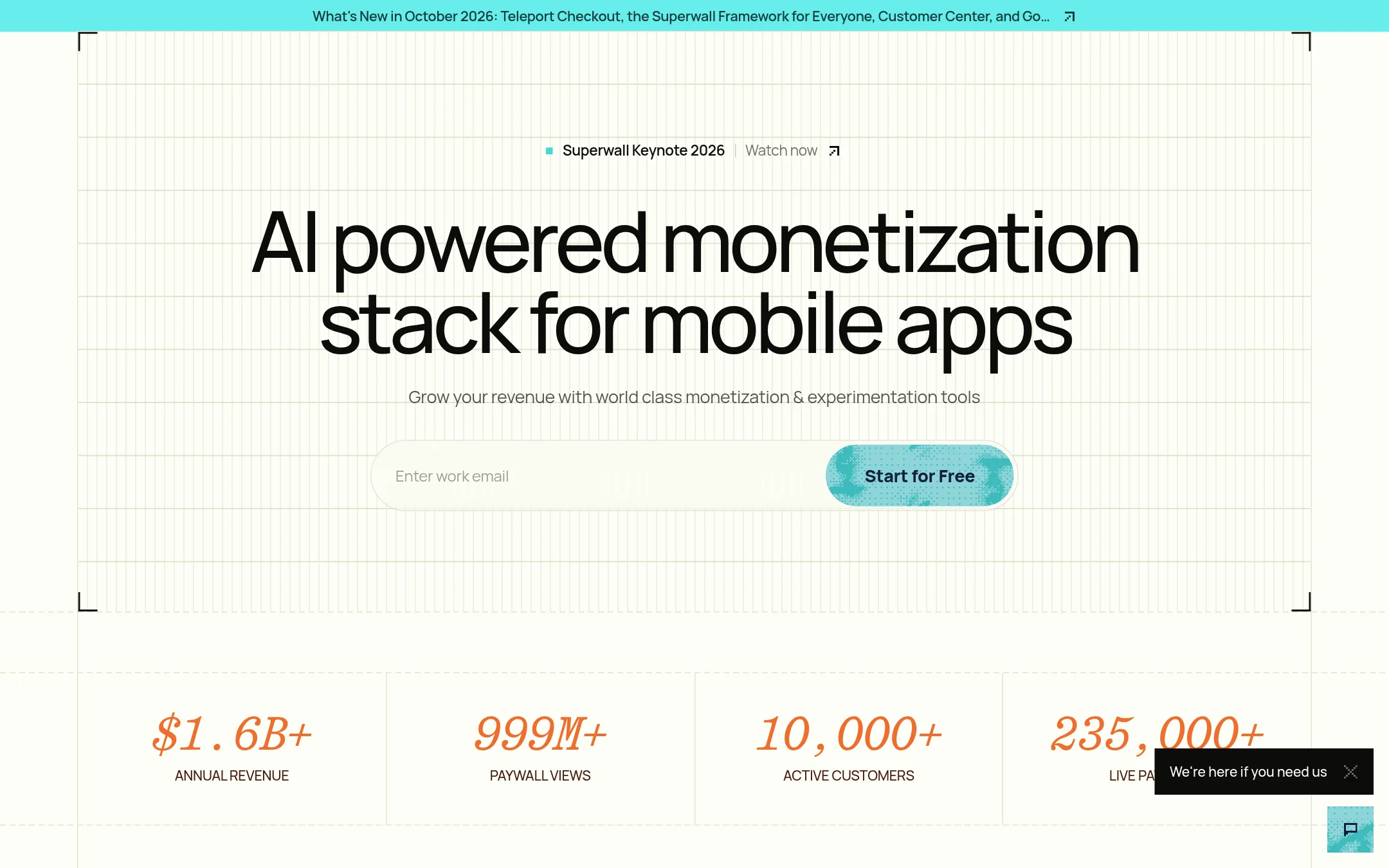
Superwall lets teams build, test, and change paywalls remotely, without shipping an app update. It also covers entitlements, purchase APIs, and webhooks, so it can act as the subscription backend. Teams choose it over RevenueCat when paywall testing and fast iteration matter most, or when they want to move off RevenueCat's model entirely.
Where it is strong
- Paywalls, audiences, and A/B tests can be changed remotely without an app release
- Entitlement, purchase, webhook, and SQL query access are stated as free on every plan
- Supports iOS, Android, and web, with SDKs for Swift, Kotlin, React Native, Expo, and Flutter
Where it falls short
- Paywall fees apply only to revenue that flows through a Superwall paywall, which means pricing depends on how much of your revenue passes th
- Advanced features such as Refund Protection, Dedicated Account Manager, and SSO are reserved for higher tiers or Enterprise
- Pricing:
- Pricing is not published as a single rate on the site: the Indie plan is listed as up to $10k MAR then 1% of total MAR, Startup adds 1% of MAR, and Scale and Enterprise are custom, with entitlements and subscription data access stated as free on every plan.
- Switching from RevenueCat:
- Moving from RevenueCat involves swapping the SDK, porting subscription history and entitlement state, and reconfiguring webhooks, and the site says an AI coding agent can handle this in under an hour.
- Q0.8% of tracked rev.
3.Qonversion
Best for: Mobile subscription apps that want paywall testing, revenue analytics, and refund handling in one tool without a separate experimentation vendor
- Pricing
- 0.8% of tracked rev.
- Category
- Other
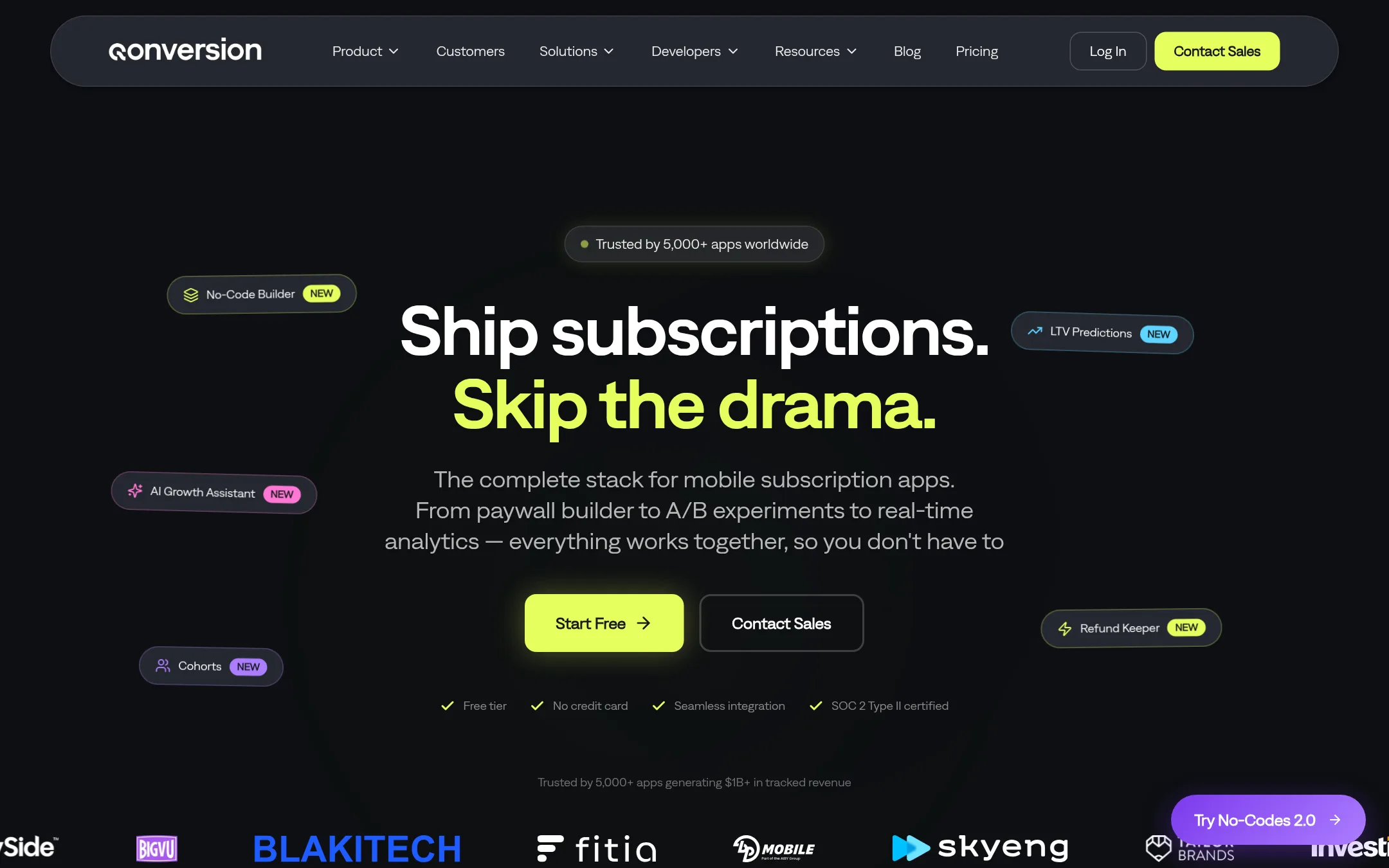
Qonversion is a subscription stack for mobile apps covering paywall building, A/B experiments, and real-time subscription analytics across iOS, Android, and web. Teams would pick it over RevenueCat when they want the paywall builder, experiments, and analytics in one place, and they want to pay only once tracked revenue passes a set threshold.
Where it is strong
- No-code paywall builder that updates without an app release
- A/B experiments that measure revenue outcomes rather than click-through rates
- Pro includes all features, with no feature tiers or seat fees
Where it falls short
- Pricing is a percentage of tracked revenue, so costs rise as revenue grows
- Enterprise terms such as SLA and onboarding are only available on custom contracts
- Pricing:
- Pricing is 0.8% of tracked revenue on the Pro plan, free until monthly tracked revenue passes $7,000, with Enterprise available on custom contracts.
- A0.99% of MTR, $49/mo m
4.Apphud
Best for: Indie and mid-size subscription apps that want paywall design, pricing tests and refund defense in one tool
- Pricing
- 0.99% of MTR, $49/mo m
- Category
- Other
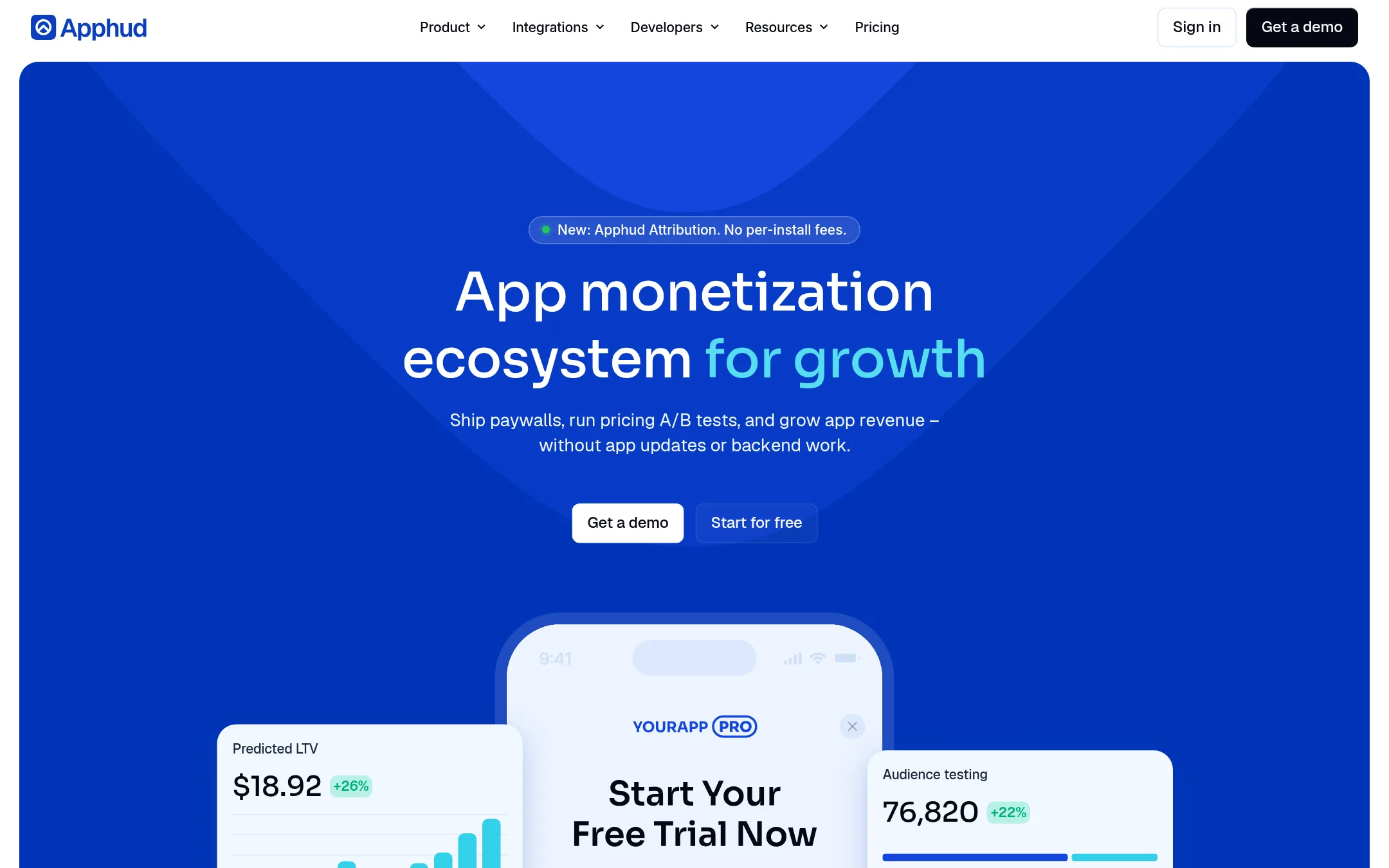
Apphud is a subscription and monetization platform for iOS, Android and web apps. It handles in-app purchase logic, runs paywall and pricing A/B tests, and offers LTV predictions and revenue reporting. A team would pick it over RevenueCat when they want paywalls built from Figma, refund protection, or a free tier with a flat percentage of tracked revenue.
Where it is strong
- Paywalls can be built from Figma designs and shipped without an app update
- Free plan includes core subscription infrastructure for apps under $10K MTR
- Refund Shield is offered as an add-on to defend against unjustified App Store refunds
Where it falls short
- Advanced features such as A/B tests, integrations and LTV predictions sit behind the Pro and Expert tiers
- Free plan access to the dashboard ends if MTR stays above $10K past a 14-day grace period
- Pricing:
- Pricing is charged as a share of Monthly Tracked Revenue: the Free plan covers apps under $10K MTR, Pro is 0.99% of MTR with a $49/mo minimum, and Expert is 1.19% of MTR with a $59/mo minimum.
- PNot published
5.Purchasely
Best for: Growth and product teams at mobile apps that want to test paywalls, onboarding and win-back flows without waiting on engineering releases.

- Pricing
- Not published
- Category
- Other
Purchasely is a mobile app platform that lets growth and product teams build, test, and publish in-app screens without a developer release. It covers paywalls, onboarding, win-back offers, and loyalty moments across the whole user lifecycle. A team would pick it over RevenueCat when the main problem is changing and testing in-app experiences quickly, not managing purchase backends.
Where it is strong
- Publish and change in-app screens without a developer release or app store review
- Run A/B tests on any screen or journey and roll out the winner the same day
- Connects with CRM, analytics and data tools to target audiences by segment
Where it falls short
- Its focus is on the in-app experience layer, so it is not a replacement for RevenueCat's purchase and receipt infrastructure
- Pricing is not published, so cost comparison requires talking to sales
- Pricing:
- Pricing is not published on the site.
- 2.9% + 30¢
6.Stripe
Best for: Web and SaaS businesses that bill customers directly and want to avoid app store fees on subscriptions
- Pricing
- 2.9% + 30¢
- Category
- Finance & Accounting
Stripe is a general payments and billing platform that handles card payments, recurring billing, invoicing and payouts across web and in-person commerce. A founder would choose it over RevenueCat when the product is a web or SaaS business, or when the goal is to take payments outside the app stores, where RevenueCat's focus on in-app subscription management and app store receipts is less relevant.
Where it is strong
- Covers payments, recurring billing, invoicing and payouts in one platform.
- Supports 135+ currencies and payment methods, per its own figures.
- Offers 99.999% historical uptime and handles high API volume.
Where it falls short
- It is not built around in-app purchase receipts, so mobile subscription handling needs more custom work than with RevenueCat.
- Dispute and 3D Secure fees add cost on top of the base rate.
- Pricing:
- Stripe's standard online card pricing is 2.9% + 30¢ per successful domestic transaction, with extra fees for international cards and currency conversion, and custom pricing is available for larger volumes.
- Switching from RevenueCat:
- Moving from RevenueCat to Stripe means rebuilding subscription state and receipt validation on your own backend, since Stripe does not replace the app store billing layer.
See more comparisons in Finance & Accounting alternatives.
FAQ
Questions about RevenueCat alternatives
Which RevenueCat alternative is best for testing paywalls without app releases?
Superwall is built for teams that run frequent paywall experiments and want to change pricing and offers remotely. Adapty and Qonversion also offer no-code paywall builders that update without an app release. Purchasely focuses on changing in-app screens and journeys quickly, though it does not publish its pricing.
Is there a free option compared with RevenueCat?
Adapty is free while an app earns under $5K per month, then charges 1% of monthly tracked revenue beyond that. Qonversion is free until monthly tracked revenue passes $7,000, and Apphud's Free plan covers apps under $10K monthly tracked revenue. RevenueCat's own free threshold is $2,500 in monthly tracked revenue.
Which alternative is not a mobile in-app purchase tool?
Stripe is a general payments and billing platform for card payments, recurring billing, and invoicing across web and in-person commerce. It is a fit for web and SaaS businesses that bill customers directly. It is not built around in-app purchase receipts, so mobile subscription handling needs more custom work.
How do the pricing models differ between these tools?
Most of the mobile options charge a percentage of monthly tracked revenue, such as 0.8% for Qonversion, 0.99% for Apphud's Pro plan, and 1% for Adapty above its free threshold. Superwall's fees apply only to revenue that flows through its paywalls. Stripe charges per transaction, at 2.9% plus 30¢ for standard domestic online card payments.
What should I check before switching from RevenueCat?
Confirm that the alternative covers the regions and app stores you sell in, and that it connects with your marketing, analytics, and MMP tools. Check whether advanced features such as refund protection or dedicated support sit behind higher tiers. Also check whether pricing will rise as your revenue grows.
Last updated November 5, 2026.