
Semaphore alternatives
12 products compared · Updated October 31, 2026
The short answer
For most teams, CircleCI offers a mature, widely adopted CI/CD platform with a free tier and flexible credit-based pricing. GitLab is the strongest choice if you want an integrated DevSecOps platform with source control, CI/CD, and security scanning in one tool. Buildkite suits teams that need self-hosted agents, unlimited parallelism, and programmable pipelines for complex or AI-driven workflows.
Your shortlist, at a glance
Read the comparisons ↓ CircleCIFree, then $15/25k creTeams that need a well-known CI/CD platform with a wide range of machine types, including GPU and macOS, and a free tier to start.
 GitHub ProjectsFree / $4 per user/moTeams already on GitHub that want basic project tracking without adopting a separate tool.
 BuildkiteFrom $30/user/moTeams that need self-hosted agents, unlimited parallelism, and programmable pipeline orchestration for complex or AI-driven CI/CD workflows.
 GitLabFrom $12/user/moTeams that want an integrated DevSecOps platform with source control, CI/CD, and security scanning in one tool.
JenkinsFree (self-hosted)Teams that want full control over their CI/CD infrastructure and need to integrate with a wide range of legacy or niche tools.
 Travis CINot publishedTeams that need on-premise or private cloud CI/CD, or that use Perforce and Subversion repositories.
 BitbucketNot publishedTeams already using Jira and Atlassian products that want a unified code hosting and CI/CD solution with native project tracking.
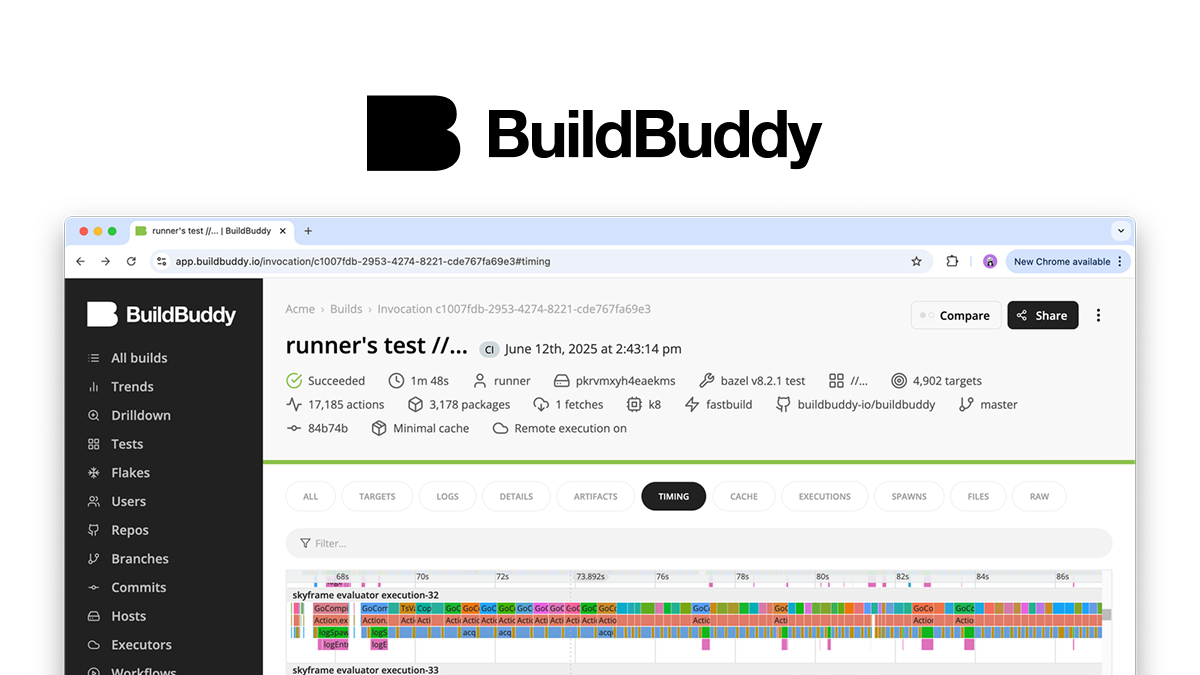 BuildBuddyFree / customTeams already using Bazel that need remote caching and execution to cut build times dramatically.
 WarpBuildSee websiteAccelerate software development with WarpBuild's 10x faster CI infra.
 AWS ParallelClusterPay-as-you-goResearch teams and engineers running HPC workloads on AWS who need to manage their own cluster infrastructure.
 BitriseNot publishedMobile engineering teams building and shipping iOS and Android apps who want a dedicated DevOps platform with managed macOS infrastructure.
 EngFlowCustom quoteLarge engineering organizations with Bazel-based monorepos that need to cut build times from hours to minutes.
About Semaphore and its alternatives
Semaphore is an AI-driven CI/CD platform built for coding agents. It offers fast builds, predictable per-job pricing, and enterprise features like SOC 2 Type II certification and SAML SSO. It is open source and provides a free tier with $15 of usage per month.
When comparing alternatives, weigh pricing structure (per-minute, per-seat, or credits), supported regions and machine types, integrations with your existing tools, support options and SLAs, and contract terms like annual discounts or free tiers. Consider whether you need a general-purpose CI/CD tool or one specialized for mobile, Bazel, or HPC workloads.
Explore the alternatives
- Free, then $15/25k cre
1.CircleCI
Best for: Teams that need a well-known CI/CD platform with a wide range of machine types, including GPU and macOS, and a free tier to start.
- Pricing
- Free, then $15/25k cre
- Category
- Developer Tools
CircleCI is a mature, widely adopted CI/CD platform that runs on a credit-based model, with a free tier and flexible usage-based pricing. Teams already invested in CircleCI's ecosystem, or those needing extensive resource classes including GPU and macOS, would choose it over Semaphore for its breadth of options and established integrations.
Where it is strong
- Free tier with 6,000 build minutes monthly
- Wide range of resource classes, including GPU and macOS
- Credits-based model lets you pay only for what you use
Where it falls short
- Credit system can be complex to estimate costs
- Advanced features like Smarter Testing are limited on lower plans
- Pricing:
- Free plan includes up to 6,000 build minutes/month and 5 active users. Performance plan starts with 30,000 free credits/month, then $15 for every additional 25,000 credits, plus $15/month per additional user.
- Free / $4 per user/mo
2.GitHub Projects
Best for: Teams already on GitHub that want basic project tracking without adopting a separate tool.
- Pricing
- Free / $4 per user/mo
- Category
- Productivity & Project Management
GitHub Projects is a lightweight project management layer that lives inside GitHub, so teams that already host code there can plan and track work without leaving the platform. Choose it over Semaphore when your priority is issue tracking and sprint planning next to your repos, not CI/CD performance.
Where it is strong
- Native integration with GitHub repos and pull requests
- Free tier includes 2,000 CI/CD minutes per month
- Simple, familiar interface for GitHub users
Where it falls short
- Not a dedicated CI/CD tool. Lacks advanced pipeline features
- CI/CD minutes are limited on lower plans
- Pricing:
- Free plan includes unlimited public/private repositories and 2,000 CI/CD minutes/month. Team is $4 per user/month. Enterprise is $21 per user/month.
- From $30/user/mo
3.Buildkite
Best for: Teams that need self-hosted agents, unlimited parallelism, and programmable pipeline orchestration for complex or AI-driven CI/CD workflows.

- Pricing
- From $30/user/mo
- Category
- Other
Buildkite is a programmable CI/CD platform that runs on your own infrastructure or hosted agents, giving you full control over compute and workflows. Choose it over Semaphore if you need unlimited parallelism, dynamic pipelines, and deep integration with your existing infrastructure, especially for AI workflows or large monorepos.
Where it is strong
- Unlimited parallelism for fast feedback
- Dynamic pipelines and flexible primitives
- Self-hosted agents keep control on your infra
Where it falls short
- Per-user pricing can add up for large teams
- Requires more setup and maintenance than managed CI
- Pricing:
- Free plan includes up to 5 users, 10 concurrent jobs, and 2,000 Linux vCPU minutes/month. Pro plan is $30 per active user/month with 4,000 Linux vCPU minutes. Hosted agents billed per vCPU minute: Linux $0.004, Mac $0.02, Windows $0.008.
- Switching from Semaphore:
- Moving from Semaphore involves reconfiguring pipelines to Buildkite's YAML format and setting up agents, though Buildkite offers migration services.
- From $12/user/mo
4.GitLab
Best for: Teams that want an integrated DevSecOps platform with source control, CI/CD, and security scanning in one tool.
GitLab is a full DevSecOps platform that combines source control, CI/CD, security scanning, and AI orchestration in one place. Choose it over Semaphore if you want a single tool for the entire software lifecycle, not just CI/CD, and need built-in security and compliance features.
Where it is strong
- Includes source control, CI/CD, and security scanning in one platform
- AI features available via GitLab Credits add-on
- Free tier for individuals and open source
Where it falls short
- Per-seat pricing can get expensive for large teams
- Compute minutes are capped per plan, unlike Semaphore's pay-as-you-go model
- Pricing:
- Free plan includes 5 users and 400 compute minutes per month. Premium is $12 per user/month with 10,000 compute minutes. Ultimate is $24 per user/month with 50,000 compute minutes.
- Switching from Semaphore:
- Moving from Semaphore to GitLab means migrating your pipelines to GitLab CI/CD syntax and reconfiguring your source control if you're not already using GitLab.
- Free (self-hosted)
5.Jenkins
Best for: Teams that want full control over their CI/CD infrastructure and need to integrate with a wide range of legacy or niche tools.
- Pricing
- Free (self-hosted)
- Category
- Developer Tools
Jenkins is a self-hosted, open-source automation server with a huge plugin ecosystem, so you control everything from infrastructure to pipeline logic. Choose it over Semaphore when you need deep customization, on-premise operation, or integration with tools that only exist as Jenkins plugins.
Where it is strong
- Open source with no per-minute or per-seat fees
- 2300+ plugins cover nearly every tool in the CI/CD chain
- Runs on your own machines, so data stays in-house
Where it falls short
- You manage servers, updates, and scaling yourself
- No built-in AI agent support or agent-native workflows like Semaphore
- Pricing:
- Pricing is not published on the site.
- Not published
6.Travis CI
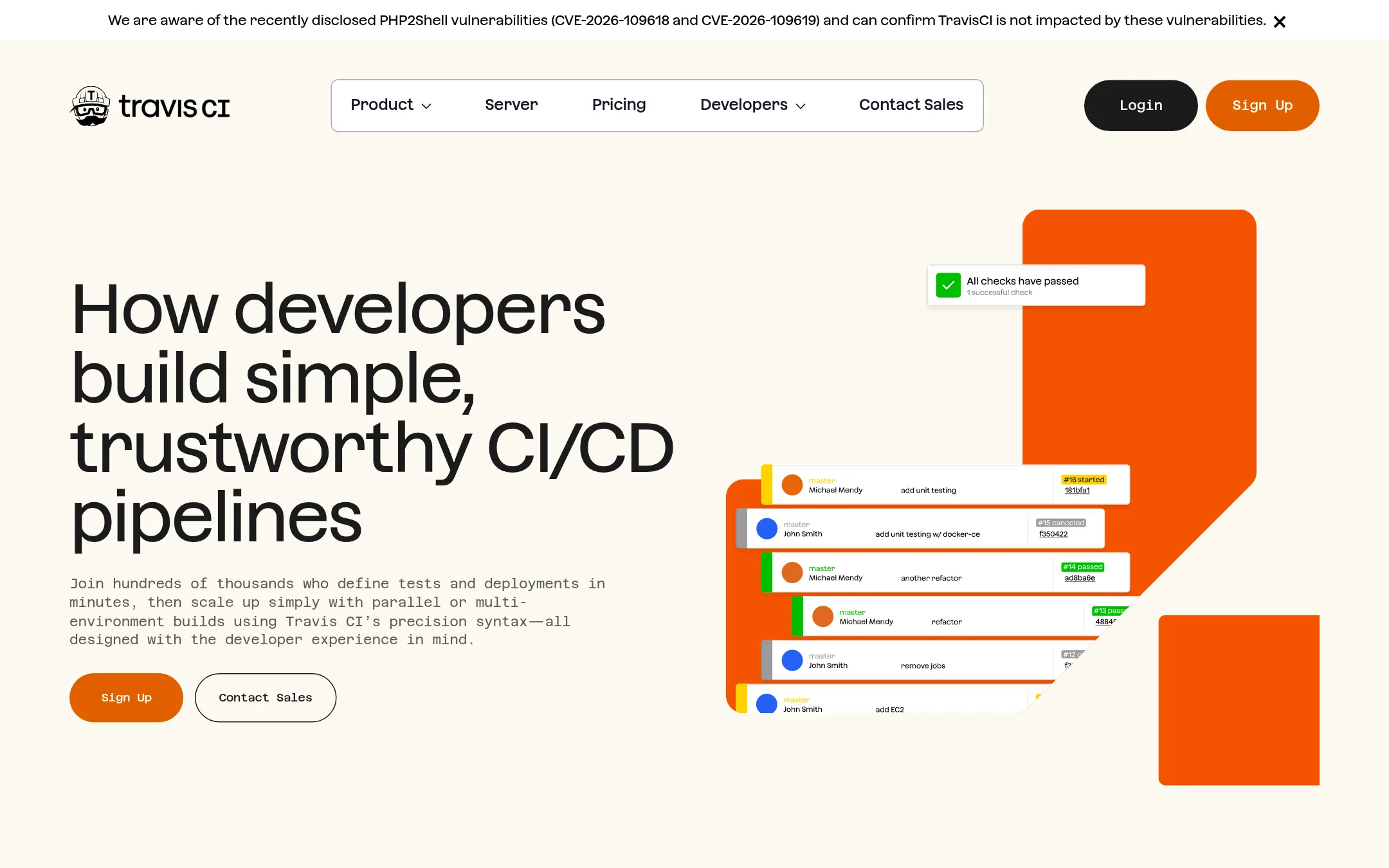
Best for: Teams that need on-premise or private cloud CI/CD, or that use Perforce and Subversion repositories.
- Pricing
- Not published
- Category
- Other
Travis CI is a straightforward CI/CD tool that supports on-premise or private cloud deployments, which is useful for teams that need to keep builds inside their own infrastructure. It also handles Perforce and Subversion, so it fits teams using those version control systems. Choose Travis CI over Semaphore if you need those deployment options or VCS support.
Where it is strong
- On-premise and private cloud deployment options
- Supports Perforce and Subversion CI/CD
- Unlimited build credits, collaborators, and repositories on higher plans
Where it falls short
- Pricing details are not transparent on the site
- No per-minute pricing model, which may be less predictable than Semaphore's pay-as-you-go
- Pricing:
- Pricing is not published on the site. Plans start with 35,000 Linux build credits per month and 80 concurrent jobs, with annual options like 420,000 credits per year.
- Switching from Semaphore:
- Moving from Semaphore to Travis CI means reconfiguring your pipelines in Travis's YAML format and adjusting to its credit-based billing model.
- Not published
7.Bitbucket
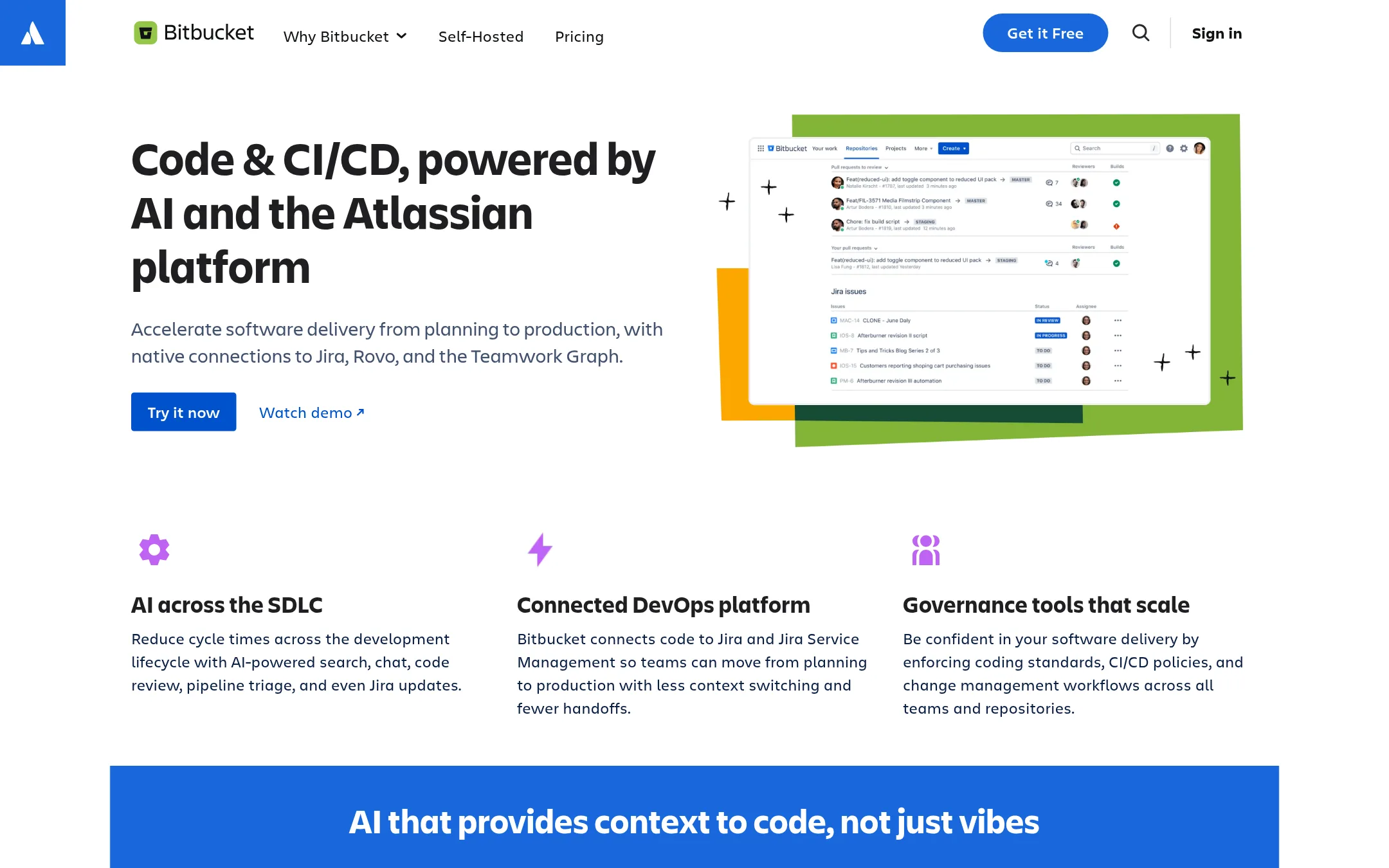
Best for: Teams already using Jira and Atlassian products that want a unified code hosting and CI/CD solution with native project tracking.
- Pricing
- Not published
- Category
- Other
Bitbucket is a Git-based code hosting and CI/CD platform tightly integrated with Jira, making it a strong choice for teams already using Atlassian tools. It offers built-in pipelines, code review, and governance features, but it is not agent-native like Semaphore and lacks the same focus on AI-driven CI/CD automation.
Where it is strong
- Deep integration with Jira for traceability from code to issues.
- Built-in CI/CD with Pipelines and support for hosted or private runners.
- Strong governance features like merge checks and granular permissions.
Where it falls short
- Not agent-native. Lacks the AI-driven CI/CD automation of Semaphore.
- Pricing details are not transparent on the site, requiring a sales contact.
- Pricing:
- Pricing is not published on the site.
- Free / custom
8.BuildBuddy
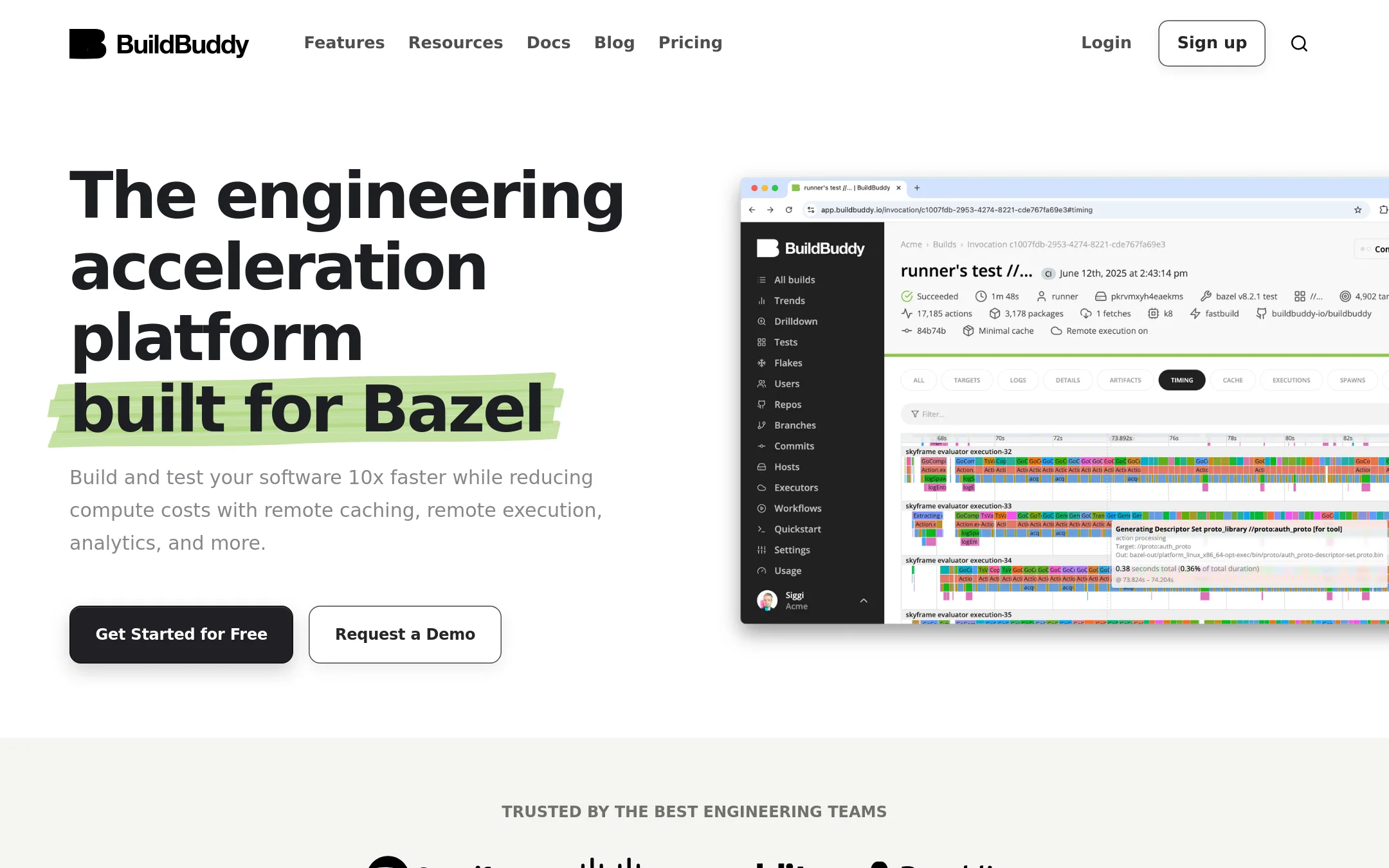
Best for: Teams already using Bazel that need remote caching and execution to cut build times dramatically.
- Pricing
- Free / custom
- Category
- Developer Tools
BuildBuddy is a remote build execution and caching platform built specifically for Bazel. If your team uses Bazel and wants to speed up builds by distributing them across many cores, BuildBuddy is the natural fit, whereas Semaphore is a general-purpose CI/CD system.
Where it is strong
- Deep Bazel integration with remote caching and execution
- Free tier for small teams and open source projects
- Enterprise options include SSO/SAML and dedicated support
Where it falls short
- Pricing for Team and Enterprise is not transparent
- Only useful if you adopt Bazel. Not a general CI/CD tool
- Pricing:
- Pricing is not fully published. The Personal plan is free with 100 GB cache transfer and up to 80 cores, Team is pay-as-you-go with per-GB cache transfer pricing shown as $X, and Enterprise requires a quote.
- Switching from Semaphore:
- Moving from Semaphore means adopting Bazel as your build system and reconfiguring your pipelines to use BuildBuddy's remote execution, which is a significant architectural change.
- See website
9.WarpBuild
Developer Tools
Accelerate software development with WarpBuild's 10x faster CI infra.
- Pay-as-you-go
10.AWS ParallelCluster
Best for: Research teams and engineers running HPC workloads on AWS who need to manage their own cluster infrastructure.
- Pricing
- Pay-as-you-go
- Category
- Developer Tools
AWS ParallelCluster is a cloud HPC cluster management tool, not a CI/CD platform. You would choose it over Semaphore if your work is high-performance computing, like large-scale simulations or batch processing, and you need to provision and manage compute clusters on AWS. Semaphore is for running CI/CD pipelines for software development.
Where it is strong
- Deep integration with AWS services like EC2 and S3.
- Scales to thousands of nodes for large compute jobs.
- Supports multiple schedulers like Slurm and AWS Batch.
Where it falls short
- Not a CI/CD tool. No pipeline or test reporting features.
- Requires manual cluster setup and management.
- Pricing:
- Pricing is not published on the site. AWS charges pay-as-you-go for the underlying services you use.
- Not published
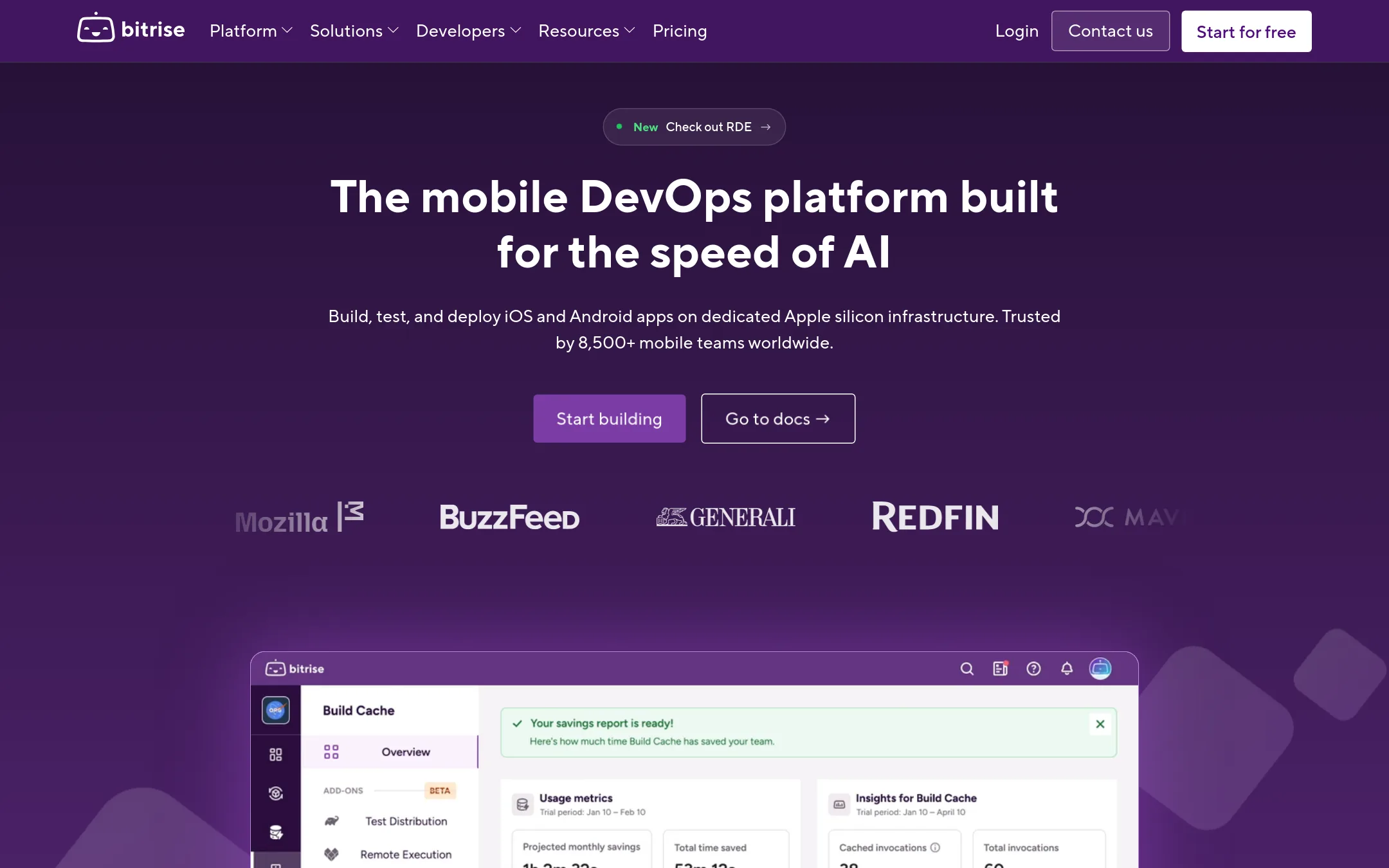
11.Bitrise
Best for: Mobile engineering teams building and shipping iOS and Android apps who want a dedicated DevOps platform with managed macOS infrastructure.
- Pricing
- Not published
- Category
- Developer Tools
Bitrise is a hosted CI/CD platform built specifically for mobile app development, covering iOS and Android. Choose it over Semaphore if your team is focused on mobile and wants a platform with mobile-specific tools like build cache and release management, rather than a general-purpose CI/CD for coding agents.
Where it is strong
- Fully-managed macOS and Linux infrastructure for mobile builds
- Unlimited team members with role-based access on paid plans
- Elastic scaling with up to 10 concurrent builds and pay-as-you-go options
Where it falls short
- Pricing details are not transparent on the website
- Focused on mobile, so less suited for general-purpose or agent-driven CI/CD compared to Semaphore
- Pricing:
- Pricing is not published on the site. Plans are described by features (e.g., free tier with 4 concurrent builds, paid plans with more concurrency and machine types) but no dollar amounts are listed.
- Custom quote
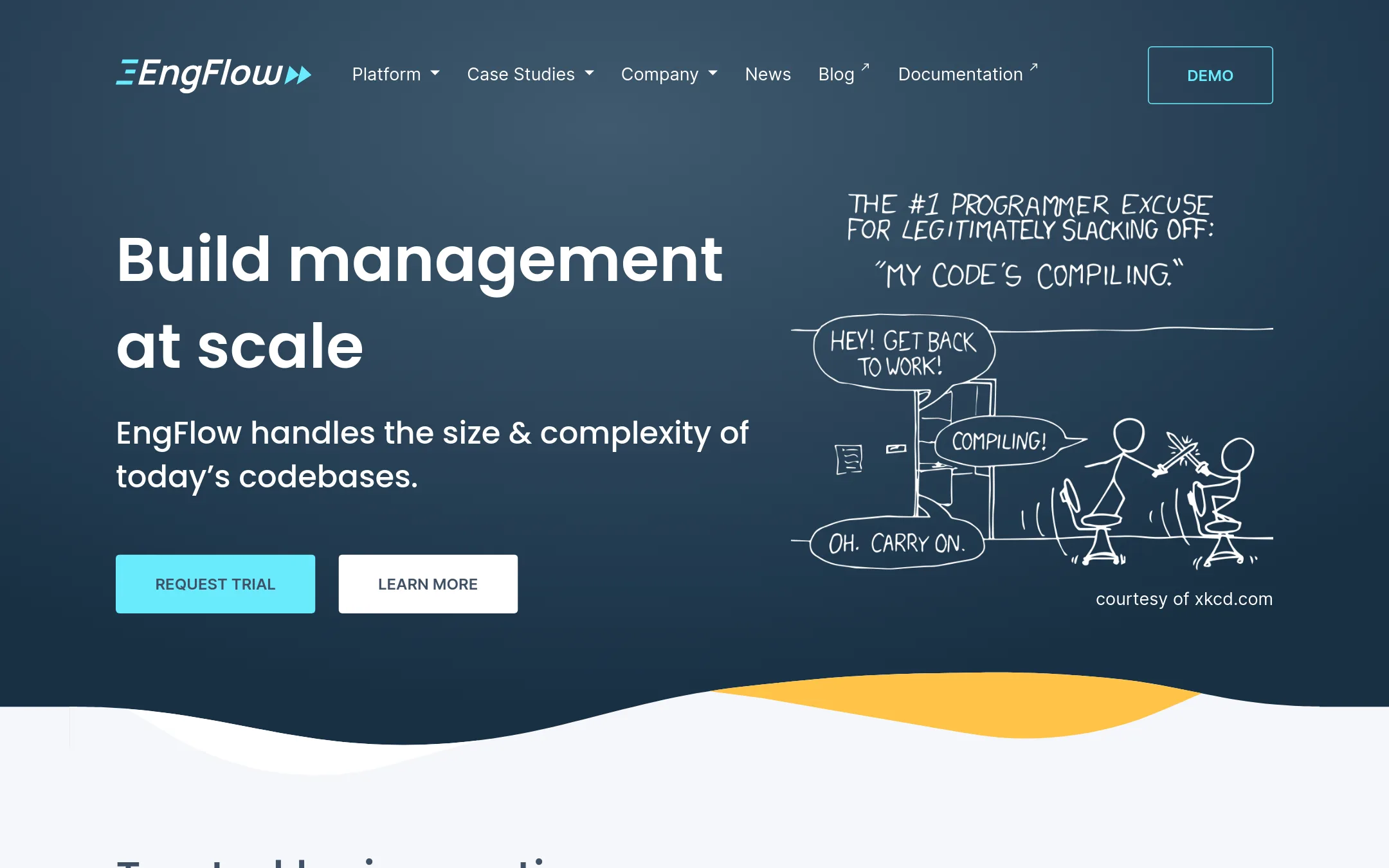
12.EngFlow
Best for: Large engineering organizations with Bazel-based monorepos that need to cut build times from hours to minutes.
- Pricing
- Custom quote
- Category
- Developer Tools
EngFlow is a build acceleration platform for teams using Bazel, Goma, or Soong. It provides remote execution, caching, and a build/test UI to speed up large, complex codebases. Choose EngFlow over Semaphore when your builds are Bazel-based and you need deep build expertise and infrastructure-level optimization.
Where it is strong
- Built by Bazel experts, including the original creator
- Remote execution and caching for massive parallel builds
- Detailed build and test UI with invocation analysis
Where it falls short
- Pricing requires a custom quote, no self-serve
- Focused on Bazel and similar tools, not a general CI/CD platform
- Pricing:
- Pricing is not published on the site.
See more comparisons in Developer Tools alternatives.
FAQ
Questions about Semaphore alternatives
What is the best free CI/CD option?
CircleCI offers a free tier with up to 6,000 build minutes per month and 5 active users. GitLab's free plan includes 5 users and 400 compute minutes. Buildkite's free plan provides 2,000 Linux vCPU minutes per month. Semaphore itself gives $15 of free usage monthly.
Which CI/CD tool is best for mobile app development?
Bitrise is built specifically for mobile, with managed macOS infrastructure and tools like build cache and release management. CircleCI also supports macOS and offers GPU resource classes. Semaphore has macOS machines but is not mobile-specific.
How do pricing models compare?
Semaphore charges per compute minute with no per-seat fees. CircleCI uses credits, with a free tier and pay-as-you-go. Buildkite charges per active user plus per vCPU minute for hosted agents. GitLab uses per-seat pricing with compute minute caps.
Which tool is best for teams using Bazel?
BuildBuddy and EngFlow are both built for Bazel, offering remote caching and execution. BuildBuddy has a free tier, while EngFlow is for large monorepos. Semaphore is general-purpose and does not specialize in Bazel.
Can I self-host any of these alternatives?
Jenkins is fully self-hosted and open source. Travis CI supports on-premise and private cloud deployments. Buildkite runs on your own infrastructure with self-hosted agents. Semaphore also offers self-hosted agents and an open source edition.
Last updated October 31, 2026.