
SingleStore alternatives
8 products compared · Updated October 18, 2026
The short answer
For teams evaluating SingleStore alternatives, the strongest options are ClickHouse for open-source, petabyte-scale real-time analytics. CockroachDB for mission-critical, globally distributed SQL workloads with PostgreSQL compatibility. And MongoDB for AI-ready applications on a flexible document model. Each suits a different primary use case, so your choice depends on whether you prioritize analytical speed, transactional resilience, or document-based flexibility.
Your shortlist, at a glance
Read the comparisons ↓ SnowflakeConsumption-basedEnterprises that need a managed, multi-cloud data platform for analytics, data engineering, and AI applications with strong governance and data sharing.
 DatabricksNot publishedEnterprises running heavy data engineering, warehousing, and AI workloads on a unified lakehouse platform.
 ClickHouseFrom $0.125/unit/hrTeams running real-time analytics, observability, or data warehousing workloads at scale who want an open-source option with cloud and self-managed choices.
 AWS ParallelClusterPay-as-you-goResearch teams and engineers running HPC, simulation, or batch workloads on AWS who need to manage their own cluster infrastructure.
 Google Cloud HPCNot publishedTeams running AI training, simulations, or other compute-heavy workloads that need flexible GPU and TPU capacity on Google Cloud.
 CockroachDBFrom $0.057/vCPU-hrMission-critical applications in financial services, payments, gaming, and SaaS that need multi-region resilience and PostgreSQL compatibility.
 MongoDBFree / from $8/moTeams building AI-ready applications on a document model who want a managed database with built-in vector search and stream processing.
 TiDBFrom $0/mo + usageTeams building AI agent platforms or scaling MySQL-based services that need ACID transactions and vector search without separate data stores.
About SingleStore and its alternatives
SingleStore is a cloud-native, operational database built for speed and scale. It combines transactions and analytics in one engine, designed for real-time AI, apps, and analytics with live reads and writes and open data access.
When comparing alternatives, weigh pricing structure (consumption-based vs. fixed tiers), cloud region availability, integration with your existing stack, support options, and contract terms like minimum commitments or free trials. These factors often matter more than feature lists alone.
Explore the alternatives
- Consumption-based
1.Snowflake
Best for: Enterprises that need a managed, multi-cloud data platform for analytics, data engineering, and AI applications with strong governance and data sharing.
- Pricing
- Consumption-based
- Category
- Analytics & Data
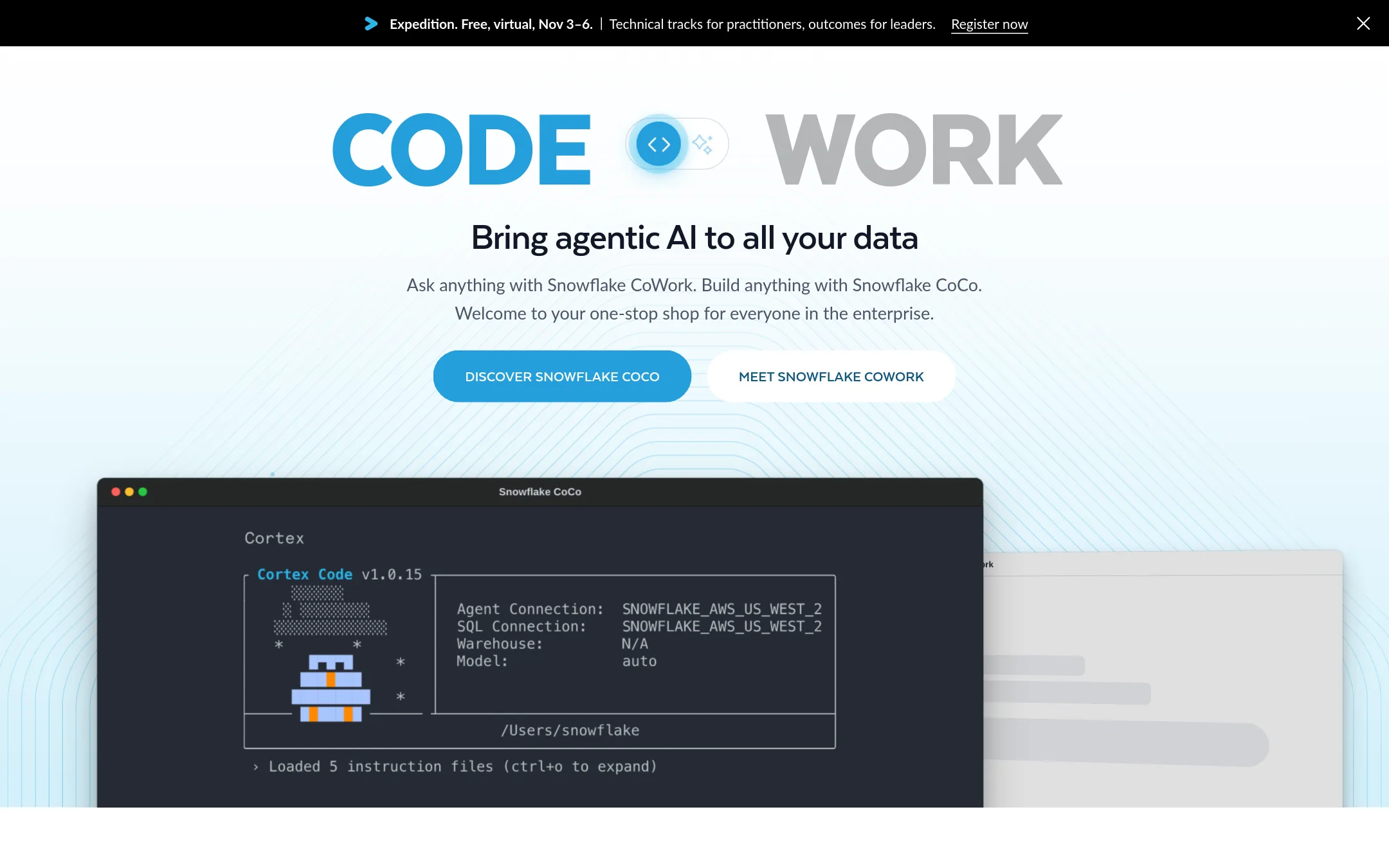
Snowflake is a fully managed data cloud for analytics, data engineering, and AI workloads. Choose it over SingleStore when you need a broad platform that spans multiple clouds, supports open table formats, and has a large partner ecosystem for enterprise-scale data sharing and governance.
Where it is strong
- Fully managed, so no infrastructure tuning
- Cross-cloud and open table format support
- Strong security, governance, and data sharing
Where it falls short
- Pricing is not transparent without contacting sales
- Not designed for low-latency transactional workloads like SingleStore
- Pricing:
- Pricing is consumption-based, with on-demand or pre-paid capacity options. Specific prices are not listed on the page.
- Not published
2.Databricks
Best for: Enterprises running heavy data engineering, warehousing, and AI workloads on a unified lakehouse platform.
- Pricing
- Not published
- Category
- Analytics & Data
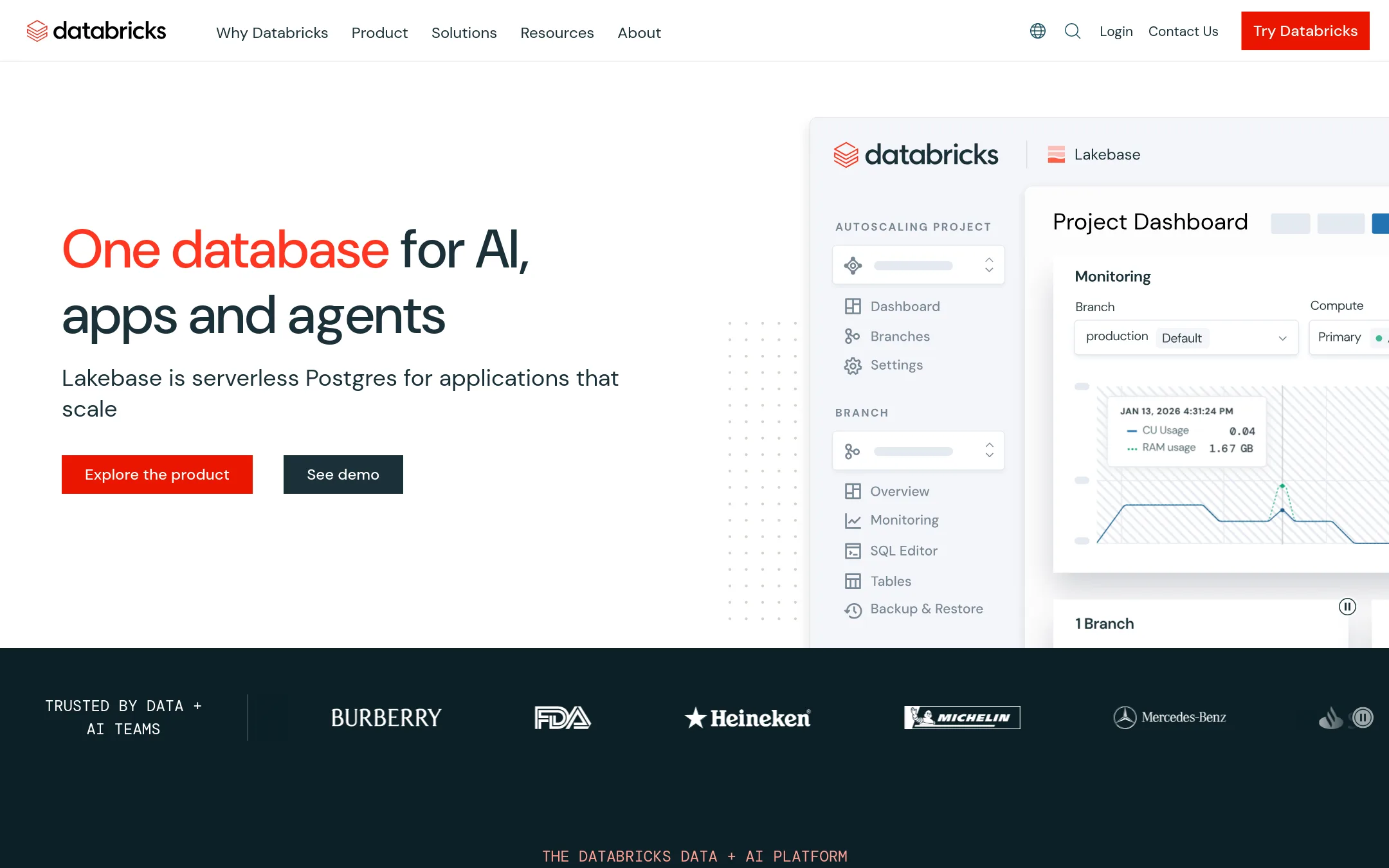
Databricks is a unified data and AI platform that handles ETL, warehousing, governance, and machine learning in one place. Choose it over SingleStore when you need a full lakehouse stack for large-scale analytics and AI workloads rather than a low-latency operational database.
Where it is strong
- Unified platform for data engineering, warehousing, and AI
- Strong governance and security features built in
- Scales to very large datasets across cloud providers
Where it falls short
- Pricing requires contacting sales, no self-serve tiers
- Not designed for low-latency operational workloads like SingleStore
- Pricing:
- Pricing is not published on the site.
- From $0.125/unit/hr
3.ClickHouse
Best for: Teams running real-time analytics, observability, or data warehousing workloads at scale who want an open-source option with cloud and self-managed choices.
- Pricing
- From $0.125/unit/hr
- Category
- Analytics & Data
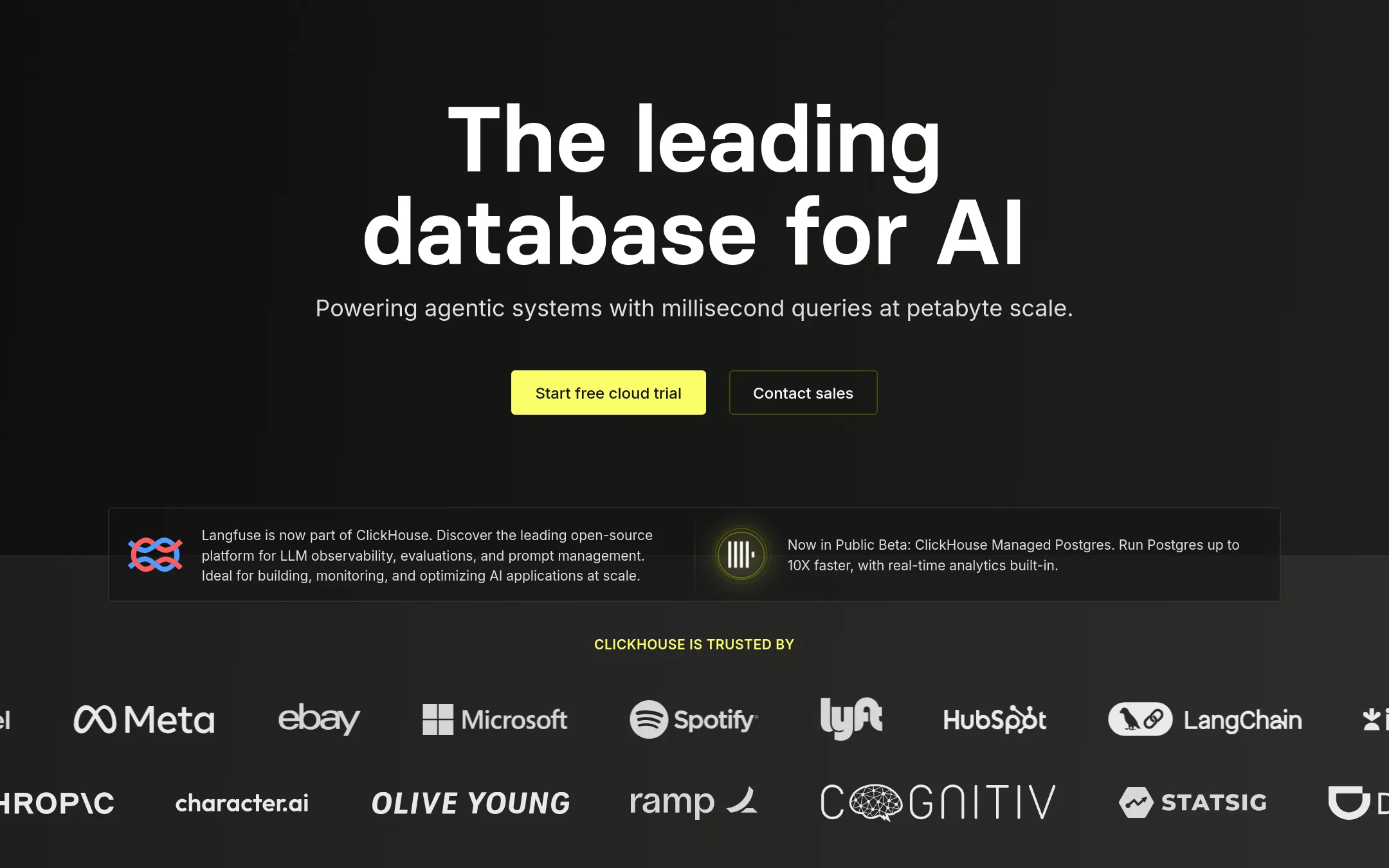
ClickHouse is an open-source column-oriented OLAP database built for real-time analytics on very large datasets. Choose it over SingleStore when you need petabyte-scale analytical queries with millisecond latency and want the flexibility of self-managed or cloud deployment.
Where it is strong
- Open source, so you can self-host for free or use the cloud
- Column-oriented design makes analytical queries extremely fast
- Scales to petabyte-scale data with high compression ratios
Where it falls short
- Not designed for transactional (OLTP) workloads like SingleStore
- Managed cloud plans have limited storage on Basic tier
- Pricing:
- ClickHouse Cloud starts with a 30-day free trial including $300 in credits. Compute and storage are metered separately, with compute from $0.125 per unit per hour. Basic plan includes up to 1 TB storage and 8-12 GiB memory.
- Switching from SingleStore:
- Moving from SingleStore means re-platforming your analytical queries and data ingestion, since ClickHouse uses a different SQL dialect and columnar storage model.
- Pay-as-you-go
4.AWS ParallelCluster
Best for: Research teams and engineers running HPC, simulation, or batch workloads on AWS who need to manage their own cluster infrastructure.
- Pricing
- Pay-as-you-go
- Category
- Developer Tools
AWS ParallelCluster is a cluster management tool that lets you build and run high-performance computing clusters on AWS. Choose it instead of SingleStore when your workload is batch or HPC-oriented and you need to manage compute clusters, not a real-time operational database.
Where it is strong
- Tight integration with AWS services like EC2, S3, and Batch
- Supports multiple schedulers including Slurm and AWS Batch
- Free to use. You only pay for the underlying AWS resources
Where it falls short
- Not a database. You must bring your own storage and query layer
- Requires AWS expertise to set up and manage clusters
- Pricing:
- Pricing is not published on the site. AWS charges pay-as-you-go for underlying services, with no long-term contracts.
- Not published
5.Google Cloud HPC
Best for: Teams running AI training, simulations, or other compute-heavy workloads that need flexible GPU and TPU capacity on Google Cloud.
- Pricing
- Not published
- Category
- Developer Tools
Google Cloud HPC provides raw compute infrastructure with GPUs, TPUs, and scalable VMs for AI and scientific workloads. Choose it instead of SingleStore when you need to run heavy batch or simulation jobs, not a transactional database with analytics.
Where it is strong
- Access to GPUs and TPUs for AI and HPC workloads
- Scales compute resources on demand
- Part of the broader Google Cloud ecosystem
Where it falls short
- No database or analytics engine included
- Requires separate data storage and query tooling
- Pricing:
- Pricing is not published on the site.
- From $0.057/vCPU-hr
6.CockroachDB
Best for: Mission-critical applications in financial services, payments, gaming, and SaaS that need multi-region resilience and PostgreSQL compatibility.
- Pricing
- From $0.057/vCPU-hr
- Category
- Analytics & Data
CockroachDB is a distributed SQL database built for extreme resilience and horizontal scaling, with PostgreSQL wire compatibility. Choose it over SingleStore when you need a globally distributed, strongly consistent operational database that survives failures and scales across regions without manual sharding.
Where it is strong
- Speaks PostgreSQL wire protocol, so most apps connect with little or no code change
- Scales horizontally with automatic rebalancing and hotspot detection
- Runs fully managed on AWS, GCP, or Azure, or self-hosted
Where it falls short
- Some PostgreSQL features behave differently in a distributed system
- Mission Critical edition requires a credit card for trial and uses provisioned storage
- Pricing:
- Standard starts at $0.057 per vCPU-hour and Mission Critical at $0.162 per vCPU-hour, with usage-based storage and a 30-day free trial with $400 credit.
- Switching from SingleStore:
- Moving from SingleStore means re-evaluating your data model for PostgreSQL compatibility, but most applications connect with minimal code changes due to wire protocol support.
- Free / from $8/mo
7.MongoDB
Best for: Teams building AI-ready applications on a document model who want a managed database with built-in vector search and stream processing.
- Pricing
- Free / from $8/mo
- Category
- Analytics & Data
MongoDB Atlas is a managed document database that handles operational workloads, vector search, and stream processing in one platform. Choose it over SingleStore when your app is built on the flexible document model and you want a fully managed service that scales from a free tier to large dedicated clusters.
Where it is strong
- Free tier for learning and prototyping
- Document model maps directly to app data
- Built-in vector search and stream processing
Where it falls short
- SQL support is limited compared to SingleStore
- Analytics on large datasets may require separate tools
- Pricing:
- Free tier includes 512 MB storage. Flex clusters start at $8/mo. Dedicated clusters start at $0.08/hr (M10) and scale up to $33.26/hr (M700).
- Switching from SingleStore:
- Moving from SingleStore means reshaping relational tables into documents and rewriting queries to use MongoDB's aggregation pipeline.
- From $0/mo + usage
8.TiDB
Best for: Teams building AI agent platforms or scaling MySQL-based services that need ACID transactions and vector search without separate data stores.
- Pricing
- From $0/mo + usage
- Category
- Analytics & Data
TiDB is a distributed SQL database that combines transactions, analytics, and vector search in one engine. Choose it over SingleStore when you need MySQL or PostgreSQL compatibility, ACID guarantees, and elastic scaling for AI agent workloads or large-scale microservices.
Where it is strong
- MySQL and PostgreSQL compatibility with familiar tools
- Autoscaling compute and storage independently
- Built-in vector search and online DDL
Where it falls short
- Pricing tiers require minimum commitments for production
- Dedicated clusters start at a high monthly cost
- Pricing:
- Pricing is published in USD. Starter is $0/month with a free allowance, then from $0.10 per million Request Units. Essential starts at $400/month, Premium at $1,800/month, and Dedicated clusters from $1,376/month.
- Switching from SingleStore:
- Moving from SingleStore involves migrating schemas and data to a MySQL- or PostgreSQL-compatible engine, which may require adjusting queries and connection settings.
See more comparisons in Analytics & Data alternatives.
FAQ
Questions about SingleStore alternatives
What is the best alternative for real-time analytics at scale?
ClickHouse is the strongest choice for real-time analytics on very large datasets. It is open-source, column-oriented, and designed for petabyte-scale queries with millisecond latency. You can self-host for free or use ClickHouse Cloud with a 30-day trial.
Which alternative is best for a globally distributed, transactional database?
CockroachDB is built for extreme resilience and horizontal scaling with PostgreSQL wire compatibility. It suits mission-critical applications in financial services, payments, and gaming that need multi-region consistency. Pricing starts at $0.057 per vCPU-hour for Standard and $0.162 for Mission Critical.
Can I get a free tier to start with any of these alternatives?
Yes, MongoDB offers a free tier with 512 MB storage, and ClickHouse Cloud includes a 30-day free trial with $300 in credits. CockroachDB also has a 30-day free trial with $400 credit. TiDB's Starter plan is $0 per month with a free allowance.
Which alternative is best if I need MySQL or PostgreSQL compatibility?
CockroachDB speaks the PostgreSQL wire protocol, so most apps connect with little code change. TiDB offers both MySQL and PostgreSQL compatibility with ACID guarantees and vector search. Choose CockroachDB for multi-region resilience, or TiDB for elastic scaling of MySQL-based services.
Are there alternatives with transparent pricing without contacting sales?
Yes, ClickHouse, CockroachDB, MongoDB, and TiDB all publish specific prices on their sites. Snowflake and Databricks require contacting sales for pricing. AWS ParallelCluster and Google Cloud HPC do not list prices but charge pay-as-you-go for underlying resources.
Last updated October 18, 2026.