
Skyvern alternatives
7 products compared · Updated November 10, 2026
The short answer
Browser Use suits developer teams that want an open-source, code-first browser agent with on-prem or EU hosting. Browserbase suits engineering teams building their own agents who need scalable hosted browser sessions. UiPath suits regulated enterprises in banking, healthcare, or finance that need governed, auditable automation across many internal systems.
Your shortlist, at a glance
Read the comparisons ↓ Browser Use$0.02/browser-hour + $Developer teams that want an open-source browser agent with on-prem or EU-hosted options and pay-as-you-go usage
- MMultionNot publishedDevice makers and their security teams building an on-device action agent for Android-style phones and PCs
- BBrowserbaseFrom $0 (Start), paid Engineering teams building their own browser agents who need hosted, scalable browser sessions and web search or fetch APIs
- IInduced AISee websiteOther
- OOctoparseNot publishedSales and research teams that need lead lists, product catalogs or market data from public websites without writing code
- AApifyFrom $19/mo + usageGrowth and research teams that need prebuilt scrapers for popular social and retail sites
 UiPathCustom quoteRegulated enterprises in banking, healthcare, or finance that need governed, auditable automation across many internal systems
About Skyvern and its alternatives
Skyvern is an open-source AI agent that automates browser workflows through an API. According to its site, it handles logins, CAPTCHAs, two-factor authentication, form fills and data extraction without brittle selectors, and it runs as a hosted service or self-hosted Docker container.
When comparing alternatives, look at how pricing is structured, whether it is usage-based, credit-based or seat-based, and how that changes at volume. Check which regions and data residency options are available, which integrations and SDKs you need, what support level you get, and what the contract terms require, including any compliance certifications your industry depends on.
Explore the alternatives
- $0.02/browser-hour + $
1.Browser Use
Best for: Developer teams that want an open-source browser agent with on-prem or EU-hosted options and pay-as-you-go usage
- Pricing
- $0.02/browser-hour + $
- Category
- Developer Tools
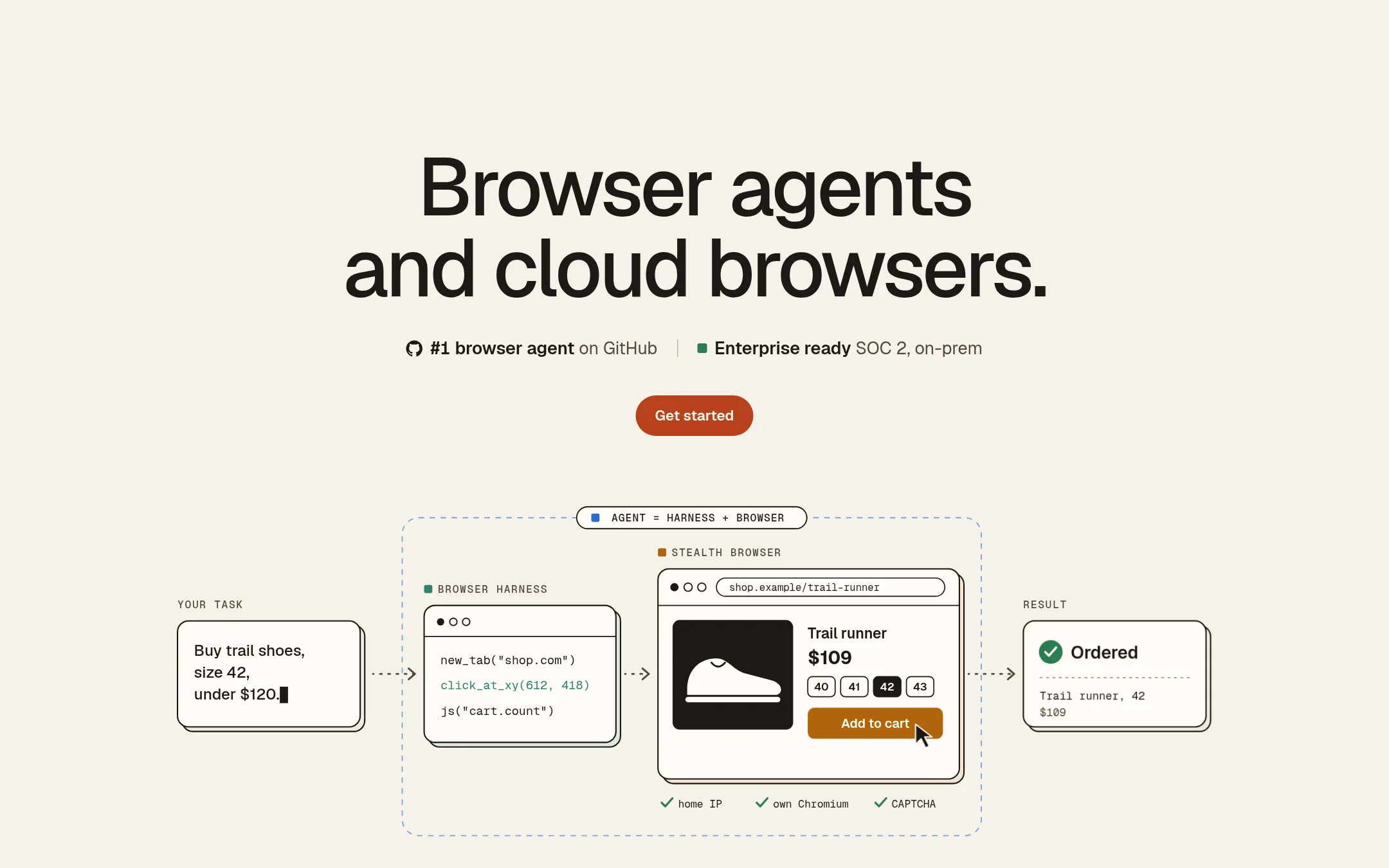
Browser Use is an open-source browser agent with a managed cloud for stealth browsers and agent runs. Teams pick it over Skyvern when they want a code-first agent, a large open-source community, or cloud browsers that get past bot checks, and when they need on-prem or EU data residency.
Where it is strong
- Open-source under MIT, with the most-starred browser agent on GitHub
- Stealth cloud browsers and CAPTCHA solving included in the usage pricing
- SOC 2 Type II, with on-prem deployment and EU data residency for enterprise customers
Where it falls short
- Enterprise features like custom concurrency, SLAs and HIPAA require talking to sales
- Proxy traffic adds up quickly, since home-IP traffic is billed per GB
- Pricing:
- Pricing is pay as you go with no subscription: cloud browsers are $0.02 per hour, home-IP proxy traffic is $5 per GB, and credits start at $5 and never expire.
- Switching from Skyvern:
- Moving from Skyvern means rewriting your workflows for Browser Use's agent and SDK, since the site does not describe a migration path.
- MNot published
2.Multion
Best for: Device makers and their security teams building an on-device action agent for Android-style phones and PCs
- Pricing
- Not published
- Category
- Other
AGI, Inc. builds AGI-0, an action model that sees the phone or computer screen and acts across any app, with no APIs or per-app integrations needed. Pick it over Skyvern when the target is a mobile device or a device maker shipping an on-device agent, rather than browser workflows on web portals. The site says the agent runs privately and can work offline.
Where it is strong
- Works across any app on the screen without API or integration work.
- Designed to run privately on the device, including offline and on wearables.
- Offers a Platform and documentation for shipping an agent to device users.
Where it falls short
- Aimed at phones and devices, so it is a weaker fit than Skyvern for browser-based portal automation.
- No public pricing or self-serve trial, so cost is unknown until you talk to sales.
- Pricing:
- Pricing is not published on the site.
- BFrom $0 (Start), paid
3.Browserbase
Best for: Engineering teams building their own browser agents who need hosted, scalable browser sessions and web search or fetch APIs
- Pricing
- From $0 (Start), paid
- Category
- Other
Browserbase gives agents a managed cloud browser, plus Search and Fetch APIs for pulling web content. Teams pick it over Skyvern when they want to build their own agent logic and need infrastructure that runs many concurrent browser sessions, with stealth and identity handling for sites that block bots.
Where it is strong
- Hosted browsers scale to 25 concurrent sessions on the Developer tier and 100 on Startup
- Search and Fetch APIs give agents web context without running a browser for every request
- Available as an SDK and used by a large developer base, with HIPAA (BAA) and SSO listed on the Enterprise tier
Where it falls short
- It is an infrastructure layer, so you still write and maintain the agent logic yourself, unlike Skyvern's natural-language workflows
- Pricing has several dimensions (browser hours, search calls, fetch calls, proxies), which can be harder to forecast than a flat credit model
- Pricing:
- Pricing is published with a free Start plan, a Developer plan at $20 per month (100 browser hours, then $0.12 per browser hour), a Startup plan at $99 per month (500 browser hours), and custom Enterprise pricing.
- ISee website
4.Induced AI
Other
A no-code platform for building AI agents that automate browser-based workflows and data extraction from websites.
- ONot published
5.Octoparse
Best for: Sales and research teams that need lead lists, product catalogs or market data from public websites without writing code
- Pricing
- Not published
- Category
- Other
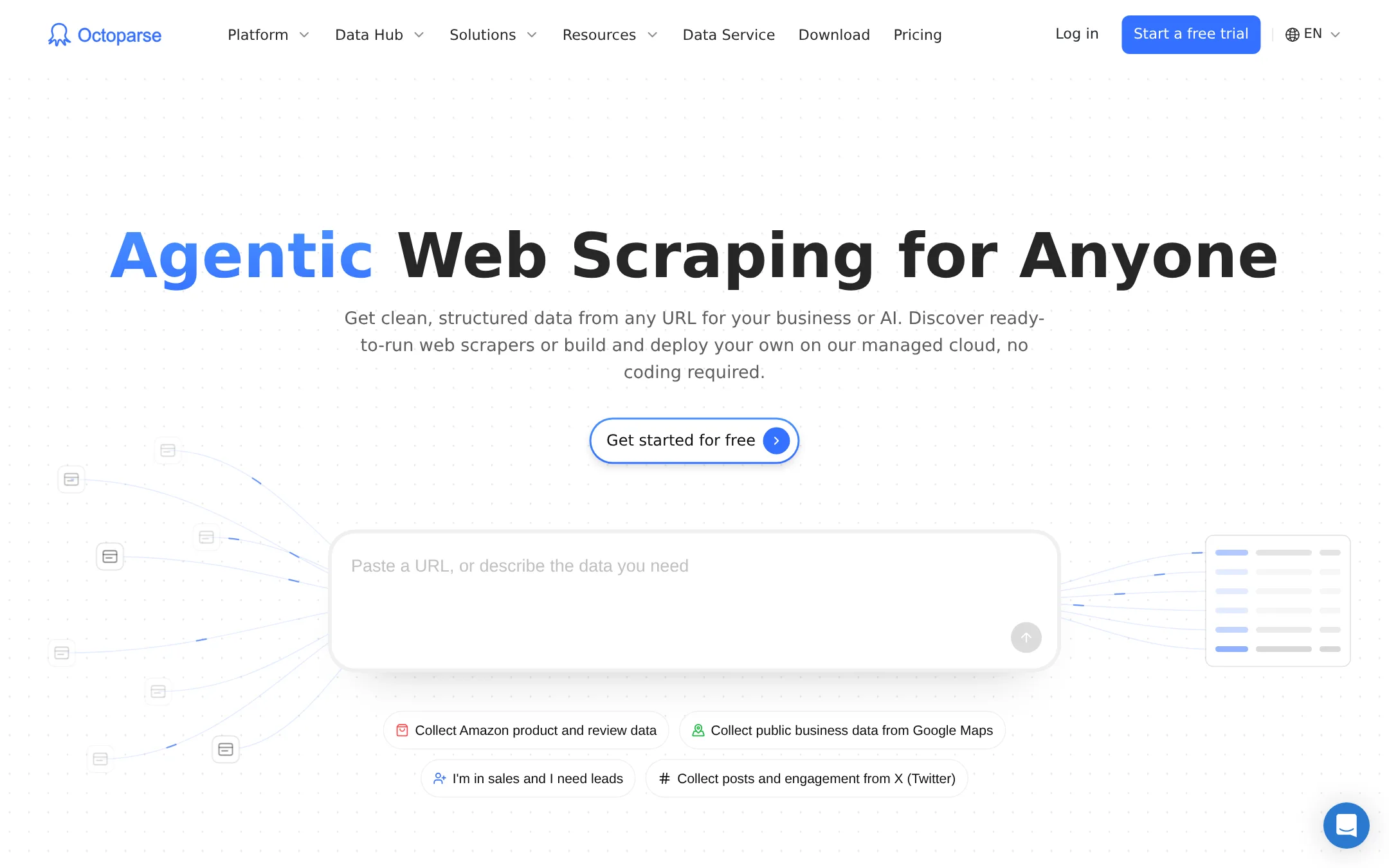
Octoparse is a no-code web scraping platform that turns any URL into structured data, with ready-made templates for sites like Google Maps, Amazon and TikTok. Choose it over Skyvern when the job is pulling data out of public pages rather than running multi-step browser tasks such as logins, form fills and invoice downloads.
Where it is strong
- Ready-to-run templates for popular sites such as Google Maps, Amazon and TikTok
- Visual point-and-click builder that needs no coding
- Cloud runs in the background with parallel subtasks and automatic IP rotation
Where it falls short
- Built mainly for extracting data, so it is a weaker fit for workflows like logging into portals and downloading documents
- Skyvern's vision-based approach to changing UIs is not described as a feature here
- Pricing:
- Pricing is not published on the site.
- AFrom $19/mo + usage
6.Apify
Best for: Growth and research teams that need prebuilt scrapers for popular social and retail sites
- Pricing
- From $19/mo + usage
- Category
- Other
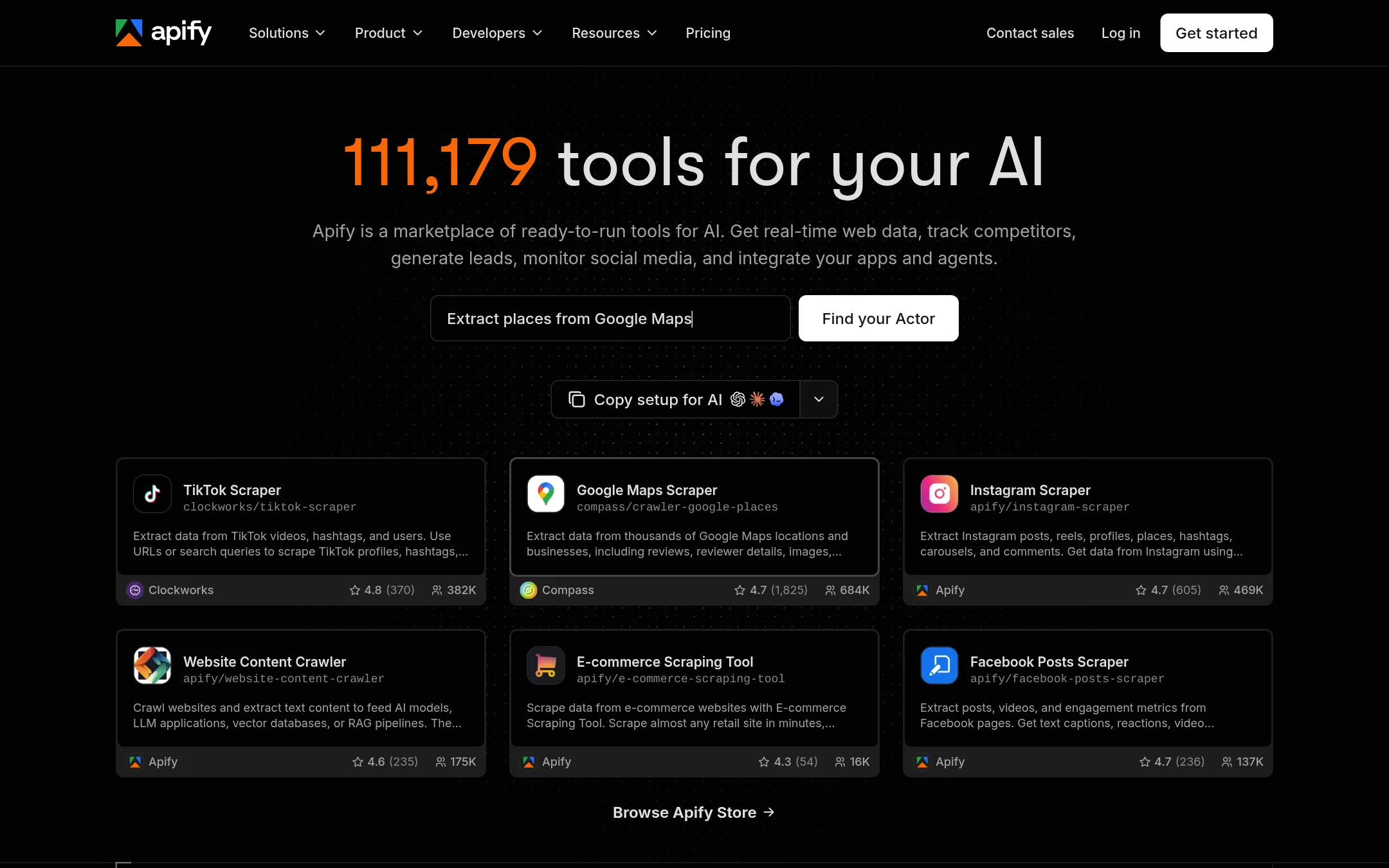
Apify is a marketplace of ready-made scrapers and automation tools, called Actors, that you can run on demand or on a schedule. It suits teams whose main need is pulling data from common sites such as Google Maps, Instagram, TikTok or e-commerce pages. Pick it over Skyvern when you want to run an existing tool for a known source rather than describe a new browser workflow in plain language.
Where it is strong
- Thousands of ready-to-run Actors cover common sites without any setup.
- You can build and publish your own Actor and sell it through the Apify Store.
- Integrations with Zapier, n8n, Google Sheets and MCP clients connect results to existing tools.
Where it falls short
- It is built around existing Actors, so unusual workflows may need custom development.
- Costs vary by Actor and run, which makes budgeting less predictable than a flat plan.
- Pricing:
- Pricing is published with a Free tier at $5 of usage, Starter at $19 per month plus pay as you go, Scale at $199 per month and Business at $999 per month, with Enterprise on custom terms.
- Switching from Skyvern:
- Moving from Skyvern would mean rebuilding each workflow as an Actor or finding a prebuilt one that does the same job.
- Custom quote
7.UiPath
Best for: Regulated enterprises in banking, healthcare, or finance that need governed, auditable automation across many internal systems
- Pricing
- Custom quote
- Category
- Productivity & Project Management
UiPath is an enterprise platform that coordinates AI agents, robots, and people across business processes, with governance, audit records, and industry solutions for banking, healthcare, and finance. Choose it over Skyvern when you need to automate many internal systems under strict compliance and orchestration, rather than browser-only tasks on external portals.
Where it is strong
- Orchestrates agents, robots, and people in one governed workflow
- Keeps a regulator-ready record of every action and decision
- Ships industry solutions for banking, healthcare, and finance
Where it falls short
- Aimed at enterprise programs, so setup is heavier than a browser-only tool
- Lacks Skyvern's focus on running browser tasks via a simple API and SDK
- Pricing:
- Pricing is not published on the site for Enterprise, while Standard and Basic tiers are listed without fixed figures in the text provided, and Test Cloud add-ons include Performance Testing at $20K for 2,500 VUs, Screenplay at $10K for 50K runs, and Self-Heali
See more comparisons in Productivity & Project Management alternatives.
FAQ
Questions about Skyvern alternatives
Which Skyvern alternative is best for developers who want open source?
Browser Use is open-source under the MIT license and is built as a code-first browser agent. It also offers on-prem deployment and EU data residency for enterprise customers. Teams that want to write and maintain their own agent logic often start there.
Is there an alternative that works if I want to build my own agent?
Browserbase provides managed cloud browsers and Search and Fetch APIs, so you write the agent logic yourself. Its Developer plan costs $20 per month with 100 browser hours included. It is a better fit than Skyvern when you want infrastructure rather than natural-language workflows.
Which option fits a regulated enterprise with strict audit needs?
UiPath is aimed at regulated enterprises in banking, healthcare and finance. It coordinates agents, robots and people under governance, and keeps a regulator-ready record of every action. Its Enterprise pricing is not published, so you will need to contact sales.
Can I use a tool to pull data from popular websites without building a workflow?
Apify offers a marketplace of ready-made scrapers called Actors for sites such as Google Maps, Instagram and TikTok. Octoparse offers no-code templates for similar sources. Both suit data collection more than multi-step tasks like logging into portals or downloading invoices.
How do the alternatives compare on price?
Browser Use is pay as you go with no subscription, and Browserbase has published tiers starting with a free plan. Apify's paid plans range from $19 to $999 per month, while Skyvern lists Hobby at $29 per month and Pro at $149 per month. UiPath and Octoparse do not publish full pricing, so confirm costs before committing.
Last updated November 10, 2026.