
Smooth alternatives
6 products compared · Updated November 12, 2026
The short answer
The three strongest alternatives to Smooth are Browserbase, Hyperbrowser and Firecrawl. Browserbase suits engineering teams whose agents must log in to and act on sites that have no API. Hyperbrowser suits teams building agents that need a browser, code execution and web data in one place. Firecrawl suits AI teams that need clean web data for retrieval, research or knowledge bases.
Your shortlist, at a glance
Read the comparisons ↓- BBrowserbaseFrom $0 (free tier)Engineering teams whose agents must log in to and act on sites with no API
- FFirecrawlFrom $19/mo, creditsAI teams that need clean web data for retrieval, research or knowledge bases and want an open source option
- AApifyNot publishedTeams that need ready-made scrapers for common sites like Google Maps, Instagram or TikTok, or that want to sell their own Actors on a marketplace
- BBrowserlessFrom 1k units freeTeams with existing Puppeteer or Playwright scripts that need reliable cloud browsers and authenticated sessions
Hyperbrowser$30/mo usage + $0.10/hTeams building agents that need a browser, code execution and web data in one place, using Playwright or Puppeteer.
- SSteelFrom $0 + usageTeams that want a managed or self-hosted browser layer under their own Playwright, Puppeteer or Selenium code
About Smooth and its alternatives
Smooth is a platform for building and running web agents. According to its site, it handles the infrastructure so teams can focus on agents that search, scrape and interact with the web at scale. Its homepage highlights natural language tasks, schema-validated JSON extraction, page scraping as markdown, screenshots or PDFs, and small language models that keep costs low.
When comparing alternatives, look at how each product prices its work. Some charge per agent step, some use credits shared across products, and some bill browser time by the hour. Also check which regions and integrations are supported, how much support comes with each plan, and what the contract terms are for security and compliance.
Explore the alternatives
- BFrom $0 (free tier)
1.Browserbase
Best for: Engineering teams whose agents must log in to and act on sites with no API
- Pricing
- From $0 (free tier)
- Category
- Other
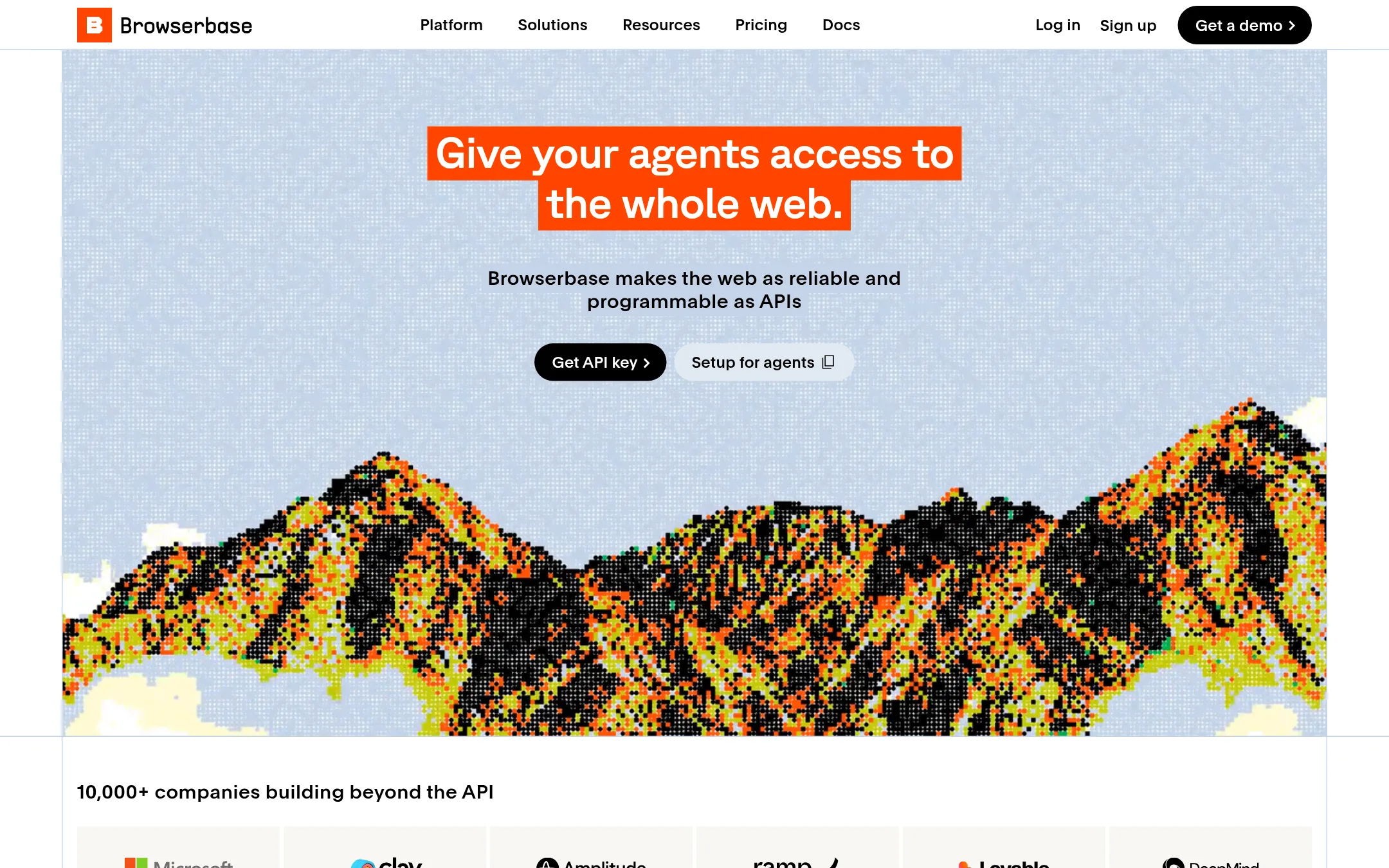
Browserbase gives agents a real browser to work with, plus Search and Fetch APIs for pulling web context. It suits teams whose agents need to log in, click through forms, or handle sites that have no API. Pick it over Smooth when the work is mostly full browser sessions across many sites, or when you want search and fetch bundled with the browser layer.
Where it is strong
- Real browser sessions that handle logins, forms and dynamic pages
- Search and Fetch APIs sit alongside the browser in one platform
- Enterprise tier offers HIPAA BAA and SSO
Where it falls short
- Browser hours are billed on top of agent runs, so costs add up on long sessions
- The site describes its approach as cloud browsers with stealth and CAPTCHA handling, but does not state where its infrastructure is located
- Pricing:
- The free plan includes 3 concurrent browsers, 1 browser hour and 1,000 Search and Fetch calls, the Developer plan is $25 per month and the Startup plan has 100 concurrent browsers with 500 browser hours at $0.10 per hour, with custom pricing for Enterprise.
- FFrom $19/mo, credits
2.Firecrawl
Best for: AI teams that need clean web data for retrieval, research or knowledge bases and want an open source option
- Pricing
- From $19/mo, credits
- Category
- Analytics & Data
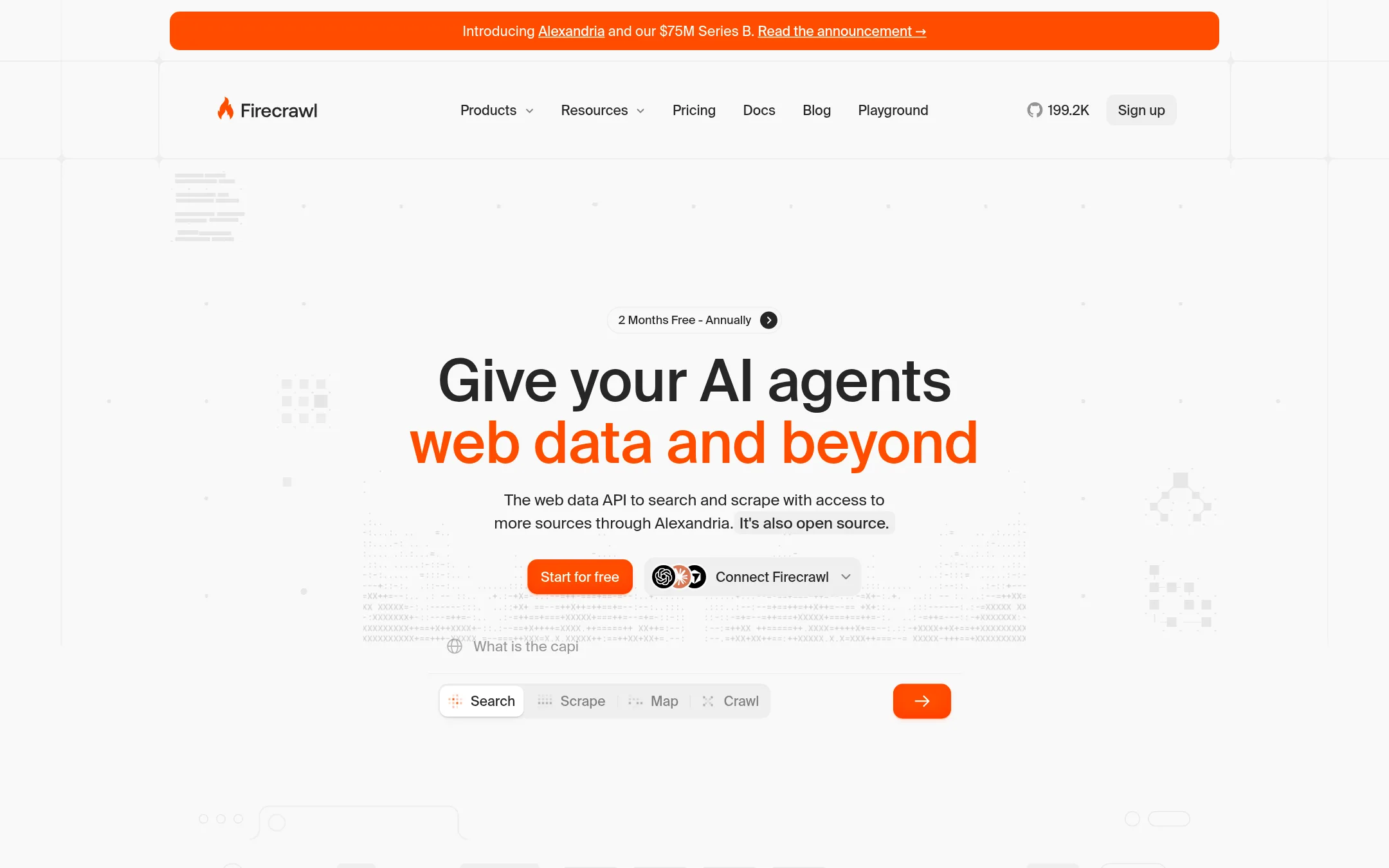
Firecrawl is a web data API for AI agents. It handles search, scraping, crawling and structured extraction, and it is open source. Teams pick it over Smooth when the job is getting clean web data into an AI pipeline or knowledge base, not running a browser agent that clicks through pages on its own.
Where it is strong
- Open source, so you can inspect and self-host the code
- Covers search, scrape, crawl and structured extraction in one API
- Free tier with 1,000 credits a month and no card required
Where it falls short
- Built around data retrieval, so it is less suited to multi-step browser tasks than Smooth's interact feature
- Credits are shared across endpoints, so heavy search or JSON extraction uses up the balance quickly
- Pricing:
- The free tier includes 1,000 credits a month, Hobby is $19/month billed monthly for 5,000 credits, Standard is $99/month billed monthly for 100,000 credits, and Growth is $399/month billed monthly for 500,000 credits.
- ANot published
3.Apify
Best for: Teams that need ready-made scrapers for common sites like Google Maps, Instagram or TikTok, or that want to sell their own Actors on a marketplace
- Pricing
- Not published
- Category
- Other
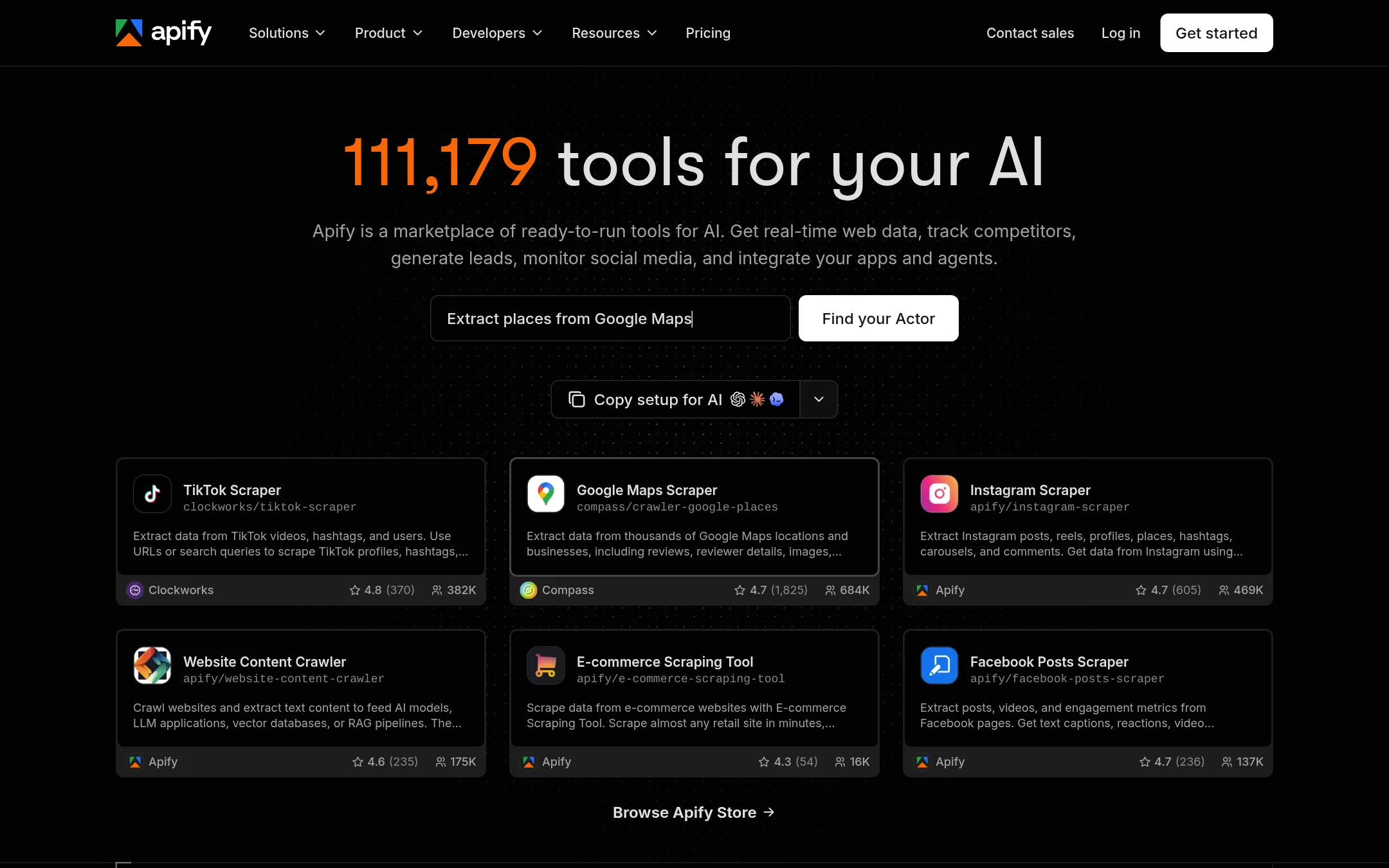
Apify is a marketplace of ready-made scrapers and automation tools called Actors, plus a platform to build and run your own. Teams pick it over Smooth when they need an existing scraper for a known site, such as Google Maps, Instagram or TikTok, or when they want to publish and sell their own scraper to other users.
Where it is strong
- Thousands of ready-made Actors for popular sites, so many jobs need no code
- You can publish your own Actor and earn from it, with Apify handling payments and invoicing
- Works with Python and JavaScript, plus Playwright, Puppeteer, Selenium, Scrapy and Crawlee
Where it falls short
- Smooth focuses on running your own browser agent with natural language and small models, which Apify does not center on
- Apify's pricing is spread across compute units, proxies and storage, so costs take more work to predict
- Pricing:
- Pricing is not published on the site.
- BFrom 1k units free
4.Browserless
Best for: Teams with existing Puppeteer or Playwright scripts that need reliable cloud browsers and authenticated sessions
- Pricing
- From 1k units free
- Category
- Other
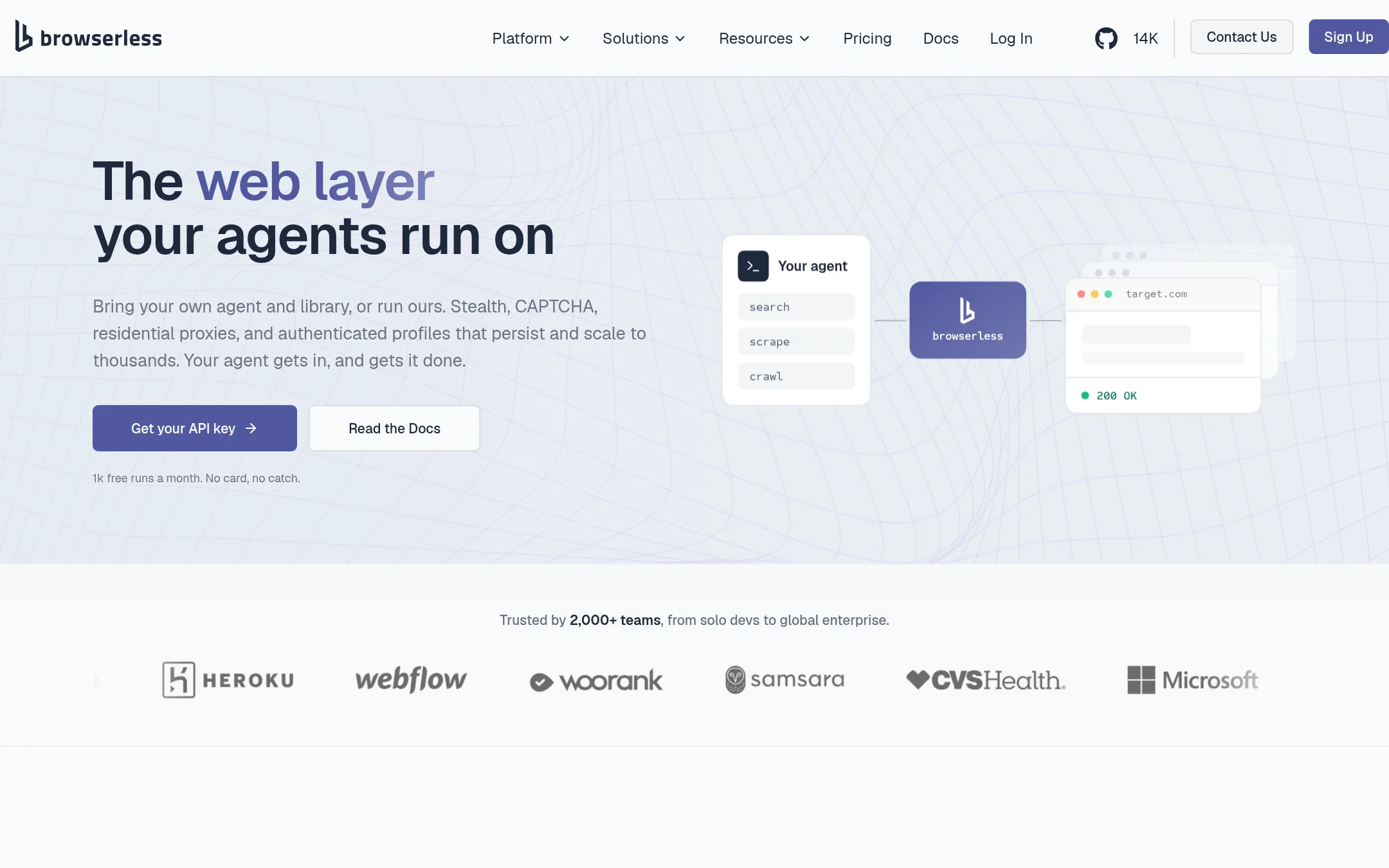
Browserless gives your agents and scripts a cloud browser that handles stealth, CAPTCHAs, proxies and logins, connected over Puppeteer, Playwright or MCP. Pick it over Smooth when you already have your own agent or automation code and mainly need reliable browser infrastructure underneath it, or when you want to self-host the same API.
Where it is strong
- Swap launch() for connect() to move existing scripts over with little rewriting
- Persistent authenticated profiles let agents stay logged in across runs
- Self-hosting is available with the same API as the cloud service
Where it falls short
- The unit-based billing model is different from Smooth's per-step pricing, so costs need estimating for your workload
- Smooth's small-model agent and built-in extraction and schema output are not part of the Browserless offering as described
- Pricing:
- The Prototyping plan includes 20k units per month at $0.0020 per unit overage, and the Starter tier includes 180k units per month, with a free plan of 1k units per month.
- Switching from Smooth:
- Moving from Smooth means replacing Smooth's SDK calls with Browserless connection endpoints and re-testing any agent logic that relied on Smooth's natural-language task runner.
- $30/mo usage + $0.10/h
5.Hyperbrowser
Best for: Teams building agents that need a browser, code execution and web data in one place, using Playwright or Puppeteer.
- Pricing
- $30/mo usage + $0.10/h
- Category
- Developer Tools
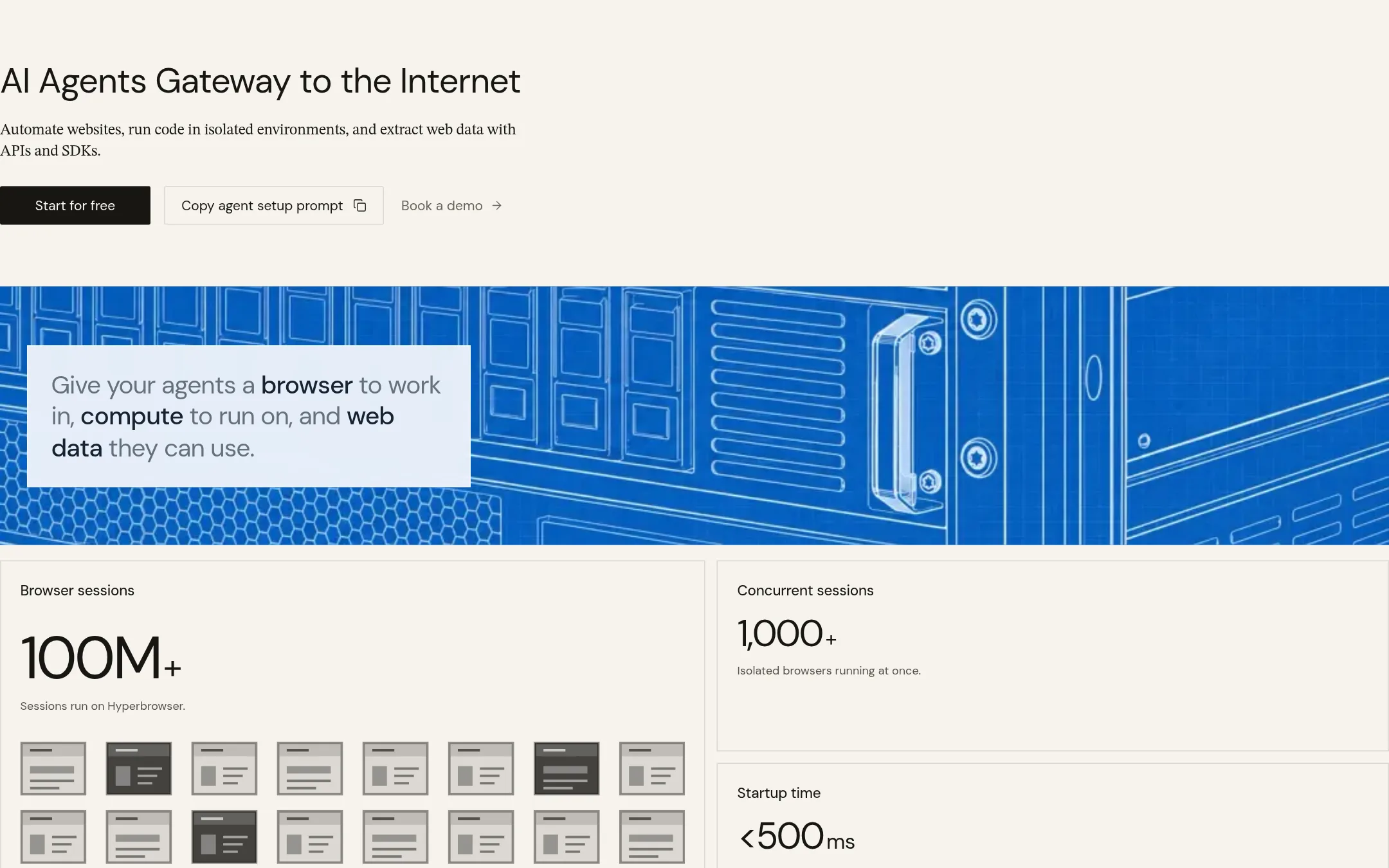
Hyperbrowser gives AI agents cloud Chrome sessions, isolated sandboxes with microVMs, and web data APIs for fetching, crawling, search and extraction, all from one set of credits. Teams pick it over Smooth when they need more than browser automation, such as running arbitrary code in a sandbox next to the browser or hosting agents like Browser Use or HyperAgent themselves.
Where it is strong
- Browsers, sandboxes and web data APIs share one credit pool.
- Sandboxes can run arbitrary commands and save snapshots for reuse.
- Works with Playwright, Puppeteer, the Node.js and Python SDKs, the CLI and MCP.
Where it falls short
- Credits across four products make it harder to predict a bill than a flat per-step rate.
- Smooth's per-step agent model is not offered in the same form, so agent cost depends on the agent you run.
- Pricing:
- Pricing is published in credits, with 1,000 credits equal to $1 in usage, a free tier of 5,000 credits, a Startup plan at $30 of usage per month and a Scale plan at $100 per month, with browser time billed at $0.10 per hour.
- Switching from Smooth:
- Moving from Smooth would mean rewriting agent tasks against Hyperbrowser's SDKs or Playwright connection, since the two services do not share an interface.
- SFrom $0 + usage
6.Steel
Best for: Teams that want a managed or self-hosted browser layer under their own Playwright, Puppeteer or Selenium code
- Pricing
- From $0 + usage
- Category
- Other
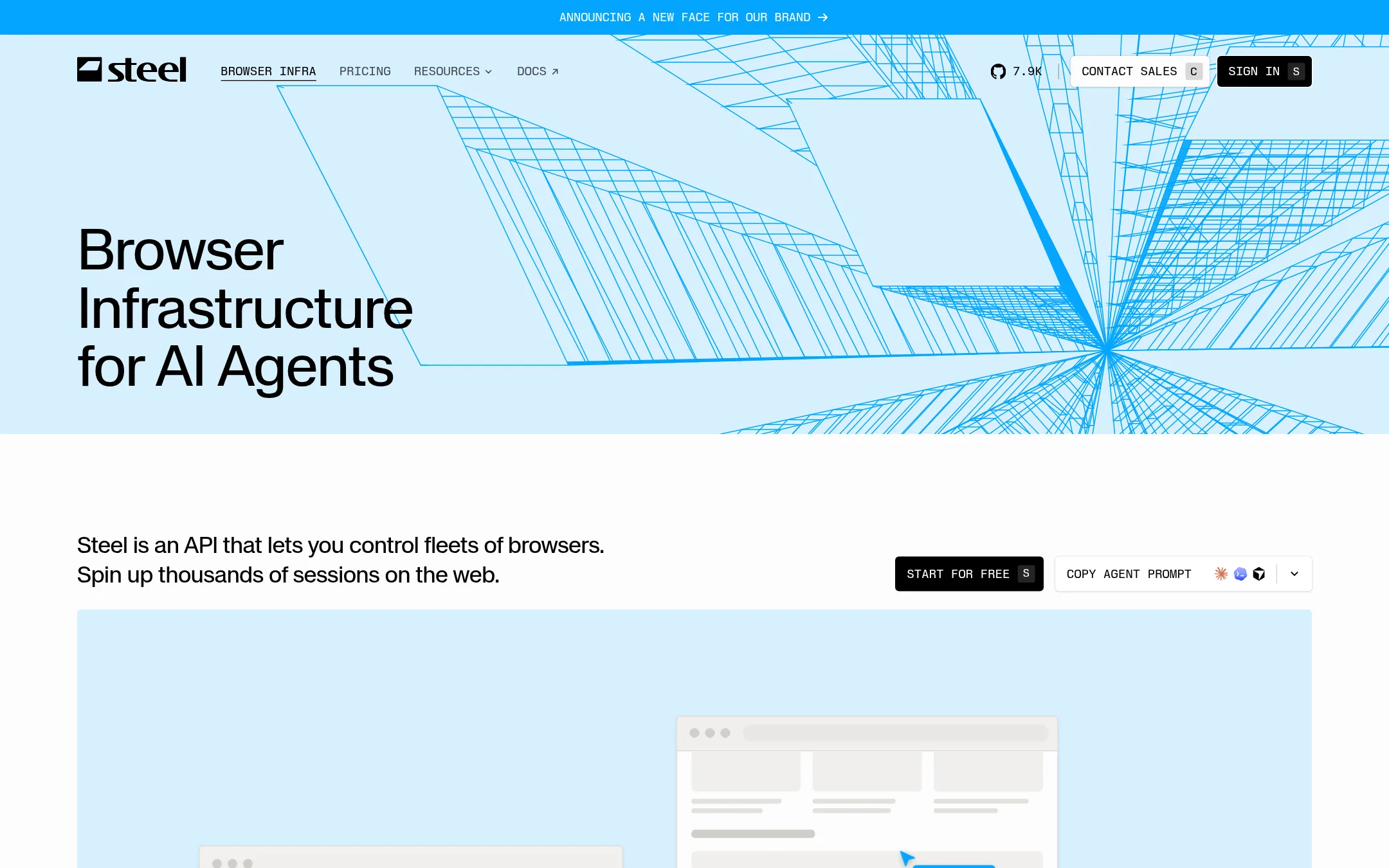
Steel gives you cloud browser sessions through an API, so your agents or Playwright, Puppeteer and Selenium scripts can run real browsers without you managing the fleet. Its open-source server can be self-hosted, and it adds stealth, proxies, CAPTCHA solving and persistent logins. Pick it over Smooth when you want to run the browser yourself or need fine control over sessions and identity, and Smooth's managed agent layer is not what you are after.
Where it is strong
- Works with Playwright, Puppeteer and Selenium over a standard CDP WebSocket, with no agent required.
- Open-source server you can self-host, with your data kept inside your own network.
- Persistent profiles keep logins and cookies across runs, and a live viewer lets a person take over a session.
Where it falls short
- The site lists no pricing for regions outside the default view, and volume rates are set by plan rather than shown per use case.
- Session length on the Launch plan is capped at 15 minutes, so long-running jobs need Scale or Enterprise.
- Pricing:
- Pricing is published with a Launch plan at $0 per month plus usage and $30 of one-time credits, a Scale plan at $250 per month with $100 of monthly credits, and custom Enterprise pricing.
- Switching from Smooth:
- Moving from Smooth would mean rebuilding your agent code against Steel's SDKs or CDP endpoint, since the two products expose different interfaces.
See more comparisons in Developer Tools alternatives.
FAQ
Questions about Smooth alternatives
What is Smooth best known for?
According to its site, Smooth is known for running web agents that can interact with pages from a natural language task, extract schema-validated JSON and scrape pages as markdown, screenshots or PDFs. It runs small language models and colocates the agent with the browser to keep latency low. The site says its goal is to let teams build agents while Smooth runs them reliably at scale.
Which alternative is best if my agents need to log in to sites without an API?
Browserbase suits this case. It provides real browser sessions that handle logins, forms and dynamic pages, along with Search and Fetch APIs. Browser hours are billed on top of agent runs, so long sessions will add to the cost.
Which option should I pick if I want a browser, code execution and web data in one place?
Hyperbrowser fits that need. It offers cloud Chrome sessions, isolated sandboxes that can run arbitrary code and web data APIs, all drawing from one credit pool. Its credit model makes the bill harder to predict than a flat per-step rate.
Is there a free option to try before paying?
Yes, several are free to start. Smooth's free plan includes welcome credits and two concurrent browsers at $0.005 per step, and no credit card is needed. Firecrawl's free tier includes 1,000 credits a month, Hyperbrowser's includes 5,000 credits, and Browserbase's includes one browser hour and 1,000 Search and Fetch calls.
Which alternative should I choose if I already have Playwright or Puppeteer scripts?
Browserless and Steel are built for this. Browserless lets you switch from launch() to connect() to move existing scripts over with little rewriting. Steel works with Playwright, Puppeteer and Selenium over a standard connection, and its open-source server can be self-hosted.
Last updated November 12, 2026.