
Speedscale alternatives
6 products compared · Updated November 6, 2026
The short answer
The three strongest Speedscale alternatives are Keploy, Postman, and WireMock. Keploy suits engineering teams that want regression tests and dependency mocks generated from real traffic inside CI. Postman suits teams that want to build, test, and document APIs in one tool and write their own test collections. WireMock suits developer teams that want free, open source API mocks inside their test suites.
Your shortlist, at a glance
Read the comparisons ↓- KKeployFree to custom quoteEngineering teams running Node, Go, Java or Python services that want regression and integration tests generated from real traffic inside their CI pipeline
 TestimNot publishedProduct teams testing Salesforce, web, or mobile user interfaces who want codeless, recorder-based end-to-end tests
 PostmanFrom $9/mo (Solo)Engineering teams that want to build, test, and document APIs in one tool and write their own test collections
- WWireMockFree (open source)Developer teams that want free, open source API mocks inside their JUnit or .NET test suites
- MMicrocksNot publishedPlatform and API teams that already maintain OpenAPI or AsyncAPI specs and want free, self-hosted mocking and contract tests in CI
- MMockoonFree open-source tierFrontend and mobile teams that need to build against unfinished or rate-limited APIs without a shared staging environment
About Speedscale and its alternatives
Speedscale is a testing platform that replays the requests your customers send against every build and grades whether the build is ready for production. According to its site, it is known for grading releases across behavior, performance, spec adherence, security, and runtime health, with its engineers confirming findings and, on the Managed plan, owning the replay suites.
When comparing alternatives in this category, weigh the pricing structure first, since some tools charge per user, some per usage, and some only on quote. Check where the product runs, whether as SaaS, self-hosted, or in your own cloud, and which integrations it supports with your stack. Also look at who writes and maintains the tests, the support and contract terms, and whether the tool grades release readiness or only generates tests.
Explore the alternatives
- KFree to custom quote
1.Keploy
Best for: Engineering teams running Node, Go, Java or Python services that want regression and integration tests generated from real traffic inside their CI pipeline
- Pricing
- Free to custom quote
- Category
- Other
Keploy records real API traffic and dependency calls with eBPF and network interception, without application code changes, then turns them into editable tests and mocks. Teams pick it when they want regression tests and dependency sandboxes generated from what the app actually does, locally or in CI, and the core recording platform is open source.
Where it is strong
- Captures traffic with eBPF and network interception, so no code changes are needed
- Generates editable YAML tests and dependency mocks for databases, queues and third-party APIs
- Core local record-and-replay is open source under Apache 2.0
Where it falls short
- Recording from Kubernetes, staging and production sits in the Enterprise tier
- Its main focus is API and integration regression testing, not the production readiness grading and managed test ownership Speedscale offers
- Pricing:
- Pricing is published as a Playground tier, a Pro tier with $19 of included usage credit, and a custom Enterprise tier, with the open-source recording platform free under Apache 2.0.
- Not published
2.Testim
Best for: Product teams testing Salesforce, web, or mobile user interfaces who want codeless, recorder-based end-to-end tests
- Pricing
- Not published
- Category
- Developer Tools
Testim is an automated UI and functional testing platform for web, mobile, and Salesforce apps. It uses AI to build tests from natural language and to keep element locators stable as the interface changes. Pick it over Speedscale when the problem is end-to-end UI coverage in a browser, not replaying production API traffic against a build.
Where it is strong
- Recorder-based test authoring with the option to add code when needed
- Self-healing locators that adjust as the app changes
- Covers web, native and hybrid mobile, and Salesforce in one product
Where it falls short
- Focuses on UI and functional tests, not replay of recorded production API traffic
- Mobile testing beyond the included local runs requires a sales conversation to purchase
- Pricing:
- Pricing is not published on the site.
- From $9/mo (Solo)
3.Postman
Best for: Engineering teams that want to build, test, and document APIs in one tool and write their own test collections
- Pricing
- From $9/mo (Solo)
- Category
- Developer Tools
Postman is an API platform for building, testing, mocking, and monitoring APIs, with AI agents that generate collections and assertions grounded in a Context Graph of your APIs. Teams pick it over Speedscale when their main problem is API development and contract testing rather than replaying real customer traffic against each release. It is the simpler starting point if you want your own team to write and run the tests.
Where it is strong
- Covers the API lifecycle, from design and mocking through testing and monitoring
- Free tier lets individuals start without a contract
- Team plan includes shared collections and role-based access control
Where it falls short
- Tests are written and maintained by your team, not built from recorded production traffic
- Full governance, audit logs and private runners sit in the Enterprise tier, which is quote-only
- Pricing:
- Postman has a free tier, Solo at $9 per month billed annually, Team at $19 per user per month billed annually, and Enterprise on custom quotes.
- WFree (open source)
4.WireMock
Best for: Developer teams that want free, open source API mocks inside their JUnit or .NET test suites
- Pricing
- Free (open source)
- Category
- Other
WireMock is an open source API mocking tool that developers embed in tests or run as a standalone server to stub HTTP responses, simulate faults, and verify requests. Teams pick it over Speedscale when they want to build their own mocks by hand and keep the tool in code, rather than replay captured production traffic with a managed service.
Where it is strong
- The core engine is free and open source, with self-hosting or embedding in code.
- Request matching, Handlebars response templating, and record and playback are built in.
- Active Slack community and GitHub repo for help and contributions.
Where it falls short
- It mocks the dependencies you define, so it does not replay real customer traffic the way Speedscale does.
- Readiness grading and a release verdict are not part of the product.
- Pricing:
- The core WireMock engine is free and open source, while WireMock Cloud pricing is not published on the site.
- MNot published
5.Microcks
Best for: Platform and API teams that already maintain OpenAPI or AsyncAPI specs and want free, self-hosted mocking and contract tests in CI
- Pricing
- Not published
- Category
- Other
Microcks is an open source tool for API mocking and contract testing. It works with OpenAPI, AsyncAPI, gRPC, GraphQL and SOAP, and it can run anywhere from a laptop to a cloud cluster. Pick it over Speedscale when you want to mock and test against API specifications rather than replaying recorded production traffic.
Where it is strong
- Open source and free to self-host
- Covers synchronous and event-driven APIs in one tool, including gRPC, GraphQL and SOAP
- Lightweight containers that run on a laptop or in the cloud
Where it falls short
- Mocks and tests come from specifications, not from recorded production traffic, so it does not replay real customer requests
- The site does not mention production readiness grading or managed services like Speedscale's
- Pricing:
- Pricing is not published on the site.
- MFree open-source tier
6.Mockoon
Best for: Frontend and mobile teams that need to build against unfinished or rate-limited APIs without a shared staging environment
- Pricing
- Free open-source tier
- Category
- Other
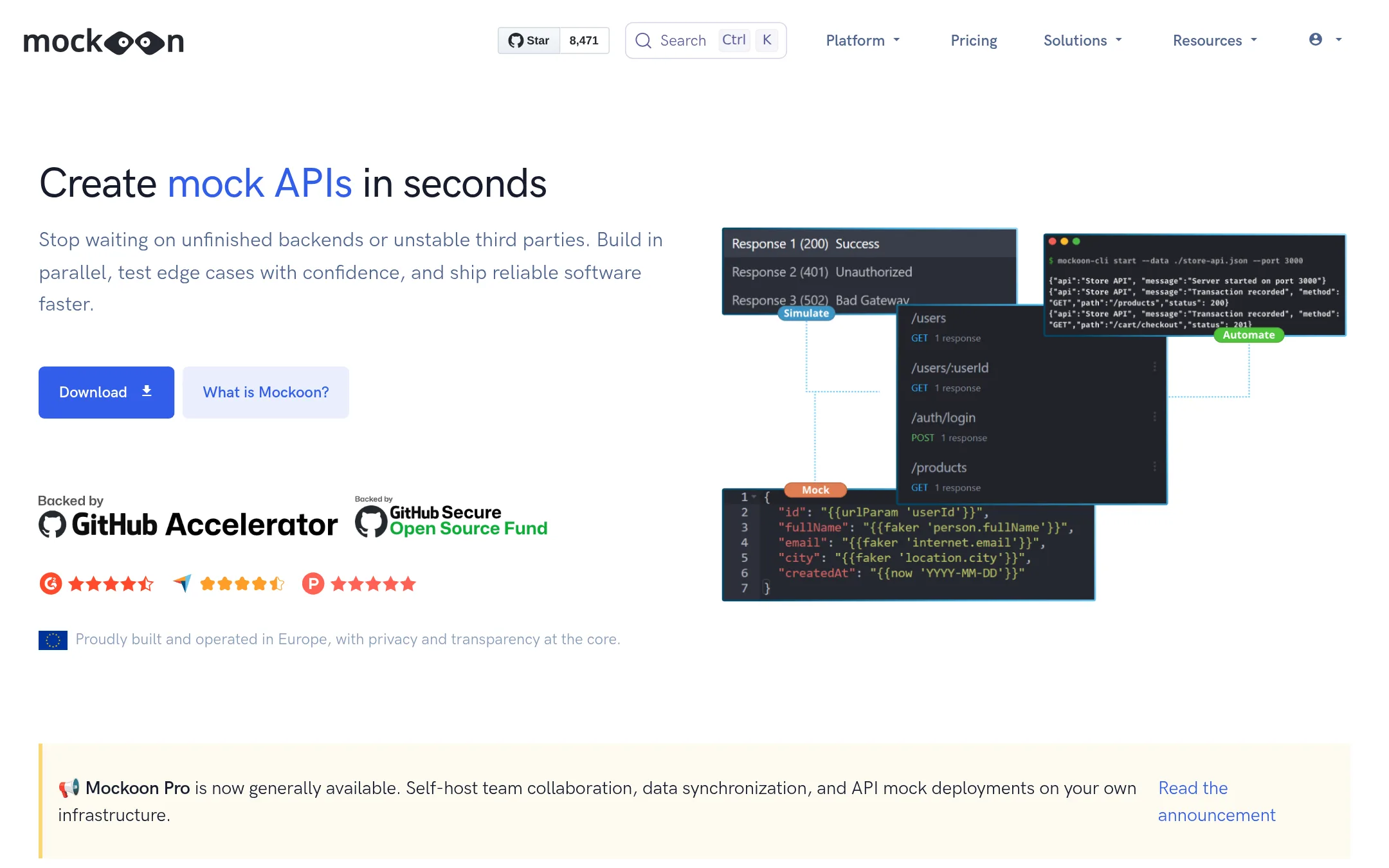
Mockoon builds mock APIs you run on your own machine or in CI, with routes, rules, templating and recorded traffic that can be turned into mock routes. Pick it over Speedscale when you need a fast, free way to stub endpoints for frontend work or test edge cases without recording production traffic or paying for a managed testing service.
Where it is strong
- Runs locally with no account, no cloud dependency and zero latency
- Simulates errors, timeouts, rate limits and dynamic responses through rules and templating
- Lightweight CLI and official Docker image run mocks headlessly in CI pipelines
Where it falls short
- Mocks are authored by hand or recorded from live calls, not generated from production replay at Speedscale's scale
- Team collaboration and managed deployment sit behind the paid Mockoon Pro plans
- Pricing:
- Pricing is not published on the site for the open-source tools, and Mockoon Pro's Team plan is self-hosted with licenses that are quoted separately, while Enterprise pricing is custom.
See more comparisons in Developer Tools alternatives.
FAQ
Questions about Speedscale alternatives
What is the best Speedscale alternative for generating tests from real traffic?
Keploy records real API traffic and dependency calls without application code changes, then turns them into editable tests and mocks. Its core recording platform is open source under Apache 2.0, though recording from Kubernetes, staging and production sits in the Enterprise tier. Its focus is API and integration regression testing rather than production readiness grading.
Which alternative is cheapest to start with?
Postman has a free tier, and its Solo plan is listed at $9 per month billed annually. WireMock's core engine is free and open source. Pricing for Keploy's Pro tier includes $19 of usage credit, and Speedscale pricing is metered by ingest or RAM with a base fee on the Managed plan.
Which tool is best if my team wants to write and run its own tests?
Postman suits teams that want to build, test, and document APIs in one tool, with tests written and maintained by the team itself. It covers the full API lifecycle from design and mocking through testing and monitoring. Speedscale's Managed plan takes that work off your team, while its Platform plan leaves suite ownership with you.
Can these alternatives tell me whether a release is ready for production?
The entries here do not describe a production readiness verdict. Postman and WireMock focus on building and mocking APIs, and Keploy focuses on regression and integration tests. If a single ready or not-ready grade per release is your requirement, check each vendor directly, because that capability is what Speedscale describes as its core output.
Which alternative should I pick for mocking unfinished or rate-limited APIs?
Mockoon is built for frontend and mobile teams that need to build against unfinished or rate-limited APIs without a shared staging environment. It runs locally with no account, simulates errors and timeouts, and can run headlessly in CI. Team collaboration and managed deployment sit behind its paid Mockoon Pro plans.
Last updated November 6, 2026.