
Stitch alternatives
12 products compared · Updated October 31, 2026
The short answer
The strongest Stitch alternatives are Fivetran for broad connector coverage and AI-ready pipelines, Airbyte for flexible deployment and capacity-based pricing, and Talend for teams already in the Qlik ecosystem needing transformation and data quality. Fivetran suits data teams needing 750+ connectors, Airbyte fits teams wanting on-prem or hybrid control, and Talend is best for those migrating from Stitch.
Your shortlist, at a glance
Read the comparisons ↓ FivetranFree tier. Usage-basedData teams that need a large connector library and want to move data into warehouses or lakes for analytics and AI workloads.
 AirbyteNot publishedTeams that need a large connector library and flexible deployment options, including on-prem or hybrid, with predictable capacity-based pricing.
 TalendNot publishedTeams that want a single platform for data ingestion, transformation, and quality, especially those already using Qlik or needing broader integration capabilities than Stitch offers.
 MatillionConsumption-basedData teams on Snowflake, Databricks, BigQuery, or Redshift that want AI-assisted pipeline building and more control over transformations.
 Hevo DataFrom $265/moData teams that need a unified ELT platform with built-in transformations and high-volume replication, especially those already using dbt.
 SegmentFrom $120/moTeams that need a customer data platform to unify first-party data and activate it across 550+ destinations, rather than just syncing raw data to a warehouse.
 Apache AirflowOpen sourceData engineering teams that need to programmatically author, schedule, and monitor custom workflows beyond simple data ingestion.
 CensusFree tier. Usage-basedTeams that already have a warehouse and want to push modeled data into Salesforce, HubSpot, or other SaaS tools for operational use.
 EtleapNot publishedTeams adopting Apache Iceberg as their data foundation who need continuous ingestion and dbt-based transformations in a single pipeline.
 InformaticaNot publishedLarge enterprises that need governed, AI-ready data across complex hybrid and multi-cloud environments, with strong compliance and MDM requirements.
 MeltanoSee websiteOpen-source ELT platform with 600+ connectors and full pipeline control as code.
 Mozart DataFree tier. Paid from $Growing businesses that want a complete data stack in one product, with no-code integrations and a built-in warehouse.
About Stitch and its alternatives
Stitch is a Qlik product for automated, secure data integration from 130+ sources. It is known for simple ELT pipelines, transparent row-based pricing, and a free trial. Stitch is being folded into Qlik Talend Cloud, so new users are encouraged to try that instead.
When comparing alternatives, weigh pricing structure (row-based vs. capacity-based vs. credit-based), region availability, integration count and type, support options, and contract terms. Some tools offer free tiers, while others require sales contact. Consider whether you need reverse ETL, transformations, or a full data platform.
Explore the alternatives
- Free tier. Usage-based
1.Fivetran
Best for: Data teams that need a large connector library and want to move data into warehouses or lakes for analytics and AI workloads.
- Pricing
- Free tier. Usage-based
- Category
- Analytics & Data
Fivetran is a fully managed data movement platform with 750+ connectors, designed for teams that need broad source coverage and AI-ready data pipelines. Choose it over Stitch if you want more connectors, faster syncs, and built-in transformation and activation capabilities.
Where it is strong
- 750+ fully managed connectors
- 15-minute syncs on Standard plan, 1-minute on Enterprise
- Built-in transformations and activations
Where it falls short
- Pricing can get complex with usage-based costs
- Enterprise features like hybrid deployment require annual contract
- Pricing:
- Pricing is usage-based with a free plan up to 500,000 monthly active rows, then a $5 base charge per standard connection. Annual contracts save up to 22%.
- Switching from Stitch:
- Moving from Stitch involves re-creating pipelines and may require adjusting to Fivetran's usage-based pricing model.
- Not published
2.Airbyte
Best for: Teams that need a large connector library and flexible deployment options, including on-prem or hybrid, with predictable capacity-based pricing.
- Pricing
- Not published
- Category
- Analytics & Data
Airbyte is an open-source data movement platform with 700+ connectors, supporting self-hosted, hybrid, and fully managed deployments. Choose it over Stitch if you need more connector coverage, want to run pipelines in your own VPC or data center, or prefer capacity-based pricing that doesn't scale with data volume.
Where it is strong
- 700+ connectors, far more than Stitch's 130+
- Deploy in your own VPC or data center with Airbyte Hybrid
- Capacity-based pricing on Pro and Enterprise Flex avoids volume spikes
Where it falls short
- Pricing details not published, requiring sales contact
- Open-source core may require more setup and maintenance than Stitch's managed service
- Pricing:
- Pricing is not published on the site. Plans include Standard (volume-based), Plus (credit packages), and Pro/Enterprise Flex (capacity-based on Data Workers).
- Not published
3.Talend
Best for: Teams that want a single platform for data ingestion, transformation, and quality, especially those already using Qlik or needing broader integration capabilities than Stitch offers.
- Pricing
- Not published
- Category
- Analytics & Data
Talend is the successor to Stitch under Qlik, offering the same data ingestion plus transformation and data quality features. Choose Talend if you need to move beyond simple ELT into full data integration and governance. Stitch customers are being encouraged to migrate to Qlik Talend Cloud as Stitch is being folded into it.
Where it is strong
- Includes data transformation and quality tools beyond Stitch's ELT-only focus
- Part of Qlik's broader analytics ecosystem
- Supports AI-ready data integration across cloud and on-premises environments
Where it falls short
- Pricing is not transparent, requiring a sales conversation
- Stitch's simple row-based pricing model is replaced by a more complex enterprise offering
- Pricing:
- Pricing is not published on the site.
- Switching from Stitch:
- Moving from Stitch to Talend is the official migration path, and Stitch customers are encouraged to try Qlik Talend Cloud with their existing credentials.
- Consumption-based
4.Matillion
Best for: Data teams on Snowflake, Databricks, BigQuery, or Redshift that want AI-assisted pipeline building and more control over transformations.
- Pricing
- Consumption-based
- Category
- Analytics & Data
Matillion is a cloud-native ELT platform with AI agents that build and manage pipelines for you. Choose it over Stitch if you want a visual, low-code environment with AI assistance and deeper transformation capabilities beyond simple data ingestion.
Where it is strong
- AI agents (Maia) plan, build, test, and fix pipelines
- 150+ connectors with drag-and-drop low-code canvas
- Supports hybrid cloud deployment and streaming CDC on Scale plan
Where it falls short
- Pricing is opaque. You must contact sales for credit costs
- Advanced features like custom SSO and lineage are locked to the Scale plan
- Pricing:
- Pricing is based on a consumption-based credit system, with plans starting at Developer (1 user, unlimited projects) and scaling to Teams and Scale. Specific credit prices are not published on the site.
- Switching from Stitch:
- Moving from Stitch to Matillion means rebuilding pipelines in a new visual environment, but Matillion offers a free trial and migration support.
- From $265/mo
5.Hevo Data
Best for: Data teams that need a unified ELT platform with built-in transformations and high-volume replication, especially those already using dbt.
- Pricing
- From $265/mo
- Category
- Analytics & Data
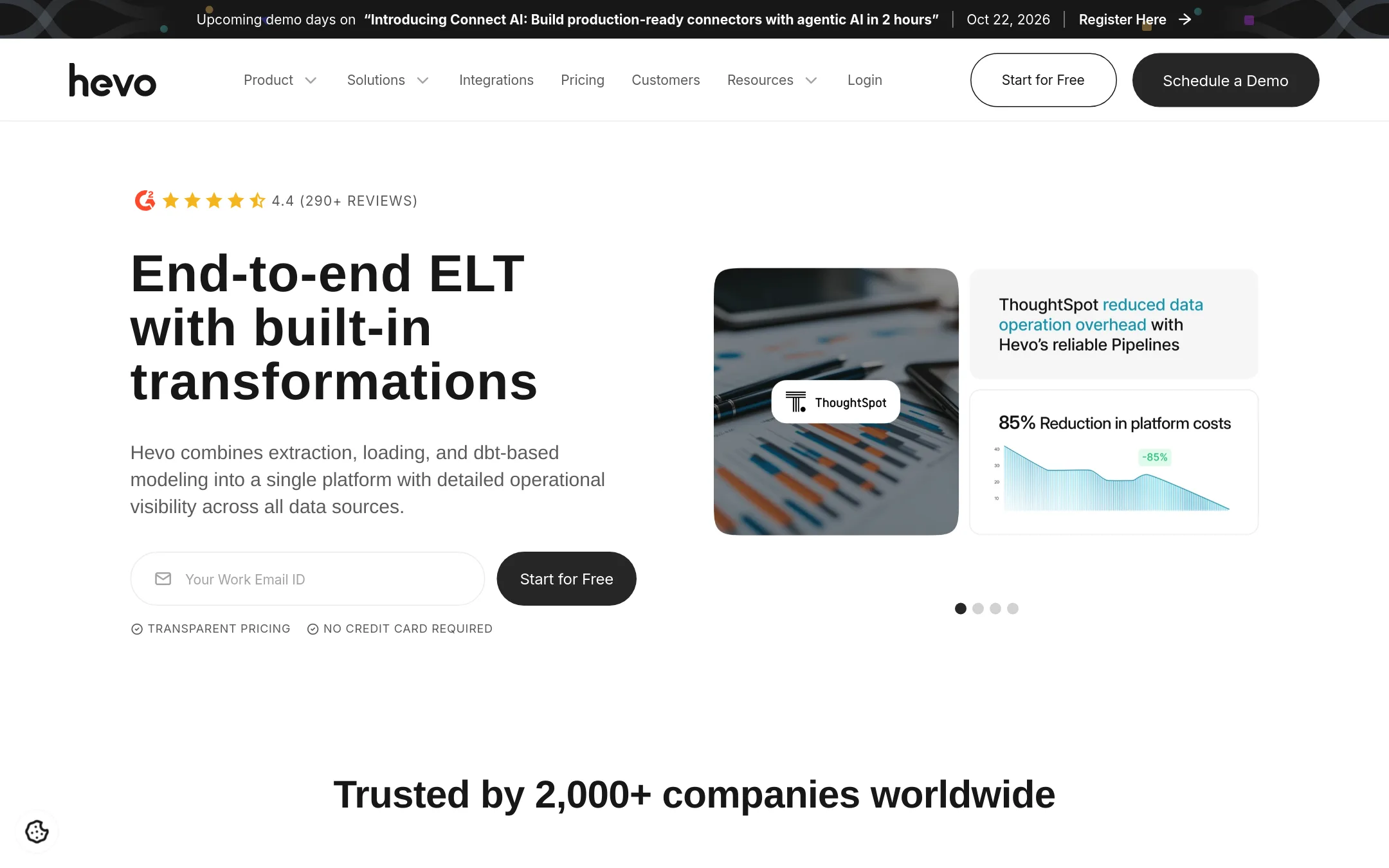
Hevo Data is an automated ETL platform with 170+ connectors and built-in dbt-based transformations. Choose it over Stitch if you want a single tool that handles both data ingestion and modeling, with real-time replication and high-volume throughput.
Where it is strong
- 170+ connectors, including custom builds
- Built-in dbt transformations
- Real-time replication with CDC
Where it falls short
- Pricing tiers jump quickly from $265 to $750
- Free tier limited to 1M events/month
- Pricing:
- Free tier for up to 1M events/month. Starter starts at $265/month. Professional starts at $750/month. Business Critical is custom quote.
- Switching from Stitch:
- Moving from Stitch involves reconfiguring your pipelines in Hevo, but Hevo offers a contract buyout if you're locked into an existing ETL contract.
- From $120/mo
6.Segment
Best for: Teams that need a customer data platform to unify first-party data and activate it across 550+ destinations, rather than just syncing raw data to a warehouse.
- Pricing
- From $120/mo
- Category
- Analytics & Data
Segment is a customer data platform that collects, unifies, and activates customer data across apps and devices, while Stitch is a data integration tool that moves raw data into a warehouse. Choose Segment when you need to build unified customer profiles and send data to marketing and engagement tools, not just load it into a warehouse.
Where it is strong
- Unified customer profiles across all touchpoints
- 550+ integrations for activation, not just warehousing
- Real-time data collection and audience building
Where it falls short
- Pricing for CDP plans is custom, not transparent
- Focus on customer data, not general-purpose ETL
- Pricing:
- In the United States, Connections starts at $120/month for up to 10k visitors, while CDP plans are custom-priced.
- Open source
7.Apache Airflow
Best for: Data engineering teams that need to programmatically author, schedule, and monitor custom workflows beyond simple data ingestion.
- Pricing
- Open source
- Category
- Analytics & Data
Apache Airflow is an open-source workflow orchestration platform where you define pipelines in Python. Choose it over Stitch if you need full control over complex, custom data workflows and already have engineering resources to build and maintain them.
Where it is strong
- Pipelines are defined in Python, giving full flexibility and dynamic generation.
- Modular architecture with a message queue scales to an arbitrary number of workers.
- Extensible with custom operators and integrations for major cloud providers.
Where it falls short
- Requires significant setup and maintenance compared to a managed service like Stitch.
- No built-in data ingestion connectors. You must build or source them yourself.
- Pricing:
- Pricing is not published on the site.
- Free tier. Usage-based
8.Census
Best for: Teams that already have a warehouse and want to push modeled data into Salesforce, HubSpot, or other SaaS tools for operational use.
- Pricing
- Free tier. Usage-based
- Category
- Analytics & Data
Census is a reverse ETL tool that syncs data from your warehouse into business tools like CRMs and ad platforms. Choose it over Stitch when you need to activate warehouse data in operational systems, not just load it into a warehouse.
Where it is strong
- Reverse ETL activates warehouse data into 200+ destinations
- Free plan covers up to 500,000 monthly active rows
- Usage-based pricing with automatic volume discounts
Where it falls short
- Not a full data ingestion tool. Requires a separate ELT solution like Stitch
- Pricing can get complex with separate costs for connections, transformations, and activations
- Pricing:
- Pricing is usage-based with a free plan up to 500,000 monthly active rows. Paid plans start at a $5 base charge per connection, with volume discounts and up to 22% savings on annual contracts.
- Not published
9.Etleap
Best for: Teams adopting Apache Iceberg as their data foundation who need continuous ingestion and dbt-based transformations in a single pipeline.
- Pricing
- Not published
- Category
- Analytics & Data
Etleap is an ETL platform built around Apache Iceberg, handling ingestion, transformation, and table maintenance in one place. Choose it over Stitch if you're standardizing on Iceberg as your data lakehouse format and want a pipeline layer that keeps tables fed and healthy.
Where it is strong
- Native Iceberg support with automated table maintenance
- Combines ingestion, transformation (wrangling + dbt Core), and coordination
- Auto-scaling EMR clusters handle large data volumes
Where it falls short
- No published pricing. Requires a demo
- Iceberg-centric, so less useful if you're not committed to that format
- Pricing:
- Pricing is not published on the site.
- Not published
10.Informatica
Best for: Large enterprises that need governed, AI-ready data across complex hybrid and multi-cloud environments, with strong compliance and MDM requirements.
- Pricing
- Not published
- Category
- Analytics & Data
Informatica is an enterprise-grade data management platform that connects, cleans, and governs data across 50,000+ sources, with 300+ connectors. Choose it over Stitch when you need deep data governance, master data management, and data quality tools alongside integration, not just simple ELT pipelines.
Where it is strong
- 300+ connectors and 50,000+ sources for broad integration
- Built-in data governance, quality, and MDM capabilities
- Recognized as a leader in multiple Gartner Magic Quadrants
Where it falls short
- Pricing is opaque and likely enterprise-only, no self-serve tier
- Heavier platform than Stitch, with more setup and operational overhead
- Pricing:
- Pricing is not published on the site. The pricing page returns a 404 error.
- See website
11.Meltano
Developer Tools
Open-source ELT platform with 600+ connectors and full pipeline control as code.
- Free tier. Paid from $
12.Mozart Data
Best for: Growing businesses that want a complete data stack in one product, with no-code integrations and a built-in warehouse.
- Pricing
- Free tier. Paid from $
- Category
- Analytics & Data
Mozart Data is a full data platform that bundles ETL, a Snowflake warehouse, transformation, and BI tools into one product. Choose it over Stitch if you want a managed stack without assembling separate tools, especially if you're a smaller team that wants to start analyzing data quickly.
Where it is strong
- Includes a Snowflake warehouse, so you don't need to set up your own
- Unlimited users and connectors on all plans
- dbt Core integration and SQL-based transformation built in
Where it falls short
- Pricing is based on monthly active rows, which can be harder to predict than Stitch's row-based model
- No mention of on-premises or private connectivity options like Stitch's VPN or VPC peering
- Pricing:
- Pricing starts with a free tier (Sonata) that includes 250,000 monthly active rows and 15 compute-hours. Paid plans start at $500 per month for 1.75M rows and 135 compute-hours, with overages billed per compute credit and per 100,000 MAR.
- Switching from Stitch:
- Moving from Stitch means migrating your data sources and reconfiguring pipelines, but Mozart Data's no-code connectors and built-in warehouse may simplify the setup.
See more comparisons in Analytics & Data alternatives.
FAQ
Questions about Stitch alternatives
What is the best Stitch alternative for a small team with limited engineering resources?
Mozart Data is a strong choice because it bundles ETL, a Snowflake warehouse, and BI tools into one product, so you don't need to set up separate components. It has a free tier and unlimited users on paid plans. Hevo Data also offers a free tier and built-in transformations, but pricing jumps quickly.
Which alternative has the most connectors?
Fivetran leads with 750+ fully managed connectors, followed by Airbyte with 700+. Informatica offers 300+ connectors but is enterprise-focused. Stitch itself has 130+ sources, so most alternatives provide broader coverage.
Are there any free or open-source options?
Airbyte is open-source and can be self-hosted for free, though you handle maintenance. Fivetran and Census both offer free plans up to 500,000 monthly active rows. Hevo Data has a free tier for up to 1M events per month. Apache Airflow is also free but requires significant setup.
Which alternative is best for reverse ETL, not just ingestion?
Polytomic and Census are designed for reverse ETL, syncing data from your warehouse back into business tools. Polytomic supports both ETL and reverse ETL in one platform, while Census focuses on activation into 200+ destinations. Both require a separate ELT solution for ingestion.
How do pricing models compare across alternatives?
Stitch uses row-based pricing. Fivetran and Census use usage-based pricing with free tiers. Airbyte offers capacity-based pricing on higher plans to avoid volume spikes. Matillion uses a credit system, and Hevo Data has event-based tiers. Many enterprise tools like Informatica and Talend do not publish pricing.
Last updated October 31, 2026.