
Superagent alternatives
6 products compared · Updated November 20, 2026
The short answer
The three strongest alternatives to Superagent are Snyk, Semgrep, and Aikido Security. Snyk suits development teams of up to 10 developers that want flat-rate scanning of code, dependencies, containers, and infrastructure as code inside their IDE and CI pipeline. Semgrep suits engineering teams that want static analysis, dependency scanning, and secrets detection inside pull requests, CI, and IDEs. Aikido Security suits engineering teams that want code, cloud, and runtime security under one vendor with a free starting tier.
Your shortlist, at a glance
Read the comparisons ↓ SnykFrom $25/moDevelopment teams of up to 10 developers that want flat-rate SCA, SAST, IaC, and container scanning inside their IDE and CI pipeline.
 Semgrep$30/contributor/moEngineering teams that want SAST, SCA and secrets scanning inside pull requests, CI and IDEs
- AAikido SecurityNot publishedEngineering teams that want code, cloud and runtime security under one vendor and a free starting tier.
- BBurp SuiteNot publishedPentesters and hands-on security professionals who test web applications directly.
 EscapeNot publishedEngineering teams that want continuous AI pentesting of web apps and APIs on every merge or deploy, with proof of exploitability.
- PPenteraNot publishedSecurity teams running continuous penetration testing across internal networks, cloud and external assets who want to prove which exposures are truly exploitable
About Superagent and its alternatives
Superagent is a security platform for software and AI agents. Its site says it scans code, tests applications for exploitable weaknesses, validates dependency updates, screens external content before agents read it, and monitors agents at runtime. Its products include PR scanning, red teaming, dependency validation, context and runtime guardrails, and a security model called Security-One-27B. Its published pricing includes a free tier for private repositories and free unlimited use for open-source repositories.
When comparing alternatives in this category, weigh what each tool actually covers. Look at whether it tests live applications or only scans code and dependencies, and whether it protects AI agents at runtime. Compare the pricing structure, since some vendors price per contributor, some by credits, and some do not publish prices at all. Check which regions and integrations the product supports with your existing tools, what support is included, and what the contract terms require before you commit.
Explore the alternatives
- From $25/mo
1.Snyk
Best for: Development teams of up to 10 developers that want flat-rate SCA, SAST, IaC, and container scanning inside their IDE and CI pipeline.
- Pricing
- From $25/mo
- Category
- Security & Privacy
Snyk is a long-running developer security platform that scans code, open source dependencies, containers, and infrastructure as code, and now extends into AI coding agents and AI-native apps. Choose Snyk over Superagent when you want a mature, widely integrated scanner across IDEs, CI/CD, and source control, and your main need is finding and fixing known vulnerabilities in what your team builds.
Where it is strong
- Scans code, open source dependencies, containers, and infrastructure as code in one platform.
- Integrates with IDEs, CLI tools, source code managers, and CI/CD pipelines, plus AI coding assistants such as Claude Code, Cursor, and Codex
- Has a free tier for individual developers and small teams, and is free for open source maintainers.
Where it falls short
- AI pentesting and coding agent security require an Enterprise Platform Subscription, so they are not available on the Free or Team plans.
- The Free and Team plans cap test volumes per product, and the Team plan is limited to about 10 developers.
- Pricing:
- The Free plan is $0 per month, and the Team plan starts at $25 per month with higher test limits and Jira integration, while Enterprise pricing is custom and based on credits.
- $30/contributor/mo
2.Semgrep
Best for: Engineering teams that want SAST, SCA and secrets scanning inside pull requests, CI and IDEs
- Pricing
- $30/contributor/mo
- Category
- Developer Tools
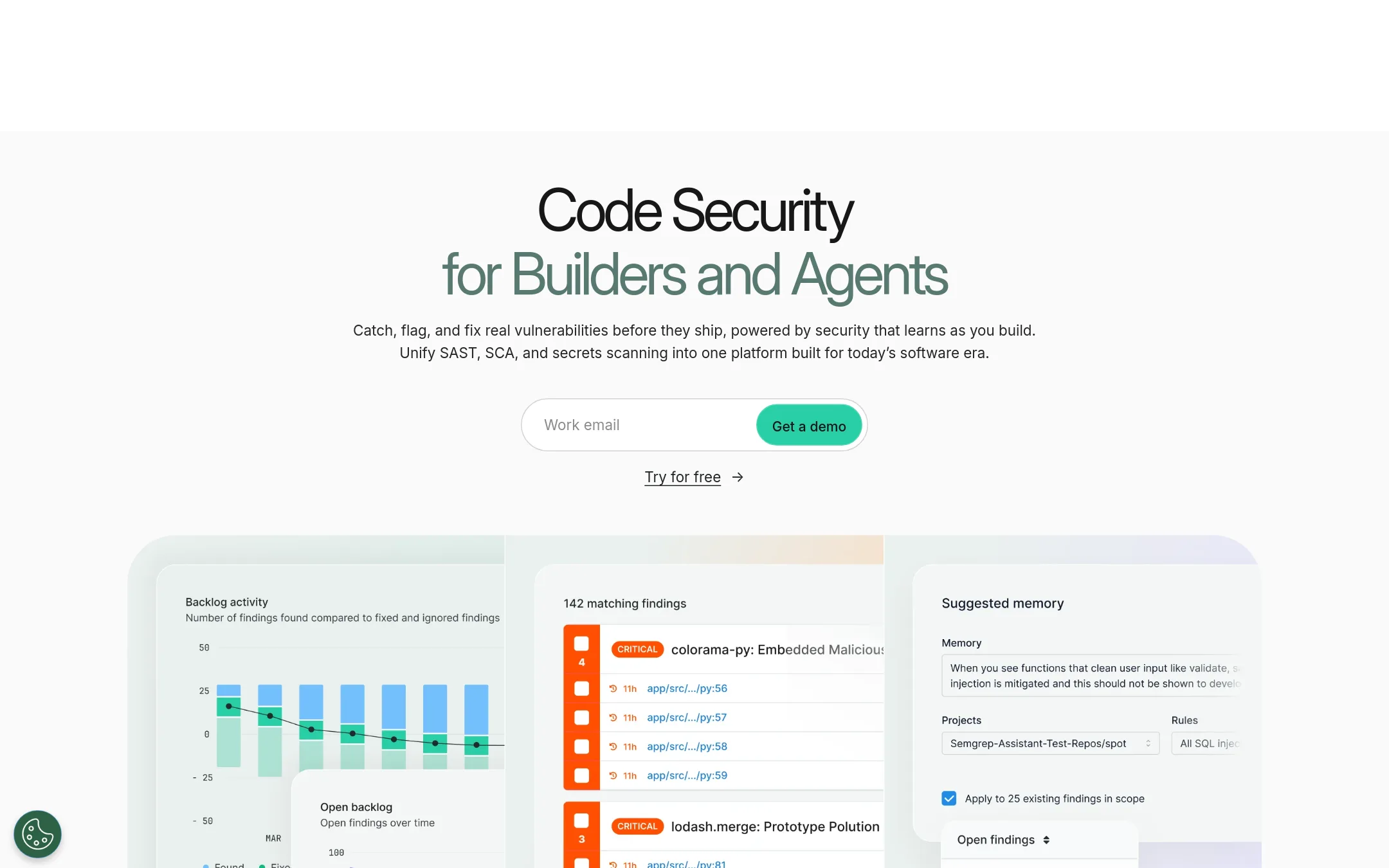
Semgrep is a code security platform that scans source code for vulnerabilities, open source dependency risks and hardcoded secrets, with AI-assisted triage and fixes in pull requests and IDEs. Choose it over Superagent when your main need is static analysis and dependency scanning tied to developer workflows, rather than red teaming running applications or runtime guardrails for agents.
Where it is strong
- Scans code for SAST, SCA and secrets in one platform
- Runs in CLI, CI/CD, IDEs and PR checks on GitHub, GitLab, Bitbucket and Azure
- Learns from human triage decisions so repeat false positives are suppressed
Where it falls short
- Focuses on code and dependencies, not red teaming of live applications
- Pricing scales per contributor, so larger teams pay more as they grow
- Pricing:
- Pricing is published per contributor: Code and Supply Chain are $30/month per contributor on the Enterprise-tier listing, Secrets is $15/month per contributor, and the Teams tier lists $0 per contributor with up to 10 repositories.
- Switching from Superagent:
- Moving from Superagent would mean reconnecting your repositories and CI checks to Semgrep, since the two products cover different parts of the security work.
- ANot published
3.Aikido Security
Best for: Engineering teams that want code, cloud and runtime security under one vendor and a free starting tier.
- Pricing
- Not published
- Category
- Other
Aikido Security is a broad application security platform that covers code, dependencies, cloud, pentesting and runtime protection in one system, with a free tier to start. Pick it over Superagent when you want code, cloud and runtime coverage in a single product, or you need compliance reports such as SOC 2 or ISO 27001 output alongside the scanning.
Where it is strong
- Covers code, cloud, pentesting and in-app runtime defense in one platform.
- Offers a free starting tier with 10 repos, 2 container images and 1 cloud account.
- Generates pentest reports that the site says auditors have accepted for SOC 2 and ISO 27001.
Where it falls short
- Superagent's red teaming and agent guardrails are not described as a core focus here, so agent-specific protection is less clear.
- Pricing tiers on the page are listed without a published price, so budgeting needs a sales conversation.
- Pricing:
- Pricing is not published on the site.
- BNot published
4.Burp Suite
Best for: Pentesters and hands-on security professionals who test web applications directly.
- Pricing
- Not published
- Category
- Other
Burp Suite is a web security testing toolkit used by pentesters and AppSec teams to find and exploit vulnerabilities in web applications. Choose it over Superagent when your need is hands-on manual web app testing, or when you want a tool your security staff already know and control directly rather than an autonomous agent running scans for you.
Where it is strong
- Has been the standard tool for web application security testing for over 20 years.
- Comes with a free online web security training academy for learning the tool.
- Offers separate products for manual testing, scalable automated scanning, and CI-driven scanning in DevOps pipelines.
Where it falls short
- Covers web applications. The supplied facts do not show coverage of agents, dependencies, or container images as Superagent does.
- Pricing is not published, so cost must be checked with the vendor.
- Pricing:
- Pricing is not published on the site.
- Not published
5.Escape
Best for: Engineering teams that want continuous AI pentesting of web apps and APIs on every merge or deploy, with proof of exploitability.
- Pricing
- Not published
- Category
- Security & Privacy
Escape is an AI-driven offensive security platform that runs continuous pentesting, including business-logic-aware DAST, and external network pentesting with attack surface management. A team would pick it over Superagent if their main need is testing live applications and APIs for business logic flaws and proving exploitability on each release, rather than the code-review, dependency, and agent-guardrail work Superagent focuses on.
Where it is strong
- Business-logic-aware DAST, aimed at modern stacks rather than only classic scanning.
- Runs pentests on merge, deploy, or a schedule, and re-checks open issues.
- Covers external network exposure and attack surface management alongside application testing.
Where it falls short
- Its listed focus is application and network pentesting, so it does not advertise the PR scanning, agent runtime guardrails, or dependency va
- No pricing or plan details are published, so cost comparison requires talking to sales.
- Pricing:
- Pricing is not published on the site.
- PNot published
6.Pentera
Best for: Security teams running continuous penetration testing across internal networks, cloud and external assets who want to prove which exposures are truly exploitable
- Pricing
- Not published
- Category
- Other
Pentera validates exploitable risk across internal networks, external assets, cloud, web applications and APIs, then helps prioritize fixes and revalidate them. Teams pick it when they want exposure validation and attack simulation across their infrastructure, including ransomware and credential testing, rather than code scanning and agent protection.
Where it is strong
- Covers internal networks, external assets, cloud, web apps and APIs on one platform
- Includes ransomware-family emulation and credential attack testing such as cracking domain credentials
- Revalidates fixes to confirm an exposure is closed
Where it falls short
- Focused on validating infrastructure and applications, with no equivalent to Superagent's PR scanning or agent runtime guardrails
- Its strengths are in network and enterprise attack paths rather than securing AI agents or dependency updates
- Pricing:
- Pricing is not published on the site.
See more comparisons in Security & Privacy alternatives.
FAQ
Questions about Superagent alternatives
Which alternative is best if I only need code and dependency scanning?
Semgrep and Snyk both focus on this work. Semgrep covers SAST, software composition analysis, and secrets scanning inside pull requests, CI, and IDEs. Snyk covers code, open source dependencies, containers, and infrastructure as code, with a free tier for small teams.
Which alternative tests running applications the way Superagent's red teaming does?
Escape runs continuous AI pentesting of web apps and APIs with business-logic-aware testing and proof of exploitability. Pentera validates exploitable risk across internal networks, cloud, web applications, and APIs. Burp Suite is a manual and automated web application testing toolkit used directly by pentesters.
Is any alternative a good fit for teams that want one vendor for code, cloud, and runtime security?
Aikido Security covers code, cloud, pentesting, and in-app runtime defense in one platform, and it offers a free starting tier with 10 repositories, 2 container images, and 1 cloud account. Its listing does not describe agent-specific protection as a core focus, so check that separately if agents matter to you.
How do the pricing models differ across these alternatives?
Snyk offers a free plan, a Team plan starting at $25 per month, and custom Enterprise pricing based on credits. Semgrep prices per contributor, with Code and Supply Chain listed at $30 per month per contributor and Secrets at $15. Escape, Burp Suite, Aikido Security, and Pentera do not publish pricing on their sites, so a sales conversation is needed to compare costs.
Which alternatives protect AI agents, which Superagent is known for?
Snyk extends into AI coding agents and AI-native apps, and its AI pentesting and coding agent security require its Enterprise Platform Subscription. The other alternatives listed here do not describe runtime guardrails for AI agents on their sites, so teams focused on agent security should verify that capability directly with the vendor.
Last updated November 20, 2026.