TensorPool alternatives
6 products compared · Updated November 12, 2026
The short answer
The three strongest alternatives to TensorPool are RunPod, Modal and Lambda GPU Cloud. RunPod suits startups serving inference traffic that spikes and drops, since its Serverless endpoints scale to zero. Modal suits teams building AI inference apps or bursty batch GPU jobs that want to pay only while code runs. Lambda GPU Cloud suits research labs and AI companies that need dedicated single-tenant GPU clusters with compliance requirements.
Your shortlist, at a glance
Read the comparisons ↓ Vast.aiLive market ratesCost-sensitive AI teams and developers who can manage their own training setup and want programmatic, per-second GPU rentals
 RunPodFrom $1.19/hr (A100)Startups serving live inference traffic that spikes and drops, and teams that want to choose GPU models per job
- LLambda GPU CloudFrom $0.69/GPU/hrResearch labs and AI companies that need dedicated single-tenant GPU clusters with compliance requirements
 CoreWeaveCustom quoteAI labs and enterprise teams training or serving models at multi-rack scale that need reserved GPU capacity
 Modal$0.001097/sec (H100)Teams building AI inference apps, agent sandboxes or bursty batch GPU jobs that want to pay only while code runs
- PPaperspaceNot publishedML teams that want notebooks and a range of GPU types on a platform tied to DigitalOcean
About TensorPool and its alternatives
TensorPool is a GPU infrastructure provider. According to its site, it offers on-demand multi-node GPU clusters, high-performance storage built for distributed training, and a git-style CLI that lets teams push and pull experiments without managing orchestration. Its site describes the service as Vercel for GPUs.
When comparing alternatives in this category, weigh the pricing structure first. Some providers bill per second, some publish fixed hourly rates, and some require a quote for large or reserved capacity. Also check the regions and GPU types available, how each tool connects to your existing stack, the level of support included, and the contract terms for reserved or committed use.
Explore the alternatives
- Live market rates
1.Vast.ai
Best for: Cost-sensitive AI teams and developers who can manage their own training setup and want programmatic, per-second GPU rentals
- Pricing
- Live market rates
- Category
- AI & Machine Learning
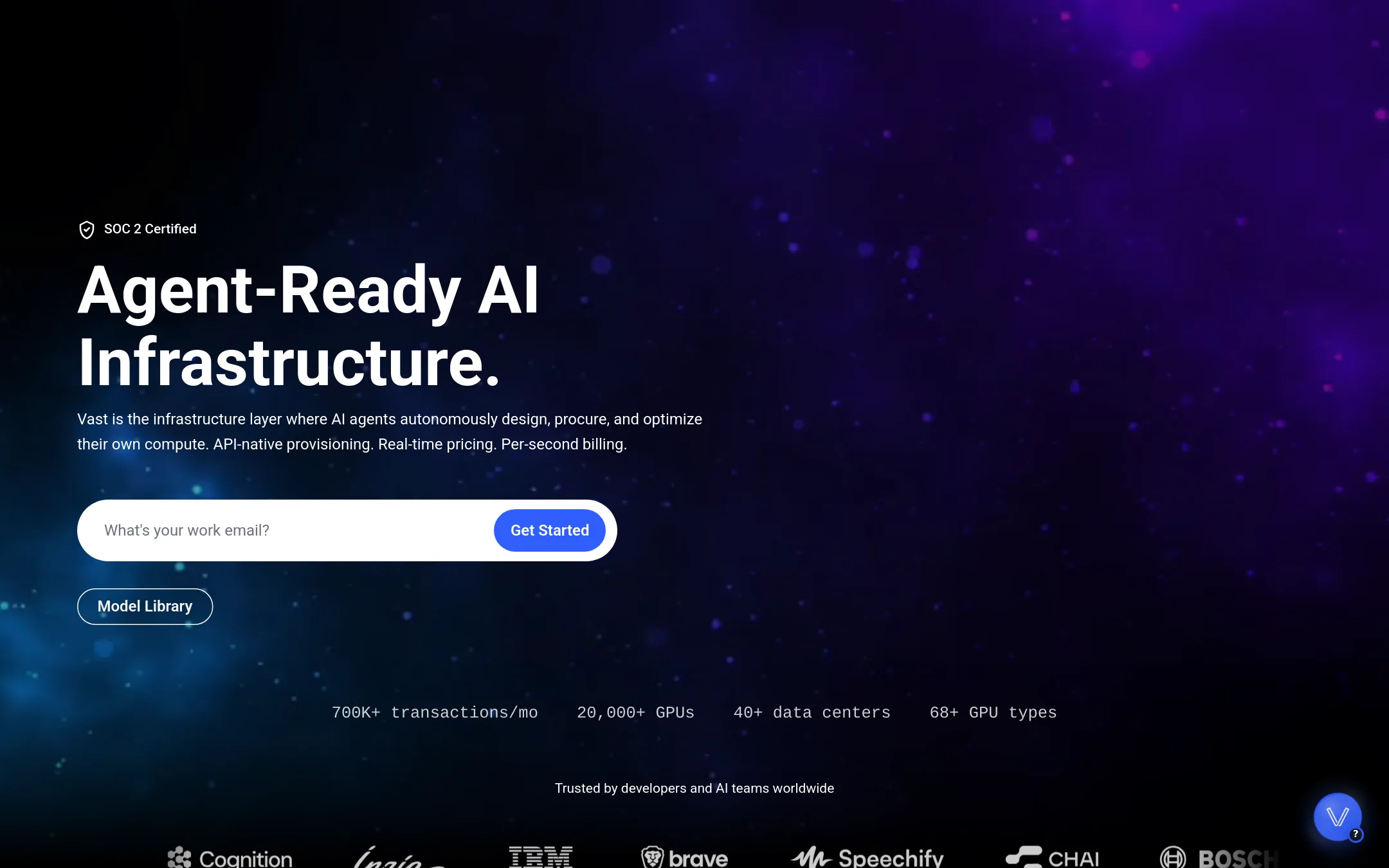
Vast.ai is a marketplace where you rent GPUs from many data centers and hosts, with prices set by supply and demand. You would choose it over TensorPool when you want the lowest hourly rate, per-second billing, and direct control over the instance, or when you want an API you can script for provisioning. TensorPool's pitch is managed multi-node clusters with a git-style CLI, so Vast.ai suits teams that want to handle their own orchestration.
Where it is strong
- Live prices set by supply and demand across 20,000+ GPUs
- Per-second billing with no minimum hours
- API, CLI and Python SDK for programmatic provisioning
Where it falls short
- Interruptible instances can be reclaimed, so they need checkpointing
- Multi-node orchestration is left to you, unlike TensorPool's managed clusters
- Pricing:
- Pricing is not published as fixed figures on the page. The site shows live market rates across 68+ GPU types, with on-demand, interruptible (50%+ cheaper, may be reclaimed), and reserved tiers on 1, 3, or 6 month terms, and starts with a $5 credit.
- From $1.19/hr (A100)
2.RunPod
Best for: Startups serving live inference traffic that spikes and drops, and teams that want to choose GPU models per job
- Pricing
- From $1.19/hr (A100)
- Category
- AI & Machine Learning
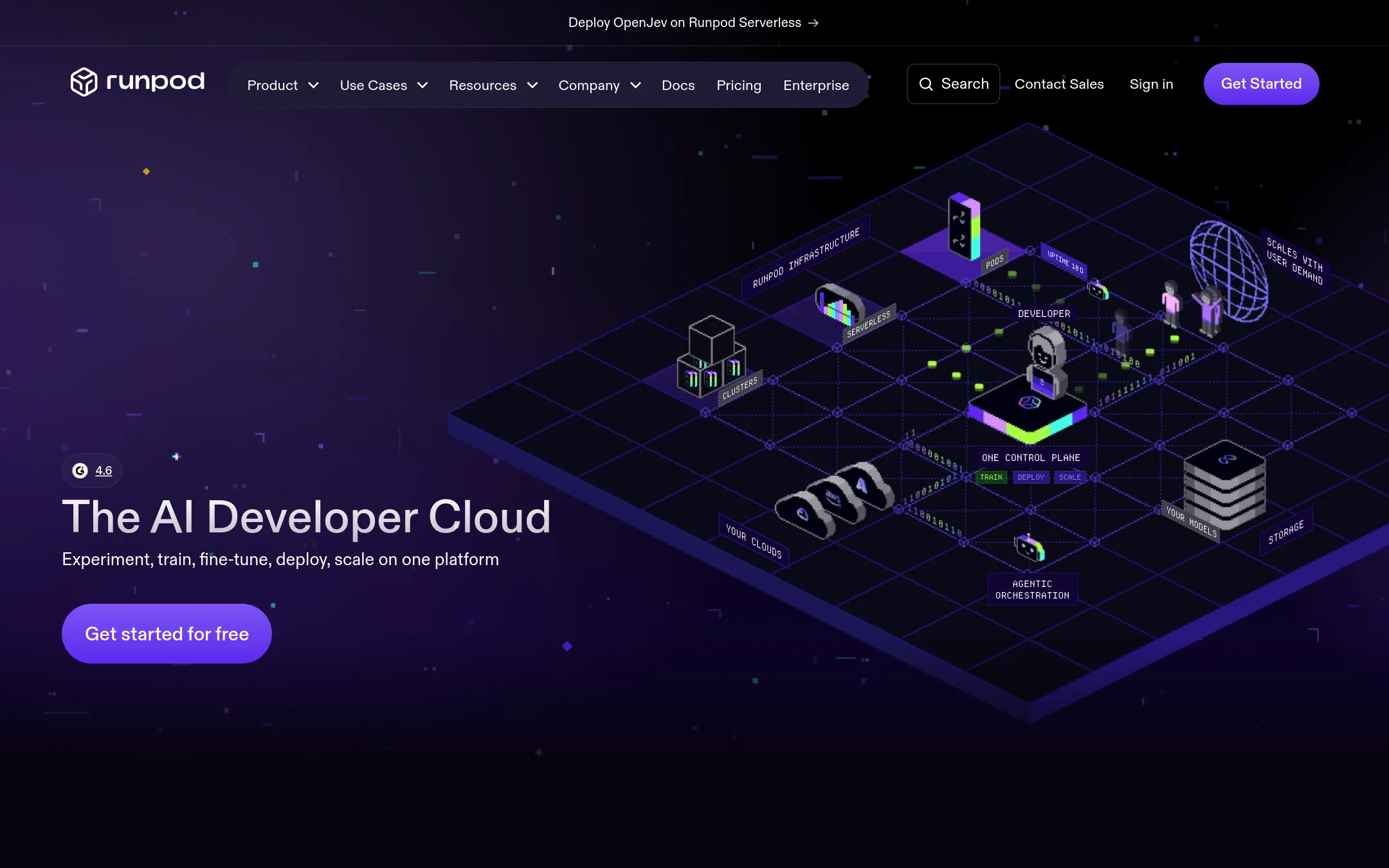
RunPod is a GPU cloud with three products: Serverless for autoscaling inference endpoints that scale to zero, Pods for persistent GPU instances, and Clusters for multi-GPU training. You would pick it over TensorPool when you need inference endpoints that cost nothing while idle, or a wide GPU catalog across many regions.
Where it is strong
- Serverless endpoints scale to zero, so idle endpoints cost nothing
- Over 30 GPU SKUs across 31 regions
- Pods, Serverless and Clusters share one account and one workflow
Where it falls short
- Cheapest tiers run on Community Cloud, which is a different reliability tier from Secure Cloud
- Guaranteed reserved capacity and SLA-backed uptime require talking to enterprise sales
- Pricing:
- Pricing is published per GPU and per workload type: H100 PCIe from $2.89/hr on Secure Cloud or from $1.99/hr on Community Cloud, billed per second with no commitment.
- LFrom $0.69/GPU/hr
3.Lambda GPU Cloud
Best for: Research labs and AI companies that need dedicated single-tenant GPU clusters with compliance requirements
- Pricing
- From $0.69/GPU/hr
- Category
- Other
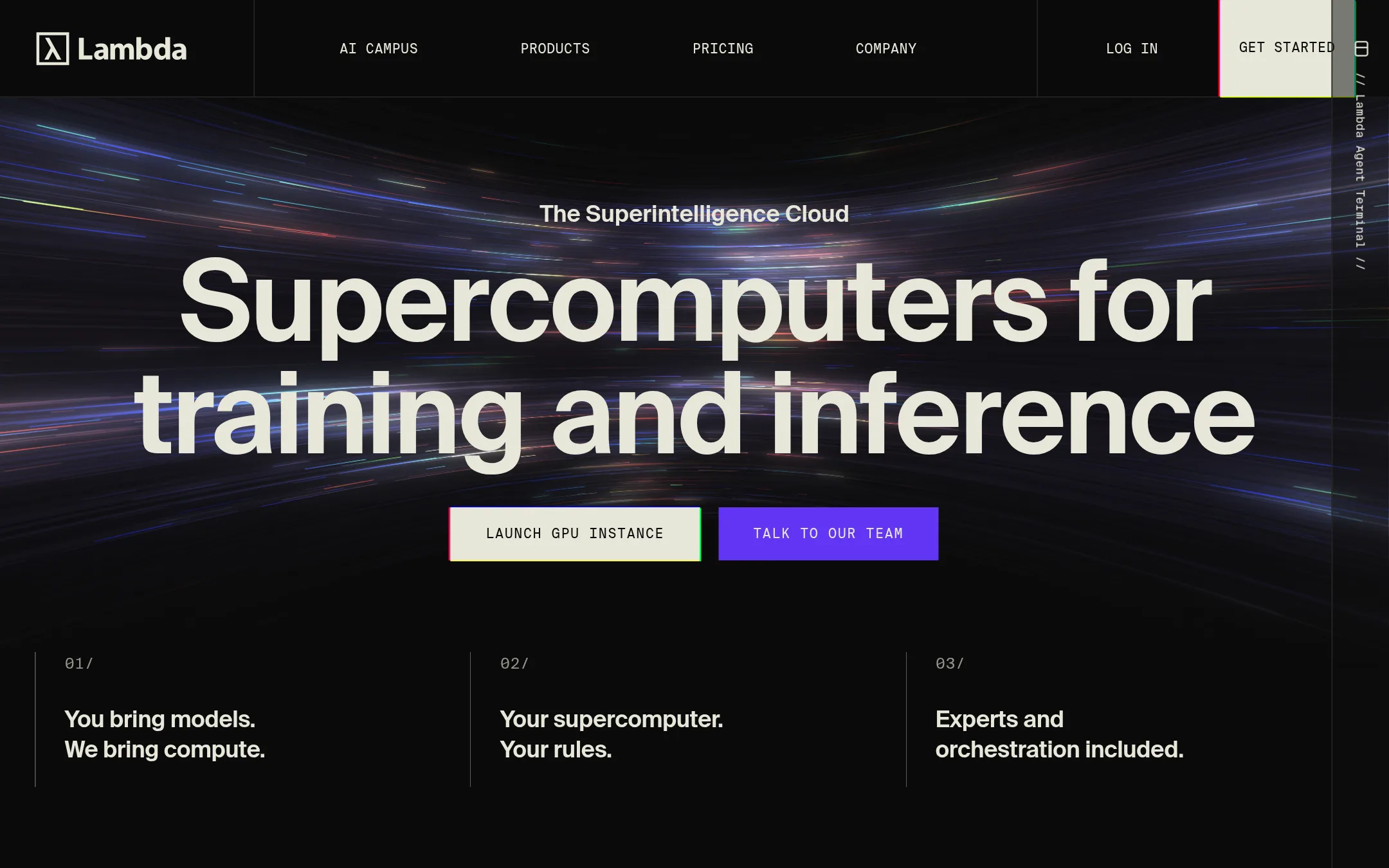
Lambda GPU Cloud rents NVIDIA GPUs at the instance level, from single B200 or H100 machines up to dedicated single-tenant superclusters with InfiniBand networking. Pick it over TensorPool when you need hardware-level isolation, SOC 2 Type II compliance, or a fixed reserved cluster for long-running foundation model training.
Where it is strong
- Single-tenant clusters with hardware-level isolation and SOC 2 Type II certification
- Wide GPU range, including H100, B200, GB300 NVL72 and Vera Rubin NVL72 systems
- Managed clusters with expert support included for orchestration
Where it falls short
- Pricing for the newest large clusters is a quote rather than a published rate, so budgeting takes a sales conversation
- Its public pages do not describe a git-style CLI with push and pull workflows like TensorPool's
- Pricing:
- Instance prices run from $0.69 per GPU per hour for a Quadro RTX 6000 to $7.99 for a B200-class instance, and 1-Click Clusters on NVIDIA B200 start at $9.86 per GPU per hour for 2 weeks to 1 year, with lower rates for longer terms and larger counts, plus appli
- Switching from TensorPool:
- Moving from TensorPool means reproducing your experiment setup on Lambda's instances or clusters, since the site does not describe a migration path.
- Custom quote
4.CoreWeave
Best for: AI labs and enterprise teams training or serving models at multi-rack scale that need reserved GPU capacity
- Pricing
- Custom quote
- Category
- AI & Machine Learning
CoreWeave is a large AI cloud built for training and inference at scale, with GPU clusters from NVIDIA GB300 down to A100, plus managed Kubernetes and high-performance storage. Teams pick it over TensorPool when they need very large or reserved GPU capacity, dedicated networking such as Direct Connect, or enterprise-grade observability and support for production AI workloads.
Where it is strong
- Offers a range of NVIDIA GPUs, from GB300 NVL72 to A100, for different training and inference needs
- Reserved capacity can cut costs by up to 60% against On-Demand prices for committed use
- Includes networking options such as Direct Connect, NAT Gateway, and dedicated public IPs
Where it falls short
- Pricing for specific GPUs is not spelled out in the supplied text, so budgeting takes a sales conversation
- Built for large deployments, which may be more platform than a small team needs
- Pricing:
- Pricing is listed per GPU type on the pricing page, and reserved compute capacity is offered at up to 60% off On-Demand prices for committed usage, but the exact hourly figures are not included in the text supplied.
- $0.001097/sec (H100)
5.Modal
Best for: Teams building AI inference apps, agent sandboxes or bursty batch GPU jobs that want to pay only while code runs
- Pricing
- $0.001097/sec (H100)
- Category
- AI & Machine Learning
Modal is a serverless platform for running Python code, inference, fine-tuning and sandboxes on GPUs and CPUs, with capacity drawn from over 20 clouds and billed by the second. Someone would pick it over TensorPool when they want to run arbitrary code or model endpoints that scale to zero, rather than reserving a multi-node training cluster and working through a git-style CLI.
Where it is strong
- Autoscales from zero to thousands of GPUs without quota requests or reservations
- Serves open-weight models through OpenAI-compatible endpoints and bills per token
- Offers SOC 2 Type II compliance, HIPAA readiness, audit logs and Okta SSO on Enterprise
Where it falls short
- Pricing is per second of runtime, so steady, always-on training can cost more than reserved capacity
- Its focus is on serverless functions and inference, not on the managed multi-node training clusters and git-style workflow TensorPool offers
- Pricing:
- Modal bills by the second, with an H100 SXM5 at $0.001097 per second, and the Starter plan includes $30 per month in free credits while the Team plan is $250 per month plus compute with $100 in credits.
- PNot published
6.Paperspace
Best for: ML teams that want notebooks and a range of GPU types on a platform tied to DigitalOcean
- Pricing
- Not published
- Category
- Other
Paperspace is a cloud GPU platform, now part of DigitalOcean, with notebooks for prototyping, machine types for training and fine-tuning, and endpoints for deployment. Choose it over TensorPool when you want a notebook-first workflow, a wide menu of GPU types from older cards up to H100s, or you already run on DigitalOcean.
Where it is strong
- Notebooks let you start a proof of concept quickly
- Wide range of GPU types, from older cards to H100s
- Part of DigitalOcean, with its cloud services nearby
Where it falls short
- The site does not mention a git-style CLI or multi-node cluster scheduling like TensorPool's
- Its public listing does not mention high-throughput storage figures like TensorPool's
- Pricing:
- Pricing is not published on the site.
See more comparisons in AI & Machine Learning alternatives.
FAQ
Questions about TensorPool alternatives
What is TensorPool best known for?
According to its site, TensorPool is known for on-demand multi-node GPU clusters, high-throughput storage for distributed training, and a git-style CLI with push and pull workflows. It positions itself as infrastructure that removes orchestration work so teams can focus on models.
Which alternative is best if I serve bursty inference traffic?
RunPod is the strongest fit for this case. Its Serverless endpoints scale to zero, so idle endpoints cost nothing, and it bills per second with no commitment. Modal is a close second if your workload is code-driven rather than endpoint-driven.
Which alternative offers the most isolation for compliance-heavy work?
Lambda GPU Cloud is the strongest option here. It offers single-tenant clusters with hardware-level isolation and holds SOC 2 Type II certification. Modal also lists SOC 2 Type II and HIPAA readiness on its Enterprise plan.
Which option has the lowest hourly GPU cost?
Vast.ai is the most likely to offer the lowest rate, since its marketplace prices move with supply and demand and interruptible instances run at 50% or more below on-demand. The trade-off is that interruptible instances can be reclaimed, so you need checkpointing and must handle orchestration yourself.
Which alternatives do not publish clear pricing?
CoreWeave, Paperspace and Lambda's large 1-Click Clusters do not publish full pricing in the supplied material, so budgeting for them takes a sales conversation. RunPod and Modal list per-unit rates publicly, which makes early cost comparisons easier.
Last updated November 12, 2026.