
Theneo alternatives
6 products compared · Updated November 8, 2026
The short answer
The three strongest Theneo alternatives are Redocly, Mintlify and ReadMe. Redocly suits API teams that keep OpenAPI descriptions in git and want docs checked on every pull request. Mintlify suits small startups and documentation teams that want Git-backed docs with a free starting tier. ReadMe suits developer-facing API teams that keep docs in GitHub or GitLab and want pull-request style review.
Your shortlist, at a glance
Read the comparisons ↓ StoplightNot publishedAPI platform teams that want design-first OpenAPI workflows and governance across many APIs
 Postman$19/user/mo (annual)Engineering teams that build, test, and monitor many APIs and want one platform for the whole lifecycle
 ReadMe$150/mo add-onDeveloper-facing API teams that keep docs in GitHub or GitLab and want pull-request review of documentation
- RRedocly$2,988/yr (Pro)API teams that keep OpenAPI descriptions in git and want docs checked on every pull request
MintlifyFree (Starter), $450/mSmall startups and documentation teams that want Git-backed docs with a free starting tier
 GitBook$65/site/mo + $12/userProduct and developer teams that want one docs site for guides and API reference, with AI answers and gap tracking
About Theneo and its alternatives
Theneo is an API documentation platform that builds API references, guides, changelogs, and private customer portals. According to its site, it is known for AI-generated docs, real-time co-editing between engineers, writers and product managers, and support for MCP, llms.txt and Ask AI.
When comparing alternatives in this category, weigh the pricing structure first, since some tools charge per workspace, per site, per user or per add-on, and some do not publish prices. Check which regions and deployment options are supported, including self-hosting. Look at integrations with your existing code and API tooling, the level of support you get on each plan, and the contract terms, such as annual billing and custom SLAs.
Explore the alternatives
- Not published
1.Stoplight
Best for: API platform teams that want design-first OpenAPI workflows and governance across many APIs
- Pricing
- Not published
- Category
- Developer Tools
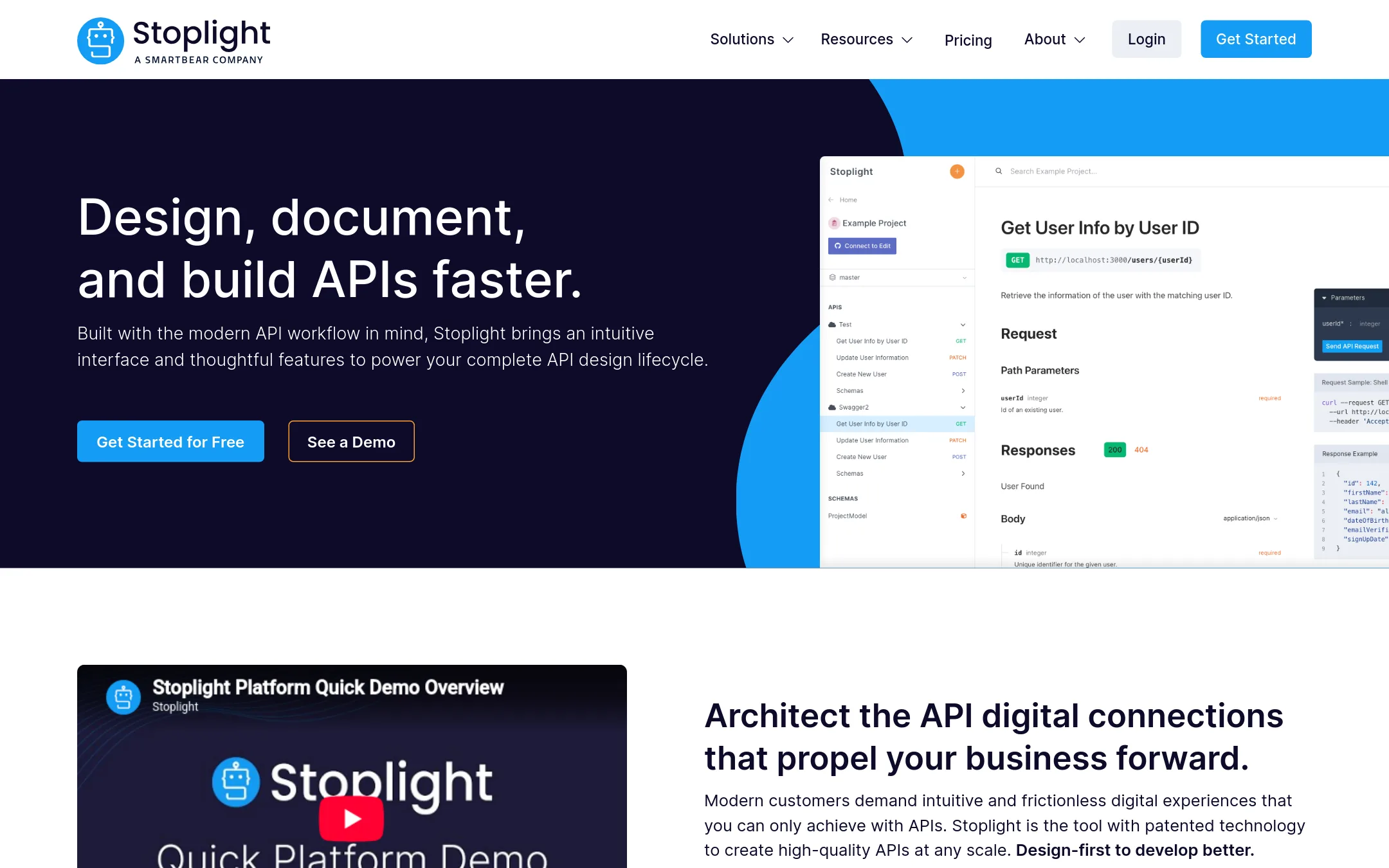
Stoplight is an API design and documentation tool built around OpenAPI, with a design-first workflow that suits teams who want to define and govern API specs before code is written. Someone would pick it over Theneo if their main need is spec design, linting and consistency across a large API portfolio, rather than customer-facing portals and AI-assisted docs.
Where it is strong
- Design-first workflow built around OpenAPI specs
- Reuse of models and components across an API portfolio
- Git integration with GitHub, GitLab, Azure DevOps and Bitbucket
Where it falls short
- Its pricing page lists plan tiers but no plan prices in the text provided
- Less focus on private customer portals than Theneo's per-customer login model
- Pricing:
- Pricing is not published on the site.
- $19/user/mo (annual)
2.Postman
Best for: Engineering teams that build, test, and monitor many APIs and want one platform for the whole lifecycle
- Pricing
- $19/user/mo (annual)
- Category
- Developer Tools
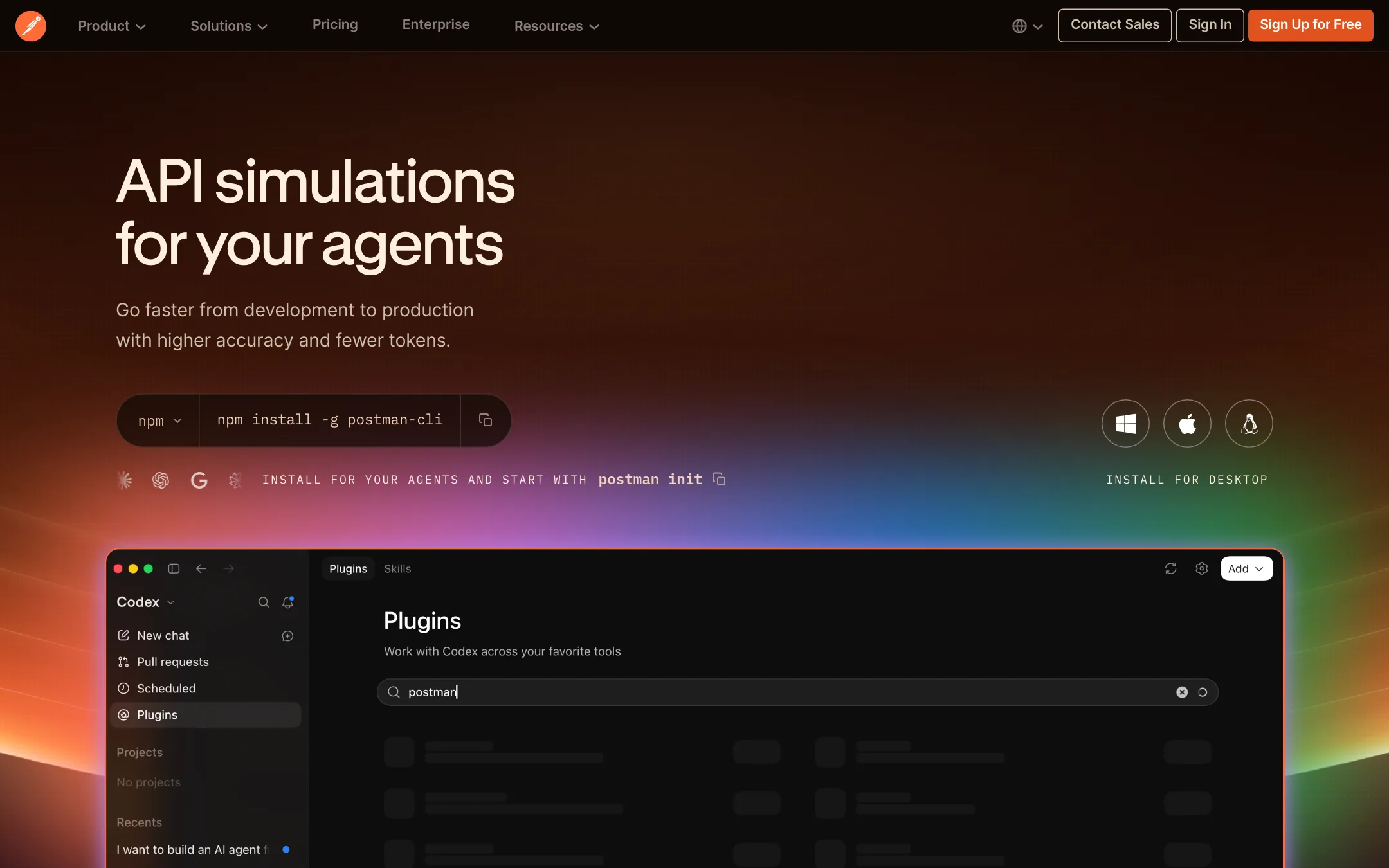
Postman is a broad API platform for building, testing, mocking, and monitoring APIs, with a growing set of tools for AI agents. Teams pick it over Theneo when the main job is testing and running APIs day to day, or when they need an agent-ready context layer that maps APIs across the organisation rather than a documentation portal.
Where it is strong
- Covers API testing, mocking, monitoring, and CI checks in one product
- Context Graph gives agents a structured map of your APIs and their relationships
- Free tier includes the API client, specs, mock servers, and Git support
Where it falls short
- Documentation publishing is one part of a wider platform, so it may be heavier than a team that only wants docs
- Advanced features such as SAML SSO, private workspaces, and audit logs sit on the Enterprise tier
- Pricing:
- Pricing is not published on the site for a Team plan at $19 per user per month billed annually, a Solo plan at $9 per month billed annually, and an Enterprise plan with custom pricing.
- $150/mo add-on
3.ReadMe
Best for: Developer-facing API teams that keep docs in GitHub or GitLab and want pull-request review of documentation
- Pricing
- $150/mo add-on
- Category
- Developer Tools
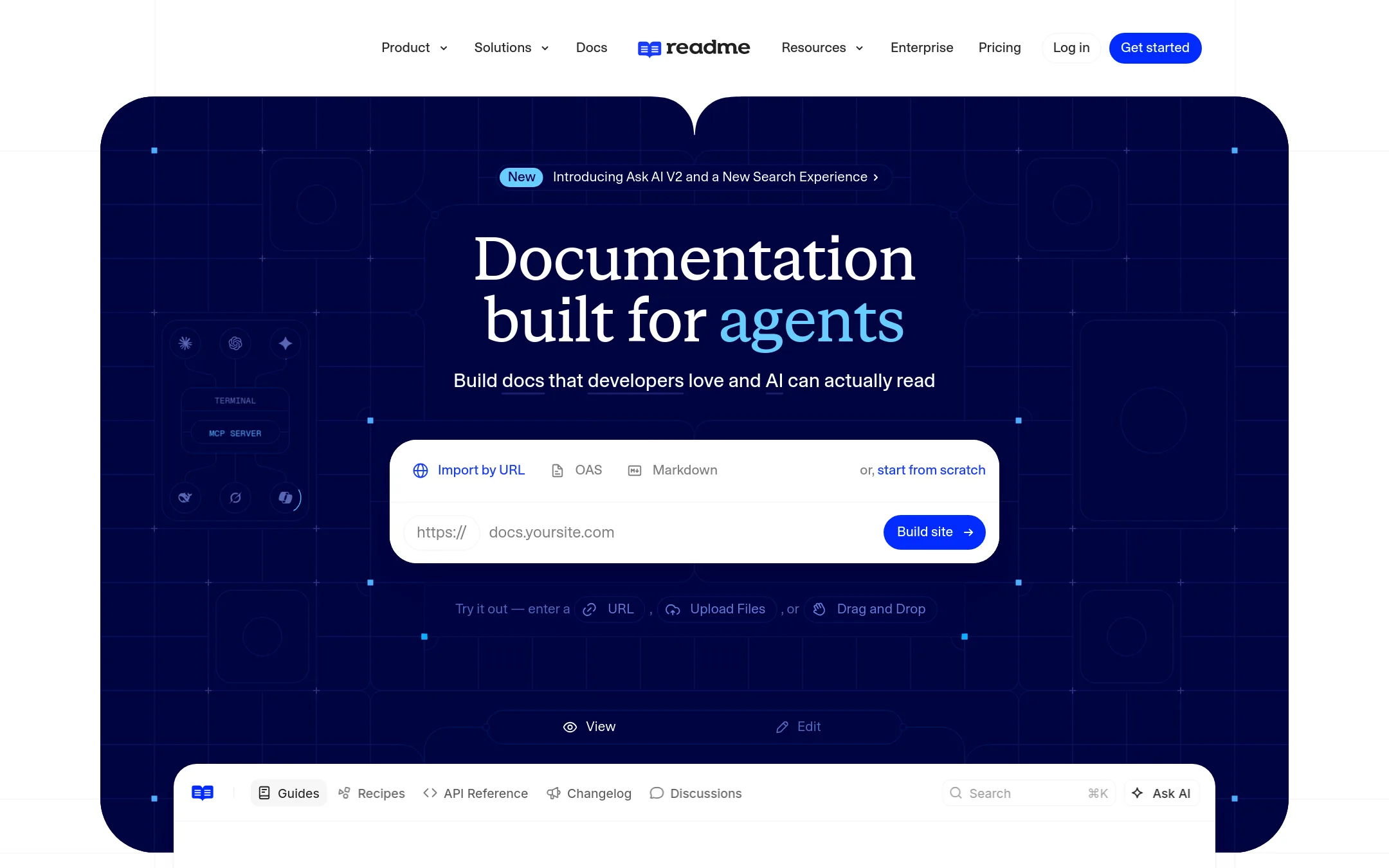
ReadMe is a developer documentation platform for API references, guides, changelogs and discussion forums, with a built-in writing editor, Git sync and AI features such as Ask AI and an AI linter. Teams pick it over Theneo when they already keep their docs in Git and want bi-directional GitHub or GitLab sync with pull-request style review. It also suits teams that want a broad set of docs formats beyond API reference, such as help-center style content.
Where it is strong
- Bi-directional sync with GitHub, GitHub Enterprise Server and GitLab
- Branches with AI linter and docs audit against a custom style guide
- Broad content types including guides, recipes, changelog and discussions
Where it falls short
- Several capabilities such as Ask AI, request history and SAML sit behind separate paid add-ons
- The pricing text does not show a private customer portal with per-customer logins as a headline feature, unlike Theneo's plan
- Pricing:
- Pricing is listed as a Documentation plan with a $150/month Ask AI add-on, a $100/month request history add-on, and $20 per additional admin beyond five, with the base plan price not shown in the pricing text.
- Switching from Theneo:
- Teams moving from Theneo can import an OpenAPI spec, and ReadMe publishes a migration guide for moving docs to its platform.
- R$2,988/yr (Pro)
4.Redocly
Best for: API teams that keep OpenAPI descriptions in git and want docs checked on every pull request
- Pricing
- $2,988/yr (Pro)
- Category
- Other
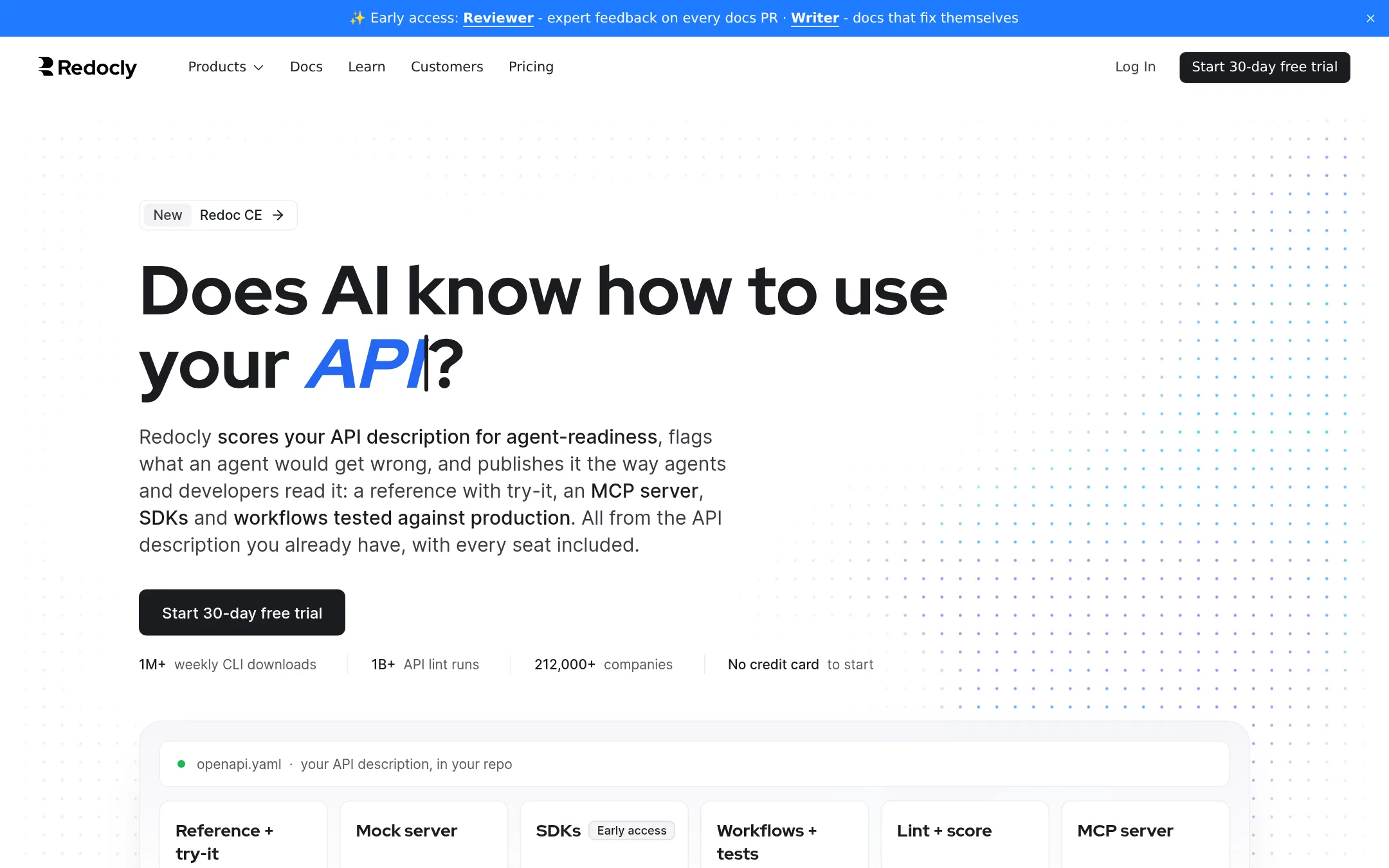
Redocly turns your OpenAPI description into reference docs, guides, a mock server, and an MCP server that lets AI agents read your docs as tools. Its homepage pitches agent-readiness scoring on every pull request and tested Arazzo workflows. Pick it over Theneo when your API description already lives in git and you want docs tied to your CI and a sign-in gate for readers.
Where it is strong
- Unlimited seats on every plan, so inviting colleagues never changes the bill
- Docs are built from your existing OpenAPI, GraphQL or AsyncAPI description in git, with a preview for each pull request
- Arazzo workflows can run against the mock server and production to catch drift between docs and the live API
Where it falls short
- Several features such as SDK generation are marked early access or beta
- Single sign-on, catalog and multi-product sites start at the Scale tier, not Pro
- Pricing:
- Pro is billed annually at $2,988 with 3 projects and unlimited seats, Scale is billed annually at $8,748 with 10 projects, and Enterprise is an annual contract priced for the organization.
- Free (Starter), $450/m
5.Mintlify
Best for: Small startups and documentation teams that want Git-backed docs with a free starting tier
- Pricing
- Free (Starter), $450/m
- Category
- Developer Tools
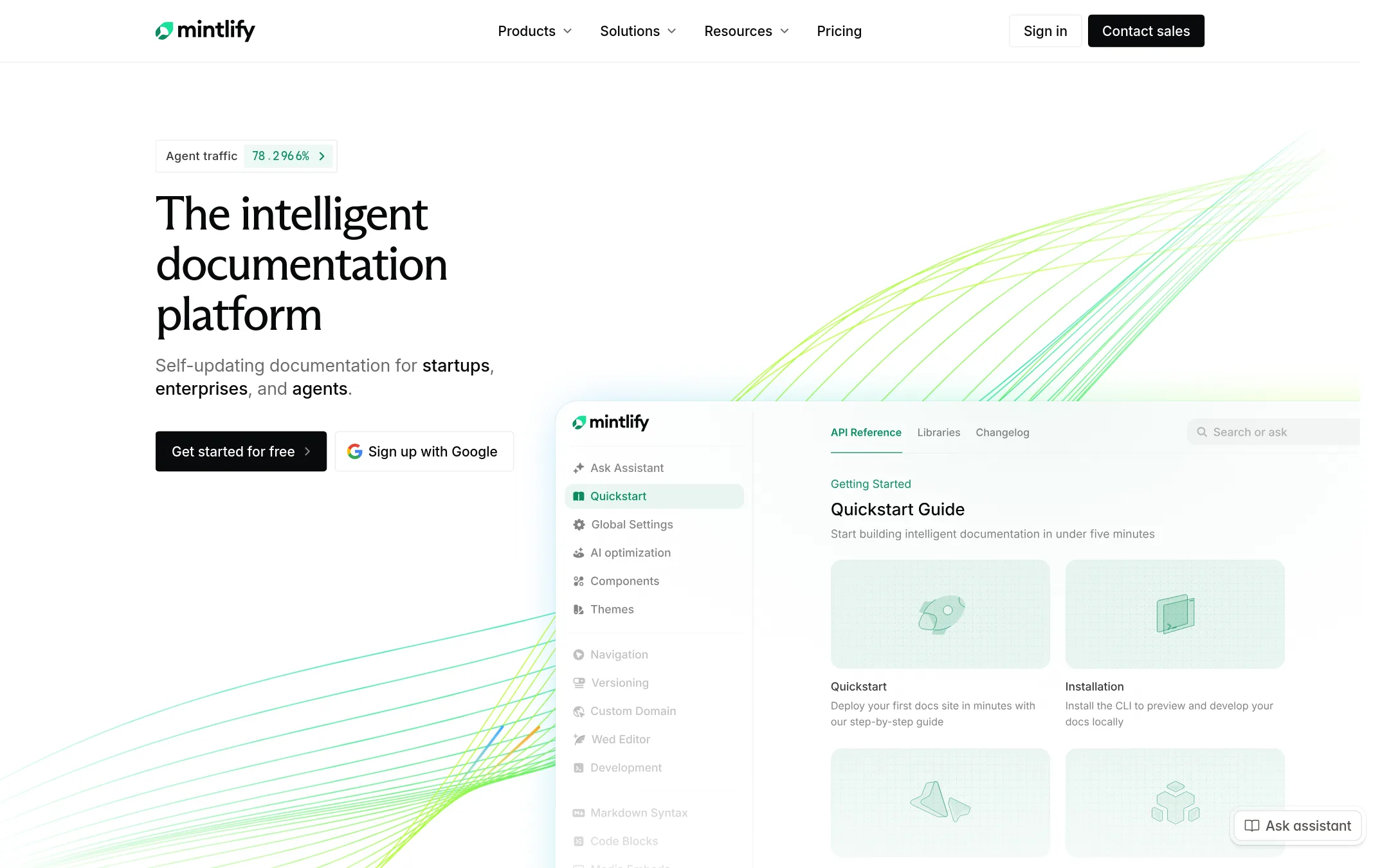
Mintlify is a documentation platform that turns Markdown or MDX files kept in Git into a hosted docs site, with search, an API playground, and llms.txt and an MCP server for AI agents. Teams choose it over Theneo when they want docs to stay in their own repository, or when a free starting tier matters more than a combined API, collaboration and private-portal suite.
Where it is strong
- Starter plan is free for up to five editors and includes hosting, search, a custom domain and an API playground.
- Docs stay in Git as Markdown or MDX, so you keep the source files if you move later.
- Built-in llms.txt and MCP server make content accessible to AI tools.
Where it falls short
- Unlimited editor seats and preview deployments require the paid Pro plan.
- Self-hosting is only available on the Enterprise plan, and Theneo lists self-hosting from its Enterprise tier as well.
- Pricing:
- Starter is free for up to five editors, and Pro is $450 per month billed annually or $540 per month billed monthly, while Theneo lists Starter at free and Business at $120 per month per workspace.
- Switching from Theneo:
- Your existing docs can move to Mintlify as Markdown or MDX files in Git, though a new site may need adjustments to navigation or custom components.
- $65/site/mo + $12/user
6.GitBook
Best for: Product and developer teams that want one docs site for guides and API reference, with AI answers and gap tracking
- Pricing
- $65/site/mo + $12/user
- Category
- Developer Tools
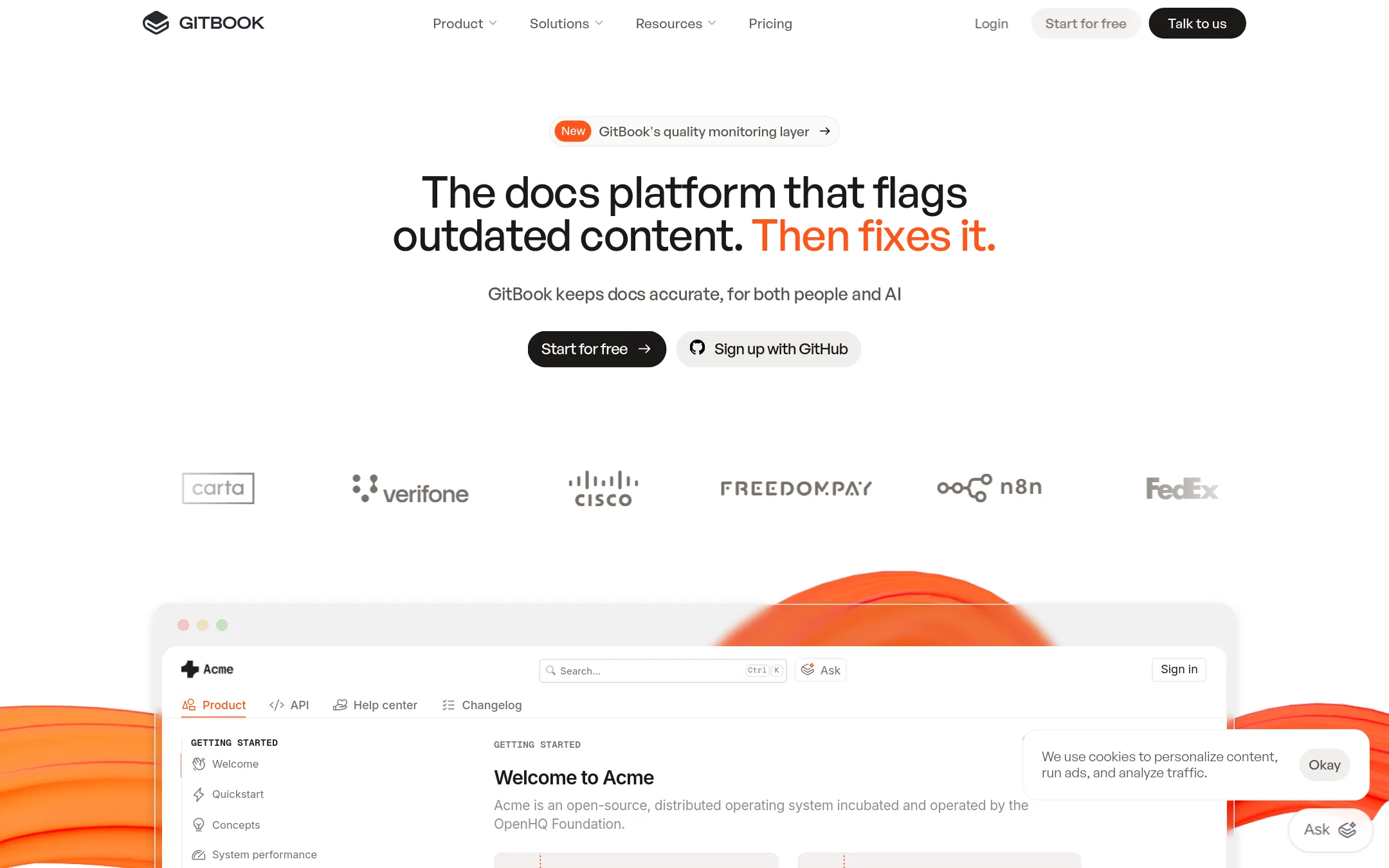
GitBook is a docs platform that covers guides, API reference, and help centers in one place, with a focus on keeping docs accurate for both people and AI. It flags outdated content and gives AI assistants a sidebar that answers reader questions. Choose it over Theneo when your main concern is ongoing docs quality and knowing where readers get stuck, rather than private per-customer API portals.
Where it is strong
- Flags outdated content and queues it for review before wrong answers spread
- Ultimate includes an AI assistant chat plus AI insights that show knowledge gaps
- Free plan includes an auto-generated MCP server and API documentation
Where it falls short
- Authenticated per-customer portals sit in the Ultimate tier and above, not the base plans
- Pricing stacks per site and per user, so costs grow with team size
- Pricing:
- GitBook lists a Free plan for individuals, Essential at $65 per site per month and Ultimate at $249 per site per month when billed annually, plus $12 per user per month, with Enterprise pricing custom.
See more comparisons in Developer Tools alternatives.
FAQ
Questions about Theneo alternatives
What is Theneo best known for?
According to its site, Theneo is known for AI-generated API documentation and a developer portal that engineers, writers and product managers can edit together. It also offers private customer portals where each customer sees only the APIs they pay for. Its homepage cites more than 18,000 companies as customers.
Which alternative is best if my API docs already live in Git?
Redocly and ReadMe both fit teams that keep docs in git. Redocly builds docs from your OpenAPI description and previews each pull request, while ReadMe offers bi-directional sync with GitHub, GitHub Enterprise Server and GitLab. Mintlify also keeps docs as Markdown or MDX in your repository.
Is there a free option compared with Theneo's Starter plan?
Mintlify has a free Starter plan for up to five editors that includes hosting, search, a custom domain and an API playground. Theneo also lists a free Starter package with one public project and limited private projects. Postman has a free tier that includes the API client, specs, mock servers and Git support.
Which alternative is better for private portals for customers?
Redocly lists single sign-on and sign-in gates for readers, but the write-up notes that SSO and multi-product sites start at its Scale tier. ReadMe's pricing text does not show a private customer portal with per-customer logins as a headline feature. Check the current plan details before deciding, since Theneo lists per-customer logins and SSO as core features.
Do any of these alternatives publish their pricing clearly?
Mintlify, Redocly and GitBook all publish plan prices, though GitBook and Redocly price Enterprise plans on a custom basis. Stoplight does not publish plan prices on its site. ReadMe lists add-on prices but not its base plan price in the pricing text, so ask for a quote before comparing costs.
Last updated November 8, 2026.