
Versori alternatives
9 products compared · Updated November 9, 2026
The short answer
Versori suits enterprise teams building custom integrations against internal or complex APIs. Strong alternatives depend on the job: Zapier suits small teams automating routine work across common SaaS apps without a developer. Workato and Boomi suit large enterprises that need governed integration and AI agents across many systems at once.
Your shortlist, at a glance
Read the comparisons ↓WorkatoNot publishedLarge enterprises with many SaaS apps that need governed AI agents and workflows across departments
 CeligoNot publishedMid-size and enterprise operations teams that need EDI, API management and app integrations under one governed platform
- MMuleSoftSee websiteEnterprise integration and API platform
 BoomiNot publishedEnterprises that need governed integration across applications, APIs, data and AI agents in one platform
 ZapierFree to EnterpriseSmall and mid-sized teams that need to automate routine workflows across common SaaS apps without a developer
 MakeCredit-based, see siteBusiness teams that need broad off-the-shelf app connections and visual workflow building without heavy developer involvement
 Tray.ioFrom $50/mo, usage-basEnterprise IT and operations teams that need governed AI agents and MCP tool access across many existing SaaS systems
PipedreamFrom $99/mo (annual)Developer teams building AI agents or per-user app integrations that need managed auth across many APIs
 IntegratelyNot publishedNon-technical teams that need standard app-to-app automations without writing code
About Versori and its alternatives
Versori is an agentic integration platform for enterprises. According to its site, it is known for building custom integrations quickly, using a Plan Agent that reads API docs, maps dependencies and generates workflows for approval, plus an IDE and SDK for editing code. The site highlights customer results such as faster go-live times and connectors built in weeks instead of months.
When comparing alternatives in this category, weigh the pricing structure first, since some tools bill by tasks, credits or usage while others publish no prices and require a sales conversation. Check regional availability, the number of prebuilt integrations and whether they cover your internal or messy APIs. Also look at integration support, hosting options and contract terms, especially for governance, security reviews and on-premise deployment.
Explore the alternatives
- Not published
1.Workato
Best for: Large enterprises with many SaaS apps that need governed AI agents and workflows across departments
- Pricing
- Not published
- Category
- AI & Machine Learning
Workato is an enterprise iPaaS that connects apps, data, APIs and AI agents on one governed platform, with 17,000+ connectors and built-in governance, observability and cost controls. Companies choose it over Versori when they need broad off-the-shelf connectivity across many SaaS tools and want AI agents and workflows managed centrally across the whole organisation rather than built one integration at a time.
Where it is strong
- Connects to 17,000+ apps, APIs, databases and MCP servers without custom infrastructure
- Central governance covering identity, policy, approvals, security and cost controls for agents and workflows
- Data integration, API management and event streaming are offered in the same platform
Where it falls short
- Pricing is tiered by edition and contract, so budgeting in advance is harder
- Advanced features such as Agent Studio and on-premises agents appear only in higher editions or as add-ons
- Pricing:
- Pricing is not published on the site.
- Not published
2.Celigo
Best for: Mid-size and enterprise operations teams that need EDI, API management and app integrations under one governed platform
- Pricing
- Not published
- Category
- E-commerce
Celigo is an intelligent automation platform that runs application integrations, data ingestion, EDI, APIs, and AI agents on one governed system. Teams would pick it over Versori when they need EDI and B2B trading partner connections alongside app integrations, or when business users should build workflows without deep technical specialisation. Versori's pitch centres on AI-assisted building of custom integrations for engineering teams, which is a different emphasis.
Where it is strong
- Covers integrations, EDI, API management and AI agents on one platform
- Prebuilt connectors, templates and AI agents in the Celigo Marketplace
- Role-based access, auditability and SSO are part of the platform
Where it falls short
- Pricing is set by edition and usage, so you need a sales conversation to get a number
- The site does not describe a Versori-style AI plan agent that generates integration code from API docs
- Pricing:
- Pricing is not published on the site.
- MSee website
3.MuleSoft
Developer Tools
Enterprise iPaaS for designing, building and managing APIs and integrations across systems.
- Not published
4.Boomi
Best for: Enterprises that need governed integration across applications, APIs, data and AI agents in one platform
- Pricing
- Not published
- Category
- E-commerce
Boomi is a single enterprise platform for connecting applications, APIs, data and AI agents, with integration, API management, data management and agent governance under one roof. Teams choose it over Versori when they need broad governance across many systems, B2B/EDI and managed file transfer, or a large partner ecosystem and support model rather than a developer-first build environment.
Where it is strong
- Covers integration, API management, data and AI agent governance in one platform
- Pre-built connectors to over 1000 enterprise applications
- Offers B2B/EDI and managed file transfer alongside application integration
Where it falls short
- Breadth of the product range makes the platform heavier to adopt than a focused tool
- Pricing is not published, so budgeting requires a sales conversation
- Pricing:
- Pricing is not published on the site.
- Free to Enterprise
5.Zapier
Best for: Small and mid-sized teams that need to automate routine workflows across common SaaS apps without a developer
- Pricing
- Free to Enterprise
- Category
- Productivity & Project Management
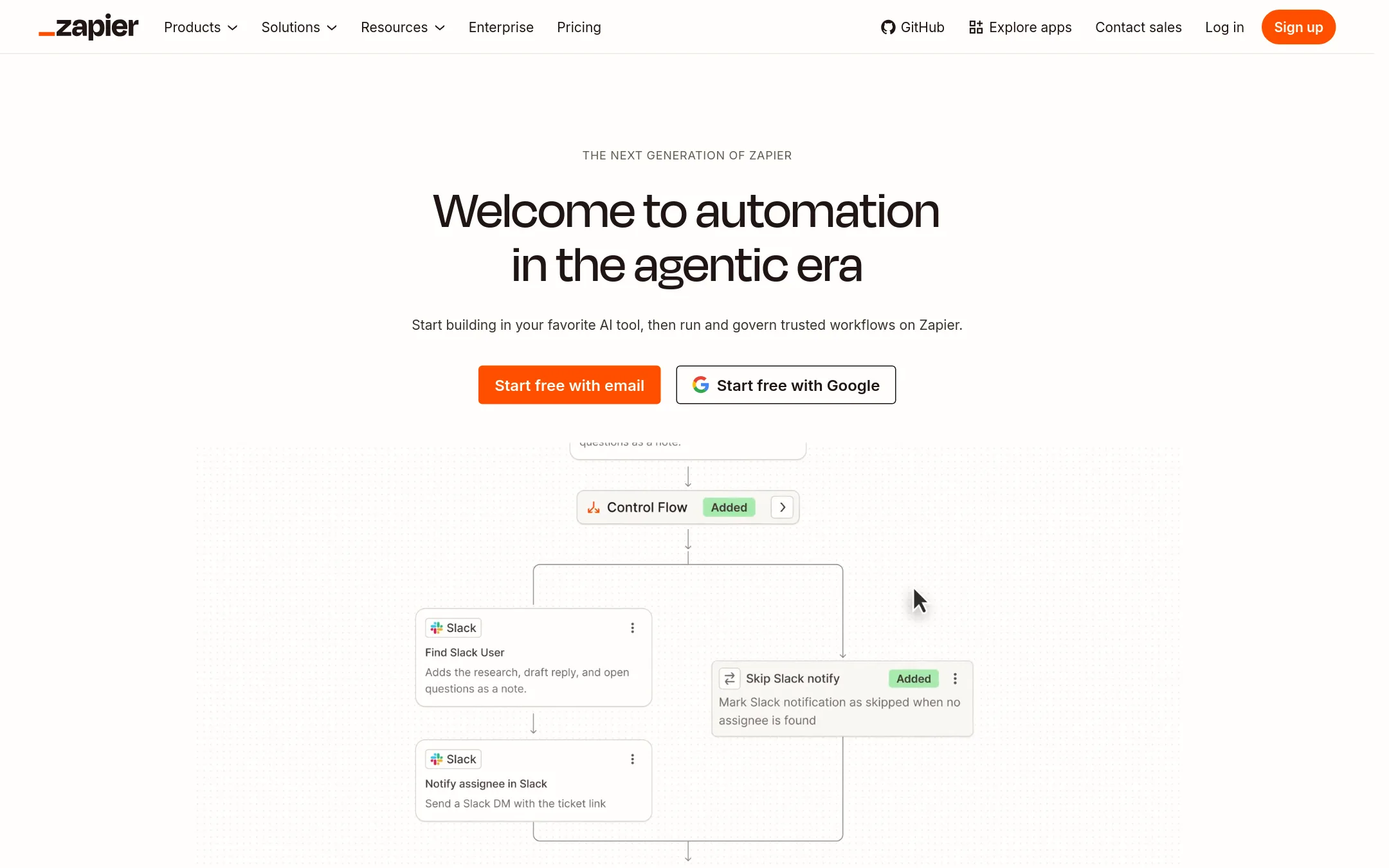
Zapier connects over 9,000 apps through a visual builder, so non-engineers can automate work without writing code. Founders and ops teams pick it over Versori when the job is wiring common SaaS tools together rather than building custom enterprise integrations against internal APIs.
Where it is strong
- Connects to over 9,000 apps with a visual editor
- Free plan includes Zaps, Tables and Forms with 100 tasks per month
- Offers SOC 2 Type II, GDPR and SAML SSO for security reviews
Where it falls short
- Versori's code-first SDK and IDE are not offered as an equivalent
- Free plan limits Zaps to two steps and polling to 15 minutes
- Pricing:
- Pricing is based on tasks, with a free plan that includes 100 tasks per month and paid tiers for Professional, Team and Enterprise, but the page does not state exact per-tier prices in the text provided.
- Credit-based, see site
6.Make
Best for: Business teams that need broad off-the-shelf app connections and visual workflow building without heavy developer involvement
- Pricing
- Credit-based, see site
- Category
- Productivity & Project Management
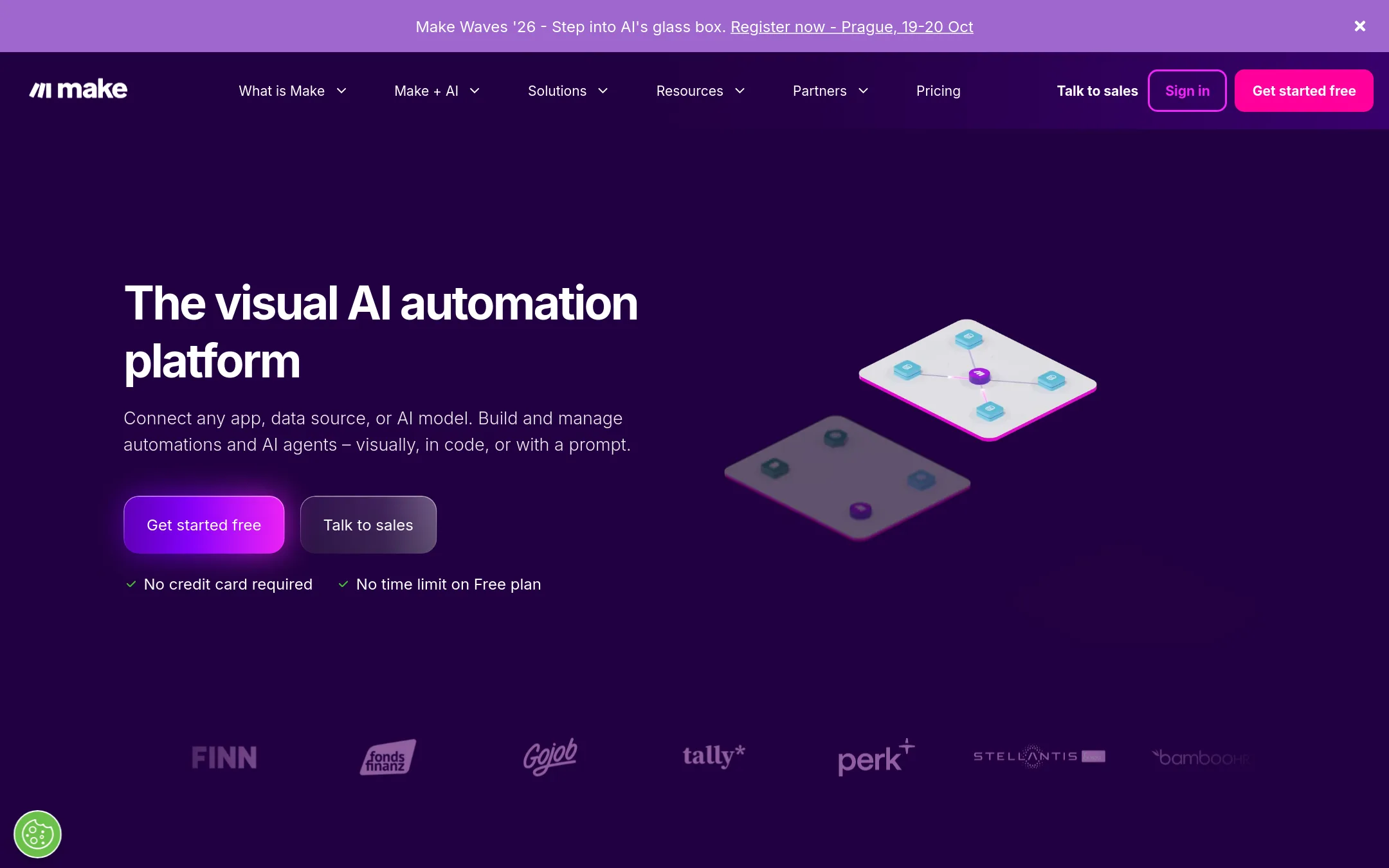
Make is a visual automation platform with 3,500+ app connectors, plus AI agents and an MCP server for building from Claude, ChatGPT or Gemini. Choose it over Versori when you want non-developers to build and run workflows across many off-the-shelf apps, and your integrations rarely need deep custom enterprise logic.
Where it is strong
- Connects to 3,500+ apps out of the box
- Visual builder that non-developers can use, with prompt-based building too
- Offers a free plan with no card required
Where it falls short
- Costs scale with the number of actions, so complex scenarios can use many credits
- Deep custom enterprise integration work leans on custom code, which Versori is built around
- Pricing:
- Pricing is billed in credits, with each action in a scenario consuming credits, and the pricing page lists plans for individuals, small teams, and enterprises, but the specific figures are not shown in the supplied text.
- From $50/mo, usage-bas
7.Tray.io
Best for: Enterprise IT and operations teams that need governed AI agents and MCP tool access across many existing SaaS systems
- Pricing
- From $50/mo, usage-bas
- Category
- Developer Tools
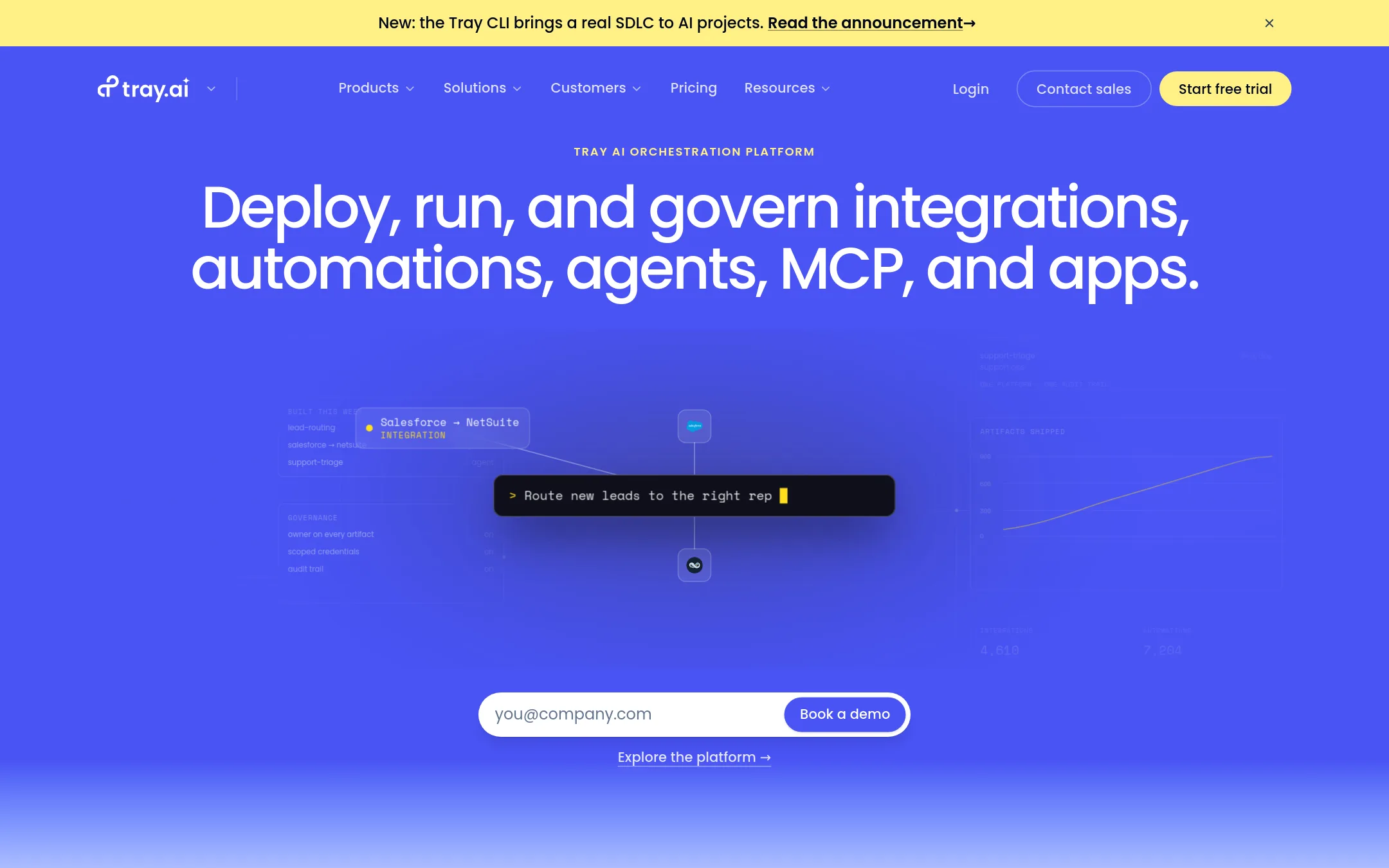
Tray.io is an iPaaS that connects 5,000+ apps, databases, APIs and services, and it adds agent building and MCP governance on the same platform. Teams pick it over Versori when they want a broad library of prebuilt connectors plus AI agents and MCP controls in one product, rather than a focus on building custom integrations from API docs.
Where it is strong
- Connects to 5,000+ apps, databases, APIs and services
- Merlin Agent Builder and Agent Gateway for MCP sit on the same platform
- Audit trails, RBAC and SOC 2 Type 2 audit across agent and workflow runs
Where it falls short
- Hosting and on-premise connectivity are limited to the Enterprise plan
- Costs are usage-based, so budgeting takes a trial to measure
- Pricing:
- Tray starts at $50 a month, with usage measured in Tasks and Helix Compute Units, and Enterprise is quoted by usage.
- From $99/mo (annual)
8.Pipedream
Best for: Developer teams building AI agents or per-user app integrations that need managed auth across many APIs
- Pricing
- From $99/mo (annual)
- Category
- Developer Tools
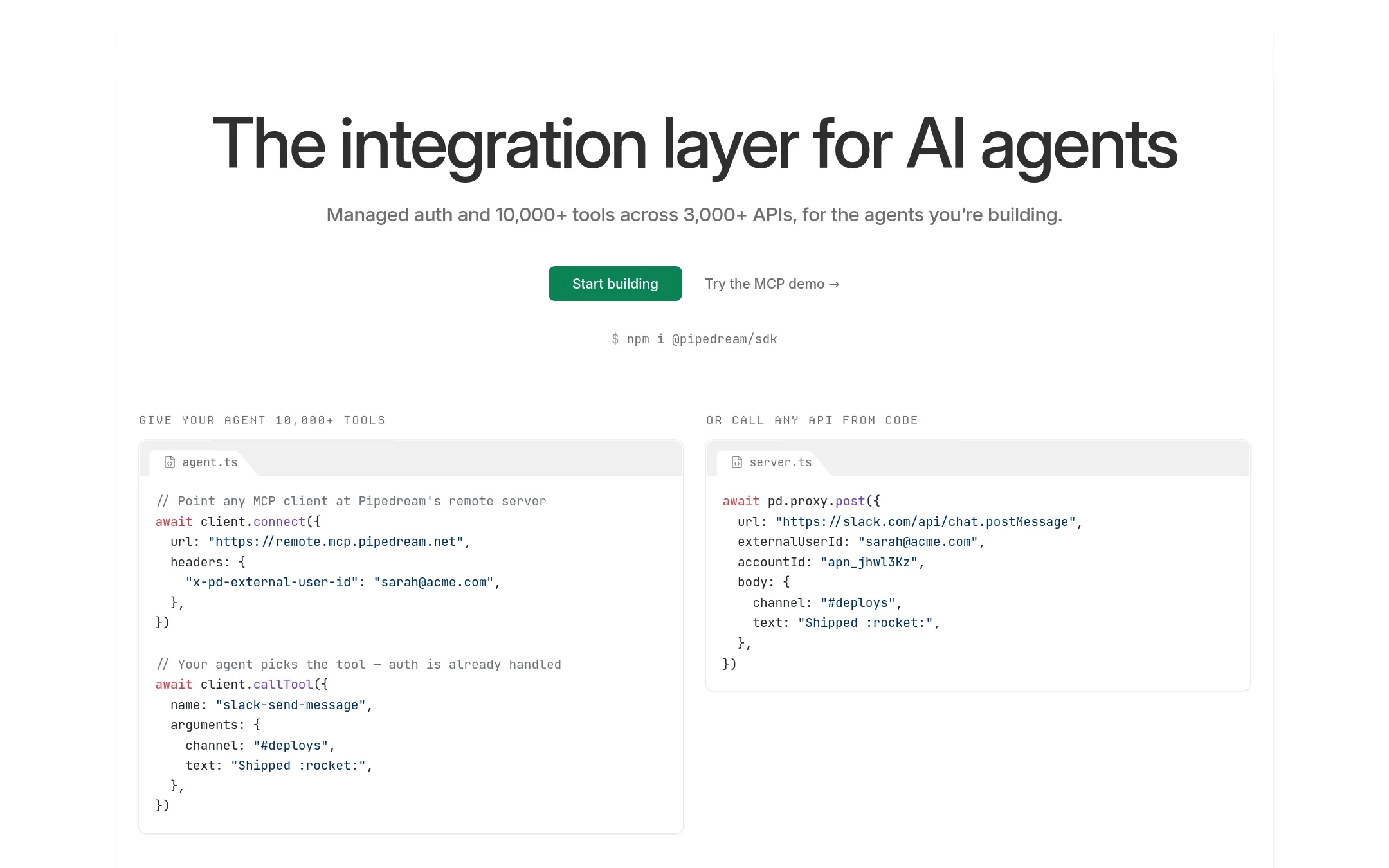
Pipedream gives developers a managed layer for connecting agents and apps to 3,000+ APIs. It handles OAuth, token refresh and per-user credentials, and offers 10,000+ prebuilt tools and triggers plus a raw API proxy. A team would choose it over Versori when they are building AI agents or user-facing integrations and want to write their own code and ship fast without running auth themselves.
Where it is strong
- Managed auth and token refresh for 3,000+ APIs, so users connect accounts without you handling credentials
- 10,000+ prebuilt tools and triggers, plus a proxy for any endpoint not covered
- Free development access with no credit card required, and an MCP server for agents
Where it falls short
- Pricing scales with users and usage credits, which can add cost at high volume
- Enterprise features like SSO, SCIM, HIPAA and dedicated support sit behind custom Business pricing
- Pricing:
- Pricing starts with a free development tier, a Startup plan at $99 per month billed annually or $150 billed monthly with 100 users and 10,000 usage credits included, and custom Business pricing for enterprise features.
- Not published
9.Integrately
Best for: Non-technical teams that need standard app-to-app automations without writing code
- Pricing
- Not published
- Category
- Productivity & Project Management
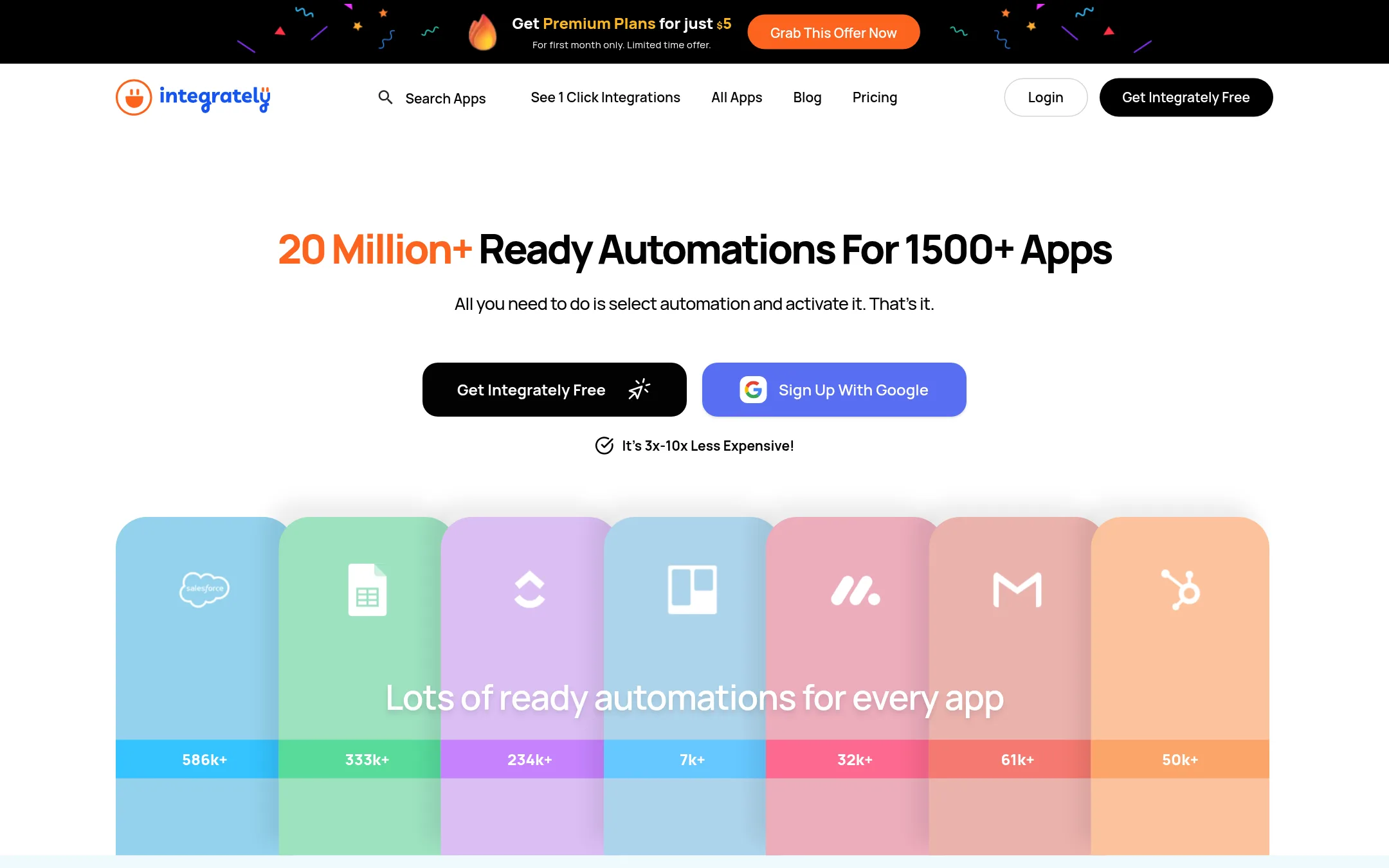
Integrately is a no-code automation tool that connects over 1,500 apps through prebuilt templates, so a non-developer can activate a ready-made workflow in a click. Teams pick it over Versori when they need standard app-to-app flows and do not want to write or maintain integration code. Versori suits enterprise teams building custom connectors against internal or messy APIs.
Where it is strong
- Over 20 million ready-made automations across 1,500+ apps
- Activate a workflow in one click, with no developer needed
- Triggers are free, and failed actions are not counted as tasks
Where it falls short
- Built for prebuilt app connections, so custom internal APIs and complex enterprise data transformation are not its focus
- Task-based usage means high-volume syncs and multi-step logic can add up quickly
- Pricing:
- Pricing is not published on the site.
See more comparisons in Developer Tools alternatives.
FAQ
Questions about Versori alternatives
What is Versori best known for?
According to its site, Versori is known for building and deploying custom integrations quickly with an AI Plan Agent, an IDE and an SDK. It targets enterprise teams connecting internal systems and REST, SOAP or GraphQL APIs. Its customer examples focus on faster go-live times for complex retail and logistics stacks.
Which alternative is best for a small team with no developer?
Zapier is the strongest fit for small teams automating routine work across common SaaS apps, since it offers a visual editor and a free plan with 100 tasks per month. Integrately also suits non-technical teams that want prebuilt app-to-app flows activated in one click. Neither is built for custom enterprise integrations against internal APIs.
Which option suits large enterprises with many SaaS apps?
Workato and Boomi both suit large enterprises that need governed workflows and AI agents across many systems. Workato offers 17,000+ connectors with central governance and cost controls, while Boomi covers application, API, data and agent governance plus B2B/EDI. Pricing for both is set by edition or contract, so expect a sales conversation.
How do the costs of these tools compare?
Pricing models vary. Zapier and Make charge by tasks or credits, so costs rise with complex or high-volume workflows. Tray.io starts at $50 a month with usage-based billing, and Pipedream starts at $99 a month on its Startup plan. Workato, Celigo and Boomi do not publish prices, so you will need to request a quote.
Which alternative is best for developers building AI agents or per-user integrations?
Pipedream suits developer teams building AI agents or user-facing integrations, since it handles OAuth, token refresh and per-user credentials across 3,000+ APIs. It also provides 10,000+ prebuilt tools and triggers and a raw API proxy, with a free development tier. Teams that want a visual builder for non-developers would look elsewhere.
Last updated November 9, 2026.