Windmill alternatives
10 products compared · Updated November 8, 2026
The short answer
The three strongest Windmill alternatives are n8n, Prefect and Apache Airflow. n8n suits ops and technical teams that want a visual, node-based builder with AI agents and human approval steps. Prefect suits Python data and ML teams that want durable pipelines and need execution kept inside their own VPC. Apache Airflow suits data engineering teams already writing Python who need scheduled pipelines across cloud services.
Your shortlist, at a glance
Read the comparisons ↓ n8nNot publishedOps and technical teams that want visual, node-based automation with AI agents and human approval steps
- TTemporalFrom $500/mo or 10%Engineering teams building long-running, failure-prone backend processes such as order fulfillment, payments or AI agent pipelines
 RetoolSee websiteBuild internal tools fast.
- PPrefectCustom quotePython data and ML teams that want durable pipelines without hosting a scheduler, and that need execution kept inside their own VPC.
- DDagsterNot publishedData teams running dbt and Snowflake pipelines that need asset lineage, freshness monitoring and governed data delivery
 Apache AirflowNot publishedData engineering teams that already write Python and need scheduled pipelines across cloud services
- HHatchetSee websiteBackground task orchestration and visibility
 Trigger.devSee websiteBuild and deploy fully‑managed AI agents and workflows
 Argo CDNot publishedPlatform teams running Kubernetes who want GitOps-based deployment of manifests and Helm charts from Git
Microsoft Azure CycleCloudNot publishedResearch and engineering teams running HPC or batch compute clusters on Azure
About Windmill and its alternatives
Windmill is an open-source platform for turning scripts into internal apps, workflows, AI agents and data pipelines. According to its site, it is known for running scripts in more than 20 languages as API endpoints and forms, with a self-hostable orchestration engine underneath.
When comparing alternatives in this category, weigh the pricing structure, including how seats, builders and guests are counted, and which regions or deployment models are supported. Also check the integrations you need, the level of support included, and the contract terms, since several vendors in this space do not publish pricing and advanced features often sit in higher tiers.
Explore the alternatives
- Not published
1.n8n
Best for: Ops and technical teams that want visual, node-based automation with AI agents and human approval steps
- Pricing
- Not published
- Category
- AI & Machine Learning
n8n is a workflow automation platform that lets teams mix visual workflow building with code, and it adds AI agents on top. Teams pick it over Windmill when they want a visual, node-based builder that non-engineers can follow, and when they need AI agents and many prebuilt app connections.
Where it is strong
- Visual workflow editor that stays readable for non-developers
- Built-in AI agents with human approval for tool calls
- Self-hosting is available through the free Community Edition on GitHub
Where it falls short
- Windmill's internal apps built from scripts are not a stated part of n8n
- Some advanced features such as SSO, LDAP, Git version control and queue mode are listed under the Business and Enterprise tiers
- Pricing:
- Pricing is not published on the site.
- TFrom $500/mo or 10%
2.Temporal
Best for: Engineering teams building long-running, failure-prone backend processes such as order fulfillment, payments or AI agent pipelines
- Pricing
- From $500/mo or 10%
- Category
- Other
Temporal is an open-source durable execution engine for code that must survive crashes, retries and long waits. Teams pick it over Windmill when they need to orchestrate long-running, failure-prone business logic across many services and already write it in a supported SDK language, rather than building internal apps and scripts on a UI-first platform.
Where it is strong
- Workflow state survives crashes and deploys without custom checkpointing code.
- Built-in retries, timeouts and saga compensation handle failing APIs and services.
- Native SDKs cover Go, Java, Python, TypeScript.NET, PHP, Ruby and Rust.
Where it falls short
- It is a developer framework, so it has no built-in app builder or script-to-UI layer like Windmill.
- Costs scale with actions and storage, which takes some estimating before committing.
- Pricing:
- Pricing is pay-as-you-go with no base fee, starting at $0.042 per GBhr of active storage and $0.00105 per GBhr of retained storage, with a Business plan at $500/month or 10% of usage, whichever is greater.
- See website
3.Retool
Productivity & Project Management
A platform for building internal tools and apps on top of databases and APIs, matching Windmill's internal software and app-building job.
- PCustom quote
4.Prefect
Best for: Python data and ML teams that want durable pipelines without hosting a scheduler, and that need execution kept inside their own VPC.
- Pricing
- Custom quote
- Category
- Other
Prefect is a workflow orchestration platform where you write workflows as plain Python and it handles scheduling, retries and recovery. Teams pick it over Windmill when they want Python-first pipelines for data, ML or agents and want Prefect Cloud to run the control plane, with hybrid workers keeping execution inside their own VPC.
Where it is strong
- Workflows are plain Python functions, with retries and state handled by the engine.
- Hybrid model lets workers run inside your own environment while Prefect handles scheduling and visibility.
- Open-source core under Apache 2.0, the same engine Prefect Cloud runs.
Where it falls short
- Windmill's built-in apps, UI-based flow editor and multi-language scripting are not part of Prefect's offering as described on the page.
- Enterprise pricing and the Team plan price are not published, so costs need a sales conversation.
- Pricing:
- Pricing is not published on the site for the Team and Enterprise plans, though the Hobby plan includes 500 serverless minutes a month, the Starter plan includes 75 hours and the Team plan includes 225 hours of serverless compute.
- Switching from Windmill:
- Moving from Windmill would mean rewriting scripts and flows as Python decorated functions and redeploying them to Prefect work pools.
- DNot published
5.Dagster
Best for: Data teams running dbt and Snowflake pipelines that need asset lineage, freshness monitoring and governed data delivery
- Pricing
- Not published
- Category
- Other
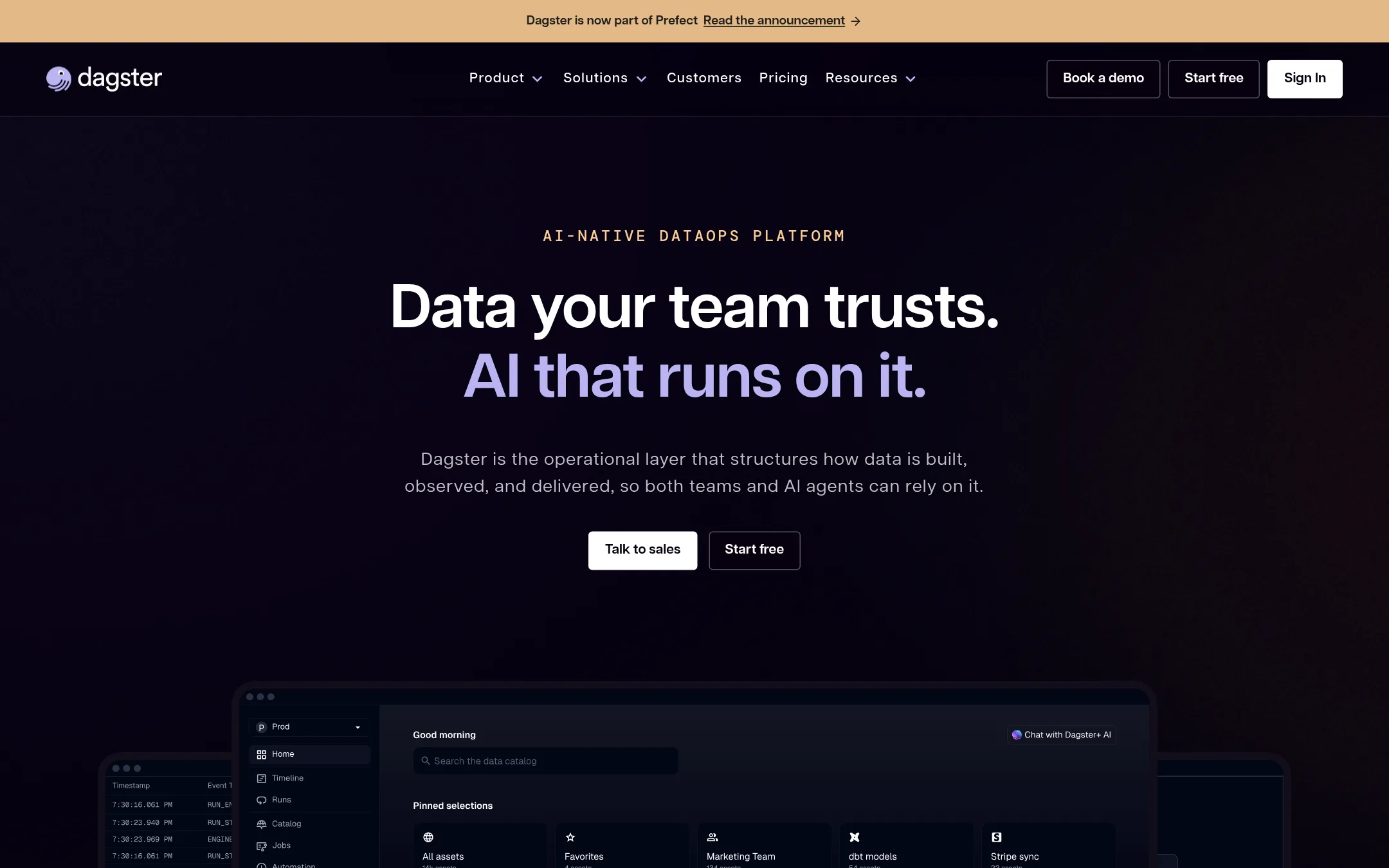
Dagster is an asset-centric data orchestrator. It tracks lineage, freshness and data health for every table or model a pipeline produces, which fits teams whose work is mostly dbt, Snowflake and ELT pipelines. Choose it over Windmill when the core problem is data pipelines and data trust, not general internal scripts and apps.
Where it is strong
- Asset-based model shows lineage and what breaks downstream when a pipeline fails
- Native dbt and Snowflake integrations without custom glue code
- Hybrid deployment keeps compute in your own infrastructure while Dagster runs the control plane
Where it falls short
- Built around data assets, so it is a poorer fit for general internal apps and form-based scripts than Windmill
- Several governance and deployment features sit in the higher-tier plans
- Pricing:
- Pricing is not published on the site.
- Not published
6.Apache Airflow
Best for: Data engineering teams that already write Python and need scheduled pipelines across cloud services
- Pricing
- Not published
- Category
- Analytics & Data
Apache Airflow is an open-source platform for writing, scheduling and monitoring workflows in Python. Its pipelines are defined as code, and it ships many plug-and-play operators for Google Cloud, AWS, Azure and other services. Teams pick it over Windmill when they want Python-defined DAGs with a large community and wide cloud integrations, rather than scripts that also turn into apps and agents.
Where it is strong
- Pipelines are plain Python, so existing Python skills carry over
- Large set of ready-made operators for major cloud providers
- Open source with an active community and Slack channel
Where it falls short
- No built-in internal apps or AI agent builder like Windmill offers
- Pipelines are defined as DAGs in code rather than from scripts in many languages
- Pricing:
- Pricing is not published on the site.
- HSee website
7.Hatchet
Developer Tools
Background task orchestration and visibility
- See website
8.Trigger.dev
AI & Machine Learning
Build and deploy fully‑managed AI agents and workflows
- Not published
9.Argo CD
Best for: Platform teams running Kubernetes who want GitOps-based deployment of manifests and Helm charts from Git
- Pricing
- Not published
- Category
- Developer Tools
Argo CD is a declarative GitOps continuous delivery tool for Kubernetes, with a full UI for syncing apps from Git to clusters. Someone would pick it over Windmill when their main problem is deploying Kubernetes manifests from Git and keeping clusters in sync, rather than building internal scripts, apps and workflows.
Where it is strong
- Open source and built for Kubernetes GitOps from the start
- Ships with a UI for viewing and syncing application state
- Part of the wider Argo project family, including Workflows and Rollouts
Where it falls short
- Focused on continuous delivery, so it does not build internal apps or AI agents the way Windmill does
- Requires Kubernetes, which adds setup for teams not already running it
- Pricing:
- Pricing is not published on the site.
- Not published
10.Microsoft Azure CycleCloud
Best for: Research and engineering teams running HPC or batch compute clusters on Azure
- Pricing
- Not published
- Category
- Developer Tools
Azure CycleCloud is Microsoft's tool for building and managing HPC and batch compute clusters on Azure, such as schedulers and GPU or MPI node pools. A team would pick it over Windmill when the job is running large simulation or scientific workloads on managed cluster infrastructure rather than building internal apps, workflows or agents.
Where it is strong
- Built for managing scalable HPC cluster infrastructure on Azure
- Sits inside the Azure ecosystem, so it works with other Azure services
- Backed by Microsoft's enterprise support and compliance
Where it falls short
- Focused on cluster management, not on building scripts, apps or AI agents the way Windmill does
- Pricing details are not published on the site, so costs need a direct inquiry
- Pricing:
- Pricing is not published on the site.
See more comparisons in Developer Tools alternatives.
FAQ
Questions about Windmill alternatives
Which Windmill alternative is best for a visual, no-code style of automation?
n8n is the closest fit for this need. Its visual workflow editor stays readable for non-developers and includes built-in AI agents with human approval for tool calls. Some advanced features such as SSO, LDAP and Git version control are listed under its Business and Enterprise tiers.
Which alternative should a Python data team consider?
Prefect and Apache Airflow are both built around Python. Prefect lets you write workflows as plain Python functions with retries and state handled by the engine, and its hybrid model keeps workers inside your own VPC. Apache Airflow defines pipelines as Python DAGs and offers many ready-made operators for major cloud providers.
Do any of these alternatives build internal apps like Windmill does?
The entries do not describe internal app builders for n8n, Prefect or Apache Airflow, so Windmill's script-to-app capability is not a stated part of those products. Windmill's apps, UI-based flow editor and multi-language scripting are the features that set it apart in this comparison.
Is pricing published for these alternatives?
Pricing is not published on the site for n8n, Apache Airflow, Argo CD, Dagster or Microsoft Azure CycleCloud, so costs need a direct inquiry. Prefect publishes some serverless compute allowances for its Hobby, Starter and Team plans but not Team or Enterprise prices. Temporal uses pay-as-you-go pricing with a published Business plan starting at $500 per month or 10% of usage.
When is Windmill a better fit than the alternatives listed here?
The entries suggest Windmill fits teams that want scripts in many languages to become APIs, forms, workflows, apps and agents in one place, with self-hosting and built-in observability. Tools such as Argo CD and Microsoft Azure CycleCloud target narrower jobs like Kubernetes deployment or HPC clusters, and Temporal targets durable backend processes for developers.
Last updated November 8, 2026.